---
title: Epicurus
author: Donald L. Wasson
source: https://www.worldhistory.org/Epicurus/
format: machine-readable-alternate
license: Creative Commons Attribution-NonCommercial-ShareAlike (https://creativecommons.org/licenses/by-nc-sa/4.0/)
updated: 1970-01-01
---
# Epicurus
_Authored by [Donald L. Wasson](https://www.worldhistory.org/user/DWasson/)_
Epicurus (341 BCE – 270 BCE) was an ancient [Greek](https://www.worldhistory.org/disambiguation/greek/) philosopher, the founder of the Epicurean school in [Athens](https://www.worldhistory.org/Athens/), who taught that "Pleasure is the principle and end to a happy life." He was a prolific writer, amassing 37 volumes, but unfortunately, only fragments and four letters remain. His teachings would influence many who followed such as Lucretius of [Rome](https://www.worldhistory.org/Rome/) and his *On the Nature of Things*, and the Utilitarians [Jeremy Bentham](https://www.worldhistory.org/Jeremy_Bentham/) and J.S. Mill.
### Early Life
Most of what historians know of Epicurus has been gathered from the writings of others. In 341 BCE Epicurus was born, according to most sources, on the small island of [Samos](https://www.worldhistory.org/samos/) located off the coast of [Asia Minor](https://www.worldhistory.org/Asia_Minor/) in the [Aegean](https://www.worldhistory.org/aegean/) Sea. His father Neocles was a schoolteacher. Neocles and his wife Chaerestrate were members of the Athenian poor – the Klirouchi – who emigrated to Samos from Athens after they had been offered land there. Initially, Epicurus was taught at home by his father but later was schooled by Amphilus (also known as Pamphilus), a Platonist, and Nausephanes, a follower of [Democritus](https://www.worldhistory.org/Democritus/), the Atomist. While Epicurus was serving his mandatory two years in the Athenian army, his family was relocated by force to the small Ionian [city](https://www.worldhistory.org/city/) of Colophon when [Perdiccas](https://www.worldhistory.org/Perdiccas/) the old Macedonian commander under [Alexander](https://www.worldhistory.org/disambiguation/Alexander/) had ordered the removal of all Athenians from Samos.
It was then that Epicurus began to develop his own, unique [philosophy](https://www.worldhistory.org/philosophy/). According to sources, at the tender age of 14, he had become disillusioned with his teachers. Like [Aristotle](https://www.worldhistory.org/aristotle/), he was an empiricist and believed that all knowledge comes from one's senses. His new philosophy centered primarily on the idea of seeking pleasure and avoiding pain. Although his name and philosophy have been misconstrued and linked to hedonism, his initial teachings were anything but. Obviously, because of his early education, Epicurus's thinking was heavily influenced by the philosophies of [Plato](https://www.worldhistory.org/plato/), Aristotle, and most of all Democritus. Slowly, his teachings drew a number of dedicated followers, even appealing to both [women](https://www.worldhistory.org/disambiguation/women/) and slaves. The fact that his schools welcomed everyone brought considerable opposition from others in and around Athens. At the age of 32, he moved to the city of Mytilene on the island of [Lesbos](https://www.worldhistory.org/lesbos/), and later, not by choice, he relocated to Lampsacus on the eastern side of the Hellespont, establishing schools at both locations.
### Philosophy
In 307/306 CE he bought a home in Athens and founded a new school, calling it 'The Garden,' where he remained for the rest of his life. On the gate of his school was the inscription: "Stranger, here you will do well to tarry; here our highest goal is pleasure." Unfortunately, his concept of pleasure has been horribly misinterpreted; to him, pleasure meant one must lead a life of restful contemplation, eating and drinking moderately. One must live without anxiety, forgoing the wants and worries of life and enjoying the "bliss of the gods." He would later write, "Do not spoil what you have desiring what you have not; remember that what you now have was once among the things you only hoped for." Happiness could be realized through attaining ataraxia, freedom from fear, and aponia, the absence of pain. "Live unknown" was a personal adage of the Epicureans, a belief that rivaled the old Greek idea of seeking fame, glory, and honor.
The Epicureans believed that all desires were derived from three main sources: those natural desires that are essential for life such as food and shelter; those natural desires that one can live without, primarily ones that cause jealousy and boredom; and lastly, narcissistic desires such as wealth and fame. He wrote, "He who is not satisfied with a little is satisfied with nothing." However, one of the most important things to Epicurus was friendship; although he never married, he actually believed in marriage and the family. Friends provide both an important defense against insecurity as well as a source of strength. Personally, Epicurus was considered by many to be humble, quiet and retiring. Some critics were not so kind, for instance, the Stoic philosopher [Epictetus](https://www.worldhistory.org/Epictetus/) called him a "preacher of effeminacy."
### Epicurean teachings
Aside from his acceptance of women and slaves into his schools, many attacked his stance on [religion](https://www.worldhistory.org/religion/) and [death](https://www.worldhistory.org/disambiguation/Death/). One of Epicurus' most important aims was to liberate people from fearing the eventual end of one's life thereby enabling them to seek both happiness and fulfillment in their personal lives. To Epicurus, one ceases to exist when one chooses to fear death. The Epicureans believed in the maxim "Death is nothing to us." There were four fundamental truths in Epicureanism:
1. There are no divine beings that can threaten us.
2. There is no afterlife.
3. What we actually need is easy to obtain.
4. What makes us suffer is easy to endure.
Of course, there were also simple cures for these ills, among which were not fearing [god](https://www.worldhistory.org/God/) and not worrying about death. As a follower of Democritus teachings, he taught that upon one's passing the body is reduced to nothing but decomposing atoms; in fact, all that exists in the entire universe is composed of atoms and space. Life – the body and mind – is a combining and dispersing of these atoms. Even one's soul is composed of atoms. These atoms are not only indestructible and eternal but unpredictable.[ 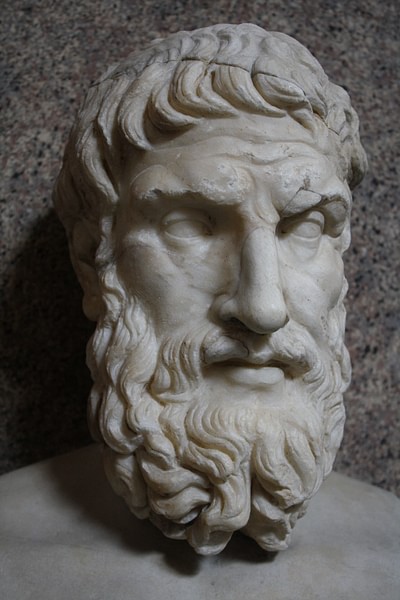 Epicurus Bust, Vatican Museums Mark Cartwright (CC BY-NC-SA) ](https://www.worldhistory.org/image/4466/epicurus-bust-vatican-museums/ "Epicurus Bust, Vatican Museums")
Unlike other religions that spoke of an afterlife, this meant that the eventuality of death should not be feared. To Epicurus, there was nothing to hope for and nothing to fear from the gods. While he rejected Plato's divine creation of the world, believing that the cosmos was the result of an accident, he tried to avoid saying that the gods did not exist, for it would have been dangerous to deny their existence; he did not consider himself to be an atheist. It was good for people to pay respect to the gods but one shouldn't expect anything from them. The gods existed, they were both happy and immortal, but were far away and took no interest in people's lives. Later, this denial of immortality and the existence of a benevolent god would bring the Epicureans into direct conflict with the rise of [Christianity](https://www.worldhistory.org/christianity/). Epicurus and his followers lived peacefully in their small communities and did not get involved in the politics of an ever-changing Athens, avoiding all social activism. And, concerning the Athenian emphasis on the importance of virtue, Epicurus held that those who were wise would avoid injustice. He once wrote, "To practice living well and to practice dying well are one and the same.” He died in 270 BCE in pain from kidney stones. His schools and philosophy would survive long after his death.
#### Editorial Review
This human-authored definition has been reviewed by our editorial team before publication to ensure accuracy, reliability and adherence to academic standards in accordance with our [editorial policy](https://www.worldhistory.org/static/editorial-policy/).
## Bibliography
- [Bryan, M. *The story of thought.* DK Publishing, 1998.](https://www.worldhistory.org/books/B000PGHVME/)
- [Critchley, S. *The Book of Dead Philosophers.* Vintage, 2008.](https://www.worldhistory.org/books/0307390438/)
- [Despeyroux, D. *The Philosophers.* Konecky & Konecky, 2008.](https://www.worldhistory.org/books/1568528108/)
- [Epicurus. *The Epicurus Reader.* Hackett Publishing Company, Inc., 1994.](https://www.worldhistory.org/books/0872202410/)
- [Hornblower, S. *The Oxford Classical Dictionary.* Oxford University Press, 2012.](https://www.worldhistory.org/books/0199545561/)
- [King, P.J. *100 Philosophers.* Barron's, 2004.](https://www.worldhistory.org/books/0785830227/)
- [Klein, D. *Every Time I Find the Meaning of Life, They Change It.* Penguin Books, 2015.](https://www.worldhistory.org/books/0143126792/)
- Mannon, J. *Essentials of Philosophy.* Fall River Press, 2002
## About the Author
Donald has taught Ancient, Medieval and U.S. History at Lincoln College (Normal, Illinois)and has always been and will always be a student of history, ever since learning about Alexander the Great. He is eager to pass knowledge on to his students.
## Timeline
- **341 BCE - 270 BCE**: Life of [Epicurus](https://www.worldhistory.org/Epicurus/).
- **306 BCE**: [Epicurus](https://www.worldhistory.org/Epicurus/) buys a garden in [Athens](https://www.worldhistory.org/Athens/) in which he begins to teach Epicureanism.
## Cite This Work
### APA
Wasson, D. L. (2016, September 07). Epicurus. *World History Encyclopedia*.
### Chicago
Wasson, Donald L.. "Epicurus." *World History Encyclopedia*, September 07, 2016. .
### MLA
Wasson, Donald L.. "Epicurus." *World History Encyclopedia*, 07 Sep 2016, .
## License & Copyright
Submitted by [Donald L. Wasson](https://www.worldhistory.org/user/DWasson/ "User Page: Donald L. Wasson"), published on 07 September 2016. The copyright holder has published this content under the following license: [Creative Commons Attribution-NonCommercial-ShareAlike](https://creativecommons.org/licenses/by-nc-sa/4.0/deed.en). This license lets others remix, tweak, and build upon this content non-commercially, as long as they credit the author and license their new creations under the identical terms. When republishing on the web a hyperlink back to the original content source URL must be included. Please note that content linked from this page may have different licensing terms.