---
title: Epaminondas
author: Mark Cartwright
source: https://www.worldhistory.org/Epaminondas/
format: machine-readable-alternate
license: Creative Commons Attribution-NonCommercial-ShareAlike (https://creativecommons.org/licenses/by-nc-sa/4.0/)
updated: 1970-01-01
---
# Epaminondas
_Authored by [Mark Cartwright](https://www.worldhistory.org/user/markzcartwright/)_
Epaminondas (or Epameinondas, c. 420 - 362 BCE) was a Theban general who famously defeated [Sparta](https://www.worldhistory.org/sparta/) at the [Battle of Leuctra](https://www.worldhistory.org/Battle_of_Leuctra/) in 371 BCE. The daring and brilliant pre-meditated tactics of Epaminondas earned a decisive victory over Sparta and established [Thebes](https://www.worldhistory.org/disambiguation/Thebes/) as the most powerful [city-state](https://www.worldhistory.org/Polis/) in [Greece](https://www.worldhistory.org/greece/). Epaminondas once again employed innovative tactics in his final [battle](https://www.worldhistory.org/disambiguation/battle/) at Mantinea in 362 BCE, effectively using mixed troops to bring a victory he himself did not live to enjoy. Shortly after the fall of their great general, so too, fell the Theban [empire](https://www.worldhistory.org/empire/).
### Early Life
Born around 420 BCE, Epaminondas was the son of Polymis. According to the historian Diodoros, he came from an aristocratic but poor family and never married. Epaminondas studied Pythagorean [philosophy](https://www.worldhistory.org/philosophy/) and rhetoric under Lysis of [Tarentum](https://www.worldhistory.org/tarentum/). Unfortunately, [Plutarch](https://www.worldhistory.org/plutarch/)'s biography of Epaminondas does not survive but the [Greek](https://www.worldhistory.org/disambiguation/greek/) historian does describe an episode in his biography of the contemporary Theban general [Pelopidas](https://www.worldhistory.org/Pelopidas/). The two fought side by side around Mantinea in 385 BCE and Epaminondas, although twice wounded, fought desperately to protect his even more badly wounded compatriot, saving his life.
When Sparta seized Kadmeia in 382 BCE, Epaminondas was exiled but in 379 BCE he was able to return to Thebes. Epaminondas was elected Boeotarch (one of seven leading federal officials) and participated in the Spartan peace negotiations of 371 BCE where he argued with the Spartan king Agesilaus over Thebe's right to represent all her allies in Boeotia. Epaminondas stormed out of the conference in protest. Known as an austere and principled leader – he was said to have owned only a single cloak and so was confined to his house on washday - Epaminondas' diplomacy skills may have been lacking but he would soon prove to be the most innovative and successful general Thebes had ever had and one of Greece's finest ever commanders. As [Xenophon](https://www.worldhistory.org/xenophon/) states, "in terms of preparation and boldness, the man was second to none" and he "led is army forward like a [trireme](https://www.worldhistory.org/trireme/)" (*Hellenika*, 7.5).
### Sparta Challenges Thebes
In the early 4th century BCE, the Greek [poleis](https://www.worldhistory.org/Polis/) or [city](https://www.worldhistory.org/city/)-states, following a century of mutually damaging on-off conflicts which included the [Peloponnesian War](https://www.worldhistory.org/Peloponnesian_War/), had established an uneasy peace but as ever-ambitious Sparta called for the Boeotian Confederacy led by Thebes to be abolished, [war](https://www.worldhistory.org/disambiguation/War/) seemed once again on the horizon. Thebes quite naturally rejected the Spartan demands, a reaction not unexpected as is evidenced by the fact that Sparta had already mobilised their army and taken a position on the western border of Boeotia before the Thebans gave their answer. The two sides would meet in battle at Leuctra not far from Thebes itself.
### Battle of Leuctra
Sparta and its allies were led by King Cleombrotus. Their army consisted of 10,000 men and 1,000 cavalry. Thebes, led by Epaminondas, had at its disposal some 7,000 hoplites which included the 300 members of the elite Sacred Band, a unit of homoerotic pairs who swore to defend their lovers to the [death](https://www.worldhistory.org/disambiguation/Death/) and who at Leuctra were led by the gifted and charismatic Pelopidas. The Thebans also had 600 cavalry who, battle-hardened, were probably the best in Greece at that time. In addition, there was a small force of light infantry (*hamippoi*) who were armed with javelins and supported the cavalry.
Some of the Theban commanders at first thought it prudent to retreat behind the walls of Thebes and invite a siege rather than face the fearsome Spartans on the open battlefield. However, Epaminondas persuaded them otherwise. Always able to use propaganda and imagery to boost morale, Epaminondas recalled the notorious rape of two local virgins by two Spartans at Leuctra. The two victims had committed suicide in shame, and a monument in their memory had been set up. Epaminondas made sure suitable homage was paid to this monument before the battle, and another symbolic gesture he was credited with was the brandishing of a snake in front of his troops. Epaminondas said that by striking the head of the snake - the Spartan army - the whole snake would die - Spartan dominance of Greece.
### Innovative Troop Deployment
The first action was a brief skirmish between Theban non-combatants (baggage porters, merchants etc.) and a Spartan force led by Hieron. The Thebans were forced to re-join the main force but Hieron was killed. Cleombrotus then positioned his troops in the traditional phalanx formation of heavily armoured hoplites 12 men deep with two wings. Cleombrotus himself, surrounded by his elite *hippeis* (300-man bodyguard), took up position on the left side of the right wing.
[ 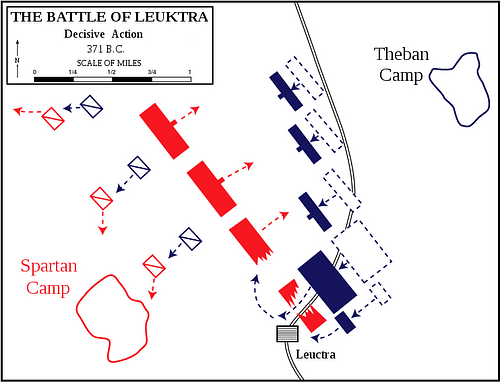 Battle of Leuctra, 371 BCE Dept. of History, U.S. Military Academy (Public Domain) ](https://www.worldhistory.org/image/1338/battle-of-leuctra-371-bce/ "Battle of Leuctra, 371 BCE")Epaminondas was much more innovative and put his cavalry and light infantry in front of his own phalanx formation. Rejecting the convention of making one's right wing the strongest, he made his left wing extraordinarily deep - 50 ranks of men - and made his lines narrower than the Spartans. The Sacred Band was also positioned on the left wing with the Boeotian allies being stationed on the right wing, 8-12 men deep.
Cleombrotus responded to this surprising development by re-organising his own lines, moving his cavalry out front and extending his line in an effort to outflank Epaminondas' left wing. This relatively complex series of battle manoeuvres exposed Cleombrotus' immediate left side, and as the Spartan cavalry were no match for the Thebans who soon routed them, the Spartan horsemen were forced back onto their own lines and through the gap which had opened on Cleombrotus' left. The Thebans followed them through this gap and proceeded to create chaos in the Spartan formation. Epaminondas, meanwhile, attacked at an angle towards the left so that, in effect, Cleombrotus was being pushed away from his own line. Epaminondas' attack was also conducted with his own right wing slightly in arrears in an echelon formation (hence Xenophon's 'trireme' allusion) to protect his own exposed flank as he attacked the Spartan *hippeis*. At this point, Pelopidas and the Sacred Band also attacked Cleombrotus' position resulting in the fatal wounding of the Spartan king and the complete defeat of the Spartan right. The Spartans lost 400 of their 700 hoplites, a huge blow from which they would never fully recover.
### Epaminondas' Victory
Thebes had won and was now the most powerful [polis](https://www.worldhistory.org/Polis/) in Greece. After 200 years of victories on land, the myth of Sparta's military invincibility was finally smashed. The strategies that Epaminondas had employed in the battle were not entirely new, but in the past they had been used more out of necessity rather than planning, and no one had ever combined them to create such a winning formula. The massively strengthened left wing, the use of cavalry in front of the [hoplite](https://www.worldhistory.org/hoplite/) lines, attacking at an angle, employing an echelon formation, and going for a direct frontal attack on the opposing commander's position were, collectively, the most innovative and devastating pre-meditated military strategy ever seen in [Greek warfare](https://www.worldhistory.org/Greek_Warfare/) and the defeat of mighty Sparta shocked the Greek world. Naturally, Epaminondas was feted as a military genius and promptly re-elected Boeotarch for 370 BCE.
### The [Peloponnese](https://www.worldhistory.org/Peloponnese/)
Sparta's defeat led to the disintegration of the [Peloponnesian League](https://www.worldhistory.org/Peloponnesian_League/) and the complete upheaval of the status quo in Greece. [Athens](https://www.worldhistory.org/Athens/) called for a peace conference in late 371 BCE but Thebes refused, perpetuating the power struggle between various Greek poleis which had bedevilled Greece for the last century or more. Athens even sided with its old enemy Sparta, but Thebes continued its expansionist policies. Epaminondas campaigned in the Peloponnese to promote the independence of [cities](https://www.worldhistory.org/city/) from Sparta to ensure the city did not rise again to its previous prominence.
[ 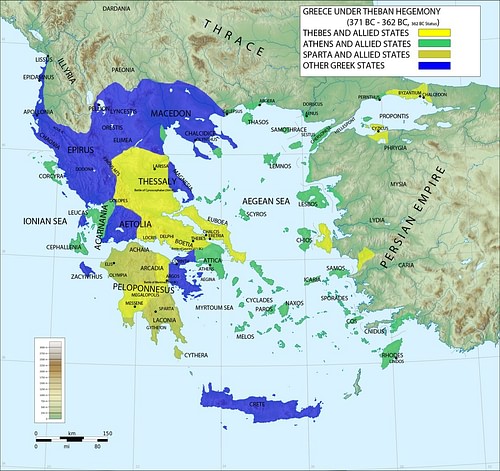 Map of Greece under Theban Hegemony Megistias (CC BY-SA) ](https://www.worldhistory.org/image/329/map-of-greece-under-theban-hegemony/ "Map of Greece under Theban Hegemony")Unusually, Epaminondas did not extract tribute from defeated cities or sell battlefield captives into slavery. He famously established the city of new Messene and had fortifications built to withstand Spartan attack, a move which further undermined Sparta's traditional source of manpower and wealth in Laconia. For the same purpose another new city was built, Megalopolis.
In 369 BCE Epaminondas' fortunes took a U-turn, as, in conflict with the Theban government over his policies in the Peloponnese, he was tried for treason. The general was accused of continuing his command beyond his term of office and criticised for not sacking Sparta itself but the charges were later dropped. However, he was not re-elected as Boeotarch. Back, then, as an ordinary hoplite legend has it, Epaminondas was called upon and successfully saved the Theban army from a disaster in [Thessaly](https://www.worldhistory.org/disambiguation/Thessaly/) in 368 BCE. Seeing a weakness in these Theban political divisions, Lykomedes of Mantinea took the opportunity to challenge Theban dominance in the Peloponnese.
Meanwhile, in 367 BCE Epaminondas, back as a Boeotarch again, led a successful expedition to Thessaly where he freed his fellow general Pelopidas from [Alexander](https://www.worldhistory.org/disambiguation/Alexander/) of Pherai. When the tyrant had heard Epaminondas was on his way north it was said "He cowered slave-like, as a beaten cock. That lets its feathers droop, (Plutarch, 96)" such was the Theban general's fearsome reputation.
Then in 366 BCE, with the backing of [Persia](https://www.worldhistory.org/Persia/), Epaminondas sought to finally defeat Athens by building a Theban fleet. By 364 BCE, 100 ships had been built and with these Epaminondas harassed the Athenian empire but with little lasting effect. Meanwhile, in the Peloponnese fighting continued between the Eleans and Arcadians, the latter being defeated and their confederation disbanded.
### Mantinea & Death
Then, in 362 BCE, Epaminondas once more led the Theban army and defeated a Spartan and Athenian alliance at the battle of Mantinea in northeast Arcadia in 362 BCE. The battle was perhaps the first effective use of mixed troops in Greek [warfare](https://www.worldhistory.org/warfare/). First the Theban cavalry along with light infantry (*hamippoi*) attacked and were then supported by the heavy hoplite infantry on the left flank. The Thebans won but Epaminondas himself was killed in the battle, and such was the glory of felling the great general that a man from each of the allies of Sparta, Athens, and Mantinea claimed it was their spear that had done the deed.
There next followed a damaging struggle amongst Epaminondas' successors and despite the continued weakness of Athens and Sparta, the short-lived Theban dominance of Greece came to an end. The Greek cities, weakened by in-fighting, were now ripe for [conquest](https://www.worldhistory.org/warfare/), a situation [Philip II](https://www.worldhistory.org/disambiguation/Philip_II/) of Macedonia would take full advantage of in 338 BCE.
#### Editorial Review
This human-authored definition has been reviewed by our editorial team before publication to ensure accuracy, reliability and adherence to academic standards in accordance with our [editorial policy](https://www.worldhistory.org/static/editorial-policy/).
## Bibliography
- [Anglim, S. *Fighting Techniques of the Ancient World.* Amber Books, 2013.](https://www.worldhistory.org/books/1909160466/)
- Bagnall, R. et al. *The Encyclopedia of Ancient History.* Wiley-Blackwell, 2012
- [Campbell, B. et al. *The Oxford Handbook of Warfare in the Classical World.* Oxford University Press, 2013.](https://www.worldhistory.org/books/0195304659/)
- [Hornblower, S. *The Oxford Classical Dictionary.* Oxford University Press, 2012.](https://www.worldhistory.org/books/0199545561/)
- [Kinzl, H. *A Companion to the Classical Greek World.* Wiley-Blackwell, 2010.](https://www.worldhistory.org/books/1444334123/)
- [Plutarch. *The Age of Alexander Paperback.* Penguin Classics; Revised edition (1 Mar. 2012), 2016.](https://www.worldhistory.org/books/B011T6UR8S/)
- [Xenophon. *The Landmark Xenophon's Hellenika.* Anchor, 2010.](https://www.worldhistory.org/books/1400034760/)
## About the Author
Mark is WHE’s Publishing Director and has an MA in Political Philosophy (University of York). He is a full-time researcher, writer, historian and editor. Special interests include art, architecture and discovering the ideas that all civilizations share.
## Timeline
- **c. 420 BCE - 362 BCE**: Life of Theban general [Epaminondas](https://www.worldhistory.org/Epaminondas/).
- **386 BCE**: Theban general [Epaminondas](https://www.worldhistory.org/Epaminondas/) saves the life of [Pelopidas](https://www.worldhistory.org/Pelopidas/) at Mantinea.
- **371 BCE**: [Thebes](https://www.worldhistory.org/disambiguation/Thebes/), led by [Epaminondas](https://www.worldhistory.org/Epaminondas/), defeats [Sparta](https://www.worldhistory.org/sparta/) in the [Battle of Leuctra](https://www.worldhistory.org/Battle_of_Leuctra/).
- **371 BCE - 362 BCE**: [Thebes](https://www.worldhistory.org/disambiguation/Thebes/) is the dominant [city-state](https://www.worldhistory.org/Polis/) in [Greece](https://www.worldhistory.org/greece/).
- **369 BCE**: Theban general [Epaminondas](https://www.worldhistory.org/Epaminondas/) is tried for treason but the charges are dropped.
- **369 BCE**: Theban generals [Pelopidas](https://www.worldhistory.org/Pelopidas/) and [Epaminondas](https://www.worldhistory.org/Epaminondas/) are both charged with exceeding their term of office but are acquitted.
- **367 BCE**: Theban general [Epaminondas](https://www.worldhistory.org/Epaminondas/) rescues fellow general [Pelopidas](https://www.worldhistory.org/Pelopidas/) from [Alexander](https://www.worldhistory.org/disambiguation/Alexander/) of Pherai in [Thessaly](https://www.worldhistory.org/disambiguation/Thessaly/).
- **366 BCE**: Theban general [Epaminondas](https://www.worldhistory.org/Epaminondas/) builds a fleet to harass the Athenian [Empire](https://www.worldhistory.org/empire/).
- **362 BCE**: Indecisive [Battle](https://www.worldhistory.org/disambiguation/battle/) of Matinea where [Thebes](https://www.worldhistory.org/disambiguation/Thebes/) fought against [Sparta](https://www.worldhistory.org/sparta/) and [Athens](https://www.worldhistory.org/Athens/). Theban general [Epaminondas](https://www.worldhistory.org/Epaminondas/) is killed.
## Cite This Work
### APA
Cartwright, M. (2016, March 22). Epaminondas. *World History Encyclopedia*.
### Chicago
Cartwright, Mark. "Epaminondas." *World History Encyclopedia*, March 22, 2016. .
### MLA
Cartwright, Mark. "Epaminondas." *World History Encyclopedia*, 22 Mar 2016, .
## License & Copyright
Submitted by [Mark Cartwright](https://www.worldhistory.org/user/markzcartwright/ "User Page: Mark Cartwright"), published on 22 March 2016. The copyright holder has published this content under the following license: [Creative Commons Attribution-NonCommercial-ShareAlike](https://creativecommons.org/licenses/by-nc-sa/4.0/deed.en). This license lets others remix, tweak, and build upon this content non-commercially, as long as they credit the author and license their new creations under the identical terms. When republishing on the web a hyperlink back to the original content source URL must be included. Please note that content linked from this page may have different licensing terms.