---
title: Eos
author: Liana Miate
source: https://www.worldhistory.org/Eos/
format: machine-readable-alternate
license: Creative Commons Attribution-NonCommercial-ShareAlike (https://creativecommons.org/licenses/by-nc-sa/4.0/)
updated: 2023-03-19
---
# Eos
_Authored by [Liana Miate](https://www.worldhistory.org/user/lianamiate/)_
Eos is the personification and goddess of the dawn in [Greek mythology](https://www.worldhistory.org/Greek_Mythology/). She is the daughter of the Titans Hyperion and Theia and the sister of [Helios](https://www.worldhistory.org/Helios/) (Sun) and [Selene](https://www.worldhistory.org/Selene/) (Moon). Dressed in a saffron-coloured mantle, Eos rides on her [chariot](https://www.worldhistory.org/chariot/) in front of Helios to announce the coming of the day. A common epithet for Eos was "rosy-fingered".
Cursed by [Aphrodite](https://www.worldhistory.org/Aphrodite/) to fall in love continually, Eos had many love affairs with beautiful mortal men, most of whom had tragic ends due to her attentions. Eos is depicted as a radiant goddess with soft hair, and rosy arms and fingers. Eos' [Roman](https://www.worldhistory.org/disambiguation/Roman/) equivalent is Aurora.
### Birth & Family
As mentioned in [Hesiod](https://www.worldhistory.org/hesiod/)'s (c. 700 BCE) *[Theogony](https://www.worldhistory.org/Theogony/)*, Eos was the daughter of the Titans Hyperion and Theia, the sister of Helios (Sun) and Selene (Moon), and the granddaughter of [Uranus](https://www.worldhistory.org/Uranus/) (Heaven) and [Gaia](https://www.worldhistory.org/Gaia/) (Earth).
> And Theia, mastered by Hyperion,
> Bore Helios the great, bright Selene,
> And Eos, who shines upon all men on earth
> And on the deathless gods who hold broad heaven. (Hesiod, *Theogony*, 372-375).
Eos was first married to Astraeus, a [Titan](https://www.worldhistory.org/Titan/) and [god](https://www.worldhistory.org/God/) of the dusk. Together they had the four Anemoi (wind gods): [Boreas](https://www.worldhistory.org/Boreas/) (North Wind), [Zephyrus](https://www.worldhistory.org/Zephyrus/) (West Wind), Notus (South Wind), and Eurus (East Wind). Some sources, including Hesiod, say that they were also the parents of Phosphorus and the stars. Eos was also the mother of Memnon, the king of Ethiopia who fought in the [Trojan War](https://www.worldhistory.org/Trojan_War/).
### Goddess of the Dawn
As the goddess of the dawn, every morning, Eos rose early from her couch in the east, draped herself in a saffron-coloured mantle, and harnessed her four horses to her chariot, so she could ride in front of her brother Helios, the sun god, and announce the coming of the day to both mortals and the gods. Helios is awakened by the rooster (his sacred animal), which is heralded by Eos.
> Now Dawn rose up from her bed by her lordly mate Tithonus,
> bringing light to immortal gods and mortal men.
> ([Homer](https://www.worldhistory.org/homer/), *[Iliad](https://www.worldhistory.org/iliad/),* 11.1-2).
Eos was said to have lived in a [palace](https://www.worldhistory.org/disambiguation/palace/) on the island of the goddess [Circe](https://www.worldhistory.org/Circe/) (her niece) in the Far East, where there was a special place for her dancing and singing. In the Homeric poems, Eos accompanies Helios throughout the day and does not rest until the sun sets in the evening. Her eternally youthful appearance is used as a metaphor for the start of the day (the day is young), and the fact that she can fly symbolises dawn's place in the sky.
[  Eos in Her Four-horse Chariot Metropolitan Museum of Art (Copyright) ](https://www.worldhistory.org/image/17086/eos-in-her-four-horse-chariot/ "Eos in Her Four-horse Chariot")During the [Giant](https://www.worldhistory.org/Giants/)'s Revolt, [Zeus](https://www.worldhistory.org/zeus/) ordered Eos and her siblings Helios and Selene not to shine any light while he searched the earth for a magical herb that would cause [Hercules](https://www.worldhistory.org/hercules/) (the chosen mortal to fight against the [Giants](https://www.worldhistory.org/Giants/)) to become invulnerable.
### [Ares](https://www.worldhistory.org/Ares/) & Aphrodite's Curse
Eos was sexual by nature; however, this intensified after an encounter with Ares and Aphrodite. Ares was taken by Eos' beauty and led her to his bed. Aphrodite was enraged to find Ares and Eos together and cursed her. From then on, Eos would develop an insatiable longing for men (especially mortal men). She would seduce one man after another. Her love affairs included [Orion](https://www.worldhistory.org/Orion/), Cephalus, Cleitus, Astraeus, [Ganymede](https://www.worldhistory.org/Ganymede/), and Tithonus.
[  Aurora Taking Leave of Tithonus Francesco Solimena (Public Domain) ](https://www.worldhistory.org/image/17090/aurora-taking-leave-of-tithonus/ "Aurora Taking Leave of Tithonus")###
Eos & Orion
After Eos' husband Astraeus was sent down to [Tartarus](https://www.worldhistory.org/Tartarus/) for rebelling against Zeus, Eos chose the handsome hunter Orion as her new husband. According to Apollodorus (180-120 BCE), Eos carried Orion to [Delos](https://www.worldhistory.org/delos/), where Aphrodite stirred up her lust and desire for him.
The gods disapproved of Eos and Orion's relationship. [Artemis](https://www.worldhistory.org/artemis/) became jealous but could not take revenge on Eos, so instead, she killed Orion with her bow and arrow. Some traditions state that Eos took Orion against his will.
[  The Gates of Dawn Herbert James Draper (Public Domain) ](https://www.worldhistory.org/image/17089/the-gates-of-dawn/ "The Gates of Dawn")### Eos & Tithonus
After Orion's [death](https://www.worldhistory.org/disambiguation/Death/), Eos married Tithonus, a prince of [Troy](https://www.worldhistory.org/troy/). Tithonus and his family were blessed with good looks, and they attracted the attention of the gods. Eos was madly in love with her new husband and could not bear the thought of losing him one day.
She pleaded for Zeus to make Tithonus immortal, which Zeus assented to. However, Eos made one fatal mistake: she forgot to ask Zeus to also grant him eternal youth. So, although Tithonus could not die, he grew older. As Tithonus lost his youth and good looks, Eos could no longer bear to take care of him and locked him in a room where he babbled to himself. Later sources state that he would eventually transform into a cicada whose chirps preserve the memory of his once beautiful voice.
[ 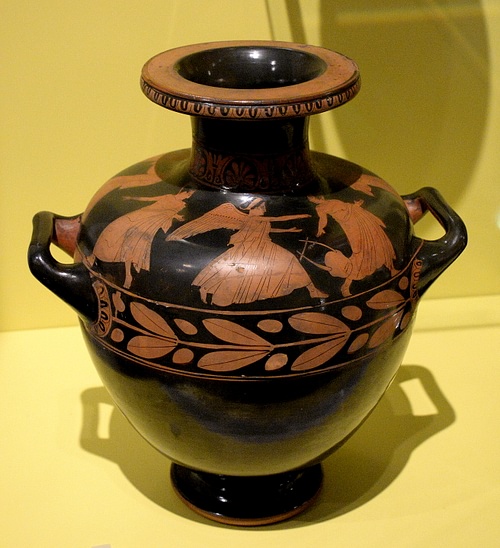 Hydria with Eos & Tithonus Scene Osama Shukir Muhammed Amin (Copyright) ](https://www.worldhistory.org/image/4195/hydria-with-eos--tithonus-scene/ "Hydria with Eos & Tithonus Scene")According to some traditions, Eos carried off both Tithonus and Ganymede, Tithonus' brother, but Ganymede was taken from her by Zeus.
### Eos & Memnon
Eos and Tithonus had two sons together, Emathion and Memnon. Memnon was the king of Ethiopia who fought on the side of the Trojans in the Trojan [War](https://www.worldhistory.org/disambiguation/War/), and his story is mentioned by [Ovid](https://www.worldhistory.org/ovid/) (43 BCE to 17 CE) in his *Metamorphoses*. Eos asked [Hephaestus](https://www.worldhistory.org/Hephaistos/) to make an armour for Memnon. [Achilles](https://www.worldhistory.org/achilles/) killed him in revenge for the death of his friend Antilochus.
> She was touched by a closer, personal grief in the loss of Memnon,
> the son whom the goddess with robes of saffron
> had watched being killed on the Phrygian plains by the spear of Achilles.
> That moment, the rosy red wings which tinges the sky in the morning
> turned to a deadly pallor and heaven was hidden in cloud.
> When Memnon's body was laid on the funeral pyre, his mother
> Was too heartbroken to watch.
> (Ovid, *Metamorphoses*, 13.577-584)
After he died, Eos wept, and her tears fell to the earth as dew. Zeus felt pity after seeing Eos' grief and made Memnon immortal.
[  Eos & the Slain Memnon Bibi Saint-Pol (Public Domain) ](https://www.worldhistory.org/image/17085/eos--the-slain-memnon/ "Eos & the Slain Memnon")###
Eos & Cephalus
Eos carried off Cephalus, the son of Herse (a princess of [Athens](https://www.worldhistory.org/Athens/)) and [Hermes](https://www.worldhistory.org/Hermes/) to [Syria](https://www.worldhistory.org/syria/), where they had a son together named Phaëthon. According to Ovid in his *Metamorphoses*, Eos abducted him when he was newly married to Procris, the daughter of King Erechtheus of Athens. Although Cephalus admired Eos' charm and freshness, Cephalus remained madly in love with his wife. Eos grew tired of him constantly talking about Procris and sent him back to her. Cephalus could not believe that Procris was his wife and began to have irrational suspicions that she was cheating on him. He came to her in different disguises and offered her awards to sleep with him. After he had offered her a golden crown, she agreed, and Cephalus revealed who he was in a rage. Procris fled to the court of King Minos in [Crete](https://www.worldhistory.org/crete/).
[  Cephalus and Aurora by John Flaxman ketrin1407 (CC BY) ](https://www.worldhistory.org/image/17087/cephalus-and-aurora-by-john-flaxman/ "Cephalus and Aurora by John Flaxman")After Procris had an affair with King Minos, she returned to Athens disguised as a boy and with the magical hound Laelaps and the spear King Minos had given her. Cephalus still mourned the marriage he had foolishly ruined but noticed the 'boy's' beautiful dog and spear. Procris, in disguise, offered them both to him, but only if he would sleep with him. Cephalus reluctantly agreed, and the couple was reunited and lived in happiness for a time.
However, Procris still feared that Cephalus was meeting with Eos since he often went hunting at dawn. One morning, an eavesdropper heard Cephalus praising the refreshing breeze and thought that he was talking to a lover. This eavesdropper went straight to Procris and told her what he had overheard. Procris was distressed but wanted to witness his infidelity for herself. The next morning, after Eos had ushered in the dawn, Procris followed Cephalus to the woods, where she heard him talking to the breeze. She let out a moan of anguish, and Cephalus, thinking that it was an animal, thrust a spear towards the sound, struck Procris in the heart, and killed her.
### In Art
Although Eos is considered a minor deity, her relatable nature and human qualities (concern for her son and her complicated romantic relationships) have inspired writers and artists over the years. In ancient [Greek](https://www.worldhistory.org/disambiguation/greek/) art, Eos is portrayed as both a grieving mother and a seductress.
Eos and her Roman counterpart, Aurora, continued to inspire artists during the Renaissance and beyond. They were the subject of three paintings: *Cephalus and Aurora* by French artist Nicolas Poussin (1594-1665), *Aurora* by Italian baroque artist Guido Reni (1575-1642), and *Aurora* by French rococo painter Jean-Honore Fragonard (1732-1806).
[  Cephalus and Aurora Nicolas Poussin (Public Domain) ](https://www.worldhistory.org/image/17088/cephalus-and-aurora/ "Cephalus and Aurora")###
Worship & Legacy
Unlike most of her relatives, Eos has no known religious rite. However, she is depicted at a few religious sites. As mentioned by [Pausanias](https://www.worldhistory.org/disambiguation/Pausanias/) (c. 115 to c. 180 CE) in his *Description of [Greece](https://www.worldhistory.org/greece/)*, an image of Eos carrying away Cephalus was found on a throne in the Sanctuary of the [Graces](https://www.worldhistory.org/Graces/) in Laconia. In Eleia (Elis), beside the Sanctuary of Hippodameia, is a statue of Eos and [Thetis](https://www.worldhistory.org/Thetis/) begging Zeus for mercy for their sons (Memnon and Achilles). At Athens, she is represented in the pediment of the kingly stoa. Eos also has an Orphic Hymn dedicated to her where she is described as being "blessed and pure." The hymn goes on to mention that she leads men to work and that they delight in her.
221 Eos is the name given to a main-belt asteroid and a family of asteroids. It was discovered in 1882 by Johann Palisa (1848-1925), an Austrian astronomer, and was named in honour of Eos.
#### Editorial Review
This human-authored definition has been reviewed by our editorial team before publication to ensure accuracy, reliability and adherence to academic standards in accordance with our [editorial policy](https://www.worldhistory.org/static/editorial-policy/).
## Bibliography
- [221 Eos](https://www.scientificlib.com/en/Astronomy/SolarSystem/221Eos.html "221 Eos"), accessed 17 Feb 2023.
- [Athanassakis, Apostolos N. & Wolkow, Benjamin M. *The Orphic Hymns.* Johns Hopkins University Press, 2013.](https://www.worldhistory.org/books/1421408821/)
- [Bowman, Laurel & Bulloch, Anthony & Campbell, Andrew & Caviness, Alys & Chew, Kathryn. *Gods and Goddesses of Greece and Rome.* Cavendish Square, 2023.](https://www.worldhistory.org/books/0761479511/)
- [Graves, Robert. *The Greek Myths\[May 15, 2018\] Graves, Robert.* Viking, 2018.](https://www.worldhistory.org/books/0241982359/)
- [Hesiod & Theognis & Wender, Dorothea & Wender, Dorothea. *Hesiod and Theognis.* Penguin Classics, 1976.](https://www.worldhistory.org/books/0140442839/)
- [Homer & Robert Fagles & Bernard Knox. *The Iliad.* Penguin Classics, 1998.](https://www.worldhistory.org/books/0140275363/)
- [Ovid & Raeburn, David & Feeney, Denis. *Metamorphoses.* Penguin Classics, 2004.](https://www.worldhistory.org/books/014044789X/)
- [Pausanias & Newberry, John & Levi, Peter & Levi, Peter. *Guide to Greece, Vol. 2.* Penguin Classics, 1984.](https://www.worldhistory.org/books/014044226X/)
- [Pausanias & Peter Levi. *Guide to Greece, Vol. 1.* Penguin Classics, 1984.](https://www.worldhistory.org/books/0140442251/)
- [Smith, William & Anthon, Charles. *A New Classical Dictionary Of Greek And Roman Biography, Mythology And Geography..* Kessinger Publishing, LLC, 2010.](https://www.worldhistory.org/books/1163441465/)
- [William Hansen. *Handbook of Classical Mythology.* ABC-CLIO, 2003.](https://www.worldhistory.org/books/1576072266/)
## About the Author
Liana is the Social Media Editor for Ancient History Encyclopedia. She holds a Bachelor of Arts Degree with a major in ancient Greece, Rome & Late Antiquity. She is particularly passionate about Rome and Greece, and anything to do with mythology or wo
- [Linkedin Profile](https://www.linkedin.com/in/lian)
## Questions & Answers
### What is the myth of Eos?
The most famous myth featuring Eos is her love affair with Tithonus, who she asked Zeus to make immortal but tragically forgot to ask Zeus to grant him eternal youth.
### What is the goddess Eos known for?
Eos is known for being the goddess of the dawn, which meant that she ushered in the new day. She is also known for her love affairs with mortal men.
### What are Eos' powers?
Eos had the power to bring a new day to gods and mortals.
### Why was Eos cursed?
Aphrodite cursed Eos to fall crazily and endlessly in love with mortal men after she caught her in bed with Ares.
## Cite This Work
### APA
Miate, L. (2023, February 21). Eos. *World History Encyclopedia*.
### Chicago
Miate, Liana. "Eos." *World History Encyclopedia*, February 21, 2023. .
### MLA
Miate, Liana. "Eos." *World History Encyclopedia*, 21 Feb 2023, .
## License & Copyright
Submitted by [Liana Miate](https://www.worldhistory.org/user/lianamiate/ "User Page: Liana Miate"), published on 21 February 2023. The copyright holder has published this content under the following license: [Creative Commons Attribution-NonCommercial-ShareAlike](https://creativecommons.org/licenses/by-nc-sa/4.0/deed.en). This license lets others remix, tweak, and build upon this content non-commercially, as long as they credit the author and license their new creations under the identical terms. When republishing on the web a hyperlink back to the original content source URL must be included. Please note that content linked from this page may have different licensing terms.