---
title: Enryakuji
author: Mark Cartwright
source: https://www.worldhistory.org/Enryakuji/
format: machine-readable-alternate
license: Creative Commons Attribution-NonCommercial-ShareAlike (https://creativecommons.org/licenses/by-nc-sa/4.0/)
updated: 1970-01-01
---
# Enryakuji
_Authored by [Mark Cartwright](https://www.worldhistory.org/user/markzcartwright/)_
The Enryakuji is a [Buddhist](https://www.worldhistory.org/buddhism/) monastic complex on the sacred Mt. Hiei, near Kyoto, [Japan](https://www.worldhistory.org/disambiguation/Japan/). The site was selected by the monk [Saicho](https://www.worldhistory.org/Saicho/) to become the headquarters of the Tendai sect, which he founded in Japan in the early 9th century CE. Enryakuji became one of the great seats of learning and had 20-25,000 residents at its peak. Systematically destroyed in the 16th century CE after it had become a troublesome military stronghold, many of its buildings have since been restored and it is now a UNESCO World Heritage Site.
### Saicho & Foundation of Enryakuji
Saicho (767-822 CE) was a monk who became disillusioned with the increasing worldliness in [Buddhism](https://www.worldhistory.org/buddhism/), and so, in 785 CE, he decided to live as an ascetic hermit on the slopes of Mount Hiei (Hieizan) near Kyoto. There, in 788 CE, he built the first shrine of what would later become the huge [temple](https://www.worldhistory.org/temple/) complex. He began to study all he could on every variation of Buddhism and to attract followers, and in 798 CE Saicho began what became a major series of annual lectures on Mount Hiei. The monk then visited [Tang](https://www.worldhistory.org/Tang_Dynasty/) [China](https://www.worldhistory.org/china/) in 804 CE, studied different branches of Buddhism there and returned with a mass of manuscripts and ritual objects to begin spreading the word in Japan.
Saicho sought to simplify the teachings of Buddhism and so he founded the eclectic Tendai Sect (Tendaishu), which was based on the Chinese Tiantai Sect and the *Lotus [Sutra](https://www.worldhistory.org/Sutra/)* (the last teachings of [Buddha](https://www.worldhistory.org/Siddhartha_Gautama/), aka the Hokekyo). Saicho believed that the best and quickest way to reach enlightenment was through esoteric ritual, that is rites which only the priesthood and initiated had access to. At the same time, the teachings of the *Lotus Sutra* allowed for many different ways to reach enlightenment.
Tendai Buddhism was eventually given royal approval and Mt. Hiei considered the protector of the north-eastern side of the then capital [Heiankyo](https://www.worldhistory.org/Heiankyo/) (Kyoto), the side of the [city](https://www.worldhistory.org/city/) with the Devil's Gate which was thought especially vulnerable to attack from evil spirits. On his [death](https://www.worldhistory.org/disambiguation/Death/) in 822 CE, Saicho was given the honorary title Dengyo Daishi and considered a bodhisattva, that is, one who has reached nirvana but remains on earth to guide others. In 823 CE the Tendai sect was officially recognised as an independent sect by the emperor.
[  Saicho (Dengyo Daishi) Unknown Artist (Public Domain) ](https://www.worldhistory.org/image/6610/saicho-dengyo-daishi/ "Saicho (Dengyo Daishi)")### A Centre of Scholarship
The headquarters of Tendai Buddhism at Enryakuji, as it became known from 824 CE (named after the name of [Emperor Kammu](https://www.worldhistory.org/Emperor_Kammu/)'s reign period: *Enryaku*), became even more popular after its founder's death and, as Tendai encouraged the study of all Buddhist texts, the complex became a major seat of learning in Japan, boasting up to 3,000 buildings and 25,000 residents in its heyday. Many great names in Buddhism studied at Enryakuji including, Eisai (1141-1215 CE), who established Rinzai Zen Buddhism in Japan; Dogen (1200-1253 CE), who further spread Zen Buddhism; Nichiren (1222-1282 CE), who founded the sect named after him; Ippen (1239-1289 CE), founder of the Ji sect; Honen (1133-1212 CE), the founder of the Pure Land sect; and Shinran (1173-1262 CE), the most influential disciple of Honen.
### Medieval History
Enryakuji did not enjoy the peaceful existence one would suppose of a monastery, and the site was attacked several times by rival temples and warlords, famously warding off an army of 20,000 men from the [Nara](https://www.worldhistory.org/Nara/) temple of [Kofukuji](https://www.worldhistory.org/Kofukuji/) in 1113 CE. This was because the monks frequently meddled in politics and many times warrior monks (*sohei*) descended from their retreat on Mt. Hiei to demonstrate in, or even attack, the capital. The Emperor Go-Shirakawa (r. 1155-1158 CE), according to the *Heike* monogatari*, famously said, “Three things refuse to obey my will: the waters of the Kamo River, the fall of backgammon dice, and the monks of Enryakuji Temple” (Whitney Hall, 683).
Nevertheless, Enryakuji prospered for the next few centuries and, like many other monasteries around the world, it did rather well on sales of alcohol (sake in this case) and the monks had a nice sideline going in moneylending, issuing business licenses, accepting bribes for tax exemptions on their land, and even a protection racket. The temple site had its religious rivals, too, notably the Miidera temple (aka Onjoji) near Lake Biwa. The rivalry gave rise to a myth involving the legendary and [giant](https://www.worldhistory.org/Giants/) warrior monk Benkei who was said to have sauntered over to Miidera in his famous black-lacquered armour and pinched their large [bronze](https://www.worldhistory.org/disambiguation/bronze/) bell. When he returned to Enryakuji with his prize the abbot admonished him for his impropriety, and so Benkei sent it all the way back to Miidera with a single nonchalant kick. In another version of the myth, the bell was only kicked back to its rightful owners because it refused to ring in its new home and would only toll "I want to return to Miidera." As a reward for his deed, Benkei was allowed to eat a great meal, and the cauldron he ate from is still to be seen at the complex today, teeth marks and all.
[ 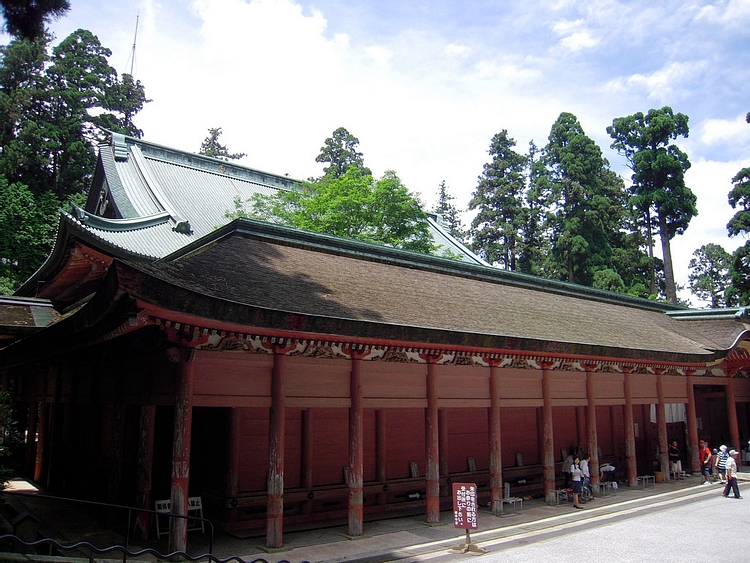 Konponchudo, Enryakuji Tamago Moffle (CC BY-SA) ](https://www.worldhistory.org/image/6611/konponchudo-enryakuji/ "Konponchudo, Enryakuji")The monastery met its greatest disaster in 1571 CE when it was systematically destroyed by [Oda Nobunaga](https://www.worldhistory.org/Oda_Nobunaga/), the feudal warlord or *daimyo*. Nobunaga was concerned at the power of the monastery of Enryakuji and its large army of warrior monks who still descended from the mountain whenever they felt they were not receiving their share of state handouts. Nobunaga solved the problem by having his troops surround the slopes of Mt. Hiei and setting fire to the forest. Thousands were killed, including [women](https://www.worldhistory.org/disambiguation/women/) and children, as they tried to escape the blaze and the sacred site was burnt to the ground. Fortunately for future generations, Enryakuji was restored to its former glory from 1595 CE onwards.
### The Temple Complex
Enryakuji has three distinct precincts spread over several kilometres across the mountain's wooded slopes: Yokawa, To-to (Eastern Pagoda), the area first settled by Saicho, and Sai-to (Western Pagoda). The most important building at the site is the Konponchudo which was built on the site of Saicho's first hut on the mountain, now the Eastern Precinct. The present version is a reconstruction dating to 1642 CE. Inside is an altar and ever-burning flame, said to have been lit since the site's foundation. The Daikodo or Great Lecture Hall has many portraits of Enryakuji's famous alumni. Next to the Great Lecture Hall stands the Bell of Good Fortune suspended in its own roofed structure. Other buildings in the To-to precinct include the reconstructed Kaidan-in or Ordination Hall, which was built to replace an older building commemorating the recognition of the Tendai sect by the emperor in the 9th century CE, the Amida Hall which was rebuilt in 1937 CE and has a two-storey pagoda, and the Monju-ro Gate.
[ 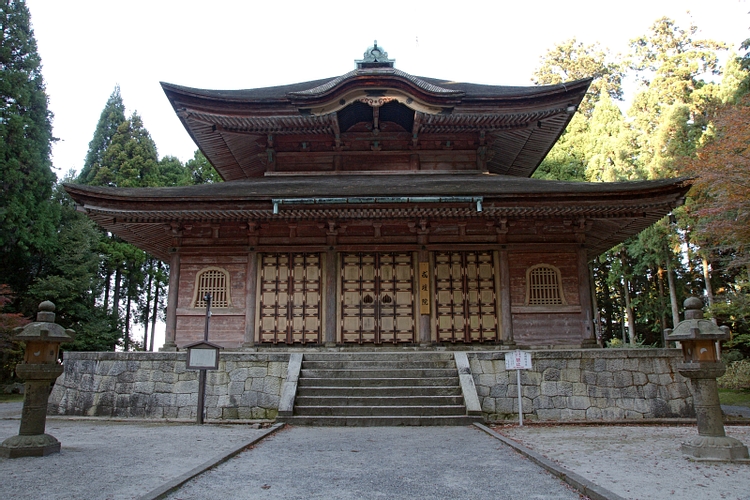 Ordination Hall, Enryakuji 663highland (CC BY-SA) ](https://www.worldhistory.org/image/6731/ordination-hall-enryakuji/ "Ordination Hall, Enryakuji")The Chu-do or Central Hall of the Yokawa precinct was built in the 9th century CE by the renowned monk and abbot of Enryakuji, [Ennin](https://www.worldhistory.org/Ennin/), but later destroyed by a lightning strike. It was rebuilt in 1971 CE. The most important structure in the Western Precinct is the Shakado, which was moved from its original location at the Miidera temple in 1595 CE and originally built by Saicho's disciple Encho. Between the Sai-to and To-to precincts, nestling in the forest is the [tomb](https://www.worldhistory.org/tomb/) of Saicho and the Jodo-in or Worship Hall. As Tendai Buddhism recognises the existence of [Shinto](https://www.worldhistory.org/Shinto/) *[kami](https://www.worldhistory.org/Kami/)* or spirits, there are several small Shinto shrines dotted around the complex, many dedicated to Oyamakui, the Shinto spirit of Mt. Hiei, and several *torii* or sacred gates.
This content was made possible with generous support from the [Great Britain Sasakawa Foundation](http://www.gbsf.org.uk/?utm_source=ancient.eu&utm_medium=link&utm_campaign=ancient.eu).
#### Editorial Review
This human-authored definition has been reviewed by our editorial team before publication to ensure accuracy, reliability and adherence to academic standards in accordance with our [editorial policy](https://www.worldhistory.org/static/editorial-policy/).
## Bibliography
- [Ashkenazi, M. *Handbook of Japanese Mythology.* Oxford University Press, 2008.](https://www.worldhistory.org/books/0195332628/)
- [Beasley, W.G. *The Japanese Experience A Short History of Japan.* University of California, 1999.](https://www.worldhistory.org/books/B000ORKKBI/)
- [Cali, J. *Shinto Shrines.* Latitude 20, 2012.](https://www.worldhistory.org/books/0824837134/)
- [Dougill, J. *Japan's World Heritage Sites.* Tuttle Publishing, 2014.](https://www.worldhistory.org/books/4805312858/)
- [Ebrey, P.B. *Pre-Modern East Asia.* Wadsworth Publishing, 2013.](https://www.worldhistory.org/books/1133606512/)
- [Mason, R.H.P. *A History of Japan.* Tuttle Publishing, 1997.](https://www.worldhistory.org/books/080482097X/)
- [Sansom, G. *A History of Japan to 1334.* Stanford University Press, 1958.](https://www.worldhistory.org/books/0804705232/)
- [Whitney Hall, J. *The Cambridge History of Japan, Vol. 2.* Cambridge University Press, 1999.](https://www.worldhistory.org/books/0521223539/)
## About the Author
Mark is WHE’s Publishing Director and has an MA in Political Philosophy (University of York). He is a full-time researcher, writer, historian and editor. Special interests include art, architecture and discovering the ideas that all civilizations share.
## Timeline
- **785 CE**: [Saicho](https://www.worldhistory.org/Saicho/) establishes the first [Buddhist](https://www.worldhistory.org/buddhism/) shrine at what would become the [Enryakuji](https://www.worldhistory.org/Enryakuji/) [temple](https://www.worldhistory.org/temple/) complex on Mt. Hiei, [Japan](https://www.worldhistory.org/disambiguation/Japan/).
- **c. 793 CE - 864 CE**: Life of [Ennin](https://www.worldhistory.org/Ennin/), the [Buddhist](https://www.worldhistory.org/buddhism/) scholar-monk and abbot of [Enryakuji](https://www.worldhistory.org/Enryakuji/), who brought many esoteric teachings from [China](https://www.worldhistory.org/china/) to [Japan](https://www.worldhistory.org/disambiguation/Japan/).n
- **808 CE**: [Ennin](https://www.worldhistory.org/Ennin/) joins the monastery of [Enryakuji](https://www.worldhistory.org/Enryakuji/), [Japan](https://www.worldhistory.org/disambiguation/Japan/).
- **854 CE**: [Ennin](https://www.worldhistory.org/Ennin/) becomes the abbot of [Enryakuji](https://www.worldhistory.org/Enryakuji/), [Heiankyo](https://www.worldhistory.org/Heiankyo/) (Kyoto), [Japan](https://www.worldhistory.org/disambiguation/Japan/).
- **1571 CE**: [Oda Nobunaga](https://www.worldhistory.org/Oda_Nobunaga/) attacks the [Buddhist](https://www.worldhistory.org/buddhism/) [Enryakuji](https://www.worldhistory.org/Enryakuji/) monastic complex near Kyoto.
## Cite This Work
### APA
Cartwright, M. (2017, June 01). Enryakuji. *World History Encyclopedia*.
### Chicago
Cartwright, Mark. "Enryakuji." *World History Encyclopedia*, June 01, 2017. .
### MLA
Cartwright, Mark. "Enryakuji." *World History Encyclopedia*, 01 Jun 2017, .
## License & Copyright
Submitted by [Mark Cartwright](https://www.worldhistory.org/user/markzcartwright/ "User Page: Mark Cartwright"), published on 01 June 2017. The copyright holder has published this content under the following license: [Creative Commons Attribution-NonCommercial-ShareAlike](https://creativecommons.org/licenses/by-nc-sa/4.0/deed.en). This license lets others remix, tweak, and build upon this content non-commercially, as long as they credit the author and license their new creations under the identical terms. When republishing on the web a hyperlink back to the original content source URL must be included. Please note that content linked from this page may have different licensing terms.