---
title: Ennin
author: Mark Cartwright
source: https://www.worldhistory.org/Ennin/
format: machine-readable-alternate
license: Creative Commons Attribution-NonCommercial-ShareAlike (https://creativecommons.org/licenses/by-nc-sa/4.0/)
updated: 1970-01-01
---
# Ennin
_Authored by [Mark Cartwright](https://www.worldhistory.org/user/markzcartwright/)_
Ennin (c. 793-864 CE, posthumous title: Jikaku Daishi) was a Japanese [Buddhist](https://www.worldhistory.org/buddhism/) monk of the Tendai sect who studied [Buddhism](https://www.worldhistory.org/buddhism/) at length in [China](https://www.worldhistory.org/china/) and brought back knowledge of esoteric rituals, sutras, and relics. On his return, he published his celebrated diary *Nitto Guho Junrei Gyoki* and became the abbot of the important [Enryakuji](https://www.worldhistory.org/Enryakuji/) monastery on Mount Hiei near Kyoto and, thus, head of the Tendai sect.
Tendai Buddhism had been introduced to [Japan](https://www.worldhistory.org/disambiguation/Japan/) by the monk [Saicho](https://www.worldhistory.org/Saicho/), also known as Dengyo Daishi (767-822 CE). Based on the teachings of the Chinese Tiantai Sect, Saicho's simplified and inclusive version of Buddhism grew in popularity, and its headquarters, the Enryakuji complex on Mount Hiei outside the capital [Heiankyo](https://www.worldhistory.org/Heiankyo/) (Kyoto), became one of the most important in Japan as well as a celebrated seat of learning. Ennin became a disciple of Saicho from 808 CE when he began to study at the monastery, aged just 14.
### Travels to China
Ennin was selected as part of a larger Japanese embassy led by the envoy to the [Tang](https://www.worldhistory.org/Tang_Dynasty/) Court, one [Fujiwara](https://www.worldhistory.org/Fujiwara_Clan/) no Tsunetsugu, to visit China in 838 CE and study there. The main aim was for Ennin to study further the Tendai doctrine at the T'ien-t'ai shan. Ultimately, he would stay there for nine years, studying under various masters and learning in greater depths the tenets and rituals of Buddhism and especially the mysteries of *Mikkyo*, that is esoteric teachings known only to a very few initiated priests.
On arrival at [Yang](https://www.worldhistory.org/Yin_and_Yang/)-chou and awaiting to be taken to T'ien-tai shan, the monk wasted no time and there and then found priests to teach him *shitan*, the Indic [script](https://www.worldhistory.org/script/) used in esoteric texts. He also made his own copies of such texts and underwent an initiation with a priest called Ch'uan-yen. As it turned out Ennin did well, for by the time the Chinese authorities had organised his transport to his original destination he was informed there would be no time to do so if he were not to return to Japan as planned with the embassy. Ennin decided to stay and passed the winter at a monastery in Shantung run by Korean monks.
In the spring Ennin set off for Wutai, an important pilgrimage site and home to some more learned monks who could help satiate his thirst for Buddhist knowledge. Mount Wutai, where the bodhisattva Manjusri was thought to have appeared, was also a centre of esoteric cults. Over the next 50 days, Ennin acquired such techniques as rhythmically chanting the name of Amida [Buddha](https://www.worldhistory.org/Siddhartha_Gautama/) and changing the intonation each repetition.
From 840 to 845 CE Ennin then studied at Ch'ang-an, learning more of *Mikkyo*, copying texts and mandalas, and being initiated by three different esoteric masters, going beyond the level that the recognised Japanese master and foremost expert [Kukai](https://www.worldhistory.org/Kukai/) had reached. In 845 CE Ennin, like many Chinese monks, suffered the persecution of anti-Buddhist emperor Wu-tsung, and he was compelled to return to Japan. This was easier said than done and it took two years, the [death](https://www.worldhistory.org/disambiguation/Death/) of Wu-tsung, and a general amnesty for him to finally find a ship that would make the voyage.
### Ennin's Travel Diary
Ennin wrote his now famous account of his time in China, the *Nitto Guho Junrei Gyoki* ('Record of Pilgrimage to China in Search of the Holy [Law](https://www.worldhistory.org/disambiguation/law/)'). The monk describes the difficulties and dangers of crossing the sea from Japan to China in a time when sailors did not have the compass. On his own trip it took three attempts to finally arrive at port and when he did the embassy was forced to await the slow wheels of Chinese bureaucracy in a region recently hit by a locust-[plague](https://www.worldhistory.org/disambiguation/plague/)-induced famine.
[  The Spread of Buddhism Be Zen (CC BY-NC-SA) ](https://www.worldhistory.org/image/1059/the-spread-of-buddhism/ "The Spread of Buddhism")The diary contains descriptions of local lore, Chinese inns, life in the monasteries, festivals, and the sights he encountered such as this lion statue which he reports took seven attempts and a good few prayers by the sculptor to complete: "It seems to be walking, and vapors come from its mouth. We looked at it for quite a while, and it looked just as if it were moving" (Keene, 360).
### Return to Japan & Royal Approval
Prior to his return to Japan from China in 847 CE, Ennin famously employed a [Shinto](https://www.worldhistory.org/Shinto/) diviner and prayed to the Shinto gods Sumiyoshi (protector of sea voyagers) and the Dragon King of the Sea. This was a symbolic instance of the increasing complimentary nature of the Buddhist and Shinto faiths in [ancient Japan](https://www.worldhistory.org/Ancient_Japan/). The effort was worth it as Ennin did make it back to Japan after another perilous sea trip. With him were 584 Buddhist texts, 21 ritual implements, and several paintings and mandalas for teaching purposes. Previously, Shingon Buddhism had been at the forefront of esoteric teachings in Japan, but now Ennin was armed with material and knowledge to champion the cause of the Tendai sect.
Back at Enryakuji, the imperial court recognised Ennin's superior *Mikkyo* knowledge and officially sponsored an annual esoteric initiation rite there (*Hiei kanjo*), starting in 849 CE. From the emperor's point of view these rites, which involved over 1,000 monks, would ensure the security and well-being of the Japanese state. Ennin became a regular guest at the royal [palace](https://www.worldhistory.org/disambiguation/palace/) at Heiankyo and personally instructed imperial family members in the basics of Buddhism and lower initiation rites, including Emperor Montoku himself in 856 CE.
### Abbot of Enryakuji
In 854 CE Ennin became the Chief Abbot (*Tendei Zasu*) of the Enryakuji monastery, a position he held for over 20 years. The monastery was one of the most important in Japan, and Ennin enjoyed the continued political and financial support of both the imperial court and the powerful [Fujiwara clan](https://www.worldhistory.org/Fujiwara_Clan/). A notable achievement during his leadership was the foundation of the Onjoji (aka Miidera) monastery on the lower slopes of the mountain. Other temples credited to Ennin include the Sanbutsudo Hall at Nikko Toshogu on the orders of Emperor Ninmyo (r. 833-850 CE) and on the island of Chikubushima where Ennin set up a statue of Benzaiten ([Saraswati](https://www.worldhistory.org/Sarasvati/)) in 834 CE following a dream in which the goddess asked to be enshrined there.
[ 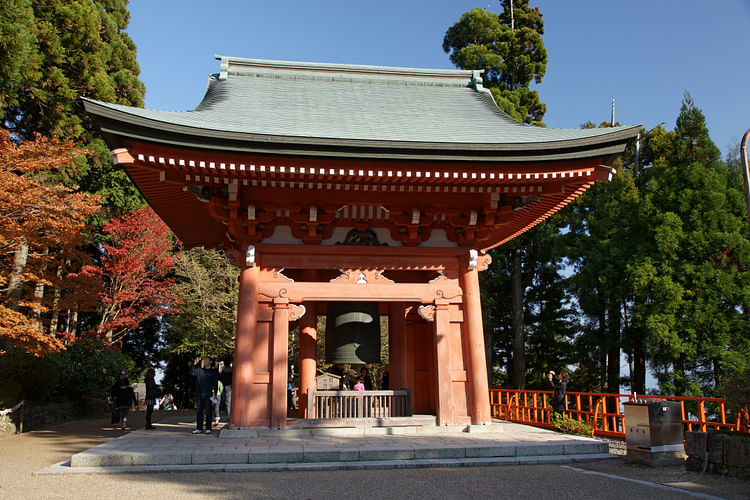 Bell Tower, Enryakuji 663highland (CC BY-SA) ](https://www.worldhistory.org/image/6730/bell-tower-enryakuji/ "Bell Tower, Enryakuji")Like many other scholar-monks of the period, Ennin was credited with being a gifted sculptor. One example of his work is the wooden copy of the Kannon Bosatsu statue at Asakusa Jinja in Tokyo. The original [bronze](https://www.worldhistory.org/disambiguation/bronze/) figure was said to have been caught by fishermen and is a *hihutsu* or 'hidden image' which may not be revealed to human eyes. Even Ennin's wooden copy is only put on display for one day each year (13th December).
In the politics of the [Heian Period](https://www.worldhistory.org/Heian_Period/) (794-1185 CE) the power of monasteries, based on their landholdings, exemption from taxes, and ability to maintain significant armies of armed retainers, meant that inevitably rivalries broke out between them. Enryakuji endured a particularly bitter rivalry with the [Kofukuji](https://www.worldhistory.org/Kofukuji/) monastery at [Nara](https://www.worldhistory.org/Nara/). Enryakuji, though, would also split from within when the followers of Ennin and those of Enchin, abbot of Onjoji, decided to go their own way and form the Mountain Order and Jimon Order respectively. There does not seem to have been any significant doctrinal differences between the two groups except a reluctance to emphasise the mystic elements of Buddhism that Ennin preached. The split, which became official following Enchin's death in 891 CE, may also have had more earthly reasons and been due to competition for resources and influence.
Two years after his death in 864 CE, Ennin was given the posthumous title of Jikaku Daishi by the emperor, meaning 'Great Teacher of Compassionate Awareness', in recognition of his contribution to Buddhism and establishing the *Tendai Mikkyo* sect as the most important officially sanctioned sect in Japan. Tendai Buddhism continued to prosper over the following century with successive emperors favouring the sect and many of the monks ordained at Enryakuji would go on to administer secondary [temple](https://www.worldhistory.org/temple/) site across Japan.
This content was made possible with generous support from the [Great Britain Sasakawa Foundation](http://www.gbsf.org.uk/?utm_source=ancient.eu&utm_medium=link&utm_campaign=ancient.eu).
#### Editorial Review
This human-authored definition has been reviewed by our editorial team before publication to ensure accuracy, reliability and adherence to academic standards in accordance with our [editorial policy](https://www.worldhistory.org/static/editorial-policy/).
## Bibliography
- [Beasley, W.G. *The Japanese Experience.* University of California Press, 2000.](https://www.worldhistory.org/books/0520225600/)
- [Cali, J. *Shinto Shrines.* Latitude 20, 2012.](https://www.worldhistory.org/books/0824837134/)
- [Ebrey, P.B. *Pre-Modern East Asia.* Wadsworth Publishing, 2013.](https://www.worldhistory.org/books/1133606512/)
- [Henshall, K. *Historical Dictionary of Japan to 1945.* Scarecrow Press, 2013.](https://www.worldhistory.org/books/0810878712/)
- [Keene, D. *Seeds in the Heart.* Columbia University Press, 1999.](https://www.worldhistory.org/books/0231114419/)
- [Sansom, G. *A History of Japan to 1334.* Stanford University Press, 1958.](https://www.worldhistory.org/books/0804705232/)
- [Whitney Hall, J. *The Cambridge History of Japan, Vol. 2.* Cambridge University Press, 1999.](https://www.worldhistory.org/books/0521223539/)
## About the Author
Mark is WHE’s Publishing Director and has an MA in Political Philosophy (University of York). He is a full-time researcher, writer, historian and editor. Special interests include art, architecture and discovering the ideas that all civilizations share.
## Timeline
- **c. 793 CE - 864 CE**: Life of [Ennin](https://www.worldhistory.org/Ennin/), the [Buddhist](https://www.worldhistory.org/buddhism/) scholar-monk and abbot of [Enryakuji](https://www.worldhistory.org/Enryakuji/), who brought many esoteric teachings from [China](https://www.worldhistory.org/china/) to [Japan](https://www.worldhistory.org/disambiguation/Japan/).n
- **808 CE**: [Ennin](https://www.worldhistory.org/Ennin/) joins the monastery of [Enryakuji](https://www.worldhistory.org/Enryakuji/), [Japan](https://www.worldhistory.org/disambiguation/Japan/).
- **838 CE - 847 CE**: Japanese Tendai [Buddhist](https://www.worldhistory.org/buddhism/) monk [Ennin](https://www.worldhistory.org/Ennin/) studies [esoteric Buddhism](https://www.worldhistory.org/Esoteric_Buddhism/) in [China](https://www.worldhistory.org/china/).
- **849 CE**: [Ennin](https://www.worldhistory.org/Ennin/) leads the first imperial-sponsored esoteric ritual at [Enryakuji](https://www.worldhistory.org/Enryakuji/), [Japan](https://www.worldhistory.org/disambiguation/Japan/).
- **854 CE**: [Ennin](https://www.worldhistory.org/Ennin/) becomes the abbot of [Enryakuji](https://www.worldhistory.org/Enryakuji/), [Heiankyo](https://www.worldhistory.org/Heiankyo/) (Kyoto), [Japan](https://www.worldhistory.org/disambiguation/Japan/).
- **864 CE**: The [Buddhist](https://www.worldhistory.org/buddhism/) monk [Ennin](https://www.worldhistory.org/Ennin/) is given the title Jikaku Daishi by the Japanese emperor, two years after his [death](https://www.worldhistory.org/disambiguation/Death/).
## Cite This Work
### APA
Cartwright, M. (2017, June 23). Ennin. *World History Encyclopedia*.
### Chicago
Cartwright, Mark. "Ennin." *World History Encyclopedia*, June 23, 2017. .
### MLA
Cartwright, Mark. "Ennin." *World History Encyclopedia*, 23 Jun 2017, .
## License & Copyright
Submitted by [Mark Cartwright](https://www.worldhistory.org/user/markzcartwright/ "User Page: Mark Cartwright"), published on 23 June 2017. The copyright holder has published this content under the following license: [Creative Commons Attribution-NonCommercial-ShareAlike](https://creativecommons.org/licenses/by-nc-sa/4.0/deed.en). This license lets others remix, tweak, and build upon this content non-commercially, as long as they credit the author and license their new creations under the identical terms. When republishing on the web a hyperlink back to the original content source URL must be included. Please note that content linked from this page may have different licensing terms.