---
title: Empuries
author: Mark Cartwright
source: https://www.worldhistory.org/Empuries/
format: machine-readable-alternate
license: Creative Commons Attribution-NonCommercial-ShareAlike (https://creativecommons.org/licenses/by-nc-sa/4.0/)
updated: 1970-01-01
---
# Empuries
_Authored by [Mark Cartwright](https://www.worldhistory.org/user/markzcartwright/)_
Empuries (also Emporiae or Emporion) was a [Greek](https://www.worldhistory.org/disambiguation/greek/) and then [Roman](https://www.worldhistory.org/disambiguation/Roman/) colony on the northeastern coast of Spain. Thriving as a local and [Mediterranean](https://www.worldhistory.org/disambiguation/mediterranean/) trading centre, it prospered from the 6th century BCE to the 2nd century CE. Several times the Romans used the port as a landing place for armies to invade and plunder [Iberia](https://www.worldhistory.org/disambiguation/iberia/) and they established a military camp at the site which evolved into a small town embellished with the usual collection of Roman architectural features. The site today offers the visitor extensive ruins, notably a large portion of the [city](https://www.worldhistory.org/city/) walls, a crytpoportico, forum space, and large private houses.
### Historical Overview
Empuries was established by settlers from Massalia (Marseilles) in the 6th century BCE who founded the port of Palaeopolis on an island at the mouth of the Fluvia River. The settlers prospered through [trade](https://www.worldhistory.org/disambiguation/trade/) and then spread to the Greek town known as Neapolis near the coast which covers about 4 hectares. The two areas were called Emporion, indicative of their dependence on trade, where wine, [pottery](https://www.worldhistory.org/pottery/), and olive oil, along with goods from Massalia and those of [Etruscan](https://www.worldhistory.org/Etruscan_Civilization/) origin, were exchanged for metals and foodstuffs from the local tribes reached via the River Fluvia and the nearby River Ter.
The Romans used the port during the [Second Punic War](https://www.worldhistory.org/Second_Punic_War/) against [Carthage](https://www.worldhistory.org/carthage/), with [Scipio Africanus](https://www.worldhistory.org/disambiguation/Scipio_Africanus/) landing expeditions there in 218 and 211 BCE, and again in 195 BCE when Marcus Porcius Cato led a force to quash the Iberian revolt which sprang up in reaction to [Rome](https://www.worldhistory.org/Rome/)'s demands for tribute. From 100 BCE, in order to create a more permanent base from which to exploit Iberia and protect the trade route from [Italy](https://www.worldhistory.org/italy/), they built a Roman town from the original army camp. Located on the coast opposite from the Greek town, which had by then covered all of the island, the Roman town was laid out in right-angled blocks and eventually spread to cover some 22.5 hectares. The town received another boost when [Julius Caesar](https://www.worldhistory.org/Julius_Caesar/) settled veterans from his legions there in 45 BCE.
[ 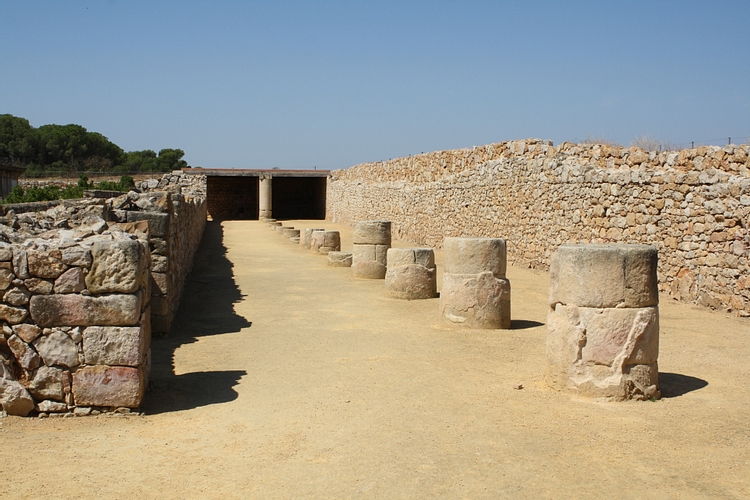 Cryptoportico, Empuries Mark Cartwright (CC BY-NC-SA) ](https://www.worldhistory.org/image/5550/cryptoportico-empuries/ "Cryptoportico, Empuries")In the reign of [Augustus](https://www.worldhistory.org/augustus/) (27 BCE – 14 CE) the two still separate towns and a nearby indigenous Iberian settlement (Indika) were combined and awarded the status of *municipium,* which was given the collective name Emporiae. The town had its own forum, [agora](https://www.worldhistory.org/agora/), small [amphitheatre](https://www.worldhistory.org/amphitheatre/), [gymnasium](https://www.worldhistory.org/Gymnasium/), and walls, and continued to mint its own [coinage](https://www.worldhistory.org/coinage/) (which began in the 5th century BCE) with a characteristic [Pegasus](https://www.worldhistory.org/Pegasus/) design. There were also temples to the Greek [god](https://www.worldhistory.org/God/) of [medicine](https://www.worldhistory.org/disambiguation/medicine/) [Asclepius](https://www.worldhistory.org/Asclepius/) and to [Serapis](https://www.worldhistory.org/Serapis/), the [Hellenistic](https://www.worldhistory.org/Hellenic_World/)-[Egyptian](https://www.worldhistory.org/disambiguation/Egyptian/) god. Empuries declined in importance for unknown reasons from the 2nd century CE but continued as a more modest, walled settlement well into the early Christian period.
### Architectural Highlights
The site of the indigenous settlement Indika has yet to be located, but pottery finds suggest the area was first inhabited from the 9th century BCE, and large grain silos are evidence of the trade which went on with their Greek and Roman neighbours. The majority of the architectural remains in the Greek quarter of Empuries (the Neapolis area) belong to the [Hellenistic Period](https://www.worldhistory.org/Hellenistic_Period/) and date to the 2nd and 1st centuries BCE, although some of the lower courses of the 4th century BCE fortification [wall](https://www.worldhistory.org/wall/) survive. The majority of the Roman town remains unexcavated and the structures which can be seen today date from the 1st century BCE to the 1st century CE.
[ 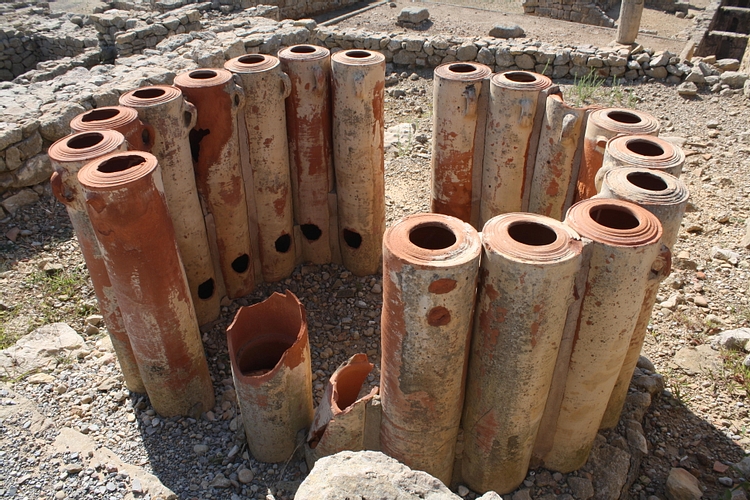 Ground Water Filter, Empuries Mark Cartwright (CC BY-NC-SA) ](https://www.worldhistory.org/image/5533/ground-water-filter-empuries/ "Ground Water Filter, Empuries")**Neapolis**
Here are the remains of various temples and sanctuaries, notably that dedicated to Asclepius, the Greek god of medicine and healing. This dates to the 4th-2nd century BCE and its large calcareous stone podium is still visible today. Here too is an unusual ceramic water filter set into the ground and a large cistern, both dating to the Hellenistic period when the sanctuary was remodelled. The foundations of the agora (50 x 40 metres) and stoa (50 x 14 metres), originally with a 12-[column](https://www.worldhistory.org/column/) façade, are still visible, as are a single large public cistern and three smaller ones, to give an impression of these places where the people of Empuries met and shopped. There are also the foundations and two short staircases of the 1st-century BCE [temple](https://www.worldhistory.org/temple/) dedicated to [Isis](https://www.worldhistory.org/isis/) and [Zeus](https://www.worldhistory.org/zeus/) Serapis. There are remains of modest one and two-roomed houses, probably used by traders and the small workshops (*tabernae*) of craftsmen. A few other homes are larger residences with colonnaded courtyards which include water-collecting drains and one residence with a hall for symposia, as indicated by the Greek ΗΔΘΚΟΙΤΟΣ ('how sweet to be reclined') laid out on the [mosaic](https://www.worldhistory.org/Mosaic/) flooring. Finally, by the agora are the remains of the 4th-century CE early Christian church and cemetery with several stone sarcophagi left in situ. The cemetery was in use up to the 9th century CE and held over 500 tombs of all social classes.
**[Roman Forum](https://www.worldhistory.org/Roman_Forum/)**
The Republic-era forum space had a temple (most probably dedicated to [Jupiter](https://www.worldhistory.org/jupiter/), [Juno](https://www.worldhistory.org/Juno/), and [Minerva](https://www.worldhistory.org/Minerva/)) with a front portico of four columns. The open area, paved with sandstone slabs, was enclosed on three sides by a double-colonnaded building with a cryptoportico beneath it. A portion of the latter structure has had its roof reconstructed to give an idea of how it originally looked. The forum was revamped in the Augustan period, and the main temple became enclosed behind a low wall to restrict the sacred area. At least one new temple was dedicated to the imperial cult, and a basilica was built for the city's administrators.
[ 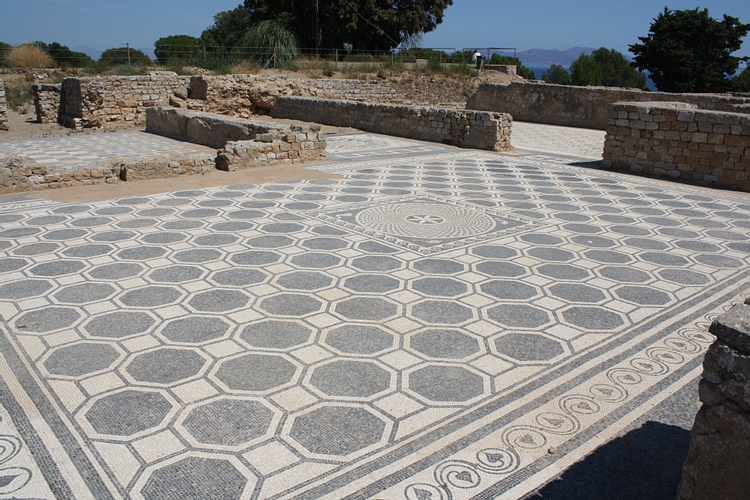 Hexagonal Mosaic Flooring, Empuries Mark Cartwright (CC BY-NC-SA) ](https://www.worldhistory.org/image/5553/hexagonal-mosaic-flooring-empuries/ "Hexagonal Mosaic Flooring, Empuries")**[Roman Domus](https://www.worldhistory.org/article/77/the-roman-domus/)**
Portions of the columned atrium of the late-Republic house (domus) no. 1 survive, including a drain to collect water into the two cisterns below. The house is typical of large Roman private houses but is built on two terraces to compensate for the uneven terrain. The many rooms, courtyards, and garden areas include a small three-roomed thermal complex or *balneum*. The domus also has a number of impressive and well-preserved black and white mosaic floors.
**Roman City Gates & Wall**
A significant stretch of the Roman city walls survives on the south side. Built from the 1st century BCE and probably initially part of the Roman fortified camp, the walls were constructed using several courses of large polygonal blocks and an upper section of concrete (*opus caementicium*). Also surviving are two city gates with the portion of stone roadway beneath one showing the wear of wheeled traffic. To the sides of these gates is a phallus carved into one of the stone blocks as a protective symbol.
[ 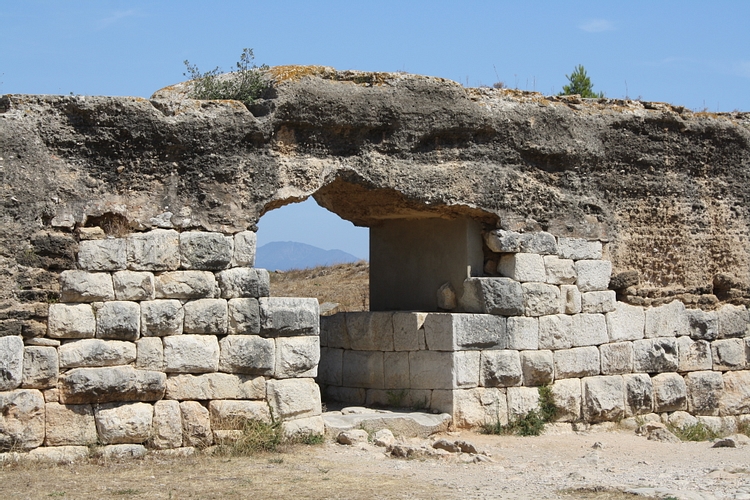 City Gate, Empuries Mark Cartwright (CC BY-NC-SA) ](https://www.worldhistory.org/image/5546/city-gate-empuries/ "City Gate, Empuries")### Archaeological Finds
With three settlements and many more cemeteries, Empuries has a rich offering in art and everyday objects. The most impressive archaeological discovery was undoubtedly a larger-than-life statue of Asclepius. The figure, once abandoned in a cistern, combines both Pentelic and Parian marble and dates to the 4th century BCE. The statue once stood in a small sanctuary dedicated to the god. Other interesting finds, also on display in the site museum include a 5th-century BCE commercial letter written in Greek on a sheet of lead, local Iberian pottery with geometric decoration, Etruscan black glaze pottery, an Iberian sandstone stele (6th century BCE) carved with a spiral to represent a bent spear, and an altar from the peristyle of a Roman villa decorated with painted scenes. Finally, several fine emblemata mosaics survive from the large villas at the site including a detailed depiction of the sacrifice of Iphigenia from [Greek mythology](https://www.worldhistory.org/Greek_Mythology/).
#### Editorial Review
This human-authored definition has been reviewed by our editorial team before publication to ensure accuracy, reliability and adherence to academic standards in accordance with our [editorial policy](https://www.worldhistory.org/static/editorial-policy/).
## Bibliography
- Aquilué, X. *Empuries.* Museu d’Arqueologia de Catalunya, 2008
- Bagnall, R. et al. *The Encyclopedia of Ancient History.* Wiley-Blackwell, 2012
- [Hornblower, S. *The Oxford Classical Dictionary.* Oxford University Press, 2012.](https://www.worldhistory.org/books/0199545561/)
## About the Author
Mark is WHE’s Publishing Director and has an MA in Political Philosophy (University of York). He is a full-time researcher, writer, historian and editor. Special interests include art, architecture and discovering the ideas that all civilizations share.
## Timeline
- **c. 550 BCE**: [Empuries](https://www.worldhistory.org/Empuries/) is founded by colonists from Massalia.
- **218 BCE**: [Scipio Africanus](https://www.worldhistory.org/disambiguation/Scipio_Africanus/) lands an army at [Empuries](https://www.worldhistory.org/Empuries/) in northeastern Spain during the [Second Punic War](https://www.worldhistory.org/Second_Punic_War/).
- **211 BCE**: [Scipio Africanus](https://www.worldhistory.org/disambiguation/Scipio_Africanus/) lands an army for the second time at [Empuries](https://www.worldhistory.org/Empuries/) in northeastern Spain during the [Second Punic War](https://www.worldhistory.org/Second_Punic_War/).
- **195 BCE**: Marcus Porcius Cato serves as [consul](https://www.worldhistory.org/Consul/) and lands an army at [Empuries](https://www.worldhistory.org/Empuries/) in northeastern Spain to quash the Iberian revolt.
- **c. 100 BCE**: The [Roman military](https://www.worldhistory.org/Roman_Army/) camp at [Empuries](https://www.worldhistory.org/Empuries/) begins to transform into a town.
- **45 BCE**: [Julius Caesar](https://www.worldhistory.org/Julius_Caesar/) settles legionary veterans at [Empuries](https://www.worldhistory.org/Empuries/).
## Cite This Work
### APA
Cartwright, M. (2016, September 01). Empuries. *World History Encyclopedia*.
### Chicago
Cartwright, Mark. "Empuries." *World History Encyclopedia*, September 01, 2016. .
### MLA
Cartwright, Mark. "Empuries." *World History Encyclopedia*, 01 Sep 2016, .
## License & Copyright
Submitted by [Mark Cartwright](https://www.worldhistory.org/user/markzcartwright/ "User Page: Mark Cartwright"), published on 01 September 2016. The copyright holder has published this content under the following license: [Creative Commons Attribution-NonCommercial-ShareAlike](https://creativecommons.org/licenses/by-nc-sa/4.0/deed.en). This license lets others remix, tweak, and build upon this content non-commercially, as long as they credit the author and license their new creations under the identical terms. When republishing on the web a hyperlink back to the original content source URL must be included. Please note that content linked from this page may have different licensing terms.