---
title: Ehecatl
author: Mark Cartwright
source: https://www.worldhistory.org/Ehecatl/
format: machine-readable-alternate
license: Creative Commons Attribution-NonCommercial-ShareAlike (https://creativecommons.org/licenses/by-nc-sa/4.0/)
updated: 1970-01-01
---
# Ehecatl
_Authored by [Mark Cartwright](https://www.worldhistory.org/user/markzcartwright/)_
Ehecatl was a Mesoamerican [god](https://www.worldhistory.org/God/) of air and winds, especially those which brought rains. Regarded as a manifestation of the great feathered serpent god [Quetzalcoatl](https://www.worldhistory.org/Quetzalcoatl/), he was sometimes known as Quetzalcoatl-Ehecatl, in which guise he helped create humanity in the [Aztec](https://www.worldhistory.org/Aztec_Civilization/) creation myth and gave the gift of the maguey plant. He was also associated with the cardinal directions, colours, and several calendar dates.
### Name & Associations
Ehecatl means 'wind' in *nahuatl*. Possibly of Huastec origin, who built many circular or curved temples in his honour, he was adopted by the Aztecs, who thought he was born from flint on the day 9 Wind, which was his other name. They also named the 2nd day in the [Aztec calendar](https://www.worldhistory.org/article/896/the-aztec-calendar/) after him. Ehecatl acquired various associations besides the wind in general, amongst them the calendar dates 6 Ehecatl the sun, 7 Ehecatl the day humanity was created, and 9 Ehecatl the winds from the four quarters. He is the patron of the second *trecena* (a time period of the calendar) 1 Jaguar.
As the god was regarded as a manifestation or wind aspect of the feathered serpent god Quetzalcoatl, one of the most important deities in the Mesoamerican [pantheon](https://www.worldhistory.org/Pantheon/), he is sometimes referred to as Quetzalcoatl-Ehecatl. Thus, two more dates carry his name: 1 Ehecatl Iztac [Tezcatlipoca](https://www.worldhistory.org/Tezcatlipoca/) ('White' Tezcatlipoca being the equivalent of Quetzalcoatl) and 4 Ehecatl [Xolotl](https://www.worldhistory.org/Xolotl/) (Xolotl being Quetzalcoatl's twin). Quetzalcoatl-Ehecatl was also one of the four sky-bearing deities, specifically in the direction west. Ehecatl was regarded as the patron of merchants and was associated with spider monkeys, perhaps because of their great speed.
### Creation [Mythology](https://www.worldhistory.org/mythology/)
Ehecatl features in the Aztec Creation mythology, first, as the 2nd sun of the cosmos Nahui Ehecatl, and then during the creation of the present world with the 5th and final sun. According to one version of the myth, Quetzalcoatl took on the guise of Ehecatl and descended into the Underworld where he stole the bones of the inhabitants of the former worlds in order to create humans in this one. [Mictlantecuhtli](https://www.worldhistory.org/Mictlantecuhtli/), the god of the Underworld, was none too happy about people popping into his realm whenever they felt like it and so would only let Ehecatl go free if he could somehow get [music](https://www.worldhistory.org/disambiguation/Music/) from a conch shell. Ehecatl cleverly had worms bore holes in it and bees buzz inside it to produce a tremendous sound, thus ensuring his liberty.
Ehecatl also helped in the movement of the 5th sun and moon. These had been created when the twin brothers Nanahuatzin and Tecuciztecatl had thrown themselves into a sacrificial fire. The problem, though, was that neither celestial body could move and so Ehecatl, in one version at least, was called upon to blow them into their respective orbits.
[ 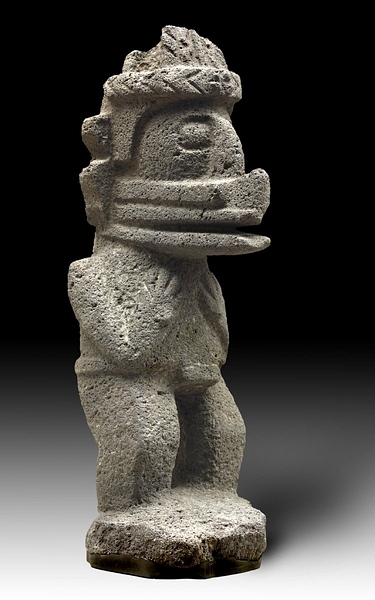 Ehecatl with Duckbill Mask The British Museum (Copyright) ](https://www.worldhistory.org/image/6447/ehecatl-with-duckbill-mask/ "Ehecatl with Duckbill Mask")### Ehecatl & Mayahuel
Ehecatl is sometimes credited with giving the important maguey plant (*Agave americana*) to humanity. This type of cactus was useful for its spines and its juice was fermented into the alcoholic drink [pulque](https://www.worldhistory.org/Pulque/). The story begins with Ehecatl persuading Mayahuel, a beautiful young goddess, to descend from the heavens and become his lover. Down on earth, the two embraced as a pair of intertwining trees but their raptures were soon rudely interrupted by Tzitzmitl, the 'grandmother' goddess, who was Mayahuel's guardian. The elderly goddess split the tree in two and fed the pieces to her demon followers, the Tzitzimime. Ehecatl, being a more powerful god, was unharmed in this episode, and so he gathered what pieces of Mayahuel he could find and planted them in a field. These remains then grew into the maguey plant. Two other gifts to humanity besides pulque which are often credited to Ehecatl are music and maize.
### Temples
The Mesoamerican temples dedicated to Ehecatl and other wind gods are distinctive in that they are circular as opposed to the usual square [pyramid](https://www.worldhistory.org/pyramid/), or they incorporate a curved end. The roof of such buildings was typically conical too. This design may reflect the desire to make them aerodynamically welcoming for the winds of the god they honour. The doorways are usually formed as the jaws of a [giant](https://www.worldhistory.org/Giants/) snake. This may well be in imitation of the caves Mesoamerican peoples considered entrances to the Underworld where the winds were thought to originate from.
[ 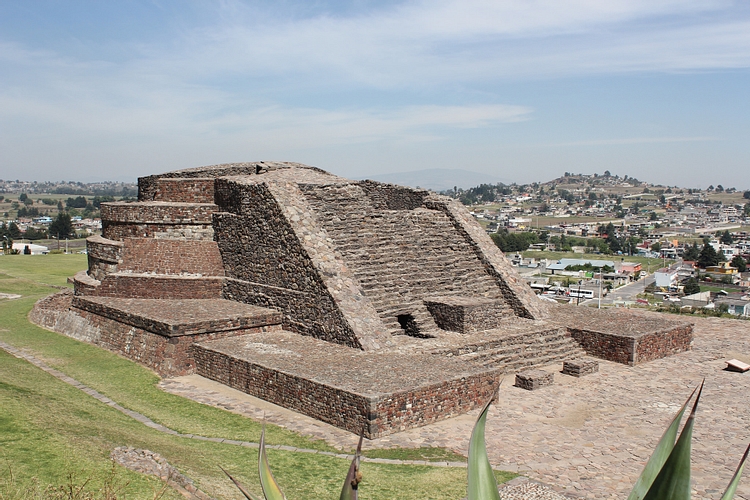 Temple of Ehecatl, Calixtlahuaca Arian Zwegers (CC BY) ](https://www.worldhistory.org/image/6440/temple-of-ehecatl-calixtlahuaca/ "Temple of Ehecatl, Calixtlahuaca")### Representation in Art
There are no known representations of the god prior to the 12th century CE, although two stelae from [Maya](https://www.worldhistory.org/disambiguation/Maya/) Seibal, dating to the 9th century CE, depict a god with a beak-like face. Ehecatl is most frequently portrayed in Postclassic sculpture and codices, wearing a conical hat and duckbill mask or *buccal* (although sometimes the corners of the bill have fangs, a common feature of rain gods) which covers the lower part of his face. If coloured, then his body is painted black and his facemask red. He sometimes wears shells, especially the conch shell (*ehecacozcatl or 'wind jewel'), worn as a pectoral, with which he whistled his way out of the Underworld. Shells may be another clue as to the god's coastal Huastec origins. One of the most famous statues of the god is from a [temple](https://www.worldhistory.org/temple/) dedicated to Quetzalcoatl-Ehecatl at Calixtlahuaca in the Toluca Valley. The god stands 1.76 m tall, rigid and ready to blow his divine winds through his beak mask. It is now on display in the National Museum of Anthropology in Mexico [City](https://www.worldhistory.org/city/).
#### Editorial Review
This human-authored definition has been reviewed by our editorial team before publication to ensure accuracy, reliability and adherence to academic standards in accordance with our [editorial policy](https://www.worldhistory.org/static/editorial-policy/).
## Bibliography
- [Miller, M.E. *An Illustrated Dictionary of the Gods and Symbols of Ancient Mexico and the Maya.* Thames & Hudson, 1997.](https://www.worldhistory.org/books/0500279284/)
- [Miller, M.E. *The Art of Mesoamerica.* Thames & Hudson, 2012.](https://www.worldhistory.org/books/0500204144/)
- [Nichols, D.L. *The Oxford Handbook of Mesoamerican Archaeology.* Oxford University Press, 2016.](https://www.worldhistory.org/books/0190230800/)
- [Phillips, C. *The Illustrated Encyclopedia of the Aztec & Maya& Central America - Including The Aztec..* Lorenz Books, 2007.](https://www.worldhistory.org/books/0754817296/)
- [Townsend, R.F. *The Aztecs.* Thames & Hudson, 2009.](https://www.worldhistory.org/books/0500287910/)
## About the Author
Mark is WHE’s Publishing Director and has an MA in Political Philosophy (University of York). He is a full-time researcher, writer, historian and editor. Special interests include art, architecture and discovering the ideas that all civilizations share.
## Cite This Work
### APA
Cartwright, M. (2017, March 24). Ehecatl. *World History Encyclopedia*.
### Chicago
Cartwright, Mark. "Ehecatl." *World History Encyclopedia*, March 24, 2017. .
### MLA
Cartwright, Mark. "Ehecatl." *World History Encyclopedia*, 24 Mar 2017, .
## License & Copyright
Submitted by [Mark Cartwright](https://www.worldhistory.org/user/markzcartwright/ "User Page: Mark Cartwright"), published on 24 March 2017. The copyright holder has published this content under the following license: [Creative Commons Attribution-NonCommercial-ShareAlike](https://creativecommons.org/licenses/by-nc-sa/4.0/deed.en). This license lets others remix, tweak, and build upon this content non-commercially, as long as they credit the author and license their new creations under the identical terms. When republishing on the web a hyperlink back to the original content source URL must be included. Please note that content linked from this page may have different licensing terms.