---
title: Ancient Dvin
author: Mark Cartwright
source: https://www.worldhistory.org/Dvin/
format: machine-readable-alternate
license: Creative Commons Attribution-NonCommercial-ShareAlike (https://creativecommons.org/licenses/by-nc-sa/4.0/)
updated: 1970-01-01
---
# Ancient Dvin
_Authored by [Mark Cartwright](https://www.worldhistory.org/user/markzcartwright/)_
Dvin (aka Duin), located 40 km south of modern Yerevan, was the capital of early medieval [Armenia](https://www.worldhistory.org/armenia/) for four centuries. Founded in the 4th century CE, the [city](https://www.worldhistory.org/city/) prospered and became the administrative head of the Armenian church. Remaining the capital under the rule of the Arab [Umayyad Caliphate](https://www.worldhistory.org/Umayyad_Dynasty/) from the mid-7th century CE, Dvin would ultimately be replaced, first by Partav in 789 CE and then Ani in 961 CE as Armenia's first city.
### Foundation
Dvin was founded by the Armenian king Khosrov III Kotak (r. c. 330 - 338 CE) who converted what was already a small settlement and royal hunting park into a new city. Situated by the Azat (aka Garni) River on a natural promontory, the site was also easily defended with fortification walls built as an additional deterrent. The son of Khosrov, King Tiran, moved the royal residence to Dvin, and by the 5th century CE, it was a thriving city. Its growth was greatly helped by the decision of Armenia's overlords at the time, the [Sasanian Empire](https://www.worldhistory.org/Sasanian_Empire/), to make Dvin the new administrative capital of their part of the country (the other being controlled by the [Roman Empire](https://www.worldhistory.org/Roman_Empire/)). Dvin was not without its competitors, though, especially in terms of [trade](https://www.worldhistory.org/disambiguation/trade/); a notable rival being the former capital and more ancient city of [Artashat](https://www.worldhistory.org/Artashat/) (Artaxata), located just a few kilometres to the west.
### Political & Religious Capital
The move away from the old capital of [Vagharshapat](https://www.worldhistory.org/Vagharshapat/) was designed to disassociate the new regime from that of the former Armenia ruling dynasty the Arsacid dynasty (12 CE - 428 CE) and increase loyalty to the Persian viceroy or *marzpan*. Dvin, as the seat of the all-powerful marzpan*, was the location of the state's central archives which listed the titles and privileges of Armenia's noble families, many of which were regularly renewed. The archives were also important for the *marzpan* to assemble the quotas of armed men expected to serve in the Persian army.
In religious affairs, too, Dvin took centre stage as the Persians moved the seat of the Armenian Church's first bishop, the *katholikos*, there. This was, once again, part of a strategy to weaken the religious structure of the country. The catholicosate, the administrative head and archival centre of the Armenian church, would remain in Dvin for the next five centuries. A large cathedral was built fitting for the city's new religious status and dedicated to [Saint Gregory the Illuminator](https://www.worldhistory.org/Saint_Gregory_the_Illuminator/) (c. 239 - c. 330 CE), Armenia's first bishop in 314 CE. The city had many fine basilicas, too, and hosted several important synods, notably the councils of 505 and 554 CE.
### A Thriving City
Dvin benefitted from the surrounding fertile plains which permitted [agriculture](https://www.worldhistory.org/disambiguation/Agriculture/) to thrive, especially [animal husbandry](https://www.worldhistory.org/Animal_Husbandry/) and the long-famous Armenian speciality of horse breeding. Natural resources nearby included the necessary raw materials for a successful manufacturing industry in and around the city, weaving and textile products, especially rugs, were produced in large numbers.
[ 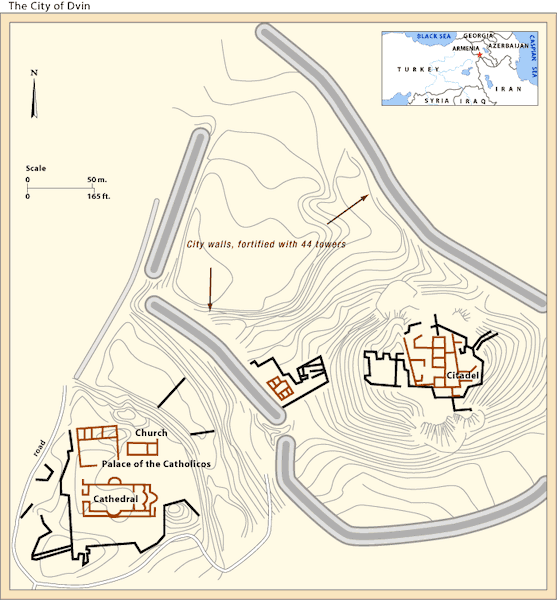 Map of Dvin Archaeological Site www.armenica.org (CC BY-SA) ](https://www.worldhistory.org/image/8430/map-of-dvin-archaeological-site/ "Map of Dvin Archaeological Site")Dvin boasted a cosmopolitan population of over 100,000 residents thanks to the influx of administrators, nobles, merchants, artisans, scholars and clergy. Mixing with the Armenians were Syrians, Jews, Persians, Arabs, Kurds, Turks, and Georgians, amongst others. International long-range traders also took up temporary residence as the city was located on the well-established trade routes between [China](https://www.worldhistory.org/china/), [India](https://www.worldhistory.org/india/), [Persia](https://www.worldhistory.org/Persia/), and the [Mediterranean](https://www.worldhistory.org/disambiguation/mediterranean/). Imported goods included [silk](https://www.worldhistory.org/Silk/), spices, medicines, and gems while the major exports were horses, grain, wine, oil, metals, and textiles. The dimensions of the city's trade and its range are attested by the number and variety of coins excavated at the site in modern times.
The [Byzantine](https://www.worldhistory.org/disambiguation/Byzantine/) historian Procopius, [writing](https://www.worldhistory.org/writing/) in the 6th century CE, gives the following description of Dvin's advantages and charms:
> Doubios \[Dvin\] is a land excellent in every respect, and especially blessed with a healthy climate and abundance of good water…In that region there are plains suitable for riding, and many very populous villages are situated in very close proximity to one another, and numerous merchants conduct their business in them. for from India and the neighbouring regions of [Iberia](https://www.worldhistory.org/disambiguation/iberia/) and from practically all the nations of Persia and some of those under [Roman](https://www.worldhistory.org/disambiguation/Roman/) sway they bring in merchandise and carry on their dealings with each other there. (quoted in Hovannisian, 102)
### Troubled Times
As Armenia was perpetually battled over by regional powers for its important strategic position, so, too, wealthy Dvin attracted the covetous ambitions of foreign rulers. In 591 CE a repartition of Armenia was drawn up between the [Byzantine Empire](https://www.worldhistory.org/Byzantine_Empire/) and the Sassanids. Under the new agreement, Dvin suddenly became a frontier city between the two spheres of influence and, as a result, disputed territory. A Byzantine army of emperor [Heraclius](https://www.worldhistory.org/Heraclius/) (r. 610-641 CE) attacked Dvin in 623 CE as he sought to expand his [empire](https://www.worldhistory.org/empire/) at the expanse of the Persians, which he did following their crushing defeat at [Nineveh](https://www.worldhistory.org/nineveh/) in 627 CE. Then, in 636 CE, the new power in the region, the Arab [Rashidun Caliphate](https://www.worldhistory.org/Rashidun_Caliphate/), won an impressive victory against Heraclius at Yarmak. The Arabs, seemingly risen from nowhere, were led by the brilliant general Khalid who had forged a formidable and highly mobile army using camels, and in October 640 CE he attacked and captured Dvin. Armenia was now part of the Rashidun Empire. The Byzantine emperors had not given up on Armenia, and in 642 CE, Constants II (641-668 CE) attacked Dvin but without success. For now, at least, the Arabs ruled the roost in the Caucasus.
[  Byzantine Empire c. 626 CE Justinian43 (CC BY-SA) ](https://www.worldhistory.org/image/7696/byzantine-empire-c-626-ce/ "Byzantine Empire c. 626 CE")### Arab Rule & Later History
The Arabs established a governor of Armenia just like the Sasanids had, only this time his title was *vostikan*, but his capital remained Dvin for another 150 years. In the first decade of the 8th century CE, Dvin was expanded and refortified with massive buttressed walls and gates, and the whole city was surrounded by a moat. In 789 CE, raids on the frontiers of what was now the [Abbasid Caliphate](https://www.worldhistory.org/Abbasid_Dynasty/) necessitated the removal of the administrative capital to the safer location of Partav. Dvin was thus relegated to the status of the second city of the province of Armenia, even if the Church maintained its headquarters there.
The next big event in the city's history was a disastrous one: the huge [earthquake](https://www.worldhistory.org/disambiguation/earthquake/) of 892 CE which destroyed much of Dvin and killed tens of thousands of the inhabitants. The catastrophe was the third large earthquake in the region in the last half-century. The *katholikos*, his [palace](https://www.worldhistory.org/disambiguation/palace/) in ruins, was obliged to move out. With the city and region in chaos, the Sadjid emir of Azerbaijan, Afshin, took advantage and invaded Armenia, easily capturing Dvin, which had neither defences nor defenders. The city was made into a military base and thereafter remained part of various independent emirates, not Armenia proper. Ani was made the capital of Armenia in 961 CE and, after several failed attempts by Armenian kings to recapture Dvin, the city was abandoned to its fate under foreign rule. The city, nevertheless, continued as an important civic centre until its destruction during the [Mongol](https://www.worldhistory.org/Mongol_Empire/) invasion of 1236 CE and definitive abandonment.
This article was made possible with generous support from the [National Association for Armenian Studies and Research](https://naasr.org/?utm_source=ancient.eu&utm_medium=link&utm_campaign=ancient.eu) and the Knights of Vartan Fund for Armenian Studies.
#### Editorial Review
This human-authored definition has been reviewed by our editorial team before publication to ensure accuracy, reliability and adherence to academic standards in accordance with our [editorial policy](https://www.worldhistory.org/static/editorial-policy/).
## Bibliography
- [Dvin -- Virtual 360°](https://360stories.com/yerevan/place/ancient-dvin "Dvin -- Virtual 360°"), accessed 19 Mar 2020.
- [Adalian, R.P. *Historical Dictionary of Armenia.* Scarecrow Press, 2010.](https://www.worldhistory.org/books/0810860961/)
- [Chahin, M. *The Kingdom of Armenia.* Routledge, 2018.](https://www.worldhistory.org/books/B01FIZNMY2/)
- [Hovannisian, R.G. *The Armenian People from Ancient to Modern Times.* Palgrave Macmillan, 2004.](https://www.worldhistory.org/books/1403964211/)
- [Kurkjian, V.M. *A History of Armenia.* IndoEuropeanPublishing.com, 2014.](https://www.worldhistory.org/books/1604447710/)
- [Payaslian, S. *The History of Armenia.* Palgrave Macmillan, 2008.](https://www.worldhistory.org/books/1403974675/)
## About the Author
Mark is WHE’s Publishing Director and has an MA in Political Philosophy (University of York). He is a full-time researcher, writer, historian and editor. Special interests include art, architecture and discovering the ideas that all civilizations share.
## Timeline
- **c. 330 CE - c. 338 CE**: Armenian king Khosrov III founds the [city](https://www.worldhistory.org/city/) of [Dvin](https://www.worldhistory.org/Dvin/).
- **506 CE**: First Council of [Dvin](https://www.worldhistory.org/Dvin/) establishes that the Armenian Church did not recognize the Fourth Ecumenical Council.
- **c. 554 CE**: The Council of [Dvin](https://www.worldhistory.org/Dvin/) declares the Armenian Church's adherence to the doctrine of monophysitism.
- **623 CE**: The [Byzantine emperor](https://www.worldhistory.org/Byzantine_Emperor/) [Heraclius](https://www.worldhistory.org/Heraclius/) attacks the Armenian capital of [Dvin](https://www.worldhistory.org/Dvin/).
- **Oct 640 CE**: A Muslim Arab force attacks and captures the Armenian capital of [Dvin](https://www.worldhistory.org/Dvin/).
- **642 CE**: [Byzantine emperor](https://www.worldhistory.org/Byzantine_Emperor/) [Constans II](https://www.worldhistory.org/Constans_II/) attacks the Armenian capital of [Dvin](https://www.worldhistory.org/Dvin/).
- **789 CE**: Partav replaces [Dvin](https://www.worldhistory.org/Dvin/) as the capital of [Armenia](https://www.worldhistory.org/armenia/).
- **892 CE**: A huge [earthquake](https://www.worldhistory.org/disambiguation/earthquake/) destroys much of [Dvin](https://www.worldhistory.org/Dvin/), the Armenian capital.
- **1236 CE**: [Dvin](https://www.worldhistory.org/Dvin/), the former capital of [Armenia](https://www.worldhistory.org/armenia/), is destroyed during the [Mongol](https://www.worldhistory.org/Mongol_Empire/) invasion and definitively abandoned.
## Cite This Work
### APA
Cartwright, M. (2018, March 23). Ancient Dvin. *World History Encyclopedia*.
### Chicago
Cartwright, Mark. "Ancient Dvin." *World History Encyclopedia*, March 23, 2018. .
### MLA
Cartwright, Mark. "Ancient Dvin." *World History Encyclopedia*, 23 Mar 2018, .
## License & Copyright
Submitted by [Mark Cartwright](https://www.worldhistory.org/user/markzcartwright/ "User Page: Mark Cartwright"), published on 23 March 2018. The copyright holder has published this content under the following license: [Creative Commons Attribution-NonCommercial-ShareAlike](https://creativecommons.org/licenses/by-nc-sa/4.0/deed.en). This license lets others remix, tweak, and build upon this content non-commercially, as long as they credit the author and license their new creations under the identical terms. When republishing on the web a hyperlink back to the original content source URL must be included. Please note that content linked from this page may have different licensing terms.