---
title: Thugga
author: Mark Cartwright
source: https://www.worldhistory.org/Dougga/
format: machine-readable-alternate
license: Creative Commons Attribution-NonCommercial-ShareAlike (https://creativecommons.org/licenses/by-nc-sa/4.0/)
updated: 1970-01-01
---
# Thugga
_Authored by [Mark Cartwright](https://www.worldhistory.org/user/markzcartwright/)_
Thugga (also Dougga) was a town in North [Africa](https://www.worldhistory.org/disambiguation/africa/) which was first a Numidian and then a Carthaginian settlement before being incorporated into the [Roman Empire](https://www.worldhistory.org/Roman_Empire/). The town was built on a strategically favourable limestone hilltop overlooking the fertile Wadi Khaled Valley (modern Tunisia) and particularly flourished during the 2nd and 3rd centuries BCE. The archaeological site has substantial remains which include a [theatre](https://www.worldhistory.org/disambiguation/theatre/), baths, mausoleum, and temples. Thugga is a UNESCO World Heritage site.
### Numidian-[Punic](https://www.worldhistory.org/carthage/) Thugga
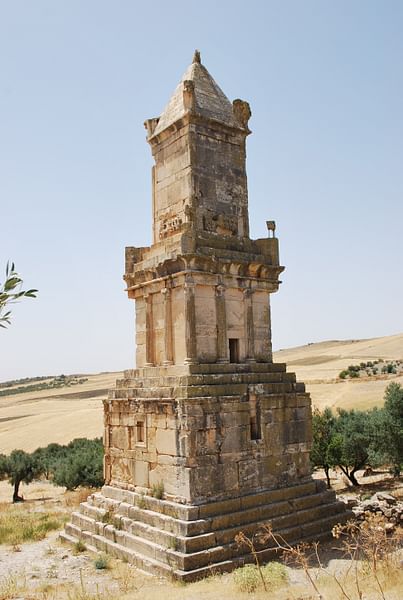
Thugga was first settled in the [Bronze Age](https://www.worldhistory.org/disambiguation/Bronze_Age/) if not before. It first appears in the wider historical record when it was conquered by [Agathocles of Syracuse](https://www.worldhistory.org/Agathocles_of_Syracuse/) in the 4th century BCE. It, then, became an important Numidian town from the reign of Masinissa (r. 238-148 BCE) when Numidia was an ally of nearby [Carthage](https://www.worldhistory.org/carthage/), 130 km to the northeast. A [temple](https://www.worldhistory.org/temple/) was built and dedicated to the Numidian king and also from this period a mausoleum of a Numidian noble survives. It carries inscriptions in both Numidian and Punic, illustrating the close ties between the two cultures. Indeed, Thugga was located almost at the very border, the *fossa regia*, between the Carthaginian and Numidian spheres of influence. The town's prosperity in this period is further attested by finds from tombs of jewellery, glass vessels, and [pottery](https://www.worldhistory.org/pottery/) from as far afield as [Greece](https://www.worldhistory.org/greece/) and [Italy](https://www.worldhistory.org/italy/) which even include wine [amphorae](https://www.worldhistory.org/Amphora/) from [Rhodes](https://www.worldhistory.org/Rhodes/).
### Roman Thugga
When [Rome](https://www.worldhistory.org/Rome/) defeated Carthage an influx of Marian settlers arrived at Thugga (according to some historians but not agreed on by all). Roman influence increased further following the [Battle](https://www.worldhistory.org/disambiguation/battle/) of Thapsus in 46 BCE. Parts of the territory of the town were controlled by the *colonia* of Carthage which led to a complex dual administration still debated by scholars. The indigenous and Numidian residents (*civitas*) were governed by the local *suffetes* (Punic judicial administrators) while the Roman populace (*pagus*) looked to Carthage for their governance. The system was not simplified until [Roman emperor](https://www.worldhistory.org/Roman_Emperor/) [Septimius Severus](https://www.worldhistory.org/Septimius_Severus/) unified the administration and made Thugga a *municipium* in 205 CE. Then in 261 CE Thugga became a *colonia* in its own right. From the 3rd century CE, Thugga sent bishops to councils held at Carthage but the town conspicuously lacks the large Christian buildings seen in other towns of the region.
In the [Byzantine](https://www.worldhistory.org/disambiguation/Byzantine/) period, the town was fortified around the forum and a small fort constructed. Although never wholly abandoned, such was the diminished status of the town from Late Antiquity that there was never a necessity to reuse the building materials of the towns more ancient monuments. As a consequence, they have survived remarkably well and have earned the site UNESCO World Heritage status.
[  Numidian Mausoleum of Thugga carinemahy (Copyright) ](https://www.worldhistory.org/image/218/numidian-mausoleum-of-thugga/ "Numidian Mausoleum of Thugga")### Archaeological Remains
Thugga has substantial remains which include the mid-2nd century BCE three-storied Numidian-Punic mausoleum monument with its bilingual inscription. Historians continue to debate whether the name of Atban mentioned in the partial inscription refers to the mausoleum's architect or occupant. The inscription also names various skilled workers suggesting the [city](https://www.worldhistory.org/city/) was prosperous enough to support such professionals. The tower-like monument is an eclectic mix of architectural styles with Ionic columns, Aeolic capitals, and [Egyptian](https://www.worldhistory.org/disambiguation/Egyptian/) mouldings all topped with a [pyramid](https://www.worldhistory.org/pyramid/)-shaped roof.
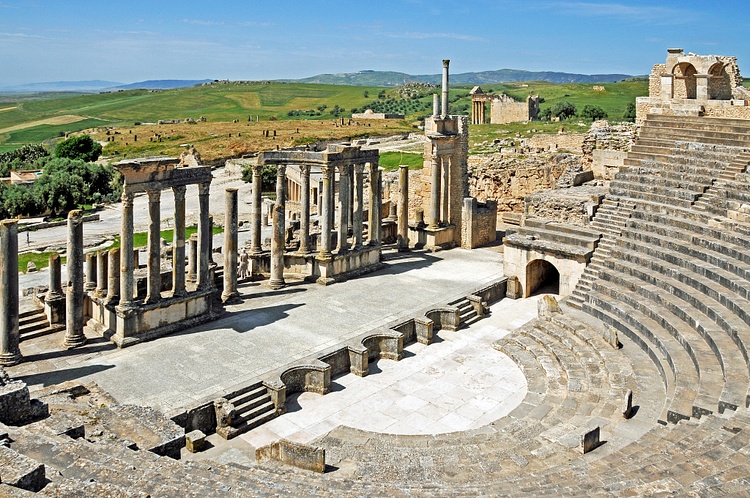
There are three Roman temples: the Capitolium temple was built c. 166 CE and dissected the forum; the temple dedicated to Caelestis, a local epithet of [Juno](https://www.worldhistory.org/Juno/) and linked to Tanit (222-235 CE); and the temple of [Saturn](https://www.worldhistory.org/Saturn/)-[Baal](https://www.worldhistory.org/baal/) (195 CE). The theatre of Thugga was constructed c. 168 CE and was set into the hillside on the east side of the town. A [triumphal arch](https://www.worldhistory.org/Triumphal_Arch/) built during the reign of Septimius Severus in 228 CE also survives. There are remains of two [Roman baths](https://www.worldhistory.org/Roman_Baths/), the principal municipal baths being the Licinian baths which were built incorporating the local topography, like much of the [architecture](https://www.worldhistory.org/disambiguation/architecture/) at Thugga.
[  Roman Theatre, Thugga Dennis Jarvis (CC BY-SA) ](https://www.worldhistory.org/image/5143/roman-theatre-thugga/ "Roman Theatre, Thugga")Finally, there are private villas and housing, many of which have well-preserved mosaic flooring, and the Byzantine fort built on the site of the [Roman forum](https://www.worldhistory.org/Roman_Forum/). Portions of the city's fortifications built to ward off the [Vandal](https://www.worldhistory.org/Vandals/) raids also survive. Besides buildings, Thugga provides several large stelae from the late Punic era. The earliest date to the 3rd century BCE and still carry Phoenician motifs such as winged disks while the latest, from the 1st century BCE, display an evolution in the use of the Tanit symbol and so a continuing Punic cultural influence.
#### Editorial Review
This human-authored definition has been reviewed by our editorial team before publication to ensure accuracy, reliability and adherence to academic standards in accordance with our [editorial policy](https://www.worldhistory.org/static/editorial-policy/).
## Bibliography
- Bagnall, R. et al. *The Encyclopedia of Ancient History.* Wiley-Blackwell, 2012
- [Hornblower, S. *The Oxford Classical Dictionary.* Oxford University Press, 2012.](https://www.worldhistory.org/books/0199545561/)
- [Hoyos, D. et al. *A Companion to the Punic Wars.* Wiley-Blackwell, 2015.](https://www.worldhistory.org/books/1119025508/)
- [Miles, R. *Carthage Must Be Destroyed.* Penguin, 2016.](https://www.worldhistory.org/books/B00YDK13S6/)
- [Moscati, S. *The World of the Phoenicians.* Weidenfeld & Nicolson History, 2016.](https://www.worldhistory.org/books/B011SL6MCE/)
## About the Author
Mark is WHE’s Publishing Director and has an MA in Political Philosophy (University of York). He is a full-time researcher, writer, historian and editor. Special interests include art, architecture and discovering the ideas that all civilizations share.
## Timeline
- **c. 250 BCE**: The Numidian mausoleum is built at [Thugga](https://www.worldhistory.org/Dougga/).
- **166 CE**: The Capitolium [temple](https://www.worldhistory.org/temple/) is built at [Thugga](https://www.worldhistory.org/Dougga/).
- **c. 168 CE**: The [Roman](https://www.worldhistory.org/disambiguation/Roman/) [theatre](https://www.worldhistory.org/disambiguation/theatre/) is built at [Thugga](https://www.worldhistory.org/Dougga/).
- **195 CE**: A [temple](https://www.worldhistory.org/temple/) to [Saturn](https://www.worldhistory.org/Saturn/)-[Baal](https://www.worldhistory.org/baal/) is built at [Thugga](https://www.worldhistory.org/Dougga/).
- **205 CE**: [Thugga](https://www.worldhistory.org/Dougga/) is made a [Roman](https://www.worldhistory.org/disambiguation/Roman/) municipium.
- **222 CE - 235 CE**: A [temple](https://www.worldhistory.org/temple/) dedicated to Caelestis is built at [Thugga](https://www.worldhistory.org/Dougga/).
- **228 CE**: A [triumphal arch](https://www.worldhistory.org/Triumphal_Arch/) is built at [Thugga](https://www.worldhistory.org/Dougga/) and dedicated to [Septimius Severus](https://www.worldhistory.org/Septimius_Severus/).
- **261 CE**: [Thugga](https://www.worldhistory.org/Dougga/) is made a [Roman](https://www.worldhistory.org/disambiguation/Roman/) colonia.
## Cite This Work
### APA
Cartwright, M. (2016, May 20). Thugga. *World History Encyclopedia*.
### Chicago
Cartwright, Mark. "Thugga." *World History Encyclopedia*, May 20, 2016. .
### MLA
Cartwright, Mark. "Thugga." *World History Encyclopedia*, 20 May 2016, .
## License & Copyright
Submitted by [Mark Cartwright](https://www.worldhistory.org/user/markzcartwright/ "User Page: Mark Cartwright"), published on 20 May 2016. The copyright holder has published this content under the following license: [Creative Commons Attribution-NonCommercial-ShareAlike](https://creativecommons.org/licenses/by-nc-sa/4.0/deed.en). This license lets others remix, tweak, and build upon this content non-commercially, as long as they credit the author and license their new creations under the identical terms. When republishing on the web a hyperlink back to the original content source URL must be included. Please note that content linked from this page may have different licensing terms.