---
title: Dionysos
author: Mark Cartwright
source: https://www.worldhistory.org/Dionysos/
format: machine-readable-alternate
license: Creative Commons Attribution-NonCommercial-ShareAlike (https://creativecommons.org/licenses/by-nc-sa/4.0/)
updated: 2023-03-29
---
# Dionysos
_Authored by [Mark Cartwright](https://www.worldhistory.org/user/markzcartwright/)_
Dionysos ([Roman](https://www.worldhistory.org/disambiguation/Roman/) name: [Bacchus](https://www.worldhistory.org/Bacchus/), also known as Dionysus) was the ancient [Greek](https://www.worldhistory.org/disambiguation/greek/) [god](https://www.worldhistory.org/God/) of wine, merriment, and [theatre](https://www.worldhistory.org/disambiguation/theatre/). Being the bad boy of Mt. Olympus, Dionysus was perhaps the most colourful of the Olympian Gods.
### Son of [Zeus](https://www.worldhistory.org/zeus/)
In [Greek mythology](https://www.worldhistory.org/Greek_Mythology/), despite being the son of Zeus and Semele (the daughter of Kadmos and Harmonia), Dionysos did not receive the best start in life when his mother died while still pregnant. [Hera](https://www.worldhistory.org/Hera/), wife of Zeus, was jealous of her husband's illicit affair and craftily persuaded Semele to ask Zeus to reveal himself to her in all his godly splendour. This was too much for the mortal and she immediately expired; however, Zeus took the unborn child and reared him in his thigh. Most accounts then attribute the satyrs and nymphs as the carers of Dionysos in his childhood and the wise [Silenus](https://www.worldhistory.org/Silenus/) as his chief educator on Mt. Nysa, far from Hera's wrath.
Homer describes the god as the 'joy of men', and Hesiod likewise describes him as 'much-cheering'. This is no doubt because Dionysos is credited with giving man the gift of wine. The god gave Ikarios, a noble citizen of Ikaria in Attica, the vine tree. From this, Ikarios made wine which he shared with a group of passing shepherds. However, unaware of the stupefying effects of wine, the shepherds thought they had been poisoned and so swiftly took revenge and killed the unfortunate Ikarios. Notwithstanding this inauspicious start to the wine industry, wine became an extremely popular drink in antiquity. The Greeks usually drank wine diluted with water (one part wine to three parts water), mixed in a large krater vessel. Wine was drunk at banquets, festivals, and private parties, in particular, at a *[symposium](https://www.worldhistory.org/Symposium/)*, a kind of informal, male-only drinking session where guests reclined on a couch (*kline*) and engaged in conversation on topics ranging from gossip to [philosophy](https://www.worldhistory.org/philosophy/).
### Dionysos & [Greek Theatre](https://www.worldhistory.org/Greek_Theatre/)
In Greek [mythology](https://www.worldhistory.org/mythology/), Dionysos travelled widely, even as far as [India](https://www.worldhistory.org/india/), and spread his cult throughout [Greece](https://www.worldhistory.org/greece/), indeed he was known as being of an eastern origin himself. Orgiastic rituals were held in his honour, where the participants were taken over by a Dionysian frenzy of dancing and merriment to such a degree that they transcended themselves. It is believed that theatre sprang from this activity as, like Dionysos' worshippers, actors strive to leave behind their own persona and become one with the character they are playing. Indeed, priests of Dionysos were given seats of honour in Greek theatres.
[ ![Dionysos Mosaic [Detail]](https://www.worldhistory.org/img/r/p/750x750/884.jpg?v=1746856867) Dionysos Mosaic \[Detail\] Mark Cartwright (CC BY-NC-SA) ](https://www.worldhistory.org/image/884/dionysos-mosaic-detail/ "Dionysos Mosaic [Detail]")### Dionysos & King [Midas](https://www.worldhistory.org/midas/)
Dionysos was a protagonist in several other Greek myths. When King Midas of [Phrygia](https://www.worldhistory.org/phrygia/) found the god's chief follower and drinking partner Silenus rather worse for wear in his garden following a drinking bout, the king gave him nourishment and returned him to Dionysos. In gratitude, the god granted Midas a wish. The king requested that everything he touched would turn to [gold](https://www.worldhistory.org/gold/) but alas this included food and water, so the king almost died of starvation and thirst until Dionysos reversed the gift by telling Midas to wash in the Pactolus river.
### Dionysus is Abducted by Pirates
Another myth tells of Dionysos' abduction by pirates who were unaware of his identity. The god transformed the ship's mast into a huge vine, the sails dripped with wine, and a heavenly choir filled the air with [music](https://www.worldhistory.org/disambiguation/Music/). Dionysos transformed himself into a lion and, assisted by a bear, he dispatched the pirate captain. In terror, the remaining crew members leapt overboard and were changed into dolphins. Only the helmsman survived the encounter as he had counselled his crewmates against abducting the stranger in the first place, and the boat sailed on to [Naxos](https://www.worldhistory.org/Naxos/) where the god remained for a while, falling in love with and marrying [Ariadne](https://www.worldhistory.org/Ariadne/) when [Theseus](https://www.worldhistory.org/Theseus/) stopped off on his return from killing the [Minotaur](https://www.worldhistory.org/Minotaur/). When Ariadne died, in her memory Dionysos made her wedding diadem into the Corona constellation.
Other myths include Dionysos persuading [Hephaistos](https://www.worldhistory.org/Hephaistos/) (probably with wine) to return to Mt. Olympus and release Hera who had been trapped by the god of metallurgy in an ingenious throne. Hera in her gratitude ensured that Dionysos, actually only a demigod, became a full Olympian god with permission to reside on Mt. Olympus for all time. [Lycurgus](https://www.worldhistory.org/Lycurgus/), King of Thrace, and Pentheus, King of [Thebes](https://www.worldhistory.org/disambiguation/Thebes/), both suffered Dionysos' wrath when they prudishly tried to stop the excesses of the god's festivals. The former was driven mad and the latter was ripped to pieces by a maddened group of female worshippers after he had disguised himself as a woman to spy on their debauchery.
[ 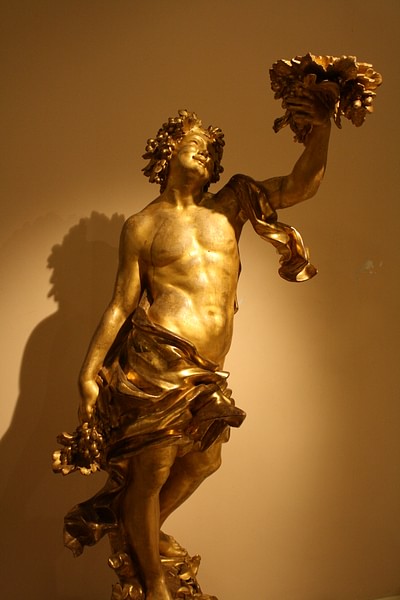 Gold Bacchus Statue Mark Cartwright (CC BY-NC-SA) ](https://www.worldhistory.org/image/719/gold-bacchus-statue/ "Gold Bacchus Statue")### The Worship of Dionysos
The cult of Dionysos became a significant part of the [Greek religion](https://www.worldhistory.org/Greek_Religion/) in [Athens](https://www.worldhistory.org/Athens/) from the 6th century BCE and the Dionysia festival of Athens and other [cities](https://www.worldhistory.org/city/) would later evolve into the Bacchanalia of [Rome](https://www.worldhistory.org/Rome/). The island of Naxos was a particularly important sanctuary to the god. There is evidence of a cult to Dionysos dating from the [Mycenaean period](https://www.worldhistory.org/Mycenaean_Civilization/) (14th century BCE) and the site continued to be important right into the Roman period. There was also a sanctuary and theatre of Dionysos at Athens and a [temple](https://www.worldhistory.org/temple/) to the god at Dion (2nd century CE) which also had [Mycenaean](https://www.worldhistory.org/Mycenaean_Civilization/) origins.
### How is Dionysos Represented in Art?
In [Archaic](https://www.worldhistory.org/disambiguation/Archaic/) and Classical Greek art, Dionysos is a popular subject and is often depicted with his *thiasos* or troupe of satyrs (half-men, half-goat) and nymphs, who from the late 6th century BCE were replaced by maenads, daemonic creatures, who when overtaken by Dionysian frenzy, hunted the forests for victims and ate their raw flesh. The god is usually bearded in 4th- and 5th-century BCE depictions and later on more often beardless. He is often identified through his association with the vine, *thyrsos* - a sacred rod topped with ivy and vine leaves and sometimes a pinecone, a *kantharos* - drinking vessel for wine - or a drinking-horn, and on occasion, he wears a wreath of ivy or the pelt of a panther. He often cuts a rather effeminate figure and is sometimes shown riding an ithyphallic mule or in a languid, reclining pose such as the celebrated [sculpture](https://www.worldhistory.org/disambiguation/Sculpture/) on the east pediment of the [Parthenon](https://www.worldhistory.org/parthenon/) (447-432 BCE). Another famous representation is as an infant in the arms of the [Hermes](https://www.worldhistory.org/Hermes/) of Praxiteles (ca 330 BCE). Coins from Naxos and Mende depicted the god from the 6th to 4th century BCE, and in the 5th century BCE, he appeared on the coins of [Crete](https://www.worldhistory.org/crete/), Thebes, and Thasos. Dionysos also plays a central role in [Euripides](https://www.worldhistory.org/Euripides/)' [Greek tragedy](https://www.worldhistory.org/Greek_Tragedy/), *The [Bacchae](https://www.worldhistory.org/Bacchae/)*, which is set in Thebes.
#### Editorial Review
This human-authored definition has been reviewed by our editorial team before publication to ensure accuracy, reliability and adherence to academic standards in accordance with our [editorial policy](https://www.worldhistory.org/static/editorial-policy/).
## Bibliography
- Ananiades D. *Ancient Greece Temples And Sanctuaries.* Toubis, Athens, 2010
- Carabatea M. *Greek Mythology.* Pergamos, Peania, 2007
- Carpenter T.H. *Art and Myth in Ancient Greece.* Thames & Hudson, London, 2012
- Eric H. Cline. *The Oxford Handbook of the Bronze Age Aegean.* Oxford University Press, USA, 2010
## About the Author
Mark is WHE’s Publishing Director and has an MA in Political Philosophy (University of York). He is a full-time researcher, writer, historian and editor. Special interests include art, architecture and discovering the ideas that all civilizations share.
## Timeline
- **c. 1350 BCE**: First evidence of a cult to [Dionysos](https://www.worldhistory.org/Dionysos/) in [Mycenaean](https://www.worldhistory.org/Mycenaean_Civilization/) [culture](https://www.worldhistory.org/disambiguation/culture/).
- **700 BCE - 600 BCE**: Temples are built in honour of [Apollo](https://www.worldhistory.org/apollo/), [Demeter](https://www.worldhistory.org/demeter/) and [Dionysos](https://www.worldhistory.org/Dionysos/) on the island of [Naxos](https://www.worldhistory.org/Naxos/).
- **600 BCE - 550 BCE**: The Dionysia becomes a major Athenian festival in honour of [Dionysos](https://www.worldhistory.org/Dionysos/).
- **600 BCE - 300 BCE**: [Dionysos](https://www.worldhistory.org/Dionysos/) appears on the coins of [Naxos](https://www.worldhistory.org/Naxos/), Mende and various other [Greek](https://www.worldhistory.org/disambiguation/greek/) [city](https://www.worldhistory.org/city/) states.
- **447 BCE - 432 BCE**: The east pediment of the [Parthenon](https://www.worldhistory.org/parthenon/) includes a reclining statue of [Dionysos](https://www.worldhistory.org/Dionysos/).
- **c. 405 BCE**: [Euripides](https://www.worldhistory.org/Euripides/) in The Bacchai has [Dionysos](https://www.worldhistory.org/Dionysos/) tell us how the [tympanon](https://www.worldhistory.org/Tympanon/) was invented by him and his Mother Goddess, [Rhea](https://www.worldhistory.org/Rhea/).
- **c. 330 BCE**: [Dionysos](https://www.worldhistory.org/Dionysos/) is represented as an infant in the arm of the [Hermes](https://www.worldhistory.org/Hermes/) of Praxiteles statue.
- **c. 150 CE - c. 200 CE**: A small [temple](https://www.worldhistory.org/temple/) dedicated to [Dionysos](https://www.worldhistory.org/Dionysos/) is built at Dion.
- **c. 400 CE**: Nonnus writes the Dionysiaca, which tells the life of [Dionysos](https://www.worldhistory.org/Dionysos/). At 48 books and 20,426 lines it is the longest surviving poem from Greco-[Roman](https://www.worldhistory.org/disambiguation/Roman/) antiquity.
## Questions & Answers
### What is Dionysus best known for?
Dionysus is best known for being the Greek god of wine.
### What is the connection between Dionysos and Greek theatre?
Dionysos was perhaps the origin of Greek theatre since his worshippers were taken over by a Dionysian frenzy of dancing and merriment to such a degree that they transcended themselves just as actors do playing a role. Priests of Dionysos were given seats of honour in Greek theatres
## Cite This Work
### APA
Cartwright, M. (2012, September 16). Dionysos. *World History Encyclopedia*.
### Chicago
Cartwright, Mark. "Dionysos." *World History Encyclopedia*, September 16, 2012. .
### MLA
Cartwright, Mark. "Dionysos." *World History Encyclopedia*, 16 Sep 2012, .
## License & Copyright
Submitted by [Mark Cartwright](https://www.worldhistory.org/user/markzcartwright/ "User Page: Mark Cartwright"), published on 16 September 2012. The copyright holder has published this content under the following license: [Creative Commons Attribution-NonCommercial-ShareAlike](https://creativecommons.org/licenses/by-nc-sa/4.0/deed.en). This license lets others remix, tweak, and build upon this content non-commercially, as long as they credit the author and license their new creations under the identical terms. When republishing on the web a hyperlink back to the original content source URL must be included. Please note that content linked from this page may have different licensing terms.