---
title: Dhammapada
author: Dhruba RC
source: https://www.worldhistory.org/Dhammapada/
format: machine-readable-alternate
license: Creative Commons Attribution-NonCommercial-ShareAlike (https://creativecommons.org/licenses/by-nc-sa/4.0/)
updated: 1970-01-01
---
# Dhammapada
_Authored by [Dhruba RC](https://www.worldhistory.org/user/dhrubaraic/)_
*Tipitaka* (Sansktrit: *Tripitaka*), the [Buddhist](https://www.worldhistory.org/buddhism/) canon, consists of three *pitaka* (*Tri* means three and *Pitaka* refers to boxes), namely *Vinaya* or Monastic regimen, *Sutta* ([Sanskrit](https://www.worldhistory.org/Sanskrit/): *[Sutra](https://www.worldhistory.org/Sutra/)*) or Discourses and *Abhidhamma* (Sanskrit: *Abhidharma*) or Abstract doctrine. *Dhammapada* (Sanskrit: *Dharmapada*) belongs to *Khuddaka nikaya* (Minor collection), which itself is a part of the *Sutta pitaka*. The name is a combination of two words *Dharma* and *Pada*. *Dharma* can be roughly translated into religious virtue and *Pada* into stanzas or steps.
### Teachings of [Buddha](https://www.worldhistory.org/Siddhartha_Gautama/)
*Dhammapada* is a collection of 423 verses as uttered by Gautama Buddha himself to his disciples. An anthology of moral precepts and maxims, it is divided into 26 chapters under such headers as *Thought, Flowers, Old Age, Self, Happiness, Pleasure, Anger, Thirst, Brahmana* and others. Though seemingly separated across so many chapters a fundamental thread runs through all the verses, which becomes perceptible on reading the text.
The teachings of Buddha focus on the way, the *magga* (Sankskrit: *marga*) or path, that delivers a person from a life that is inescapably connected with desires, infatuation, sorrows, hate and an endless cycle of Becoming. “He whose appetites are stilled, who is not absorbed in enjoyment, who has perceived void and unconditioned freedom (Nirvâna),” continues Buddha, “his path is difficult to understand, like that of birds in the air” (No 93, Chapter VII). There is *nirvana* (*moksha* for [Hindu](https://www.worldhistory.org/hinduism/), *fana* for Sufi mystic), here and now, not in a supposed afterlife.
As because the ills that trouble of our lives stem from *avidya* (ignorance), all efforts of Buddhist doctrine are therefore directed to illumine that darkness, to carry us towards the highest summit of wisdom, unmoving, un-originated, uncontaminated. Verily he says, “Him I call indeed a Brâhmana who has traversed this miry road; the impassable world and its vanity, who has gone through, and reached the other shore, is thoughtful, guileless, free from doubts, free from attachment, and content” (No 414, Chapter XXVI).
The verses continue to enjoy such superlative popularity among people, both followers of the way and others, because they present axioms in a very plain language, easily accessible and relatable to all irrespective of “aristocracy of birth and intellect” (Coomaraswamy 1967, 249). In fact, to further ease the process of understanding, Buddhaghosa included a parable for nearly every verse, possibly uttered by Buddha, in his monumental work of *Atthakatha*.
The word 'Brahmana' in the preceding passage should not be confused with its homonymic counterpart, which denotes a caste. Its etymological meaning, i.e. a person who has realised [Brahma](https://www.worldhistory.org/Brahma/), should be remembered to understand the whole of the last chapter of this book. The following verse from the same chapter should make it clear: “A man does not become a Brahmana by his platted hair, by his family or by birth; in whom there is truth and righteousness, he is blessed, he is a Brahmana” (No 393, Chapter XXVI).
Also, *nirvana* should not be considered equivalent to an ethical state just because the means to it are ethical, even if partly. The numerous exhortations of Gautama Buddha in *Dhammapada* if not properly considered may lead to this erroneous conclusion. In one of the verses, he succinctly reveals the nature of this unfettered bliss, “Him I call indeed a Brahmana who in this world is above good and evil, above the bondage of both, free from grief, from sin, and from impurity” (No 412, Chapter XXVI).
### Translations
There is a general disagreement as to when it was reduced to a written format in Pali language. It can, however, be dated back to at least the 1st century BCE. While [writing](https://www.worldhistory.org/writing/) his commentary on Dhammapada, Buddhaghosa (a Buddhist scholar from 5th century CE) asserted that the Pali text before him was consolidated in the First Council itself held after Parinirvana of Buddha. His commentary known as Atthakatha (Sanskrit: Arthakatha) was written in Anuradhapura, Sri Lanka. While any debate in assigning a date to this manuscript may hold archaeological interest, the teachings of this sacred collection of verses are definitely independent of both time and creed.
[ 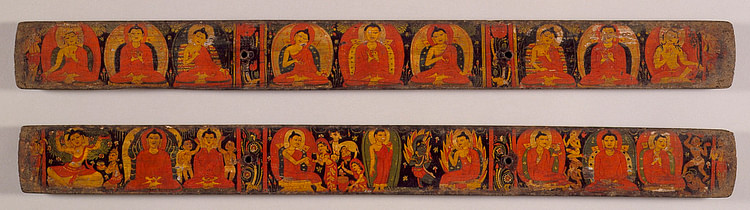 Illustrated Buddhist Manuscript Cover Ashley Van Haeften (CC BY) ](https://www.worldhistory.org/image/5002/illustrated-buddhist-manuscript-cover/ "Illustrated Buddhist Manuscript Cover")Translations of this book in various Asian languages are in existence from at least early 3rd century CE when it was translated to Chinese as *Shamana* (Sanskrit: *Shramana*) by Wei Chi Lan and other Buddhist ascetics. Many such extant copies in vernacular languages abound in South, South-east Asian countries, not to mention Tibet.
First Latin translation by Dr Fausböll appeared in 1855, subsequent to which other prominent editions were published by D J Gogerly, Max Müller etc. While it is nevertheless difficult to convey exactly the beauty and affection of the original stanzas in translation, all such initiatives have only contributed to make *Dhammapada* widely available among curious readers and scholars alike. In conclusion, nothing could be more apt than recalling the words of Gautama Buddha to his disciple Ananda, “… be ye lamps unto yourselves. Be ye a refuge to yourselves. Betake yourselves to no external refuge. Hold fast to the truth as a lamp. Hold fast as a refuge to the truth. Look not for refuge beside yourselves…” (Rhys Davids, Vol II, 108).
#### Editorial Review
This human-authored definition has been reviewed by our editorial team before publication to ensure accuracy, reliability and adherence to academic standards in accordance with our [editorial policy](https://www.worldhistory.org/static/editorial-policy/).
## Bibliography
- Basu, C.C. *Dhammapada.* Printed by J. N. Bose, Calcutta, 1905
- [Coomaraswamy, A.K. *Hinduism and Buddhism.* Philosophical Library, 2007.](https://www.worldhistory.org/books/0806530138/)
- [Coomaraswamy, A.K. *Myths of the Hindus and Buddhists (Dover Books on Anthropology & Ethnology).* Dover Publications, 1967.](https://www.worldhistory.org/books/0486217590/)
- [Muller, M. *The Dhammapada and the Sutta Nipata.* Eremitical Press, 2011.](https://www.worldhistory.org/books/192677728X/)
- [Rhys Davids, T.W. *Dialogues of the Buddha Vol. I, II, III.* Motilal Banarsidass,India, 2007.](https://www.worldhistory.org/books/8120816684/)
## Timeline
- **c. 200 CE**: [Dhammapada](https://www.worldhistory.org/Dhammapada/) is translated to Chinese and other Asian languages.
- **c. 450 CE**: [Buddhist](https://www.worldhistory.org/buddhism/) scholar Buddhaghosa writes his commentary on [Dhammapada](https://www.worldhistory.org/Dhammapada/).
- **1855 CE**: First Latin translation of the [Dhammapada](https://www.worldhistory.org/Dhammapada/).
## Cite This Work
### APA
RC, D. (2016, May 02). Dhammapada. *World History Encyclopedia*.
### Chicago
RC, Dhruba. "Dhammapada." *World History Encyclopedia*, May 02, 2016. .
### MLA
RC, Dhruba. "Dhammapada." *World History Encyclopedia*, 02 May 2016, .
## License & Copyright
Submitted by [Dhruba RC](https://www.worldhistory.org/user/dhrubaraic/ "User Page: Dhruba RC"), published on 02 May 2016. The copyright holder has published this content under the following license: [Creative Commons Attribution-NonCommercial-ShareAlike](https://creativecommons.org/licenses/by-nc-sa/4.0/deed.en). This license lets others remix, tweak, and build upon this content non-commercially, as long as they credit the author and license their new creations under the identical terms. When republishing on the web a hyperlink back to the original content source URL must be included. Please note that content linked from this page may have different licensing terms.