---
title: Derbent
author: James Blake Wiener
source: https://www.worldhistory.org/Derbent/
format: machine-readable-alternate
license: Creative Commons Attribution-NonCommercial-ShareAlike (https://creativecommons.org/licenses/by-nc-sa/4.0/)
updated: 2023-02-03
---
# Derbent
_Authored by [James Blake Wiener](https://www.worldhistory.org/user/jbw288/)_
Derbent (sometimes "Derbend" or "Darbend") is an ancient [city](https://www.worldhistory.org/city/) located along the Caspian Sea in what is present-day Russia. Although the area in and around Derbent has been continuously inhabited since at least the 8th century BCE, Shah Yazdegerd II (r. 438-457 CE) of the Persian [Sasanian Empire](https://www.worldhistory.org/Sasanian_Empire/) founded Derbent in 438 CE as a fortress city to curb raids from nomadic peoples into the Caucasus from Central Asia. Derbent can claim to be the oldest occupied city in Russia, and it is the southernmost Russian city, lying only 50 km (31 miles) from the border with Azerbaijan. Derbent is renown for its citadel (“Naryn-Kala” or “Dagh Bary” in Persian) and its imposing walls that date from the 6th century CE. Derbent prospered for over 1,500 years under Persian, Arab, Turkish, Azeri, [Mongol](https://www.worldhistory.org/Mongol_Empire/), Timurid, and Russian rule due to its position on the [Silk Road](https://www.worldhistory.org/Silk_Road/) and geostrategic importance as the gateway to the Caucasus. UNESCO declared Derbent's citadel, ancient city, and defensive walls to be a UNESCO World Heritage Site in 2003 CE.
### Geography
The city of Derbent is located in southern Russia in what is present-day Dagestan. The Dagestani capital, Makhachkala, is located 127.5 km (79 miles) to Derbent's northwest. Derbent is situated quite close to the head of the Samur River, the Rubas River, and the Sukhodol River within the Caucasus Mountain range. Blessed with a warm climate, Derbent is concurrently Russia's oldest and southernmost city, and it abords the Caspian Sea. Derbent's success as a city and importance in history is rooted in its special geographic location.
The Caucasus Mountains near Derbent are less 3 km (1.8 miles) from the shores of the Caspian Sea, meaning that the mountains almost extend directly to the seashore. Derbent thus was an essential area in the management of the flow of peoples moving to and from the Caucasus. Throughout its ancient and medieval history, Derbent was only one of two crossings through the Caucasus mountain range, and the city attracted the attention of foreign merchants traversing the famed [Silk](https://www.worldhistory.org/Silk/) Road as well as the notice of great military powers. In Persian, Derbent is formed from the compound of “dar,” meaning “gate,” and “band,” meaning “knot” or “barrier.”
### Early history
People have long recognized the strategic importance of the area in and around Derbent. It was the [Greek](https://www.worldhistory.org/disambiguation/greek/) historian [Herodotus](https://www.worldhistory.org/herodotus/) who first mentioned Derbent's unusual geographical features in his writings about [Scythian](https://www.worldhistory.org/Scythians/) activities in the [Near East](https://www.worldhistory.org/Near_East/); however, archaeologists working in the 1970s CE have shown that the hilltop on which Derbent's citadel now rests has been settled since the 8th century BCE. An even older fortress once existed here, and it was likely built by ancient peoples to withstand incursions from the [Scythians](https://www.worldhistory.org/Scythians/). Curiously, [Alexander the Great](https://www.worldhistory.org/Alexander_the_Great/), has been traditionally associated with Derbent and its fortress; he is said to have ordered the construction to defend his newly conquered lands in the south from the barbarians to the north, but there is no substance to this legend.
A small town grew up around this ancient fortress in the 4th century BCE, and it is probable that the [Roman](https://www.worldhistory.org/disambiguation/Roman/) general [Pompey](https://www.worldhistory.org/pompey/) mentions this same town and fortress in the accounts of his c. 65 BCE campaign to the Caucasus. This ancient fortress, during the 1st and 2nd centuries CE, was under the control of the Caucasian Kingdom of Albania, which acted as a buffer state between the Romans and the Persians. The Persian [Sasanian](https://www.worldhistory.org/Sasanian_Empire/) [Empire](https://www.worldhistory.org/empire/) annexed the Caucasian Kingdom of Albania c. 252-253 CE, rendering it little more than a vassal. It should be noted that the Caucasian Kingdom of Albania had also acted as a vassal state to the [Roman Empire](https://www.worldhistory.org/Roman_Empire/) on several occasions as well.
[ 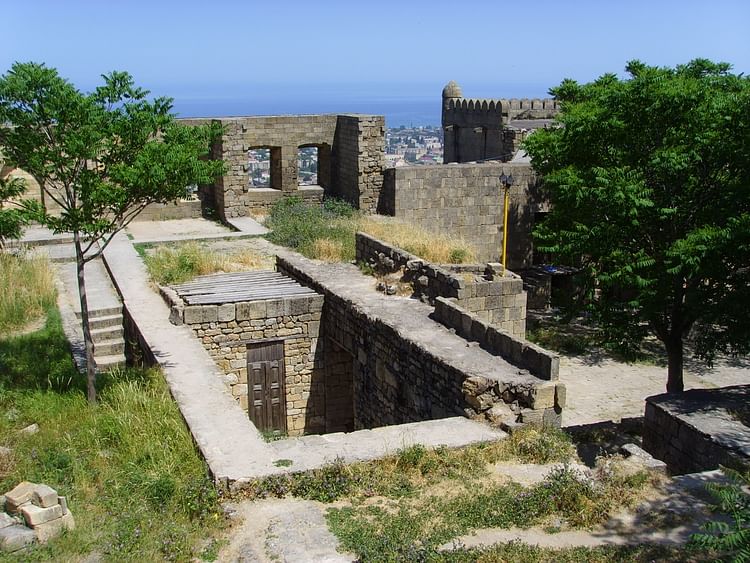 Derbent Citadel allie (CC BY-NC-SA) ](https://www.worldhistory.org/image/9290/derbent-citadel/ "Derbent Citadel")Following the construction of Derbent's fortified walls by Shah Yazdegerd II (r. 438-457 CE), Derbent withstood numerous attacks over the next 300 years by the [White Huns](https://www.worldhistory.org/White_Huns_(Hephthalites)/), Khazars, and other nomadic tribes that threatened the Persian heartlands. Construction of the current citadel, fortified walls, and city walls began c. 570 CE at the request of [Kosrau I](https://www.worldhistory.org/Kosrau_I/) (531-579 CE) who is widely remembered by Persians today as one of their greatest rulers. The Khazars - allied to the [Byzantine Empire](https://www.worldhistory.org/Byzantine_Empire/) under Emperor [Heraclius](https://www.worldhistory.org/Heraclius/) (r. 610-641 CE) during the Third Perso-Turkic [War](https://www.worldhistory.org/disambiguation/War/) (627-629 CE) - attacked and seized Derbent in 627 CE. Although a devastating description of the siege and Derbent's fall is imparted by the 10th-century CE Armenian historian Movses Kaghankatvatsi in his *The History of the Country of Albania*, the Khazars soon lost Derbent themselves to the Arabs c. 643 CE.
### Medieval & Early modern Derbent
The Arabs were impressed by Derbent's size and wealth, and they greatly appreciated the citadel and the mighty walls of Derbent. They called the city “Bab al-Abwab” or the “Gate of Gates.” They associated the city with Surah *Al-Kahf* in the *Qu'ran,* which narrates [Alexander](https://www.worldhistory.org/disambiguation/Alexander/) the Great's efforts to construct a gigantic iron gate to keep people from the north out of [Persia](https://www.worldhistory.org/Persia/). Under Arab rule, the city flourished as an entrepôt on the Silk Road, and the Arabs consistently strengthened and reinforced Derbent's walls and citadel during their rule of the city until the late 10th century CE. They also constructed the Juma Mosque, the oldest mosque in Russia, in 734 CE over the remains of an old Christian basilica. The city's population swelled to about 50,000, and the celebrated Abbasid Caliph Harun al-Rashid (r. 786-809 CE) even lived in Derbent for a short duration. Many Jews, Georgians, and Armenians came to settle in Derbent, giving the city a cosmopolitan flavor in the Middle Ages and Early Modern Era.
[ 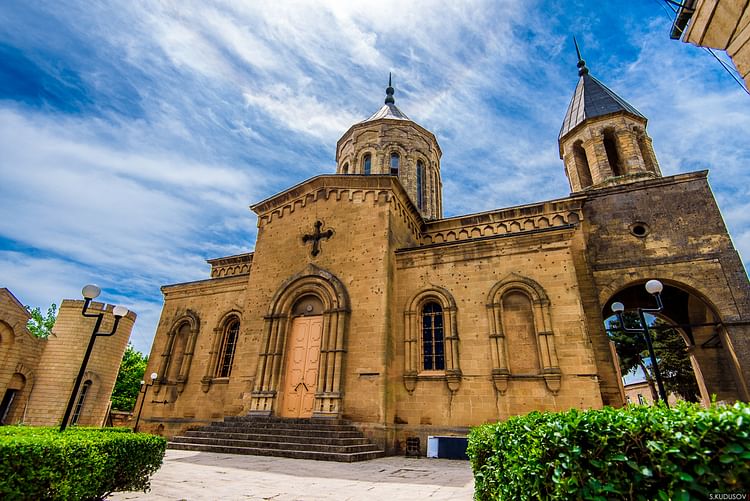 Old Armenian Church at Derbent Сулим Кудусов (CC BY-NC-SA) ](https://www.worldhistory.org/image/9291/old-armenian-church-at-derbent/ "Old Armenian Church at Derbent")Derbent remained relatively prosperous as it changed hands from the Arabs to the Seljuk Turks to the Azeris to the [Mongols](https://www.worldhistory.org/Mongol_Empire/) and Timurids, and back to the Persians over the course of seven centuries. Under Persian Safavid rule (1501-1736 CE), Derbent lay close to the frontier region with the [Ottoman Empire](https://www.worldhistory.org/Ottoman_Empire/) and Russia. Although it was taken once by the Ottoman Turks in 1583 CE following the Persian defeat at the [Battle](https://www.worldhistory.org/disambiguation/battle/) of Torches during the Ottoman–Safavid War (1578-1590 CE), it remained in Persian hands until 1813 CE when the Russians occupied and annexed Derbent and Dagestan. There was, however, a brief period of 12 years in which the Russians occupied Derbent from 1723-1735 CE.
### Derbent's Walls & Citadel
Derbent's ancient city, citadel, [wall](https://www.worldhistory.org/wall/), and other constructions cover an area of around 10 ha, extending additionally outward some 200 ha from there as a buffer zone. Derbent contains two walls that are located approximately 300-400 m apart and extend nearly 4 km (2.5 miles) from the mountain citadel to the Caspian Sea. These walls also extend nearly 500 m (1640 ft) into the Caspian sea itself to protect Derbent's harbor. A total of nine out of the original 14 ancient gates survive. During the wall's construction in the late 6th century CE, the Sasanians employed dry brickwork and made blocks on lime mortar. Originally 73 defense towers were constructed, and 46 of those were located in a portion of Derbent's northern wall. An impressive mountain wall acted as a line of defense, spreading over a remarkable 40 km (25 miles) in a westward direction away from Derbent and through the Caucasus Mountains.
[ 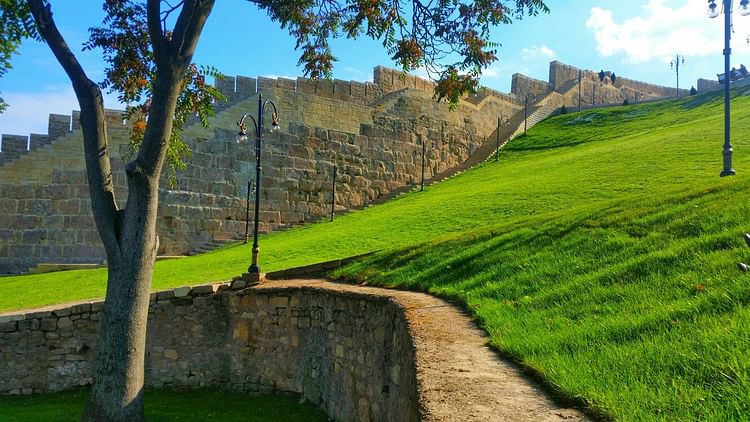 Walls at Derbent Шамиль Магомедов (CC BY-SA) ](https://www.worldhistory.org/image/9289/walls-at-derbent/ "Walls at Derbent")The citadel of Derbent is located upon a lofty enclosure of three slopes, and it is protected by enormous walls, which are 2.5-3.2 m (8.2-10.5 ft) thick, 10-15 m (33-49 ft) in height, and 700 m (2297 ft) in length. The citadel contains a number of important archaeological remains, ancient and medieval structures, and even an Islamic bathhouse. Derbent's commercial districts lie close to the waterfront and thus between the parallel defense walls. Sadly, one of the southern walls was destroyed in the late 19th century CE. The modern city center grew near the seafront, and it expanded rapidly in the 20th century CE. Derbent's old district contains mosques, elegant old homes, and the ruins of a medieval caravanserai.
#### Editorial Review
This human-authored definition has been reviewed by our editorial team before publication to ensure accuracy, reliability and adherence to academic standards in accordance with our [editorial policy](https://www.worldhistory.org/static/editorial-policy/).
## Bibliography
- ["Derbent as Russia’s Oldest City? Think Again, Moscow Says" -- New York Times](https://www.nytimes.com/2016/02/18/world/europe/derbent-as-russias-oldest-city-think-again-moscow-says.html ""Derbent as Russia’s Oldest City? Think Again, Moscow Says" -- New York Times"), accessed 19 Mar 2020.
- ["How has Russia’s oldest mosque stood for 1,300 years?" -- Russia Beyond the Headlines](https://www.rbth.com/arts/327141-russias-oldest-mosque ""How has Russia’s oldest mosque stood for 1,300 years?" -- Russia Beyond the Headlines"), accessed 19 Mar 2020.
- ["Russia’s oldest city: 5,000 and counting" -- RT](https://www.rt.com/news/derbent-russian-olders-city-861/ ""Russia’s oldest city: 5,000 and counting" -- RT"), accessed 19 Mar 2020.
- [Andreeva, E. *Russia and Iran in the Great Game.* Routledge, 2007.](https://www.worldhistory.org/books/0415781531/)
- Bonner, M. "Al-KhalÄ«fa Al-Mará¸Ä«: The Accession of HÄrÅ«n Al-RashÄ«d." *Journal of the American Oriental Society*, Vol. 108, No. 1 (Jan. - Mar., 1988), pp. 79-91.
- [Citadel, Ancient City and Fortress Buildings of Derbent -- UNESCO](https://whc.unesco.org/en/list/1070 "Citadel, Ancient City and Fortress Buildings of Derbent -- UNESCO"), accessed 19 Mar 2020.
- Cuneo, P. "LE MURA DI DERBENT: Note sulla topografia e la morfologia urbana di una città-stato del limes islamico nell'area caucasica." *Rivista degli studi orientali*, Vol. 59, Fasc. 1/4 (1985), pp. 57-75.
- [DAGH BARY -- Encyclopaedia Iranica](http://www.iranicaonline.org/articles/dagh-bary "DAGH BARY -- Encyclopaedia Iranica"), accessed 1 Oct 2018.
- [DARBAND -- Encyclopædia Iranica](http://www.iranicaonline.org/articles/darband-i-ancient-city "DARBAND -- Encyclopædia Iranica"), accessed 1 Oct 2018.
- [Dashdondog, B. *The Mongols and the Armenians.* BRILL, 2010.](https://www.worldhistory.org/books/9004186352/)
- [Derbent Silk Roads -- UNESCO](https://en.unesco.org/silkroad/content/derbent "Derbent Silk Roads -- UNESCO"), accessed 19 Mar 2020.
- Gadjiev, M. "On the Construction Date of the Derbend Fortification Complex." *Brill*, Iran & the Caucasus, Vol. 12, No. 1 (2008), pp. 1-15.
- [Mikaberidze, A. *Conflict and Conquest in the Islamic World\[2 volumes\].* ABC-CLIO, 2011.](https://www.worldhistory.org/books/1598843362/)
- Powell, E. A. "The Shah's Great Wall." *Archaeology*, Vol. 61, No. 4 (July/August 2008), pp. 36-41.
- [Çiçek, Kemal, Kuran, Ercüment. *The Great Ottoman-Turkish Civilisation.* University of Michigan, 2000.](https://www.worldhistory.org/books/9004186352/)
## About the Author
James Blake Wiener has a particular interest in cross-cultural exchange and world history. He is a co-founder of World History Encyclopedia and formerly was its Communications Director.
- [Linkedin Profile](https://www.linkedin.com/in/jameswiener)
## Timeline
- **438 CE**: Fortress of [Derbent](https://www.worldhistory.org/Derbent/) is founded by Shah Yazdegerd II.
- **c. 570 CE**: Construction of the current citadel, fortified walls, and [city](https://www.worldhistory.org/city/) walls begins at [Derbent](https://www.worldhistory.org/Derbent/) at the request of Shah [Khosrow I](https://www.worldhistory.org/Kosrau_I/).
- **627 CE**: Khazar attack on [Derbent](https://www.worldhistory.org/Derbent/).
- **c. 643 CE**: [Derbent](https://www.worldhistory.org/Derbent/) in Arab hands.
- **2003 CE**: [Derbent](https://www.worldhistory.org/Derbent/)'s citadel, ancient [city](https://www.worldhistory.org/city/), and defensive walls are declared to be a UNESCO World Heritage Site.
## Cite This Work
### APA
Wiener, J. B. (2018, October 01). Derbent. *World History Encyclopedia*.
### Chicago
Wiener, James Blake. "Derbent." *World History Encyclopedia*, October 01, 2018. .
### MLA
Wiener, James Blake. "Derbent." *World History Encyclopedia*, 01 Oct 2018, .
## License & Copyright
Submitted by [James Blake Wiener](https://www.worldhistory.org/user/jbw288/ "User Page: James Blake Wiener"), published on 01 October 2018. The copyright holder has published this content under the following license: [Creative Commons Attribution-NonCommercial-ShareAlike](https://creativecommons.org/licenses/by-nc-sa/4.0/deed.en). This license lets others remix, tweak, and build upon this content non-commercially, as long as they credit the author and license their new creations under the identical terms. When republishing on the web a hyperlink back to the original content source URL must be included. Please note that content linked from this page may have different licensing terms.