---
title: Demosthenes
author: Mark Cartwright
source: https://www.worldhistory.org/Demosthenes/
format: machine-readable-alternate
license: Creative Commons Attribution-NonCommercial-ShareAlike (https://creativecommons.org/licenses/by-nc-sa/4.0/)
updated: 1970-01-01
---
# Demosthenes
_Authored by [Mark Cartwright](https://www.worldhistory.org/user/markzcartwright/)_
Demosthenes (c. 384 - 322 BCE) was an Athenian statesman who famously stood against Macedonian [king Philip](https://www.worldhistory.org/disambiguation/King_Philip/) II and whose surviving speeches have established him as one of the greatest patriots and powerful orators from ancient [Greece](https://www.worldhistory.org/greece/). He is not to be confused with the 5th century BCE Athenian general of the same name.
### Early Life & Works
Born in c. 384 in [Athens](https://www.worldhistory.org/Athens/), Demosthenes' parents died while he was still only seven years old, and so he then lived under guardianship. Famously, at the age of 18, he prosecuted his guardians for wasting his inheritance, delivered his own speeches in court, and won the case. Studying under Isaeus and working as a speech writer (*logographos*) like his master, his first experience in court was as a prosecutor's assistant. We also know that in 358 BCE he was a grain-buyer (*sitones*). Then, from c. 355 BCE, he came to wider attention when he started to deliver his own speeches in the assembly of Athens.
61 speeches of Demosthenes - both public and private - have survived, along with the rhetorical openings (*prooimia*) for around 50 speeches and 6 letters. Probably, some of that number were speeches given by another orator by the name of Apollodorus but it is, nevertheless, a substantial amount of material. That is, even if, Demosthenes would have given many more speeches than that in his long and illustrious political career. Those that survive show a speaker who could use plain language and lucid argument to devastating effect. He was a master of metaphor but never overused it and, perhaps his greatest and most enduring quality, his work shows an absolute and convincing sincerity.
### Demosthenes Against [Philip II](https://www.worldhistory.org/disambiguation/Philip_II/) of [Macedon](https://www.worldhistory.org/macedon/)
Demosthenes aimed his oratory in the assembly at one particular target – Philip II of Macedon who seemed intent on conquering all of Greece. The four surviving speeches by Demosthenes on this topic are referred to as the *Philippics* and date to 351, 344 and 341 BCE. In them, he proposed that Athens prepare for invasion by forming two armies – one of citizens and another of mercenaries. The former would be put on standby while the latter would directly engage with the Macedonians in the north of Greece. The assembly did not take his advice and preferred, instead, the more passive approach of Demosthenes' great political rival Aeschines. The latter once disparagingly described Demosthenes' as, 'the pirate of politics, who sails on his craft of words over the sea of state' (Kinzl, 425)
Demosthenes went on two embassies to Philip's court c. 347 BCE but did not get on well with the Macedonian king or even with his fellow delegates. Returning to Athens Demosthenes' persistently passionate pleas and stark warnings of the dire consequences of rule under Philip were ignored. In one speech he states the threat to [Athenian democracy](https://www.worldhistory.org/Athenian_Democracy/) in the following terms,
> Do you not see that Philip has titles which are irreconcilable to this? King and tyrant are all enemies of freedom and are the opposite of [law](https://www.worldhistory.org/disambiguation/law/). Will you not be on your guard lest in seeking to change from [war](https://www.worldhistory.org/disambiguation/War/) you find a despot? (3.20)
It was not until his 346 BCE speech *On the Peace* that the [city](https://www.worldhistory.org/city/) took a more aggressive stance against Macedon, following the realisation of the ineffectiveness of the Peace of Philocrates. In 344 BCE Demosthenes was sent to [Argos](https://www.worldhistory.org/argos/) and Messene in the [Peloponnese](https://www.worldhistory.org/Peloponnese/) to dissuade them from forming an alliance with the dangerous and ambitious Philip. In c. 342 BCE war seemed inevitable and Demosthenes was charged with forming a [Hellenic](https://www.worldhistory.org/greece/) league to withstand the Macedonian army. Demosthenes also pushed the Athenians to ask [Persia](https://www.worldhistory.org/Persia/) for assistance and to form an alliance with [Byzantium](https://www.worldhistory.org/Byzantium/).
[ 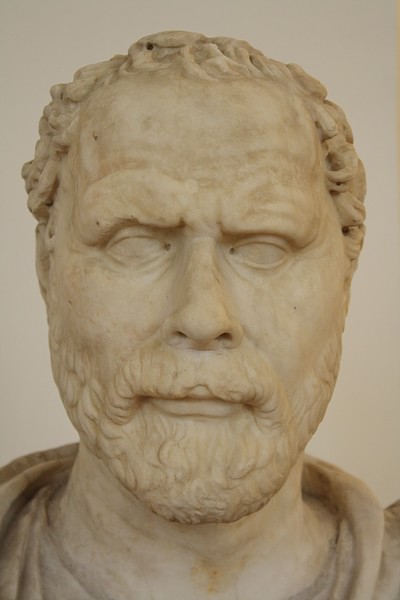 Demosthenes, Palazzo Massimo Mark Cartwright (CC BY-NC-SA) ](https://www.worldhistory.org/image/4432/demosthenes-palazzo-massimo/ "Demosthenes, Palazzo Massimo")These political manoeuvres were all to no avail, though. In 340 BCE Philip declared war. As Demosthenes had already warned, Philip had been allowed to build a state of such power that the Greeks were soundly beaten at the [Battle of Chaeronea](https://www.worldhistory.org/Battle_of_Chaeronea/) in 338 BCE. The Athenians lost their independence and Demosthenes fled the city in fear of reprisals from Philip. However, when time passed without any action from the Macedonian king, Athens invited Demosthenes to give a funeral speech (*epitaphios*) in honour of the fallen at Chaeronea. The speech survives and is the last made by Demosthenes to do so, even if he made several more important speeches during the reign of [Alexander the Great](https://www.worldhistory.org/Alexander_the_Great/).
Demosthenes was far from finished, though. When Philip was assassinated in 336 BCE, Demosthenes was said to have been so delighted with the downfall of his old enemy that he went dancing in the streets of Athens, decked out in his finest clothes and wearing a garland. However, as [Plutarch](https://www.worldhistory.org/plutarch/) points out, this was said of Demosthenes by his number one critic Aeschines. Indeed, the whole city of Athens staged official celebrations but there was to be no respite from the Macedonian threat.
### The Harpalos Affair & Exile
In 324 BCE Demosthenes' political reputation suffered a major blow when he was accused of taking bribes from [Alexander](https://www.worldhistory.org/disambiguation/Alexander/) the Great's treasurer, a man called Harpalos. The great orator had already been subjected to long-standing accusations of accepting bribes from Persia. Put on trial Demosthenes was found guilty and exiled. A year later, though, Demosthenes was pardoned and allowed to return to Athens after he had made clear just whose side he was on when he advised several [Greek](https://www.worldhistory.org/disambiguation/greek/) city-states to take advantage of the [death](https://www.worldhistory.org/disambiguation/Death/) of Alexander and re-establish their autonomy by force. Yet again, though, the Greeks were no match for the Macedonians, and in 322 BCE Demosthenes once again had to flee his defeated city. This time he was not let off and the Macedonians followed him to Calauria (modern-day Poros) where, rather than be captured, Demosthenes committed suicide. According to Plutarch, on hearing news of Demosthenes' death his home city erected a [bronze](https://www.worldhistory.org/disambiguation/bronze/) statue in his honour with the following inscription,
> If only your strength had been equal, Demosthenes, to your wisdom.
> Never would Greece have been ruled by a Macedonian [Ares](https://www.worldhistory.org/Ares/).
### Legacy
Demosthenes may have been reassessed by modern scholars as a little more opportunistic than the traditional picture of him as a confirmed patriot and it is much debated whether the policies of his political opponents might have better served his city in the end but, certainly, his reputation as a great orator endures. Demosthenes' speeches show the full range of rhetorical technique and were admired in the ancient world as much as they are by modern historians. [Cicero](https://www.worldhistory.org/Cicero/), the great [Roman](https://www.worldhistory.org/disambiguation/Roman/) politician and orator, famously titled his speeches given in the [Roman senate](https://www.worldhistory.org/Roman_Senate/) against [Mark Antony](https://www.worldhistory.org/Mark_Antony/), the *Philippics* in honour of his illustrious Greek predecessor. Another admirer was Winston Churchill who, in the years leading up to WWII, cast himself as Demosthenes and Hitler as Philip II.
Below is a selection of extracts from Demosthenes' work:
> \[Aeschines\] bids you be on your guard against me, for fear that I should mislead and deceive you, calling me a clever speaker, a mountebank and a sophist and so forth. (Kinzl, 425)
> Every deed of violence \[is\] a public offence. (21.44-5)
> The private citizen should not be confused and at a disadvantage compared with those who know the laws, but all should have the same ordinances before them, simple and clear to read and understand. (20.93)
> Where is the strength of the laws? If one of you is wronged and cries aloud will the laws run up and stand at his side to assist him? No. They are only writings and could not do this. Wherein then lies their power? In yourselves, if only you support them and make them all-powerful to help whoever needs them. So the laws are strong through you and you through the laws. (21.224)
#### Editorial Review
This human-authored definition has been reviewed by our editorial team before publication to ensure accuracy, reliability and adherence to academic standards in accordance with our [editorial policy](https://www.worldhistory.org/static/editorial-policy/).
## Bibliography
- Bagnall, R. et al. *The Encyclopedia of Ancient History.* Wiley-Blackwell, 2012
- [Boyes-Stones, G. *The Oxford Handbook of Hellenic Studies.* Oxford University Press, 2009.](https://www.worldhistory.org/books/0199286140/)
- [Hornblower, S. *The Oxford Classical Dictionary.* Oxford University Press, 2012.](https://www.worldhistory.org/books/0199545561/)
- [Kinzl, H. *A Companion to the Classical Greek World.* Wiley-Blackwell, 2010.](https://www.worldhistory.org/books/1444334123/)
- [Plutarch (Trans. Ian Scott-Kilvert). *The Age of Alexander.* Penguin Classics, 2016.](https://www.worldhistory.org/books/B012YXAQNQ/)
## About the Author
Mark is WHE’s Publishing Director and has an MA in Political Philosophy (University of York). He is a full-time researcher, writer, historian and editor. Special interests include art, architecture and discovering the ideas that all civilizations share.
## Timeline
- **c. 384 BCE - 322 CE**: Life of Athenian statesman [Demosthenes](https://www.worldhistory.org/Demosthenes/).
- **c. 366 BCE**: Athenian orator [Demosthenes](https://www.worldhistory.org/Demosthenes/) wins his first court case against his own guardians.
- **355 BCE**: [Demosthenes](https://www.worldhistory.org/Demosthenes/) begins to deliver speeches in the Athenian assembly.
- **351 BCE**: [Herakleia Lynkestis](https://www.worldhistory.org/Herakleia_Lynkestis/) appears for the first time in a written document: [Demosthenes](https://www.worldhistory.org/Demosthenes/)' first speech Against Philip the [Macedon](https://www.worldhistory.org/macedon/).
- **c. 347 BCE**: Athenian orator [Demosthenes](https://www.worldhistory.org/Demosthenes/) is sent on a diplomatic embassy to the court of [Philip II of Macedon](https://www.worldhistory.org/Philip_II_of_Macedon/).
- **346 BCE**: [Demosthenes](https://www.worldhistory.org/Demosthenes/) gives his 'On the Peace' speech to the Athenian assembly advocating [war](https://www.worldhistory.org/disambiguation/War/) against [Philip II of Macedon](https://www.worldhistory.org/Philip_II_of_Macedon/).
- **342 BCE**: [Demosthenes](https://www.worldhistory.org/Demosthenes/) is charged with organising a league of [Greek](https://www.worldhistory.org/disambiguation/greek/) [city](https://www.worldhistory.org/city/)-states for [war](https://www.worldhistory.org/disambiguation/War/) against [Macedon](https://www.worldhistory.org/macedon/).
- **338 BCE**: The first [battle of Chaeronea](https://www.worldhistory.org/Battle_of_Chaeronea/). [Philip II of Macedon](https://www.worldhistory.org/Philip_II_of_Macedon/) defeats the [Greek](https://www.worldhistory.org/disambiguation/greek/) alliance directed against him, led by [Athens](https://www.worldhistory.org/Athens/) and [Thebes](https://www.worldhistory.org/disambiguation/Thebes/).
- **324 BCE**: [Demosthenes](https://www.worldhistory.org/Demosthenes/) is exiled from [Athens](https://www.worldhistory.org/Athens/), accused of taking bribes from [Alexander the Great](https://www.worldhistory.org/Alexander_the_Great/)'s treasurer Harpalos.
- **322 BCE**: Athenian orator [Demosthenes](https://www.worldhistory.org/Demosthenes/) commits suicide to avoid capture by the Macedonians.
## Cite This Work
### APA
Cartwright, M. (2016, March 14). Demosthenes. *World History Encyclopedia*.
### Chicago
Cartwright, Mark. "Demosthenes." *World History Encyclopedia*, March 14, 2016. .
### MLA
Cartwright, Mark. "Demosthenes." *World History Encyclopedia*, 14 Mar 2016, .
## License & Copyright
Submitted by [Mark Cartwright](https://www.worldhistory.org/user/markzcartwright/ "User Page: Mark Cartwright"), published on 14 March 2016. The copyright holder has published this content under the following license: [Creative Commons Attribution-NonCommercial-ShareAlike](https://creativecommons.org/licenses/by-nc-sa/4.0/deed.en). This license lets others remix, tweak, and build upon this content non-commercially, as long as they credit the author and license their new creations under the identical terms. When republishing on the web a hyperlink back to the original content source URL must be included. Please note that content linked from this page may have different licensing terms.