---
title: Daigoji
author: Mark Cartwright
source: https://www.worldhistory.org/Daigoji/
format: machine-readable-alternate
license: Creative Commons Attribution-NonCommercial-ShareAlike (https://creativecommons.org/licenses/by-nc-sa/4.0/)
updated: 1970-01-01
---
# Daigoji
_Authored by [Mark Cartwright](https://www.worldhistory.org/user/markzcartwright/)_
Daigoji is a Shingon [Buddhist](https://www.worldhistory.org/buddhism/) [temple](https://www.worldhistory.org/temple/) complex in Kyoto (ancient [Heiankyo](https://www.worldhistory.org/Heiankyo/)), [Japan](https://www.worldhistory.org/disambiguation/Japan/), which was founded in 874 CE by the scholar monk Shobo (aka Rigen Daishi). The site established close ties with the imperial family and became an important place of pilgrimage. The famous pagoda of Daigoji is the oldest building in Kyoto. The temple complex has 70 wooden structures, 18 National Treasures of Japan and is a UNESCO World Heritage Site.
### A Royal Temple
Daigoji is one the head temples of the Shingon Buddhist sect and is located in southern Kyoto in an area which was once on the outskirts of the capital of Japan, Heiankyo. Here the monk Shobo, posthumously known as Rigen Daishi (Great Master of Holy Treasures), received a vision by a natural spring and so he built a simple hermitage for himself in 874 CE and the first temple later in the 9th century CE. The monastery received the backing of Emperor Daigo (r. 897-930 CE), and in 919 CE he decreed that only monks descended from Shobo's family line could hold the position of Lord Abbot. More importantly, the abbot would acquire the rank of *zasu, which put him on an equal footing with the abbots of the other great monasteries of Japan: [Enryakuji](https://www.worldhistory.org/Enryakuji/) and Kongobuji. The complex would enjoy further imperial support over the next century which saw the site expand and benefit from an exemption from tax.
Daigoji continued to be a major imperial-sponsored temple through the years, as is evidenced by the [burial](https://www.worldhistory.org/burial/) at the site of emperors and their consorts including Emperor Suzaku (930-946 CE), Emperor Murakami, and the consorts of Emperor Shirakawa (1073-1086 CE) and Go-Toba (1183-1198 CE). Daigoji became a famous pilgrimage site, and a tradition developed whereby emperors would pray at the site whenever they were expecting a royal birth. Another tie to the imperial family was the holding of office of abbot by royal personages, for example, Lord Abbot Kakugen was the son of Emperor Kazan (984-986 CE).
A new round of building occurred from 1115 CE under the auspices of the Lord Abbot Shokaku when the Sambo-in area was developed and the landscape gardens built. By the end of the 12th century CE, the complex had become a major centre of learning and boasted five subtemples, the *Daigoiji gomonzeki* (Five Aristocratic Temples of Daigoji), 42 main halls, four pagodas, three royal villas, and 183 dormitories for monks.
### [Kami](https://www.worldhistory.org/Kami/) Daigo
The Daigoji complex is divided into two distinct areas: the *Shimo Daigo (Lower Daigo) and *Kami Daigo* (Upper Daigo), the latter also being the name of the mountain on whose wooded slopes it is built. The upper precinct is the site of the original temple founded by Shobo. One of the most important structures in the Kami Daigo is the Yakushido Hall. Today's version was built in 1121 CE, and it contains ancient artworks which include an image dating to 907 CE when the original building was constructed. The spring which convinced Shobo to build on the site is now enshrined in its own wooden enclosure.
[ 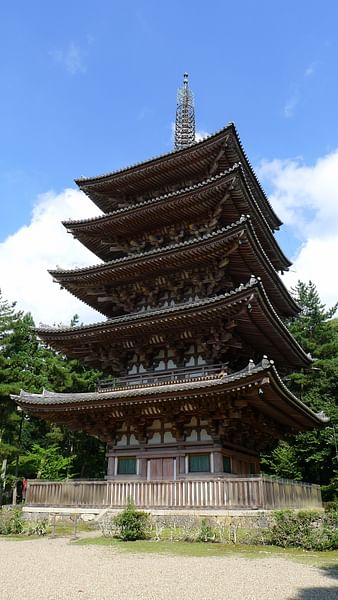 Daigoji Pagoda, Kyoto Felix filnkoessi (CC BY) ](https://www.worldhistory.org/image/6750/daigoji-pagoda-kyoto/ "Daigoji Pagoda, Kyoto")### Shimo Daigo
Nestling at the base of the mountain, 4.5 km (2.5 miles) from the Kami Daigo, the lower precinct was developed from 926 CE, when the site received imperial patronage, and includes the massive Main Golden Hall (Kondo) with its impressive sloping roof which dates to the [Kamakura Period](https://www.worldhistory.org/Kamakura_Period/) (1185-1333 CE). Here, too, are the Sambo-in or Monastery of the Three Treasures (first built in the 12th century CE), the Imperial Messenger Gate (not actually used as a gate), and gardens famous for their cherry blossoms, the Benten Pond with its wooden bridge and shrine, and the site's museum. Also architecturally significant are the Front Reception Hall (*Omote-shoin*) and the Inner Reception Hall (*Oku-shoin*) which are examples of 16th-century CE domestic buildings in the *shoin-zukuri* style. Inside both buildings, the walls and sliding paper screens (*fusuma*) are painted with landscape pictures.
The star attraction of the Shimo Daigo precinct, and symbol of Daigoji in general, is the five-roofed pagoda, Kyoto's oldest building, which was erected in 951 or 952 CE thanks to the sponsorship of Emperor Murakami (r. 946-967 CE). The wooden pagoda is 34 metres high and a fine example of [Fujiwara](https://www.worldhistory.org/Fujiwara_Clan/) style [architecture](https://www.worldhistory.org/disambiguation/architecture/). It contains several examples of paintings from [ancient Japan](https://www.worldhistory.org/Ancient_Japan/), including depictions of the eight patriarchs of Shingon [Buddhism](https://www.worldhistory.org/buddhism/), although, unfortunately, it is not open to the public.
[  Benten Pond, Daigoji hira3 (CC BY-NC-SA) ](https://www.worldhistory.org/image/6752/benten-pond-daigoji/ "Benten Pond, Daigoji")### Later History
As with many other ancient buildings in Japan the site suffered its fair share of destruction, both deliberate and accidental, especially during the Onin [War](https://www.worldhistory.org/disambiguation/War/) (1467-1477 CE). [Toyotomi Hideyoshi](https://www.worldhistory.org/Toyotomi_Hideyoshi/), the 16th-century CE imperial regent, restored the site's main temple and beautified the Sambo-in gardens. According to the diary of Gien, the abbot at the time, Hideyoshi personally landscaped the gardens to his own liking, bringing in 700 large stones for the purpose which he selected for their unusual shape and then placed for a maximum aesthetic effect. Many stones were pinched from other scenic sites across Japan, and some even came from his own pleasure [palace](https://www.worldhistory.org/disambiguation/palace/), the splendidly named Mansion of Collected Luxuries or *Juraku-dai*. Since Hideyoshi's efforts, many of the other buildings at Daigoji have been similarly restored.
Today Daigoji is still a working temple and monastery, the upper precinct continues to be a place where monks practise asceticism (*Shugendo*), and it remains a passage on major pilgrimage routes. As a UNESCO World Heritage Site since 1994 CE and home to many important ancient buildings and artworks Daigoji is, of course, also popular with tourists, especially those keen to see each spring the celebrated cherry blossoms of the Sambo-in gardens.
This content was made possible with generous support from the [Great Britain Sasakawa Foundation](http://www.gbsf.org.uk/?utm_source=ancient.eu&utm_medium=link&utm_campaign=ancient.eu).
#### Editorial Review
This human-authored definition has been reviewed by our editorial team before publication to ensure accuracy, reliability and adherence to academic standards in accordance with our [editorial policy](https://www.worldhistory.org/static/editorial-policy/).
## Bibliography
- [Dougill, J. *Japan's World Heritage Sites.* Tuttle Publishing, 2014.](https://www.worldhistory.org/books/4805312858/)
- [Henshall, K. *Historical Dictionary of Japan to 1945.* Scarecrow Press, 2013.](https://www.worldhistory.org/books/0810878712/)
- [Tsuda, N. *A History of Japanese Art.* Tuttle Publishing, 2009.](https://www.worldhistory.org/books/4805310316/)
- [Whitney Hall, J. *The Cambridge History of Japan, Vol. 2.* Cambridge University Press, 1999.](https://www.worldhistory.org/books/0521223539/)
## About the Author
Mark is WHE’s Publishing Director and has an MA in Political Philosophy (University of York). He is a full-time researcher, writer, historian and editor. Special interests include art, architecture and discovering the ideas that all civilizations share.
## Timeline
- **874 CE**: The [Buddhist](https://www.worldhistory.org/buddhism/) [Daigoji](https://www.worldhistory.org/Daigoji/) [temple](https://www.worldhistory.org/temple/) is founded by Shobo at [Heiankyo](https://www.worldhistory.org/Heiankyo/) (Kyoto).
- **926 CE**: The lower precinct or Shimo Daigo is developed at the [Buddhist](https://www.worldhistory.org/buddhism/) [temple](https://www.worldhistory.org/temple/) site of [Daigoji](https://www.worldhistory.org/Daigoji/).
- **c. 951 CE**: The five-storey pagoda is built at [Daigoji](https://www.worldhistory.org/Daigoji/), [Heiankyo](https://www.worldhistory.org/Heiankyo/) (Kyoto).
- **1115 CE**: The [Buddhist](https://www.worldhistory.org/buddhism/) [Daigoji](https://www.worldhistory.org/Daigoji/) [temple](https://www.worldhistory.org/temple/) complex at [Heiankyo](https://www.worldhistory.org/Heiankyo/) (Kyoto) is significantly expanded.
## Cite This Work
### APA
Cartwright, M. (2017, June 13). Daigoji. *World History Encyclopedia*.
### Chicago
Cartwright, Mark. "Daigoji." *World History Encyclopedia*, June 13, 2017. .
### MLA
Cartwright, Mark. "Daigoji." *World History Encyclopedia*, 13 Jun 2017, .
## License & Copyright
Submitted by [Mark Cartwright](https://www.worldhistory.org/user/markzcartwright/ "User Page: Mark Cartwright"), published on 13 June 2017. The copyright holder has published this content under the following license: [Creative Commons Attribution-NonCommercial-ShareAlike](https://creativecommons.org/licenses/by-nc-sa/4.0/deed.en). This license lets others remix, tweak, and build upon this content non-commercially, as long as they credit the author and license their new creations under the identical terms. When republishing on the web a hyperlink back to the original content source URL must be included. Please note that content linked from this page may have different licensing terms.