---
title: Coricancha
author: Mark Cartwright
source: https://www.worldhistory.org/Coricancha/
format: machine-readable-alternate
license: Creative Commons Attribution-NonCommercial-ShareAlike (https://creativecommons.org/licenses/by-nc-sa/4.0/)
updated: 1970-01-01
---
# Coricancha
_Authored by [Mark Cartwright](https://www.worldhistory.org/user/markzcartwright/)_
The religious complex of Coricancha (Qorikancha) in the [Inca](https://www.worldhistory.org/Inca_Civilization/) capital at [Cuzco](https://www.worldhistory.org/Cuzco/) contained the [Temple](https://www.worldhistory.org/temple/) of the Sun which was not only the most sacred site or *huaca* in the [Inca religion](https://www.worldhistory.org/Inca_Religion/) but was considered the very centre of the Inca world. The site was also known as the Golden Enclosure and was dedicated to the highest gods in the Inca [pantheon](https://www.worldhistory.org/Pantheon/) such as the Creator [god](https://www.worldhistory.org/God/) [Viracocha](https://www.worldhistory.org/Viracocha/), the moon goddess Quilla and especially to [Inti](https://www.worldhistory.org/Inti/), the god of the sun. Little remains today except some sections of its fine stone walls which hint at the site's once massive size and the legendary stories which tell of the enormous quantity of [gold](https://www.worldhistory.org/gold/) used to decorate the temples and its golden garden.
### Layout & [Architecture](https://www.worldhistory.org/disambiguation/architecture/)
The construction of the complex is commonly attributed to [Pachacuti Inca Yupanqui](https://www.worldhistory.org/Pachacuti_Inca_Yupanqui/), the 9th Inca ruler (1438-1471 CE) who also embarked on a general rebuilding programme in the capital. Despite excavations, though, the exact chronology of the site is not clear. In Inca [mythology](https://www.worldhistory.org/mythology/) the first Inca leader Manco Capac (Manqo Qhapaq) built a temple at the site in the early 12th century CE and [archaeology](https://www.worldhistory.org/Archaeology/) does show evidence of pre-[empire](https://www.worldhistory.org/empire/) structures.
The lay-out of the site, as seen from above, actually resembled a sun with rays shining out in all directions. These were the sacred *ceque* (*zeq'e*) lines - physical and cosmic roads - of which there were 41 which led to an impressive 328 sacred sites. Cuzco itself was deliberately laid out to represent a jaguar and Coricancha was located at the tail. In typical Inca symmetry the second most important sacred site in the [city](https://www.worldhistory.org/city/) - [Sacsahuaman](https://www.worldhistory.org/Sacsayhuaman/) - was located at the head. Coricancha was also built where the city's two great rivers of Huantanay and Tullamayo met.
Built using the fine masonry skills for which the Inca have rightly become famous, the massive walls of the complex were built from large stone blocks finely cut and fitted together without mortar. The large curved western wall was particularly noted for its form and elegant, regular masonry. Most walls also leaned slightly inwards as they rose in height, a typical feature of [Inca architecture](https://www.worldhistory.org/Inca_Architecture/). Many trapezoid doorways and windows allowed access and light to enter the interior spaces and a broad band of gold was added mid-way height around the walls. The interior buildings were of one storey and had thatched roofs. The doors were also covered in gold sheets, as were the interiors and exteriors of the various temples and the inner side of the perimeter wall was even said to have been studded with emeralds.
### Temple of the Sun
The most important temple in the precinct was the Temple of the Sun, dedicated to the sun god Inti. The interior and exterior walls of the temple, situated in the northern corner of the complex, were covered in gold - considered the sweat of the sun - which was beaten into sheet plates. There were, reportedly, 700 of these half-metre square sheets, each weighing 2 kg.
Inside the temple, besides golden artefacts relevant to the god's worship, was a gold statue of Inti encrusted with jewels. The statue represented Inti as a small seated boy called Punchao (Day or Midday Sun). From his head and shoulders the sun's rays shone, he wore a royal headband and had snakes and lions coming out of his body. The stomach of the statue was hollow and used to store the ashes of the vital organs of previous Inca rulers. Everyday this statue was brought out into the open air and returned to the shrine each night. Another important representation of the god - a [giant](https://www.worldhistory.org/Giants/) mask with zig-zag rays bursting from the head - was hung from the wall of a specially dedicated chamber within the temple.
[  Inca Gold Sun Mask Andrew Howe (CC BY-NC-SA) ](https://www.worldhistory.org/image/2356/inca-gold-sun-mask/ "Inca Gold Sun Mask")The garden of the temple was a wonderfully conceived homage to Inti. Just as land - sometimes even entire regions - were dedicated to the god, so too, this garden was constructed in honour of the great sun god Inti. Everything in it was made of gold and [silver](https://www.worldhistory.org/Silver/). A large field of corn and life-size models of shepherds, llamas, jaguars, guinea pigs, monkeys, birds and even butterflies and insects were all crafted in precious [metal](https://www.worldhistory.org/disambiguation/metal/). And if that wasn't enough to please Inti there were also a large number of gold and silver jars all encrusted with precious stones. All that survives of these wonders are a few golden corn stalks, a convincing, if silent, testimony to the lost treasures of Coricancha.
### Other Temples
Five other temples or *wasi* were placed around the main square courtyard of Coricancha. In order of hierarchy, one temple was dedicated to the creator god Viracocha (more or less equal to Inti), one to Quilla the goddess of the moon, one to [Venus](https://www.worldhistory.org/venus/) or Chaska-Qoylor, one to the god of thunder Illapa, and finally one for Cuichu the rainbow god. Just as Inti's temple was covered in gold, Quilla's temple was covered in silver, a metal thought to be the tears of the moon. Each *wasi* contained a cult statue of that particular god and precious art and religious objects connected to them.
There was also a dedicated space for the mummified remains of former Inca emperors and their wives, known as *mallquis*. These were brought out of storage during special ceremonies such as those celebrating the solstices. Offerings were made to these mummies dressed in fine clothes, and the great achievements they had made during their reigns were read out for all to hear. There were also living quarters for priests and priestesses and still other rooms of the complex were used as art and religious treasuries stuffed with artefacts taken from conquered peoples. These may well have been kept in order to guarantee compliance to Inca rule, just as conquered rulers were sometimes held hostage at Cuzco for periods of the year. Yet another interesting feature of the site was an underground channel through which sacred water flowed to the surrounding squares outside the complex.
[ 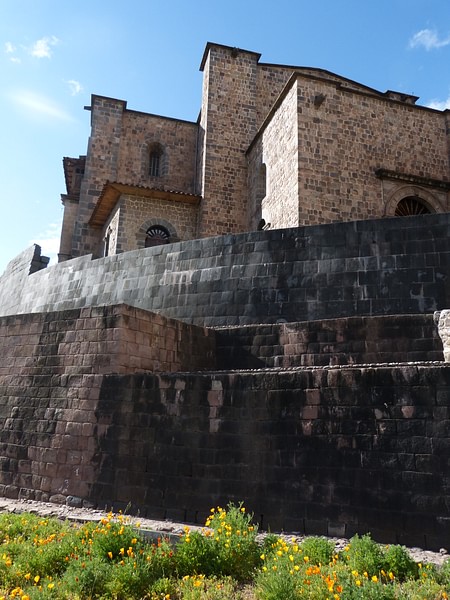 Coricancha Curved Wall Richard Twigg (CC BY-NC-SA) ](https://www.worldhistory.org/image/3467/coricancha-curved-wall/ "Coricancha Curved Wall")Other important functions of Coricancha included the taking of astronomical observations, especially of the Milky Way (*Mayu*). There was, for example, a pair of towers which marked the Summer solstice and sightings were taken from the sacred *ushnu* stone against man-made and natural landmarks on the horizon to track the sun. Sacrificial victims (*capacochas*) were also made ready for their great moment in the precinct's courtyard and then marched along the *ceque* lines to be sacrificed in the various provinces in honour of Inti and his living incarnation, the Inca emperor.
### Later History
The rather plain entrance doorway of the complex survives today with its typical double jamb, as do sections of the outer walls and some interior walls. The Christian monastery of Santo Domingo was built on top of the complex, no doubt, in a deliberate attempt to signify that one [religion](https://www.worldhistory.org/religion/) had been replaced by another. Most of the gold from the site was, of course, melted into ingots and taken for the Spanish Crown. The star piece, the golden statue of Inti, was taken to a place of safety when the Spanish arrived but it seems that they did eventually find it thirty years later in 1572 CE but it disappeared without trace, probably melted down like so many other Inca artefacts.
#### Editorial Review
This human-authored definition has been reviewed by our editorial team before publication to ensure accuracy, reliability and adherence to academic standards in accordance with our [editorial policy](https://www.worldhistory.org/static/editorial-policy/).
## Bibliography
- D'Altroy, T.N. *The Incas.* Blackwell, London, 2012
- Howard, C. *Pizarro & the Conquest of Peru.* Cassel, London, 1968
- [Jones, D.M. *Mythology of the Incas.* Southwater, 2007.](https://www.worldhistory.org/books/1844763382/)
- [Jones, D.M. *The Complete Illustrated History of the Inca Empire.* Lorenz Books, 2012.](https://www.worldhistory.org/books/075482358X/)
- [Mason, J.H. *The Ancient Civilizations of Peru.* Penguin, 2014.](https://www.worldhistory.org/books/B0000CJRG8/)
- [Moseley, M.E. *The Incas and Their Ancestors Rev Sub edition by M. E. Moseley.* Thames & Hudson, 2014.](https://www.worldhistory.org/books/B003Z1JZRA/)
- [Stone, R.R. *Art of the Andes.* Thames & Hudson, 2012.](https://www.worldhistory.org/books/0500204152/)
## About the Author
Mark is WHE’s Publishing Director and has an MA in Political Philosophy (University of York). He is a full-time researcher, writer, historian and editor. Special interests include art, architecture and discovering the ideas that all civilizations share.
## Timeline
- **c. 1100 CE**: The [Inca](https://www.worldhistory.org/Inca_Civilization/), led by Manco Capac, migrate to the [Cuzco](https://www.worldhistory.org/Cuzco/) Valley and establish their capital at Cuzco.
- **c. 1425 CE - 1532 CE**: The [Inca](https://www.worldhistory.org/Inca_Civilization/) [Empire](https://www.worldhistory.org/empire/) flourishes in South America.
- **1438 CE**: Pachacunti [Inca](https://www.worldhistory.org/Inca_Civilization/) Yupanqui begins a rebuilding programme in the Inca capital of [Cuzco](https://www.worldhistory.org/Cuzco/).
- **15 Nov 1533 CE**: [Francisco Pizarro](https://www.worldhistory.org/Francisco_Pizarro/) takes the [Inca](https://www.worldhistory.org/Inca_Civilization/) capital of [Cuzco](https://www.worldhistory.org/Cuzco/).
## Cite This Work
### APA
Cartwright, M. (2014, March 09). Coricancha. *World History Encyclopedia*.
### Chicago
Cartwright, Mark. "Coricancha." *World History Encyclopedia*, March 09, 2014. .
### MLA
Cartwright, Mark. "Coricancha." *World History Encyclopedia*, 09 Mar 2014, .
## License & Copyright
Submitted by [Mark Cartwright](https://www.worldhistory.org/user/markzcartwright/ "User Page: Mark Cartwright"), published on 09 March 2014. The copyright holder has published this content under the following license: [Creative Commons Attribution-NonCommercial-ShareAlike](https://creativecommons.org/licenses/by-nc-sa/4.0/deed.en). This license lets others remix, tweak, and build upon this content non-commercially, as long as they credit the author and license their new creations under the identical terms. When republishing on the web a hyperlink back to the original content source URL must be included. Please note that content linked from this page may have different licensing terms.