---
title: Copan
author: Mark Cartwright
source: https://www.worldhistory.org/Copan/
format: machine-readable-alternate
license: Creative Commons Attribution-NonCommercial-ShareAlike (https://creativecommons.org/licenses/by-nc-sa/4.0/)
updated: 1970-01-01
---
# Copan
_Authored by [Mark Cartwright](https://www.worldhistory.org/user/markzcartwright/)_
Copán (in modern Honduras) is located on the floodplain of the river of the same name. It was the most southerly of the Classic [Maya](https://www.worldhistory.org/disambiguation/Maya/) centres and, at an altitude of 600 metres, the highest. Copán reached the height of its power in the 8th century CE when it boasted 20,000 inhabitants. An artificial platform, built to a height of over 30 metres, forms a main 12 acre [acropolis](https://www.worldhistory.org/Acropolis/) with lesser platforms spreading out to form an imposing mass of precincts of monumental courts and [pyramids](https://www.worldhistory.org/pyramid/). An elite residential area and more modest dwellings surrounded the sacred centre so that Copán once covered some 250 acres. Copan is listed by UNESCO as a World Heritage Site.
### Historical Overview
A farming settlement from as early as 1000 BCE, Copán emerged as a major centre in the Early Classic Period (250-550 CE), almost certainly with influence from [Teotihuacan](https://www.worldhistory.org/Teotihuacan/). The Copán rulers themselves claimed their own dynasty was founded in 331 CE, but there is no record of the names of these early rulers. The traditional named founder of Copán was actually K'inich Yax K'uk Mo' ('Great Sun Quetzal-Macaw'), who reigned from 426 CE to c. 437 CE and who was probably not himself from Copán but another Maya [city](https://www.worldhistory.org/city/), perhaps [Tikal](https://www.worldhistory.org/Tikal/). K'inich Yax K'uk Mo' was the first of a line of 16 rulers, and he is credited with making Copán a major centre, whose wealth was based on regional [conquest](https://www.worldhistory.org/warfare/) and control of the lucrative local [trade](https://www.worldhistory.org/disambiguation/trade/) in obsidian and jade.
King Smoke Imix (the 12th ruler, reign 628 - 695 CE) was another Copán ruler who oversaw a period of great prosperity in the 7th century CE. The ruler known as King 18 Rabbit or Waxaklahun Ubah K'awiil (reign 695 - 738 CE) again aggrandized Copán in the early 8th century CE. The last well-documented ruler was Yax Pasaj Chan Yopaat, whose mother was from [Palenque](https://www.worldhistory.org/Palenque/) and whose reign ended in 820 CE. Although Copán subsequently declined, there are no great signs of destruction, and there is some evidence (albeit controversial) that the elite rulers of Copán survived the general Maya collapse, which occurred between c. 760 and c. 910 CE, and continued their rule until 1000 CE.
Copán competed with local rival Quirigua over the centuries. Although Copán founded Quirigua, King 18 Rabbit was famously captured and beheaded by Chan Yopaat of Quirigua in 738 CE, possibly whilst campaigning for sacrificial victims. Copán recovered from this blow and even expanded the acropolis, but in the longer-term Quirigua gained in prominence, and Copán would never again enjoy the power and prosperity enjoyed during the Yax K'uk Mo' dynasties.
[ 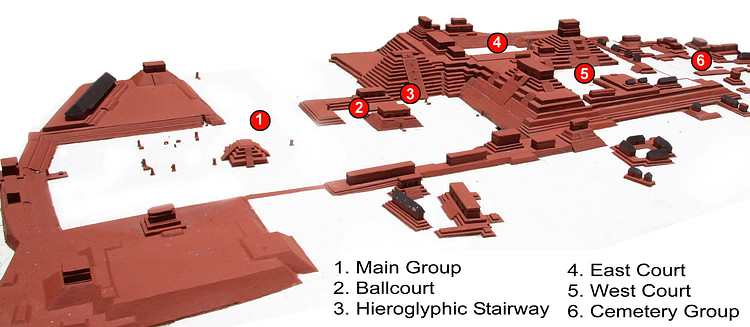 Copan Site Plan Arjuno3 (CC BY-SA) ](https://www.worldhistory.org/image/3513/copan-site-plan/ "Copan Site Plan")### [Architecture](https://www.worldhistory.org/disambiguation/architecture/)
The unusually few buildings at Copán, constructed using local tufa, andesite, and limestone blocks cemented with mud and faced with stucco, include several [pyramid](https://www.worldhistory.org/pyramid/) structures, a ball court, and the Hieroglyphic Stairway, all laid out along a north-south axis. Many of the structures were deliberately placed to take advantage of specific views of the surrounding valleys, notably the ball court with its stone macaw markers. The river Copán has washed away a sizeable chunk of the east side of the main site, especially the grand stairway, but enough remains of the site to indicate its once great prosperity.
The Hieroglyphic Stairway is a wide series of 63 steps which give access to the main court and heart of ceremonial Copán which dates to the 6th century CE. The stairway was constructed in the first half of the 8th century CE and is rich in both relief and fully round [sculpture](https://www.worldhistory.org/disambiguation/Sculpture/), a feature of Copán. Its name derives from the 2,500 glyphs which adorn it. These narrate the history of the Late Classical dynasty, and it constitutes one of the longest surviving Maya texts. The steps are interrupted by five Copán rulers and captives, whilst at the top of the stairway there was the shrine to Yax K'uk Mo'.
The 8th century CE kings of Copán built elaborately stucco-decorated tombs which were then deliberately covered in their entirety by less ornate pyramids, sometimes several times. An example is the largest building and earliest funerary monument Structure 16, a nine level pyramid inside of which are two [tomb](https://www.worldhistory.org/tomb/) buildings known as Rosalila and Margarita. [Temple](https://www.worldhistory.org/temple/) 16 was further excavated in 1996-7 CE, and within was discovered the earliest structure in the pyramid, a small platform temple in the Teotihuacan style, inside of which was a tomb of a male over 50 years of age. As it is now known that Temple 16 was dedicated to the cult of Yax K'uk' Mo', the remains are considered to be of the great ruler himself. Isotopic analysis of the teeth suggests the man came from near Tikal. The neighbouring tomb of Margarita, the richest at Copán, is now considered to be that of the widow of Yax K'uk' Mo'.
Another important building at Copán is the rectangular Temple 22 with its short stepped entrance. It has mask facades on all four sides and dates to before 780 CE. The doorway is framed by a [giant](https://www.worldhistory.org/Giants/) serpent-mask so that the portal seems to be the creature's open mouth with fangs on the sill and sides. This is a common Maya technique to reproduce the entrances to sacred caves and may specifically represent the sacred mountain entrance to the Maya underworld [Xibalba](https://www.worldhistory.org/Xibalba/) of Maya [mythology](https://www.worldhistory.org/mythology/). The cornices were additionally decorated with maize gods. Another important building is Structure 22a which was built as a *popol na* or council house, where nobles advised the king and which has a fish on its façade, possibly the symbol of a prominent noble family.
[  Stela D at Copan by Catherwood N/A (CC BY-SA) ](https://www.worldhistory.org/image/760/stela-d-at-copan-by-catherwood/ "Stela D at Copan by Catherwood")### Art & [Pottery](https://www.worldhistory.org/pottery/)
Copán art is well represented by 14 altars, some which commemorate units of the Maya calendar, and over 60 elaborately carved stelae depicting Copán rulers (especially King 18 Rabbit). Several of the later stelae stand above a small cruciform vault which contained votive offerings, and some stelae were placed to create lines of sight connected to solar dates important in the agricultural year. Other fine examples of three-dimensional sculpture by Copán artists include a half-metre high monkey scribe [god](https://www.worldhistory.org/God/) and a stone bust of the young maize god from Temple 22.
From c. 800 CE Copán also produced its own distinctive pottery style which was exported and even imitated, notably in western El Salvador. The style, known as Copador pottery, is distinct for its shiny surface (from the presence of hematite in the pigments) and stylised human and bird figures. Other finds include the 'Dazzler', a three-legged lidded box which depicts a Copán ruler and temple. The vessel is brightly coloured, and its clay came from distant Central Mexico. Altar Q has relief figures of 16 Copán rulers, including Yax K'uk Mo' (wearing the goggles of a Teotihuacan [war](https://www.worldhistory.org/disambiguation/War/) god) handing over the sceptre of power to Yax Pasaj Chan Yopaat who commissioned the altar in 776 CE. Finally, there are various objects related to the Mesoamerican ballgame indicating an influence from Veracruz.
#### Editorial Review
This human-authored definition has been reviewed by our editorial team before publication to ensure accuracy, reliability and adherence to academic standards in accordance with our [editorial policy](https://www.worldhistory.org/static/editorial-policy/).
## Bibliography
- [Coe, M.D. *The Maya.* Thames & Hudson, 2011.](https://www.worldhistory.org/books/0500289026/)
- [Kubler, G. *The Art and Architecture of Ancient America, Third Edition.* Yale University Press, 1984.](https://www.worldhistory.org/books/0300053258/)
- [Miller, M.E. *The Art of Mesoamerica.* Thames & Hudson, 2012.](https://www.worldhistory.org/books/0500204144/)
- [Nichols, D.L. *The Oxford Handbook of Mesoamerican Archaeology.* Oxford University Press, 2012.](https://www.worldhistory.org/books/0195390938/)
- [Phillips, C. *The Illustrated Encyclopedia of the Aztec & Maya& Central America - Including The Aztec..* Lorenz Books, 2007.](https://www.worldhistory.org/books/0754817296/)
## About the Author
Mark is WHE’s Publishing Director and has an MA in Political Philosophy (University of York). He is a full-time researcher, writer, historian and editor. Special interests include art, architecture and discovering the ideas that all civilizations share.
## Timeline
- **c. 1000 BCE**: [Copan](https://www.worldhistory.org/Copan/) is first settled by farming communities.
- **250 CE - 950 CE**: The Classic [Maya](https://www.worldhistory.org/disambiguation/Maya/) Period which saw the height of the [Maya Civilization](https://www.worldhistory.org/Maya_Civilization/) in [cities](https://www.worldhistory.org/city/) such as [Chichen Itza](https://www.worldhistory.org/Chichen_Itza/), [Palenque](https://www.worldhistory.org/Palenque/), [Tikal](https://www.worldhistory.org/Tikal/), [Copan](https://www.worldhistory.org/Copan/) and [Uxmal](https://www.worldhistory.org/Uxmal/).
- **331 CE**: Traditional founding date of [Maya](https://www.worldhistory.org/disambiguation/Maya/) [Copan](https://www.worldhistory.org/Copan/).
- **426 CE - 437 CE**: Reign of the first named [Copan](https://www.worldhistory.org/Copan/) ruler K'inich Yax K'uk Mo.
- **628 CE - 695 CE**: Reign of King Smoke Imix at [Copan](https://www.worldhistory.org/Copan/).
- **695 CE - 738 CE**: Reign of King 18 Rabbit at [Copan](https://www.worldhistory.org/Copan/).
- **820 CE**: Reign ends of Yax Pasaj Chan Yopaat at [Copan](https://www.worldhistory.org/Copan/).
## Cite This Work
### APA
Cartwright, M. (2015, January 23). Copan. *World History Encyclopedia*.
### Chicago
Cartwright, Mark. "Copan." *World History Encyclopedia*, January 23, 2015. .
### MLA
Cartwright, Mark. "Copan." *World History Encyclopedia*, 23 Jan 2015, .
## License & Copyright
Submitted by [Mark Cartwright](https://www.worldhistory.org/user/markzcartwright/ "User Page: Mark Cartwright"), published on 23 January 2015. The copyright holder has published this content under the following license: [Creative Commons Attribution-NonCommercial-ShareAlike](https://creativecommons.org/licenses/by-nc-sa/4.0/deed.en). This license lets others remix, tweak, and build upon this content non-commercially, as long as they credit the author and license their new creations under the identical terms. When republishing on the web a hyperlink back to the original content source URL must be included. Please note that content linked from this page may have different licensing terms.