---
title: Constantinople
author: Donald L. Wasson
source: https://www.worldhistory.org/Constantinople/
format: machine-readable-alternate
license: Creative Commons Attribution-NonCommercial-ShareAlike (https://creativecommons.org/licenses/by-nc-sa/4.0/)
updated: 2022-08-22
---
# Constantinople
_Authored by [Donald L. Wasson](https://www.worldhistory.org/user/DWasson/)_
Built in the seventh century BCE, the ancient [city](https://www.worldhistory.org/city/) of [Byzantium](https://www.worldhistory.org/Byzantium/) proved to be a valuable city for both the Greeks and Romans. Because it lay on the European side of the Strait of Bosporus, the Emperor [Constantine](https://www.worldhistory.org/disambiguation/Constantine/) understood its strategic importance and upon reuniting the [empire](https://www.worldhistory.org/empire/) in 324 CE built his new capital there – Constantinople.
### Foundation by Constantine (284 - 337 CE)
Emperor [Diocletian](https://www.worldhistory.org/Diocletian/) who ruled the [Roman Empire](https://www.worldhistory.org/Roman_Empire/) from 284 to 305 CE believed that the empire was too big for one person to rule and divided it into a tetrarchy (rule of four) with an emperor ([augustus](https://www.worldhistory.org/augustus/)) and a co-emperor ([caesar](https://www.worldhistory.org/disambiguation/caesar/)) in both the east and west. Diocletian chose to rule the east. Young Constantine rose to power in the west when his father, Constantius, died. The ambitious ruler defeated his rival, Maxentius, for power at the [Battle](https://www.worldhistory.org/disambiguation/battle/) of Milvian Bridge and became sole emperor of the west in 312 CE. When Licinius assumed power in the east in 313 CE, Constantine challenged and ultimately defeated him at the Battle of Chrysopolis, thereby reuniting the empire.
Constantine was unsure where to locate his new capital. Old [Rome](https://www.worldhistory.org/Rome/) was never considered. He understood the infrastructure of the city was declining; its [economy](https://www.worldhistory.org/disambiguation/economy/) was stagnant and the only source of income was becoming scarce. Nicomedia had everything he could want for a capital – a [palace](https://www.worldhistory.org/disambiguation/palace/), a basilica and even a [circus](https://www.worldhistory.org/disambiguation/Circus/) – but it had been the capital of his predecessors, and he wanted something new. Although he had been tempted to build his capital on the site of ancient [Troy](https://www.worldhistory.org/troy/), Constantine decided it was best to locate his new city at the site of old Byzantium, claiming it to be a New Rome (Nova [Roma](https://www.worldhistory.org/disambiguation/Roma/)). The city had several advantages. It was closer to the geographic center of the Empire. Since it was surrounded almost entirely by water, it could be easily defended (especially when a chain was placed across the bay). The location provided an excellent harbor – thanks to the Golden Horn – as well as easy access to the Danube River region and the Euphrates frontier. Thanks to the funding of Licinius's treasury and a special tax, a massive rebuilding project began.
Although he kept some remnants of the old city, New Rome – four times the size of Byzantium – was said to have been inspired by the Christian [God](https://www.worldhistory.org/God/), yet remained classical in every sense. Built on seven hills (just like Old Rome), the city was divided into fourteen districts. Supposedly laid out by Constantine himself, there were wide avenues lined with statues of [Alexander the Great](https://www.worldhistory.org/Alexander_the_Great/), Caesar, Augustus, Diocletian, and of course, Constantine dressed in the garb of [Apollo](https://www.worldhistory.org/apollo/) with a scepter in one hand and a globe in the other. The city was centered on two colonnaded streets (dating back to Septimus Severus) that intersected near the baths of Zeuxippus and the Tetrastoon.
The intersection of the two streets was marked by a four-way arch, a tetrapylon. North of the arch stood the old basilica which Constantine converted into a square court, surrounded by several porticos, housing a library and two shrines. Southward stood the new imperial palace with its massive entrance, the Chalke Gate. Besides a new forum, the city boasted a large meeting hall that served as a market, stock exchange, and court of [law](https://www.worldhistory.org/disambiguation/law/). The old circus was transformed into a victory monument, including one monument that had been erected at [Delphi](https://www.worldhistory.org/delphi/) – the Serpent [Column](https://www.worldhistory.org/column/) – celebrating the Greek victory over the Persians at [Plataea](https://www.worldhistory.org/Plataea/) in 479 BCE. While the old amphitheater was abandoned (the Christians disliked gladiatorial contests), the hippodrome was enlarged for [chariot](https://www.worldhistory.org/chariot/) races.
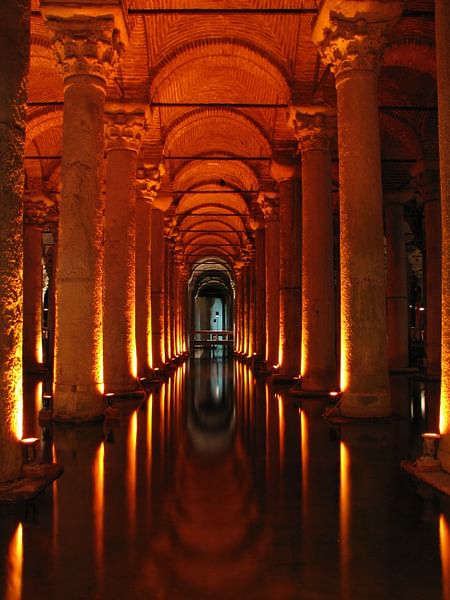
One of Constantine's early concerns was to provide enough water for the citizenry. While Old Rome didn't have the problem, New Rome faced periods of intense drought in the summer and early autumn and torrential rain in the winter. Together with the challenge of the weather, there was always the possibility of invasion. The city needed a reliable water supply. There were sufficient [aqueducts](https://www.worldhistory.org/aqueduct/), tunnels and conduits to bring water into the city but a lack of storage still existed. To solve the problem the Binbirderek Cistern (it still exists) was constructed in 330 CE.
[ 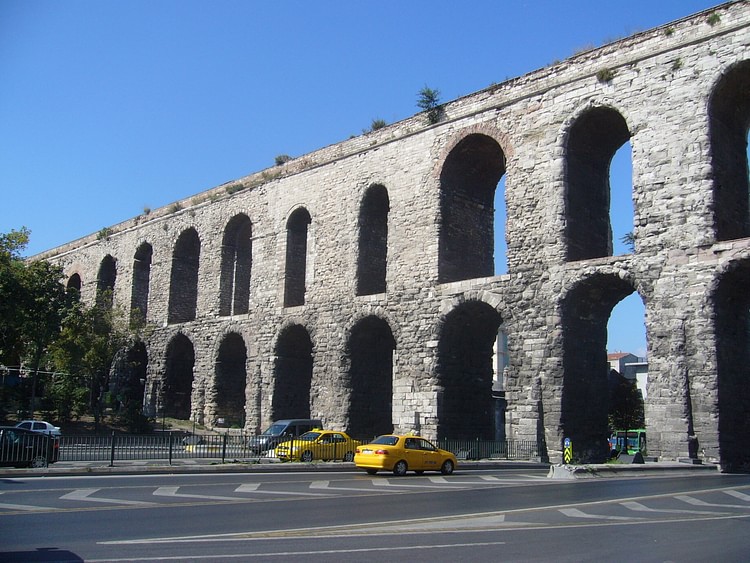 Valens Aqueduct, Constantinople Oleg (CC BY-NC-ND) ](https://www.worldhistory.org/image/1142/valens-aqueduct-constantinople/ "Valens Aqueduct, Constantinople")[Religion](https://www.worldhistory.org/religion/) took on new meaning in the empire. Although Constantine openly supported [Christianity](https://www.worldhistory.org/christianity/) (his mother was one), historians doubt whether or not he truly ever became a Christian, waiting until his deathbed to convert. New Rome would boast temples to pagan deities (he had kept the old [acropolis](https://www.worldhistory.org/Acropolis/)) and several Christian churches; Hagia Irene was one of the first churches commissioned by Constantine. It would perish during the Nika Revolts under Justinian in 532 CE.
In 330 CE, Constantine consecrated the Empire's new capital, a city which would one day bear the emperor's name. Constantinople would become the economic and cultural hub of the east and the center of both Greek classics and Christian ideals. Its importance would take on new meaning with [Alaric](https://www.worldhistory.org/Alaric/)'s invasion of Rome in 410 CE and the eventual fall of the city to [Odoacer](https://www.worldhistory.org/Odoacer/) in 476 CE. During the Middle Ages, the city would become a refuge for ancient Greek and [Roman](https://www.worldhistory.org/disambiguation/Roman/) texts.
### Constantius to Theodosius (337 - 526 CE)
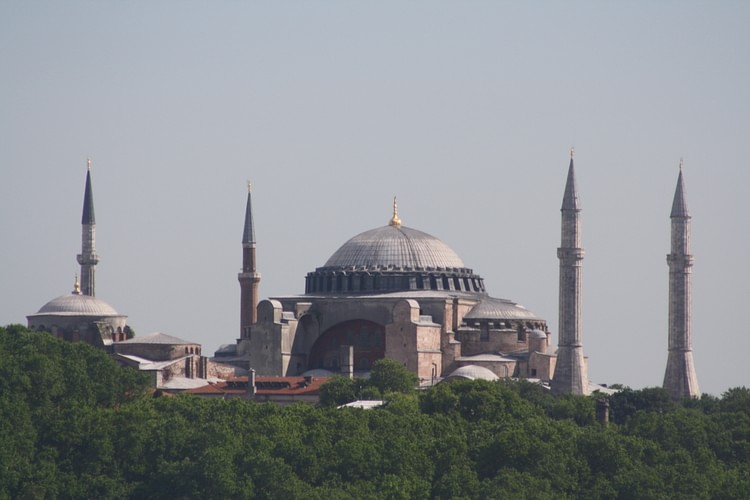
In 337 CE Constantine died, leaving his successors and the empire in turmoil. [Constantius II](https://www.worldhistory.org/Constantius_II/) defeated his brothers (and any other challengers) and became the empire's sole emperor. The only individual he spared was his cousin Julian, only five years old at the time and not considered a viable threat; however, the young man would surprise his older cousin and one day become an emperor himself, Julian the Apostate. Constantius II enlarged the governmental bureaucracy, adding quaestors, praetors, and even tribunes. He built another cistern and additional grain silos. Although some historians disagree (claiming Constantine laid the foundation), he is credited with building the first of three Hagia Sophias, the Church of Holy Wisdom, in 360 CE. The church would be destroyed by fire in 404 CE, rebuilt by Theodosius II, destroyed and rebuilt again under Justinian in 532 CE.
A convert to Arianism, Constantius II's [death](https://www.worldhistory.org/disambiguation/Death/) would place the already tenuous status of Christianity in the empire in jeopardy. His successor, Julian the Apostate, a student of Greek and [Roman philosophy](https://www.worldhistory.org/Roman_Philosophy/) and [culture](https://www.worldhistory.org/disambiguation/culture/) (and the first emperor born in Constantinople), would become the last pagan emperor. Although Constantius had considered him weak and non-threatening, Julian had become a brilliant commander, gaining the support and respect of the army, easily assuming power upon the emperor's death. Although he attempted to erase all aspects of Christianity in the empire, he failed. Upon his death fighting the Persians in 363 CE, the empire was split between two brothers, Valentinian I (who died in 375 CE) and Valens. Valentinian, the more capable of the two, ruled the west while the weaker and short-sighted Valens ruled the east. Valens's only contribution to the city and the empire was to add a number of aqueducts, but in his attempt to shore up the empire's frontier – he had allowed the [Visigoths](https://www.worldhistory.org/visigoth/) to settle there – he would lose a decisive battle and his life at Adrianople in 378 CE. After Valens's embarrassing defeat, the Visigoths believed Constantinople to be vulnerable and attempted to scale the walls of the city but ultimately failed.
Valens's successor was Theodosius the Great (379 - 395 CE). In response to Julian, he outlawed paganism and made Christianity the official religion of the empire in 391 CE. He called the Second Ecumenical Council, reaffirming the Nicene Creed, written under the reign of Constantine. As the last emperor to rule both east and west, he did away with the [Vestal Virgins](https://www.worldhistory.org/Vestal_Virgin/) of Rome, outlawed the [Olympic Games](https://www.worldhistory.org/Olympic_Games/) and dismissed the Oracle at Delphi which had existed long before the time of [Alexander](https://www.worldhistory.org/disambiguation/Alexander/) the Great. His grandson, Theodosius II (408 - 450 CE) rebuilt [Hagia Sophia](https://www.worldhistory.org/Hagia_Sophia/) after it burned, established a university, and, fearing a barbarian threat, expanded the city's walls in 413 CE; the new walls would be forty feet high and sixteen feet thick.
[  Hagia Sophia Panorama Mark Cartwright (CC BY-NC-SA) ](https://www.worldhistory.org/image/1139/hagia-sophia-panorama/ "Hagia Sophia Panorama")### Justinian & the Nika Revolt (527 - 565 CE)
A number of weak emperors followed Theodosius II until Justinian (527 - 565 CE) – the creator of the Justinian Code – came to power. By this time the city boasted over three hundred thousand residents. As emperor Justinian instituted a number of administrative reforms, tightening control of both the provinces and tax collection. He built a new cistern, a new palace, and a new Hagia Sophia and Hagia Irene, both destroyed during the Nika Revolt of 532 CE. His most gifted advisor and intellectual equal was his wife Theodora, the daughter of a bear trainer at the Hippodrome. She is credited with influencing many imperial reforms: expansion of [women](https://www.worldhistory.org/disambiguation/women/)'s rights in divorce, closure of all brothels, and the creation of convents for former prostitutes. Under the leadership of his brilliant general [Belisarius](https://www.worldhistory.org/Belisarius/), Justinian expanded the empire to include North [Africa](https://www.worldhistory.org/disambiguation/africa/), Spain and [Italy](https://www.worldhistory.org/italy/). Sadly, he would be the last of the truly great emperors; the empire would fall into gradual decline after his death until the Ottoman Turks conquered the city in 1453 CE.
One of the darker moments during his reign was the Nika Revolt. It started as a riot at the hippodrome between two sport factions, the blues and greens. Both were angry at Justinian for some of his recent policy decisions and openly opposed his appearance at the games. The riot expanded to the streets where looting and fires broke out. The main gate of the imperial palace, the Senate house, public baths, and many residential houses and palaces were all destroyed. Although initially choosing to flee the city, Justinian was convinced by his wife to stay and fight: thirty thousand would die as a result. When the smoke cleared, the emperor saw an opportunity to clear away remnants of the past and make the city a center of [civilization](https://www.worldhistory.org/civilization/). Forty days later Justinian began the construction of a new church: a new Hagia Sophia.
No expense was to be spared. He wanted the new church to be built on a grand scale – a church no one would dare destroy. He brought in [gold](https://www.worldhistory.org/gold/) from [Egypt](https://www.worldhistory.org/egypt/), porphyry from [Ephesus](https://www.worldhistory.org/ephesos/), white marble from [Greece](https://www.worldhistory.org/greece/) and precious stones from [Syria](https://www.worldhistory.org/syria/) and North Africa. The historian Procopius said:
> … it soars to a height to match the sky, and as if surging up from other buildings it stands as high and looks down on the remnants of the city … it exults in an indescribable beauty.
Over ten thousand workers would take almost six years to build it. Afterwards Justinian was reported to say, “Solomon, I have surpassed thee.” Near the height of his reign, Justinian's city suffered an epidemic in 541 CE – the [Black Death](https://www.worldhistory.org/Black_Death/) – where over one hundred thousand of the city's residents would die. Even Justinian wasn't immune, although he survived. The economy of the empire would never completely recover.
[  Binbirderek Cistern, Constantinople marcus\_jb1973 (CC BY-NC-ND) ](https://www.worldhistory.org/image/1140/binbirderek-cistern-constantinople/ "Binbirderek Cistern, Constantinople")### Medieval Constantinople (until 1453 CE)
Two other emperors deserve mention: [Leo III](https://www.worldhistory.org/Leo_III/) and [Basil I](https://www.worldhistory.org/Basil_I/). Leo III (717 - 741 CE) is best known for instituting iconoclasm, the destruction of all religious relics and icons – the city would lose monuments, mosaics and works of art – but he should also be remembered for saving the city. When the Arabs lay siege to the city, he used a new weapon “Greek fire”, a flammable liquid to repel the invaders. It was comparable to napalm, and water was useless against it as it would only help to spread the flames. While his son [Constantine V](https://www.worldhistory.org/Constantine_V/) was equally successful, his grandson Leo IV, initially a moderate iconoclast, died shortly after assuming power, leaving the incompetent [Constantine VI](https://www.worldhistory.org/Constantine_VI/) and his mother and regent Irene in power. Irene ruled with an iron hand, preferring treaties to [warfare](https://www.worldhistory.org/warfare/), aided by several purges of the military. Although she saw the return of religious icons (endearing her to the Roman church), her power over her son and the empire ended when she chose to have him blinded; she was exiled to the island of [Lesbos](https://www.worldhistory.org/lesbos/).
Basil I (867 - 886 CE), the Macedonian (although he had never set foot in Macedonia), saw a city and empire that had fallen into disrepair and set about a massive rebuilding program: Stone replaced wood, mosaics were restored, churches as well as a new imperial palace were constructed, and lastly, considerable lost territory was recovered. Much of the rebuilding, however, was lost during the [Fourth Crusade](https://www.worldhistory.org/Fourth_Crusade/) (1202 - 1204 CE) when the city was plundered and burned, not by the Muslims, but by the Christians who had initially been called to repel invaders but sacked the city themselves. Crusaders roamed the city, tombs were vandalized, churches desecrated, and Justinian's sarcophagus was opened and his body flung aside. The city and the empire never recovered from the [Crusades](https://www.worldhistory.org/Crusades/) leaving them vulnerable for the Ottoman Turks in 1453 CE.
#### Editorial Review
This human-authored definition has been reviewed by our editorial team before publication to ensure accuracy, reliability and adherence to academic standards in accordance with our [editorial policy](https://www.worldhistory.org/static/editorial-policy/).
## Bibliography
- Brownsworth, L. *Lost to the West.* Three Rivers Press, 2009
- Grafton, A. *The Classical Tradition.* Harvard University Press, 2008
- Hill, D. *Ancient Rome: From the Republic to the Empire.* Parragon Books, 2007
- Kinross, Lord. *Hagia Sophia.* Newsweek Book Division, 1972
- Pollardm J. *Wonders of the Ancient World.* Metro Books, 2008
- Potter, D. *Constantine: The Emperor.* Oxford University Press, 2013
## About the Author
Donald has taught Ancient, Medieval and U.S. History at Lincoln College (Normal, Illinois)and has always been and will always be a student of history, ever since learning about Alexander the Great. He is eager to pass knowledge on to his students.
## Timeline
- **272 CE**: Possible year of Emperor [Constantine](https://www.worldhistory.org/disambiguation/Constantine/)'s birth.
- **308 CE**: [Constantine I](https://www.worldhistory.org/Constantine_I/) named "[caesar](https://www.worldhistory.org/disambiguation/caesar/)" of the west.
- **11 May 330 CE**: [Constantinople](https://www.worldhistory.org/Constantinople/) is founded on the site of old [Byzantium](https://www.worldhistory.org/Byzantium/) as "the new [Rome](https://www.worldhistory.org/Rome/)."
- **c. 331 CE**: The [Great Palace of Constantinople](https://www.worldhistory.org/article/1211/the-great-palace-of-constantinople/) is first built by [Constantine I](https://www.worldhistory.org/Constantine_I/).
- **337 CE**: [Death](https://www.worldhistory.org/disambiguation/Death/) of [Constantine](https://www.worldhistory.org/disambiguation/Constantine/).
- **337 CE**: [Death](https://www.worldhistory.org/disambiguation/Death/) of Emperor [Constantine I](https://www.worldhistory.org/Constantine_I/).
- **360 CE**: First [Hagia Sophia](https://www.worldhistory.org/Hagia_Sophia/) built in [Constantinople](https://www.worldhistory.org/Constantinople/).
- **363 CE**: [Death](https://www.worldhistory.org/disambiguation/Death/) of Julian the Apostate.
- **379 CE - 395 CE**: Reign of Theodosius the Great.
- **391 CE**: [Christianity](https://www.worldhistory.org/christianity/) becomes official [religion](https://www.worldhistory.org/religion/) of [Empire](https://www.worldhistory.org/empire/).
- **410 CE - 413 CE**: The [Theodosian Walls](https://www.worldhistory.org/Theodosian_Walls/) are built to better protect [Constantinople](https://www.worldhistory.org/Constantinople/).
- **1 Apr 527 CE**: Coronation of [Justinian I](https://www.worldhistory.org/Justinian_I/) and Theodora in the [Hagia Sophia](https://www.worldhistory.org/Hagia_Sophia/) Church in [Constantinople](https://www.worldhistory.org/Constantinople/).
- **532 CE**: Nika Revolt in [Constantinople](https://www.worldhistory.org/Constantinople/).
- **532 CE**: [Hagia Sophia](https://www.worldhistory.org/Hagia_Sophia/) rebuilt by Justinian.
- **532 CE - 537 CE**: [Hagia Sophia](https://www.worldhistory.org/Hagia_Sophia/) is built anew in [Constantinople](https://www.worldhistory.org/Constantinople/).
- **626 CE**: A coalition of Persians, [Slavs](https://www.worldhistory.org/Slavs/), [Avars](https://www.worldhistory.org/Avars/) and Bulgars unsuccessfully lays siege to [Constantinople](https://www.worldhistory.org/Constantinople/).
- **674 CE - 678 CE**: The Arab [Umayyad Caliphate](https://www.worldhistory.org/Umayyad_Dynasty/) unsuccessfully besieges [Constantinople](https://www.worldhistory.org/Constantinople/).
- **678 CE**: First recorded use of [Greek Fire](https://www.worldhistory.org/Greek_Fire/) in [Byzantine](https://www.worldhistory.org/disambiguation/Byzantine/) [warfare](https://www.worldhistory.org/warfare/) during the Arab siege of [Constantinople](https://www.worldhistory.org/Constantinople/).
- **705 CE**: [Justinian II](https://www.worldhistory.org/Justinian_II/) besieges [Constantinople](https://www.worldhistory.org/Constantinople/) and reinstates himself as [Byzantine emperor](https://www.worldhistory.org/Byzantine_Emperor/), removing the usurper Tiberios III.
- **711 CE**: Pope [Constantine](https://www.worldhistory.org/disambiguation/Constantine/) visits [Constantinople](https://www.worldhistory.org/Constantinople/) at the invitation of [Byzantine emperor](https://www.worldhistory.org/Byzantine_Emperor/) [Justinian II](https://www.worldhistory.org/Justinian_II/).
- **717 CE - 718 CE**: [Greek Fire](https://www.worldhistory.org/Greek_Fire/) is used by [Byzantine](https://www.worldhistory.org/disambiguation/Byzantine/) ships to attack an Arab fleet besieging [Constantinople](https://www.worldhistory.org/Constantinople/).
- **730 CE**: [Byzantine emperor](https://www.worldhistory.org/Byzantine_Emperor/) [Leo III](https://www.worldhistory.org/Leo_III/) decrees that all religious icons be destroyed.
- **741 CE - 775 CE**: Reign of [Byzantine emperor](https://www.worldhistory.org/Byzantine_Emperor/) [Constantine V](https://www.worldhistory.org/Constantine_V/)
- **821 CE - 822 CE**: [Greek Fire](https://www.worldhistory.org/Greek_Fire/) is used by [Byzantine](https://www.worldhistory.org/disambiguation/Byzantine/) ships to attack a Slav fleet besieging [Constantinople](https://www.worldhistory.org/Constantinople/).
- **Dec 821 CE - Dec 823 CE**: Thomas the Slav unsuccessfully besieges [Constantinople](https://www.worldhistory.org/Constantinople/).
- **867 CE - 886 CE**: Reign of [Byzantine emperor](https://www.worldhistory.org/Byzantine_Emperor/) [Basil I](https://www.worldhistory.org/Basil_I/).
- **907 CE**: Oleg, Prince of Kiev, attacks the [Byzantine](https://www.worldhistory.org/disambiguation/Byzantine/) capital [Constantinople](https://www.worldhistory.org/Constantinople/).
- **941 CE**: [Greek Fire](https://www.worldhistory.org/Greek_Fire/) is used by [Romanos I](https://www.worldhistory.org/Romanos_I/)'s fleet against a Russian fleet attacking [Constantinople](https://www.worldhistory.org/Constantinople/).
- **976 CE - 1025 CE**: Reign of [Byzantine emperor](https://www.worldhistory.org/Byzantine_Emperor/) [Basil II](https://www.worldhistory.org/Basil_II/).
- **994 CE**: [Trdat the Architect](https://www.worldhistory.org/Trdat_the_Architect/) completes his reconstruction of the dome of [Hagia Sophia](https://www.worldhistory.org/Hagia_Sophia/), [Constantinople](https://www.worldhistory.org/Constantinople/).
- **1025 CE - 1028 CE**: Reign of [Byzantine emperor](https://www.worldhistory.org/Byzantine_Emperor/) [Constantine](https://www.worldhistory.org/disambiguation/Constantine/) VIII.
- **1097 CE**: The First Crusaders arrive at [Constantinople](https://www.worldhistory.org/Constantinople/).
- **1133 CE**: [Byzantine emperor](https://www.worldhistory.org/Byzantine_Emperor/) [John II Komnenos](https://www.worldhistory.org/John_II_Komnenos/) celebrates a [triumph](https://www.worldhistory.org/Roman_Triumph/) in [Constantinople](https://www.worldhistory.org/Constantinople/) after five successful campaigns in [Asia Minor](https://www.worldhistory.org/Asia_Minor/).
- **Sep 1147 CE - Oct 1147 CE**: The armies of the [Second Crusade](https://www.worldhistory.org/Second_Crusade/) arrive in [Constantinople](https://www.worldhistory.org/Constantinople/).
- **1149 CE**: A fleet led by George of [Antioch](https://www.worldhistory.org/Antiochia/) attacks [Constantinople](https://www.worldhistory.org/Constantinople/).
- **1202 CE - 1204 CE**: The [Fourth Crusade](https://www.worldhistory.org/Fourth_Crusade/) is formed to recapture [Jerusalem](https://www.worldhistory.org/jerusalem/) for Christendom. Instead, the Crusaders attack [Constantinople](https://www.worldhistory.org/Constantinople/).
- **24 Jun 1203 CE**: The army of the [Fourth Crusade](https://www.worldhistory.org/Fourth_Crusade/) arrives at [Constantinople](https://www.worldhistory.org/Constantinople/).
- **12 Apr 1204 CE**: [Constantinople](https://www.worldhistory.org/Constantinople/) is sacked by the Fourth Crusaders.
- **9 May 1204 CE**: Count Baldwin of Flanders is made the first Latin Emperor of [Constantinople](https://www.worldhistory.org/Constantinople/).
- **29 May 1453 CE**: Ottoman Sultan [Mehmed II](https://www.worldhistory.org/Mehmed_II/) sacks [Constantinople](https://www.worldhistory.org/Constantinople/).
## External Links
- [It's a church. It's a mosque. It's Hagia Sophia. - Kelly Wall](http://ed.ted.com/lessons/it-s-a-church-it-s-a-mosque-it-s-hagia-sophia-kelly-wall)
- [All about Hagia Sophia and Byzantine Heritage](https://hagiasophiaturkey.com)
- [Istanbul Museums](https://muze.gen.tr/Museums)
- [List of Rulers of the Roman Empire | Lists of Rulers | Heilbrunn Timeline of Art History | The Metropolitan Museum of Art](https://www.metmuseum.org/toah/hd/roru/hd_roru.htm)
## Cite This Work
### APA
Wasson, D. L. (2013, April 09). Constantinople. *World History Encyclopedia*.
### Chicago
Wasson, Donald L.. "Constantinople." *World History Encyclopedia*, April 09, 2013. .
### MLA
Wasson, Donald L.. "Constantinople." *World History Encyclopedia*, 09 Apr 2013, .
## License & Copyright
Submitted by [Donald L. Wasson](https://www.worldhistory.org/user/DWasson/ "User Page: Donald L. Wasson"), published on 09 April 2013. The copyright holder has published this content under the following license: [Creative Commons Attribution-NonCommercial-ShareAlike](https://creativecommons.org/licenses/by-nc-sa/4.0/deed.en). This license lets others remix, tweak, and build upon this content non-commercially, as long as they credit the author and license their new creations under the identical terms. When republishing on the web a hyperlink back to the original content source URL must be included. Please note that content linked from this page may have different licensing terms.