---
title: Commagene
author: Joshua J. Mark
source: https://www.worldhistory.org/Commagene/
format: machine-readable-alternate
license: Creative Commons Attribution-NonCommercial-ShareAlike (https://creativecommons.org/licenses/by-nc-sa/4.0/)
updated: 2025-02-04
---
# Commagene
_Authored by [Joshua J. Mark](https://www.worldhistory.org/user/JPryst/)_
The Kingdom of Commagene (163 BCE - 72 CE) was a [Hellenistic](https://www.worldhistory.org/Hellenic_World/) political entity, heavily influenced by Armenian and [ancient Persian culture](https://www.worldhistory.org/Ancient_Persian_Culture/) and traditions, established in southwestern [Anatolia](https://www.worldhistory.org/Asia_Minor/) (modern-day [Turkey](https://www.worldhistory.org/Asia_Minor/)) by Ptolemaeus of Commagene (r. 163-130 BCE) of the [Orontid Dynasty](https://www.worldhistory.org/Orontid_Dynasty/) who had formerly been [satrap](https://www.worldhistory.org/Persian_Governor/) (governor) of the region under the [Seleucid Empire](https://www.worldhistory.org/Seleucid_Empire/) (312-63 BCE). The [Seleucid](https://www.worldhistory.org/Seleucid_Empire/) [Empire](https://www.worldhistory.org/empire/) had been in steady decline since it came into conflict with [Rome](https://www.worldhistory.org/Rome/) in 190 BCE and, by 163 BCE, no longer had the strength to maintain its earlier cohesion. Ptolemaeus seized on the weakness, declared Commagene an independent state, and became its first king.
The name derives from Kummuh, a Neo-[Hittite](https://www.worldhistory.org/hittite/) kingdom of the [Iron Age](https://www.worldhistory.org/disambiguation/Iron_Age/) located in the same area, and Commagene would retain indigenous Luwian and Hittite traditions and motifs in its [architecture](https://www.worldhistory.org/disambiguation/architecture/). The region had been part of [Urartu](https://www.worldhistory.org/Urartu_Civilization/), the proto-Armenian kingdom, under the name Sophene, which became part of the [Achaemenid Empire](https://www.worldhistory.org/Achaemenid_Empire/) (c. 550-330 BCE). The [Achaemenid](https://www.worldhistory.org/disambiguation/Achaemenid/) Empire fell to [Alexander the Great](https://www.worldhistory.org/Alexander_the_Great/) in 330 BCE and, after [Alexander](https://www.worldhistory.org/disambiguation/Alexander/)'s [death](https://www.worldhistory.org/disambiguation/Death/), the region became part of the Seleucid Empire at which point Sophene became its own kingdom.
The Orontid Dynasty ruled Sophene, and Commagene was only one small kingdom among many in that region until Ptolemaeus broke away in 163 BCE. Commagene was bordered on the east by the Euphrates River and on the west by the Taurus Mountains and so became a thoroughfare for [trade](https://www.worldhistory.org/disambiguation/trade/) and enriched by its control over merchants' access to the crossings of the Euphrates to and from [Mesopotamia](https://www.worldhistory.org/Mesopotamia/).
Commagene is commonly referred to as a “buffer state” between the greater powers of [Armenia](https://www.worldhistory.org/armenia/), [Parthia](https://www.worldhistory.org/disambiguation/Parthia/), Pontus, and Rome as it maintained friendly relations with all four, favoring one over the others at different times. Its wealth, from trade and [agriculture](https://www.worldhistory.org/disambiguation/Agriculture/), would have made it an attractive prize for any of the larger powers of the region but the kings of Commagene managed to maintain its autonomy until 72 CE when it was absorbed into the [Roman Empire](https://www.worldhistory.org/Roman_Empire/). It is best known for the building projects of its fourth king, Antiochus I Theos (r. 70-38 BCE), especially the monumental statuary of the site known as Nemrut Dag (also Nemrut Dagi) at Mount Nemrut.
### Early History & Empires
As part of Urartu, the larger region around the future-Commagene was known as Sophene, named for the indigenous people of the area, while the actual area which would encompass the future-Commagene was known as Kummuh by the Luwians and [Hittites](https://www.worldhistory.org/hittite/) who lived there or by the Assyrian designation, Kuinukh; nothing is known of its history at this time. Urartu declined after the 714 BCE military campaign of the Neo-Assyrian king [Sargon II](https://www.worldhistory.org/Sargon_II/) (r. 722-705 BCE) which was so decisive a victory that it thoroughly destabilized the region, making it an easy [mark](https://www.worldhistory.org/disambiguation/Mark/) for later [Scythian](https://www.worldhistory.org/Scythians/) invasions. After the [Neo-Assyrian Empire](https://www.worldhistory.org/Neo-Assyrian_Empire/) fell in 612 BCE, the region was taken by the [Medes](https://www.worldhistory.org/Medes/) who held it until the rise of the Achaemenid Empire c. 550 BCE.
The region's location, and importance in trade, brought it into contact with [Greek culture](https://www.worldhistory.org/disambiguation/Greek_Culture/) and this interaction would define Sophene (and later Commagene) as a cultural blend of Armenian, [Greek](https://www.worldhistory.org/disambiguation/greek/), and Persian influences, traditions, and religious practices. The Orontid ruling house was Zoroastrian but they were among those who encouraged the worship of the goddess [Anahita](https://www.worldhistory.org/Anahita/), one of the most popular deities of the Early Iranian [Religion](https://www.worldhistory.org/religion/) which [Zoroastrianism](https://www.worldhistory.org/zoroastrianism/) had replaced.
[  Map of Armenia, 50 CE Cplakidas (CC BY-SA) ](https://www.worldhistory.org/image/565/map-of-armenia-50-ce/ "Map of Armenia, 50 CE")Under Zoroastrianism, Anahita continued in popularity as an aspect of the one, true [god](https://www.worldhistory.org/God/) [Ahura Mazda](https://www.worldhistory.org/Ahura_Mazda/) but, in some regions, she was worshipped as she had been in pre-Zoroastrian [Persia](https://www.worldhistory.org/Persia/). The temples and shrines to Anahita, and the seeming polytheism represented by shrines to other deities (such as [Mithra](https://www.worldhistory.org/Mithra/)), encouraged a comfortable rapport with Greek merchants who came from a polytheistic tradition and would have recognized aspects of their own goddesses in Anahita. This rapport, naturally, encouraged closer contact and a further blending of Armenian, Persian, and Greek cultures.
After the Achaemenid Empire fell, Sophene asserted itself as a separate kingdom, breaking away from the satrapy of Greater Armenia to form its own under the Seleucids. Its capital was the town of Carcathiocerta (modern-day Egil, Turkey) and its major urban trade center was Arsamosata (later known as Samosata, modern-day Samsat in the Adiyaman Province of Turkey). This new satrapy remained a cohesive entity under the Orontid satraps Sames I (r. 290-260 BCE) through Ptolemaeus of Commagene (r. as satrap 201-163 BCE) until, as noted Ptolemaeus founded Commagene.
### Early Kings & Antiochus I Theos
Ptolemaeus claimed descent from the third Achaemenid king [Darius I](https://www.worldhistory.org/Darius_I/) (the Great, r. 522-486 BCE) to legitimize his reign and moved the capital of his [new kingdom](https://www.worldhistory.org/disambiguation/New_Kingdom/) to Arsamosata, which was then renamed Samosata. He expanded his kingdom into Cappadocia without resistance from the Seleucid Empire which, between 163-145 BCE, was in steady decline as it was ruled by three kings, in quick succession, who cared more about their own comfort and position than governing.
He patterned the administration of his kingdom on the Seleucid model, dividing his realm into satrapies overseen by a governor who collected taxes, sent them to the king, and were responsible for providing troops for the army. Greek was the official language of the kingdom but Armenian and Persian were also spoken. Little else is recorded of his reign but he set the paradigm of the later kings in claiming legitimacy based on their familial connection to the Achaemenid Empire.
Ptolemaeus was succeeded by his son Sames II (r. 130-109 BCE, also given as [Samos](https://www.worldhistory.org/samos/) II Theosebes Dikaios) who fortified Samosata and is mostly known through coins issued during his reign and inscriptions on Mount Nemrut. It was possibly Sames II who developed the major [cities](https://www.worldhistory.org/city/) of Commagene: Samosata, Arsameia on the Nymphaios, and Arsameia on the Euphrates. All three cities would later reach their height of grandeur under Antiochus I Theos.
Sames II was succeeded by his son Mithridates I Callinicus (r. 109-70 BCE) who reigned during the Mithridatic Wars (89-63 BCE) between Rome and [Mithridates VI](https://www.worldhistory.org/Mithridates_VI/) of Pontus (r. 120-63 BCE). Concerned for his kingdom's survival in the midst of these hostilities, Mithridates I Callinicus married Laodice, daughter of the Seleucid king Antiochus VIII Grypos (r. 125-96 BCE) who was the son of the powerful [Cleopatra](https://www.worldhistory.org/disambiguation/cleopatra/) Thea (l. c. 164-121 BCE). Cleopatra Thea was known as the power behind the Seleucid throne at this time, but her various schemes did nothing but hasten the Seleucid decline and no help came for Mithridates I Callinicus or the people of Commagene.
[Tigranes the Great](https://www.worldhistory.org/Tigranes_the_Great/) of Armenia (r. 95-56 BCE) marched across Commagene during this time, meeting no resistance, and claimed it as part of his Kingdom of Armenia after the Seleucids were no more than a phantom presence and while Rome and Pontus were at each other's throats. Mithridates I Callinicus could do nothing about Tigranes' [conquest](https://www.worldhistory.org/warfare/) and so became a vassal king.
He was succeeded by Antiochus I Theos who consistently tried to balance all three sides of the conflict – Pontus, Rome, and Armenia – to maintain a separate peace for himself while also being ever-mindful of Parthia to the east. Once Mithridates VI of Pontus was defeated, however, and then Tigranes surrendered to Rome, Antiochus I Theos – though personally more loyal to Parthia – pledged himself to [Pompey the Great](https://www.worldhistory.org/pompey/) (l. 106-48 BCE) of Rome. He was rewarded with lucrative trade agreements between regions to the east, including merchants of the [Parthian Empire](https://www.worldhistory.org/Parthia_(Empire)/) (227 BCE - 224 CE), and those of [Roman](https://www.worldhistory.org/disambiguation/Roman/) Mesopotamia and [Cilicia](https://www.worldhistory.org/Cilicia/).
[ 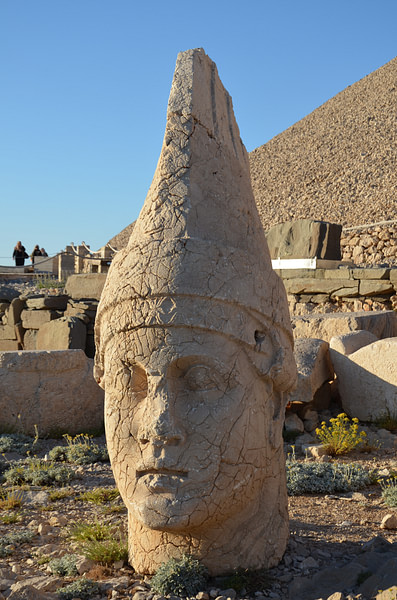 King Antiochus I on Mount Nemrut Carole Raddato (CC BY-NC-SA) ](https://www.worldhistory.org/image/12585/king-antiochus-i-on-mount-nemrut/ "King Antiochus I on Mount Nemrut")Antiochus I Theos maintained his legitimacy as a Persian king via his connection to [Darius](https://www.worldhistory.org/disambiguation/darius/) I but expanded this by claiming direct descent, through his mother Laodice VII Thea (b. c. 122 BCE), from [Seleucus I Nicator](https://www.worldhistory.org/Seleucos_I/) (r. 305-281 BCE), founder of the Seleucid Empire, and [Ptolemy I](https://www.worldhistory.org/Ptolemy_I/) Soter (r. 305/304-282 BCE) of the [Ptolemaic Dynasty](https://www.worldhistory.org/Ptolemaic_Dynasty/) of [Egypt](https://www.worldhistory.org/egypt/), as well as others who had served as generals of Alexander the Great. He thereby established himself as a Greco-Persian monarch and assumed the title of 'Antiochus, the just god, friend of Romans and Greeks', which pleased Rome while, at the same time, arranging the marriage of his daughter, Laodice, to King Orodes II of Parthia (r. 57-37 BCE) and securing peace with the east.
His clever political maneuverings kept Commagene from being absorbed by either Rome or the Parthians and maintained social stability while he grew rich from trade. Believing himself to be a god in human form, he created a royal cult based upon worship of himself and including a [pantheon](https://www.worldhistory.org/Pantheon/) of syncretized Greco-Persian deities. In order that he might live forever in the hearts of his people – and among his gods as their equal - he decreed a great mortuary complex be built at Mount Nemrut which included an enormous tumulus and ornate statuary of himself, the other gods, and protective animals.
Out of his vast treasury, he allotted a certain sum to be used in perpetuity to hold parties on Mount Nemrut at his [tomb](https://www.worldhistory.org/tomb/) every year on his birthday and the date of his coronation. He explicitly stipulated that everyone who attended was to enjoy themselves fully by setting aside the cares and antagonisms they were involved in at the base of the mountain before making the ascent to his celebration. He also revitalized the three major cities of Commagene, possibly reinforcing the walls around Samosata of Sames II, improved the efficiency of Ptolemaeus' original administrative vision, and brought the kingdom to an economic and cultural height it would not see again until the reign of Antiochus IV, the last king of Commagene.
Although Antiochus I Theos managed to maintain friendly relations throughout his reign, he was finally forced to choose sides by his father-in-[law](https://www.worldhistory.org/disambiguation/law/) Orodes II and backed Orodes' son, Pacorus I (d. 38 BCE) in a [war](https://www.worldhistory.org/disambiguation/War/) in [Syria](https://www.worldhistory.org/syria/) against Rome. Pacorus I was defeated and killed and the victorious Roman general, Publius Ventidius Bassus, came after Antiochus I Theos for betraying Rome, confining him under siege at Samosata. Antiochus tried to bribe his way out of trouble but Ventidius Bassus rejected his offer.
[Mark Antony](https://www.worldhistory.org/Mark_Antony/) (l. 83-30 BCE) took over the siege when it became clear Ventidius Bassus could not break the fortifications, but he had no better luck and withdrew after accepting a bribe of 300 talents, significantly less than what Antiochus had offered Bassus earlier. Antiochus I Theos was killed by the Parthian king Phraates IV (r. 37-2 BCE) in 38 BCE in a coup in which he assassinated Orodes II (Phraates IV's father) and his wife Laodice, the brothers and half-brothers of Phraates IV, and Antiochus I Theos of Commagene who would have sought revenge.
### Later Kings & Antiochus IV
He was succeeded by his son Mithridates II (r. 38-20 BCE) who allied himself with Mark [Antony](https://www.worldhistory.org/Mark_Antony/) of Rome in his conflict with [Octavian](https://www.worldhistory.org/augustus/) (the future [Augustus](https://www.worldhistory.org/augustus/) [Caesar](https://www.worldhistory.org/disambiguation/caesar/), r. 27 BCE - 14 CE). Mithridates II had co-ruled with his father and was no doubt present at Antony's siege of Samosata when Antony had proved himself more reasonable than Bassus. Mithridates II proved his loyalty to Antony by personally commanding his own forces at the [Battle of Actium](https://www.worldhistory.org/Battle_of_Actium/) in 31 BCE at which Antony and [Cleopatra VII](https://www.worldhistory.org/Cleopatra_VII/) of Egypt were defeated by Octavian. He afterwards swore loyalty to Augustus and continued to align his kingdom with Rome's interests. After his death, he was succeeded by his son Mithridates III (r. 20-12 BCE) about whose reign almost nothing is known.
Mithridates III was succeeded by his son Antiochus III Epiphanes (r. 12 BCE - 17 CE) whose reign was also unremarkable except for his unexpected death which left Commagene without a king. Antiochus III's two children – Antiochus IV (l. c. 17 - c. 72 CE; r. 38-72 CE) and Iotapa (r. 38-52 CE) – were too young to assume the throne and the court counselors, apparently, refused to appoint a regent. They instead appealed to Rome for help in finding a king and Rome responded by simply taking control of the kingdom, holding it in trust for Antiochus IV between 17-38 CE. Antiochus IV and Iotapa were taken to Rome, granted [Roman citizenship](https://www.worldhistory.org/article/859/roman-citizenship/), and raised as Romans.
[ 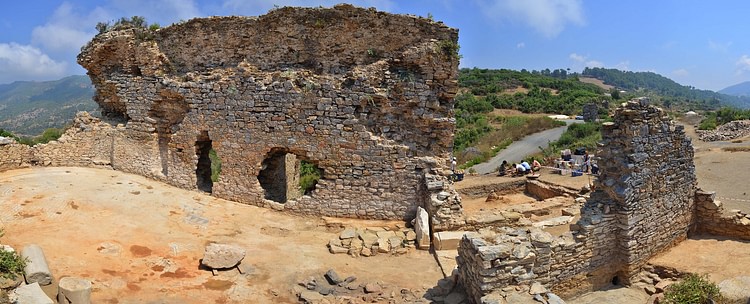 Bath Complex at Antiochia ad Cragum orientalizing (CC BY-NC-ND) ](https://www.worldhistory.org/image/11030/bath-complex-at-antiochia-ad-cragum/ "Bath Complex at Antiochia ad Cragum")The brother and sister, as nobles and guests of Rome, moved in the elite [patrician](https://www.worldhistory.org/Patrician/) circles and made friends with many of the notables of the day. Among Antiochus IV's friends was the young [Caligula](https://www.worldhistory.org/Caligula/), adoptive son of the emperor [Tiberius](https://www.worldhistory.org/Tiberius/) (r. 14-37 CE), who would later succeed him (r. 37-41 CE). After Tiberius died and Caligula assumed power, he returned Commagene to Antiochus IV and his, by then, sister-wife Iotapa. He also presented Antiochus IV with all the revenue Commagene had earned as a Roman province since 17 CE (upwards of a million [gold](https://www.worldhistory.org/gold/) pieces) and added a part of Cilicia (Cilicia Aspera) to the kingdom. A year later, Caligula became displeased with Antiochus IV and took the kingdom back (for reasons unknown), placing it again under Roman rule. Antiochus IV continued to live in his kingdom, without any political power, until Caligula was assassinated and his successor, [Claudius](https://www.worldhistory.org/claudius/) (r. 41-54 CE) returned Commagene to Antiochus IV.
Antiochus IV used Caligula's money to build himself a grand [city](https://www.worldhistory.org/city/) on the coast of Cilicia (now part of Commagene as Caligula's gift) known as [Antiochia ad Cragum](https://www.worldhistory.org/Antiochia_ad_Cragum/) (“Antioch on the Cliffs” or “Antioch at Cragus”). The city incorporated Greek, Luwian, Hittite, Persian, and Armenian architecture, symbolism, and ornamentation to represent all the different ethnic groups of Commagene. A grand [temple](https://www.worldhistory.org/temple/) (55x33.8 feet/16.465x10.32 meters long) was built, ornamented with indigenous designs, notably the six-petal flower of the Luwians and Hittites who first inhabited the region. Antiochus IV also decreed a great bath complex be constructed which measured 114 feet long by 65 feet wide (35 x 20 meters), encompassing an area of 5, 249 square feet (1,600 sq. meters), which was open to the public. A colonnaded street brought visitors from the city's gate to an ornate portico by the pool with a [mosaic](https://www.worldhistory.org/Mosaic/) floor. The mosaic at [Antiochia](https://www.worldhistory.org/Antiochia/) ad Cragum, in fact, is the largest ever found in modern-day Turkey and exemplifies the wealth Antiochus IV lavished on his city.
### Conclusion
His sister-wife Iotapa died in 52 CE and he had another city, [Aytap](https://www.worldhistory.org/Iotape/), built in her honor down the coast. He was, at this time (c. 71 CE) among the richest tributary kings of Rome and enjoyed a good relationship with the [Roman government](https://www.worldhistory.org/Roman_Government/). Commagene at this time was at its greatest height since the reign of Antiochus I Theos and Antiochus IV had just ingratiated himself to the new emperor [Vespasian](https://www.worldhistory.org/Vespasian/) (r. 69-79 CE) by supporting him over other contenders for the throne and sending him and his son troops.
In 72 CE, however, a senator named Lucius Junius Caesennius Paetus (governor of Roman Syria c. 70-72 CE) accused Antiochus IV and his sons of plotting to overthrow Vespasian. There was no evidence of any conspiracy on the part of Commagene, but this did not seem to matter. Vespasian was notoriously paranoid, and the wealth and popularity of Antiochus IV was indisputable, and so Vespasian listened to Paetus and gave him leave to march on Antiochia ad Cragum without ever even asking Antiochus IV to refute the charge.
[  Ruins of Aytap Htkava (CC BY-SA) ](https://www.worldhistory.org/image/5139/ruins-of-aytap/ "Ruins of Aytap")According to some accounts, the sons of Antiochus IV met Paetus' troops in [battle](https://www.worldhistory.org/disambiguation/battle/), according to others, there was no battle at all, but all agree that Antiochus IV himself did not raise arms against Rome. He most likely surrendered to Paetus, who clearly had only made the accusation to acquire Commagene's wealth, but this is unknown. He left the city afterwards, lived in [Cilicia Campestris](https://www.worldhistory.org/Cilicia_Campestris/), [Greece](https://www.worldhistory.org/greece/), and finally at Rome. What happened to Paetus is unknown, but Antiochus was received with respect at Rome, as were his sons, and must have died there, although no death date is known. Vespasian abolished the Kingdom of Commagene the same year and absorbed the region into the province of Cilicia.
Today, the Kingdom of Commagene is remembered primarily through the monumental site of Nemrut Dagi on Mount Nemrut, (rediscovered in 1881 CE, and a UNESCO World Heritage site since 1987 CE), and the various other building projects, reliefs, and statuary from the reign of Antiochus I Theos and his successors. The ruins of Antiochia ad Cragum and Aytap also remain popular tourist attractions as well as communal recreation areas, down by the water, for the local population. Nemrut Dagi, however, is the central monument to Commagene and its kings, drawing millions of visitors every year from around the world, and fulfilling the wish of Antiochus I Theos that his name should live on forever.
#### Editorial Review
This human-authored definition has been reviewed by our editorial team before publication to ensure accuracy, reliability and adherence to academic standards in accordance with our [editorial policy](https://www.worldhistory.org/static/editorial-policy/).
## Bibliography
- [Bryce, T. *The Kingdom of the Hittites.* Oxford University Press (1998-06-04), 2010.](https://www.worldhistory.org/books/B01A64OSES/)
- [Cassius Dio & Mallan, C. T. *Cassius Dio Histories.* Oxford University Press, 2010.](https://www.worldhistory.org/books/0198797893/)
- [COMMAGENE – Encyclopaedia Iranica - by Michael Weiskopf](https://iranicaonline.org/articles/commagene-a-portion-of-southwestern-asia-minor-modern-turkey- "COMMAGENE – Encyclopaedia Iranica - by Michael Weiskopf"), accessed 25 Aug 2020.
- [Hoff, M. C. & Townsend, R. F. *Rough Cilicia: New Historical and Archaeological Approaches.* Oxbow Books, 2013.](https://www.worldhistory.org/books/1842175181/)
- [Massive Mosaic Uncovered in Roman Cilicia by Noah Wiener](https://www.biblicalarchaeology.org/daily/ancient-cultures/ancient-near-eastern-world/massive-mosaic-uncovered-in-roman-cilicia/ "Massive Mosaic Uncovered in Roman Cilicia by Noah Wiener"), accessed 25 Aug 2020.
- [Mellor, R. *The Historians of Ancient Rome.* Routledge, 2012.](https://www.worldhistory.org/books/0415527163/)
- [Nemrut Dağ - UNESCO World Heritage Site](https://whc.unesco.org/en/list/448/ "Nemrut Dağ - UNESCO World Heritage Site"), accessed 25 Aug 2020.
- [Stiebing Jr., W. H. *Ancient Near Eastern History and Culture.* Pearson Higher Education, 2008.](https://www.worldhistory.org/books/032142297X/)
- [Strabo & Roller, D. W. *The Geography of Strabo.* Cambridge University Press, 2010.](https://www.worldhistory.org/books/1316625672/)
- [Van De Mieroop, M. *A History of the Ancient Near East ca. 3000 - 323 BC, 2nd Edition.* Blackwell Publishing, 2006.](https://www.worldhistory.org/books/1405149116/)
## About the Author
Joshua J. Mark is World History Encyclopedia's co-founder and Content Director. He was previously a professor at Marist College (NY) where he taught history, philosophy, literature, and writing. He has traveled extensively and lived in Greece and Germany.
- [Linkedin Profile](https://www.linkedin.com/pub/joshua-j-mark/38/614/339)
## Timeline
- **163 BCE - 130 BCE**: Reign of the first king of [Commagene](https://www.worldhistory.org/Commagene/), Ptolemaeus of Commagene.
- **163 BCE - 72 CE**: Duration of The Kingdom of [Commagene](https://www.worldhistory.org/Commagene/), founded by Ptolemaeus of Commagene.
- **130 BCE - 109 BCE**: Reign of the second king of [Commagene](https://www.worldhistory.org/Commagene/), Sames II.
- **109 BCE - 70 BCE**: Reign of the third king of [Commagene](https://www.worldhistory.org/Commagene/), Mithridates I Callinicus.
- **70 BCE - 38 BCE**: Reign of the fourth (and greatest) king of [Commagene](https://www.worldhistory.org/Commagene/), Antiochus I Theos, who built the mortuary complex of Nemrut Dagi on Mount Nemrut.
- **38 BCE - 20 BCE**: Reign of the fifth king of [Commagene](https://www.worldhistory.org/Commagene/), Mithridates II.
- **20 BCE - 12 BCE**: Reign of the sixth king of [Commagene](https://www.worldhistory.org/Commagene/), Mithridates III.
- **12 BCE - 17 CE**: Reign of the seventh king of [Commagene](https://www.worldhistory.org/Commagene/), Antiochus III Epiphanes.
- **17 CE - 38 CE**: The Kingdom of [Commagene](https://www.worldhistory.org/Commagene/) is ruled by [Rome](https://www.worldhistory.org/Rome/).
- **38 CE - 72 CE**: Reign of the eighth and last king of [Commagene](https://www.worldhistory.org/Commagene/), Antiochus IV (also considered the greatest), who built [Antiochia ad Cragum](https://www.worldhistory.org/Antiochia_ad_Cragum/) and [Aytap](https://www.worldhistory.org/Iotape/).
- **72 CE**: The Kingdom of [Commagene](https://www.worldhistory.org/Commagene/) absorbed by the [Roman Empire](https://www.worldhistory.org/Roman_Empire/) into the province of [Cilicia](https://www.worldhistory.org/Cilicia/).
## Cite This Work
### APA
Mark, J. J. (2020, August 26). Commagene. *World History Encyclopedia*.
### Chicago
Mark, Joshua J.. "Commagene." *World History Encyclopedia*, August 26, 2020. .
### MLA
Mark, Joshua J.. "Commagene." *World History Encyclopedia*, 26 Aug 2020, .
## License & Copyright
Submitted by [Joshua J. Mark](https://www.worldhistory.org/user/JPryst/ "User Page: Joshua J. Mark"), published on 26 August 2020. The copyright holder has published this content under the following license: [Creative Commons Attribution-NonCommercial-ShareAlike](https://creativecommons.org/licenses/by-nc-sa/4.0/deed.en). This license lets others remix, tweak, and build upon this content non-commercially, as long as they credit the author and license their new creations under the identical terms. When republishing on the web a hyperlink back to the original content source URL must be included. Please note that content linked from this page may have different licensing terms.