---
title: Cincinnatus
author: Donald L. Wasson
source: https://www.worldhistory.org/Cincinnatus/
format: machine-readable-alternate
license: Creative Commons Attribution-NonCommercial-ShareAlike (https://creativecommons.org/licenses/by-nc-sa/4.0/)
updated: 1970-01-01
---
# Cincinnatus
_Authored by [Donald L. Wasson](https://www.worldhistory.org/user/DWasson/)_
Lucius Quinctius Cincinnatus was a [Roman](https://www.worldhistory.org/disambiguation/Roman/) [consul](https://www.worldhistory.org/Consul/) (460 BCE) and dictator (458 and 439 BCE), a legendary figure in the early days of the [Roman Republic](https://www.worldhistory.org/Roman_Republic/). He responded to a call from the [city](https://www.worldhistory.org/city/) fathers, left his plow lying in the fields, donned his senatorial toga, and led the [Roman army](https://www.worldhistory.org/Roman_Army/) to victory over the invading Aequi, only to return to his small farm 15 days later. For generations, he served as the symbol to Romans young and old of what a loyal citizen ought to aspire.
Although Cincinnatus has long been considered a heroic representation of the virtuous Roman citizen, there are some historians who doubt the story altogether, claiming it to be nothing more than a myth. Yet, while there are many who may not accept the story as genuine, they contend that it does not really matter whether or not it is true. As with any myth or legend, the story of the heroic Cincinnatus served a useful purpose by rallying the citizens of the fledgling Republic together as one, demonstrating that a loyal citizen must place the matters of the state over his own self-interest.
### Aequi Threat
According to the accepted version of the story, Cincinnatus was a [patrician](https://www.worldhistory.org/Patrician/) and former consul who had fallen on difficult times, finding himself farming a small plot of four acres along the right bank of the Tiber River, later called Quinctian Meadows (*prata Quinctia*) in his honor. It was 458 BCE, and the young Roman Republic was being besieged by its neighbors. This time it was the Aequi, a small tribe located in central [Italy](https://www.worldhistory.org/italy/) east of [Rome](https://www.worldhistory.org/Rome/). The Roman army under the leadership of the less-than-capable consul Lucius Minucius Esquilinus Augurinus was trapped on Mt. Algidus in the Alban Hills southeast of Rome. With few alternatives - the consul Gaius Nautius Rutilus was equally incapable - Rome turned to the elderly Cincinnatus and offered him the position of dictator. A dictator or *magister populi* was appointed in times of extreme emergency, serving for only six months; however, during this period he held complete authority.
According to the 1st-century BCE Roman historian [Livy](https://www.worldhistory.org/livy/) in his *History of Rome*, Cincinnatus was plowing his field (others believe he was digging a ditch) when approached by a delegation from Rome. The former consul was unanimously chosen because "in him were the courage and resolution equal to the majestic authority of that office" (3.26). Livy added,
> After mutual salutations he was requested to put on his toga that he might hear the mandate of the senate, and they expressed the hope that it might turn out well for him and for the State. He asked then, in surprise, if all was well, and bade his wife, Racilia, bring him his toga quickly from the cottage. (3.26)
After an appeal for the blessings of the gods upon the Republic and "to save his old age from bringing loss or dishonor upon his country in her trouble," he listened as the delegation informed him of the danger facing Rome (3.26). With some hesitation, Cincinnatus, still questioning why he had been chosen, accepted the appointment and left with the delegation. Upon entering the city, he advanced to the assembly, proclaiming a suspension of all public and private business and ordering the shops to be closed. Next, he requested all men of military age to arrive at the Campus Martius fully armed with five days of rations. Victory, according to the legend, was swift, and a limited peace with the Aequi was reached. Livy wrote of the [battle](https://www.worldhistory.org/disambiguation/battle/) and the requests of the defeated Aequi, "… not to make their extermination the price of victory, but to allow them to surrender their arms and depart" (3.29). Unfortunately, the Aequi would return in 457 and 455 BCE; another reason why many believe the story to be untrue.
### Triumphal Return
Within 15 days, Cincinnatus had left his farm, led the Roman army to victory, and returned to the plow. Of course, he could not return home without celebration. Following a parade of the defeated enemy commanders, Cincinnatus's own conquering Roman soldiers, and a display of the captured booty, the victorious dictator's [chariot](https://www.worldhistory.org/chariot/) made its way through the city, beginning at the Campus Martius (Field of [Mars](https://www.worldhistory.org/Mars/)), proceeding past the [Circus Maximus](https://www.worldhistory.org/Circus_Maximus/), up the Via Sacra to the [Temple](https://www.worldhistory.org/temple/) of [Jupiter](https://www.worldhistory.org/jupiter/) where appropriate sacrifices were made. The city celebrated with a [Roman triumph](https://www.worldhistory.org/Roman_Triumph/). Livy wrote, "It is said that tables spread with provisions stood before all the houses, and the feasters followed the chariot with songs of [triumph](https://www.worldhistory.org/Roman_Triumph/) and the customary jests and lampoons" (3.29). Relinquishing his position of dictator, Cincinnatus returned to his farm.
### Second Dictatorship
According to a second myth, Cincinnatus was again summoned from the plow during the Maelius-controversy in 439 BCE. Supposedly, the plebian Spurius Maelius was rumored to be attempting tyranny against the Republic. For the past year, Rome had been caught in a terrible famine. To oversee the grain supply, the [Roman Senate](https://www.worldhistory.org/Roman_Senate/) appointed the old former consul Minucius who was found incapable of supplying enough grain for the people. Many believed at that time that wealthy Maelius purposely bought large amounts of wheat outside the city, hoping to either sell it to the people of Rome at low prices (or even giving it away free), thereby winning their favor. The city's [patricians](https://www.worldhistory.org/Patrician/) felt he was planning to establish himself in a monarchy.
[ 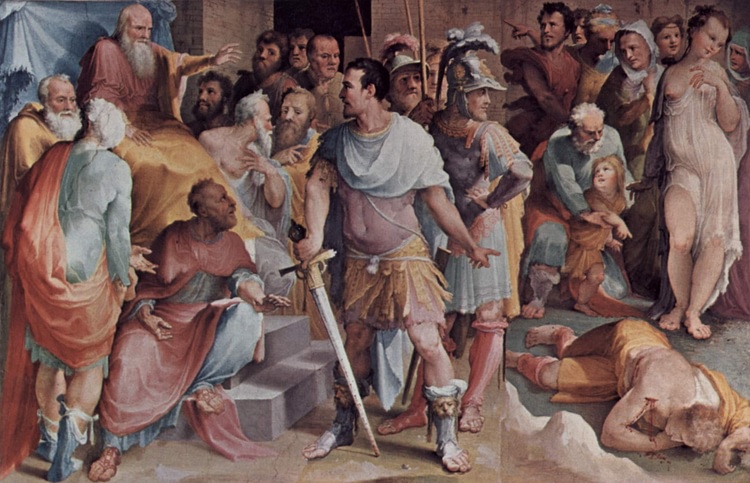 Maelius Before Cincinnatus Domenico Beccafumi (Public Domain) ](https://www.worldhistory.org/image/6475/maelius-before-cincinnatus/ "Maelius Before Cincinnatus")Again, as appointed dictator, Cincinnatus called for Maelius to appear before him, but Maelius refused. It was at this point Cincinnatus ordered his [death](https://www.worldhistory.org/disambiguation/Death/). Years later, the 1st-century BCE statesman and orator [Cicero](https://www.worldhistory.org/Cicero/) referred to Maelius in his essay *The Joys of Farming* as a usurper. According to Cicero's account of the incident, Cincinnatus was recalled and expected to resolve the problem, and solve it he did. "His were the orders, as dictator, upon which his Master of the Horse, Gaius Servilius Ahala, caught Spurius Maelius attempting to make himself king, and put him to death" (236).
### Myth or Reality?
Why is Cincinnatus considered by so many to be a hero? Are any of the stories about him true? The answer to both questions given by many is that it does not really matter. Of course, not everyone believed him to be heroic, even during his lifetime, there were many in Rome who would not call him a hero. Many plebians would definitely not consider him heroic for his opposition to the rights of both the plebians and the poor of the city. Livy wrote of their reaction to the dictator's arrival in the city, "…they were by no means so pleased to see Quinctius; they regarded the power with which he was invested as excessive, and the man himself more dangerous than his power" (3.26). To many others, however, he was the model of the ideal Roman. He had gained glory and dignity through his victory over the Aequi, but out of duty and loyalty, he relinquished the power of dictator, caring more for the good of the state than his personal prestige.[ 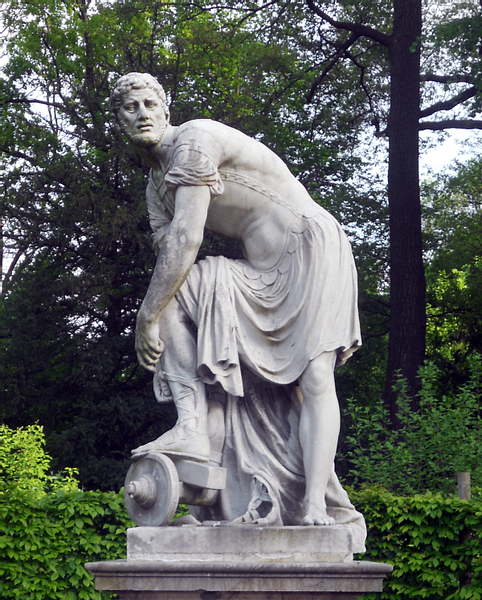 Cincinnatus at Schönbrunn Maclemo (CC BY-SA) ](https://www.worldhistory.org/image/11681/cincinnatus-at-schonbrunn/ "Cincinnatus at Schönbrunn")
This unselfish act represented both the virtues of a true Roman as well as the greatness of the Republic. These virtues included leading a simple life, being patriotic and committed to Roman values, being even-handed, and forgoing riches. However, many patriotic Romans questioned the validity of the stories concerning Cincinnatus. Even Cicero, who wrote of the dictator's recall in 439 BCE, raised some doubt to the supposed legendary exploits when he wrote,
> But I want to talk about my own affairs, so let us return to the farmers. In those days, Senators lived on their farms - if we are to believe the story that the men sent to tell Lucius Quinctius Cincinnatus of his appointment as dictator found him at the plough (sic). (236)
Again, are the stories true? It does not seem to be important. The Romans were a proud people who looked to their past, often an ideal one, to establish and vindicate themselves and their rise to power. They looked to the rich history of their [Greek](https://www.worldhistory.org/disambiguation/greek/) neighbors with envious eyes. With Greek colonies having been on the Italian peninsula for generations, Romans had been in constant contact with the rich [Hellenistic](https://www.worldhistory.org/Hellenic_World/) [civilization](https://www.worldhistory.org/civilization/), [philosophy](https://www.worldhistory.org/philosophy/), art, [literature](https://www.worldhistory.org/literature/), and even [religion](https://www.worldhistory.org/religion/). They adopted much from the [Greek culture](https://www.worldhistory.org/disambiguation/Greek_Culture/) even hiring Greek tutors for their children. [Virgil](https://www.worldhistory.org/virgil/)'s [Aeneid](https://www.worldhistory.org/The_Aeneid/) even connected Rome's past with one of the greatest Greek legends, the [Trojan War](https://www.worldhistory.org/Trojan_War/). Cincinnatus gave the Romans a home-grown hero. He left the plow to lead Roman forces to victory and without a second thought returned to his farm, forgoing the power of a dictator. What could be more heroic than that?
#### Editorial Review
This human-authored definition has been reviewed by our editorial team before publication to ensure accuracy, reliability and adherence to academic standards in accordance with our [editorial policy](https://www.worldhistory.org/static/editorial-policy/).
## Bibliography
- [Anonymous. *The Encyclopedia of Ancient History, 13 Volume Set.* Wiley-Blackwell, 2012.](https://www.worldhistory.org/books/140517935X/)
- [Beard, M. *SPQR.* Liveright, 2015.](https://www.worldhistory.org/books/1631492225/)
- [Everitt, A. *The Rise of Rome.* Random House Trade Paperbacks, 2012.](https://www.worldhistory.org/books/0812978153/)
- [Gwynn, D.M. *The Roman Republic.* Oxford University Press, 2012.](https://www.worldhistory.org/books/0199595119/)
- [Hornblower, S. *The Oxford Classical Dictionary.* Oxford University Press, 2012.](https://www.worldhistory.org/books/0199545561/)
- [Marcus Tullius Cicero. *Cicero.* Penguin Classics, 1960.](https://www.worldhistory.org/books/0140440992/)
- [Titus Livy. *History of Rome.* .](https://www.worldhistory.org/books/0140448098/)
## About the Author
Donald has taught Ancient, Medieval and U.S. History at Lincoln College (Normal, Illinois)and has always been and will always be a student of history, ever since learning about Alexander the Great. He is eager to pass knowledge on to his students.
## Timeline
- **460 BCE**: Consulship of Lucius Quinctius [Cincinnatus](https://www.worldhistory.org/Cincinnatus/).
- **458 BCE**: [Cincinnatus](https://www.worldhistory.org/Cincinnatus/) leaves his plow, defeats the Aequi as dictator, and returns to his land in 15 days.
- **439 BCE**: Second dictatorship of [Cincinnatus](https://www.worldhistory.org/Cincinnatus/).
## Cite This Work
### APA
Wasson, D. L. (2017, April 04). Cincinnatus. *World History Encyclopedia*.
### Chicago
Wasson, Donald L.. "Cincinnatus." *World History Encyclopedia*, April 04, 2017. .
### MLA
Wasson, Donald L.. "Cincinnatus." *World History Encyclopedia*, 04 Apr 2017, .
## License & Copyright
Submitted by [Donald L. Wasson](https://www.worldhistory.org/user/DWasson/ "User Page: Donald L. Wasson"), published on 04 April 2017. The copyright holder has published this content under the following license: [Creative Commons Attribution-NonCommercial-ShareAlike](https://creativecommons.org/licenses/by-nc-sa/4.0/deed.en). This license lets others remix, tweak, and build upon this content non-commercially, as long as they credit the author and license their new creations under the identical terms. When republishing on the web a hyperlink back to the original content source URL must be included. Please note that content linked from this page may have different licensing terms.