---
title: Cerveteri
author: Mark Cartwright
source: https://www.worldhistory.org/Cerveteri/
format: machine-readable-alternate
license: Creative Commons Attribution-NonCommercial-ShareAlike (https://creativecommons.org/licenses/by-nc-sa/4.0/)
updated: 1970-01-01
---
# Cerveteri
_Authored by [Mark Cartwright](https://www.worldhistory.org/user/markzcartwright/)_
Cerveteri ([Etruscan](https://www.worldhistory.org/Etruscan_Civilization/) name: Cisra or Caisra, [Greek](https://www.worldhistory.org/disambiguation/greek/): Agylla, [Roman](https://www.worldhistory.org/disambiguation/Roman/): Caere) was an important Etruscan town which flourished between the 7th and 4th century BCE. Located near the western coast of central [Italy](https://www.worldhistory.org/italy/), around 50 km north of [Rome](https://www.worldhistory.org/Rome/), Cerveteri is today most famous for its thousands of rock-cut tombs which were rich in artefacts and [wall](https://www.worldhistory.org/wall/) paintings depicting scenes from Etruscan daily life. Outstanding among these is the [Regolini-Galassi tomb](https://www.worldhistory.org/article/1020/regolini-galassi-tomb/), found chock-full of precious artefacts from [silver](https://www.worldhistory.org/Silver/) cups to the finest Etruscan [gold](https://www.worldhistory.org/gold/) jewellery ever discovered. Etruscan Cerveteri is listed by UNESCO as a World Heritage Site.
### Early Settlement
Cerveteri, located on a tufa outcrop overlooking the Tyrrhenian Sea, has archaeological evidence of settlement from the [Bronze Age](https://www.worldhistory.org/disambiguation/Bronze_Age/) and has cemeteries which date back to the [Iron Age](https://www.worldhistory.org/disambiguation/Iron_Age/). Many of these latter burials contain instruments related to wool working such as spools, spindles and loom weights made of [pottery](https://www.worldhistory.org/pottery/) and, less frequently, [bronze](https://www.worldhistory.org/disambiguation/bronze/). Blessed with fertile land for [agriculture](https://www.worldhistory.org/disambiguation/Agriculture/), mineral resources in the nearby Tolfa Mountains, and beginning to exchange goods with neighbours such as [Tarquinia](https://www.worldhistory.org/Tarquinia/), Cerveteri was a thriving settlement of the pre-[Etruscan culture](https://www.worldhistory.org/Etruscan_Civilization/) known as the Villanovan (1000-750 BCE) and was set to become a prosperous town in the [Etruria](https://www.worldhistory.org/Etruscan_Civilization/) region of central Italy.
### A Thriving Etruscan [City](https://www.worldhistory.org/city/)
From the 7th century BCE, Cerveteri was an important production centre for the indigenous *[bucchero](https://www.worldhistory.org/Bucchero/)* pottery (perhaps even the first, c. 675 BCE), which has a glossy dark grey, almost black finish, as well as wares imitating Greek (especially Ionian) and Near Eastern styles, sometimes made by Greek immigrant artists. The town's workshops produced its own distinctive vase shape, the *Caeretan hydria*, a large two-handled vessel used for holding water and often decorated with scenes from Greek and Etruscan [mythology](https://www.worldhistory.org/mythology/). Evidence of Cerveteri's position as a [trade](https://www.worldhistory.org/disambiguation/trade/) centre takes the form of the many fine Greek vases found at the site. The general prosperity of the city's elite is evidenced in the large tombs and their contents, placed within tumuli and set in orderly rows along streets. By the 6th century BCE, city covered some 150 hectares and was creating colonies of its own such as at Tolfa.
Etruscan Cerveteri is the only known city of that [culture](https://www.worldhistory.org/disambiguation/culture/) to have had its own treasury at the sacred site of Delphi in [Greece](https://www.worldhistory.org/greece/), indicative of its status as one of the richest members of the Etruscan League. It had three ports: Alsium, Punicum, and Pyrgi with its two grand temples and sanctuary. One of these temples had three gold plaques nailed to its door, which were dedicated by a king of Cerveteri called Thefarie Velianas. The inscriptions, dating to around 500 BCE, were written in both Etruscan and Phoenician, again indicating the town's role as an international trade centre.
Cerveteri was a member of the Etruscan League, a loose confederacy of 12 (or perhaps 15) Etruscan towns. They included [Chiusi](https://www.worldhistory.org/Chiusi/), [Populonia](https://www.worldhistory.org/Populonia/), Tarquinia (Tarchuna), [Vulci](https://www.worldhistory.org/Vulci/) (Velch) and [Volterra](https://www.worldhistory.org/Volterra/). Very little is known of this league except that its members had common religious ties and that leaders met annually at the Fanum Voltumnae sanctuary near [Orvieto](https://www.worldhistory.org/volsinii/) (exact location as yet unknown). That Cerveteri was one of the most advanced Etruscan [cities](https://www.worldhistory.org/city/) and something of a trendsetter is evidenced in finds of some of the earliest pottery, artwork, and inscriptions produced in the region of Etruria.
[  Etruscan Civilization NormanEinstein (GNU FDL) ](https://www.worldhistory.org/image/119/etruscan-civilization/ "Etruscan Civilization")### Decline & Roman [Conquest](https://www.worldhistory.org/warfare/)
Cerveteri's interests were safeguarded following a naval victory in the [Battle](https://www.worldhistory.org/disambiguation/battle/) of Alalia (aka Battle of the Sardinian Sea) in 540 BCE. Allied with a Carthaginian force, they saw off a fleet of the Phocaeans. According to [Herodotus](https://www.worldhistory.org/herodotus/) (1:167), some of the Greek survivors were taken to Cerveteri and brutally stoned to [death](https://www.worldhistory.org/disambiguation/Death/). There then followed a curse of paralysis on anyone who went near the spot of this tragedy. Seeking to allay the curse the rulers of Cerveteri consulted the oracle at Delphi and were told to hold athletic games in honour of the dead. This they did, says Herodotus, and continued to do so regularly thereafter.
A period of decline set in, though, from the mid-5th century BCE as control of the lucrative local trade routes fell into the hands of [Sicily](https://www.worldhistory.org/sicily/)'s rising power [Syracuse](https://www.worldhistory.org/syracuse/). The loss of the naval battle at Cumae in 474 BCE was the beginning of a slow decline. Then the Syracusan tyrant Dionysius I, no doubt remembering the Etruscan support of [Athens](https://www.worldhistory.org/Athens/)' attack on his city 30 years before, sent an expedition to central Italy to grab what riches it could. The ports of Cerveteri were sacked and the temples robbed of their treasures in 384 BCE. Further Syracusan attacks would hit Etruria in the following decades. Even worse was to come, however, when the Etruscan's southern neighbours started to show more territorial ambition too: the Romans were coming.
The Romans would exploit the lack of political and military unity between the Etruscan League members and eventually take over all of the Etruscan cities. Cerveteri had actually been a loyal ally of Rome, giving a safe haven for the [Vestal Virgins](https://www.worldhistory.org/Vestal_Virgin/), for example, when the Gauls had attacked Rome in the 4th century BCE. The cultural and military march of the Romans would stop for no one, though, and Cerveteri was assimilated into the Republic along with its fellow Etruscan cities after a long and bloody conflict punctuated by periods of peace. A Roman maritime colony was established at Pyrgi, and by the early 2nd century BCE Cerveteri's ultimate Romanisation included the granting of [Roman citizenship](https://www.worldhistory.org/article/859/roman-citizenship/), several building projects including a [theatre](https://www.worldhistory.org/disambiguation/theatre/), and the imposition of further Roman colonies in Cerveteri's former territories. Cerveteri became something of a cultural backwater, dedicating itself to agriculture and the production of cloth and rope. Gone forever were its glory days as one of the liveliest cultural centres of the ancient [Mediterranean](https://www.worldhistory.org/disambiguation/mediterranean/).
### Archaeological Remains
To the south of the city, the foundations of two large temples have been excavated. Both dating to the 6th century BCE, one may have been dedicated to [Hercules](https://www.worldhistory.org/hercules/), if the presence of an inscribed cup and several clubs are taken as evidence of votive offerings to the [god](https://www.worldhistory.org/God/). Similarly, a lead weight inscribed with the Etruscan word for [Hermes](https://www.worldhistory.org/Hermes/) (*Turms*) may indicate the deity of the second [temple](https://www.worldhistory.org/temple/). A third large structure, known as the Manganello temple, had a tufa block base, cisterns, water channels, wells, and a furnace, perhaps as part of workshop manufacturing votive goods.
[ 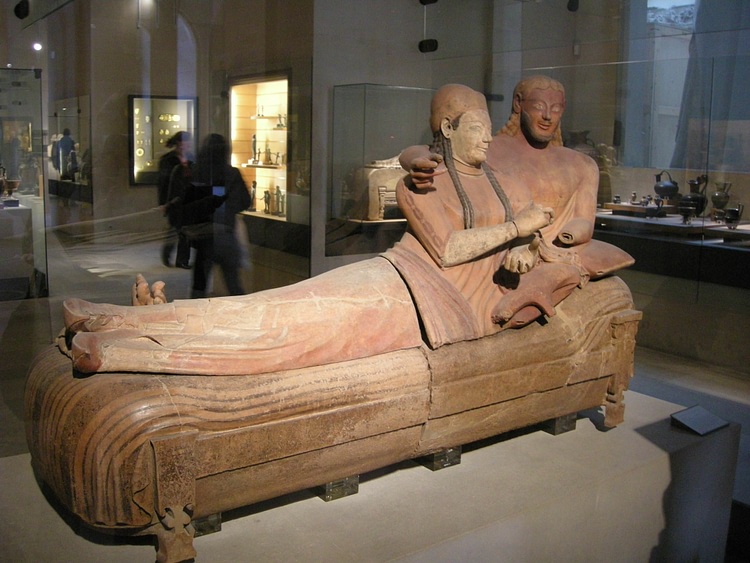 Sarcophagus of the Married Couple, Cerveteri Sailko (CC BY-SA) ](https://www.worldhistory.org/image/6272/sarcophagus-of-the-married-couple-cerveteri/ "Sarcophagus of the Married Couple, Cerveteri")The thousands of rock-cut chamber tombs at Cerveteri are distributed over several cemeteries, the Banditaccia, Cava Della Pozzolana, Monte Abatone, and Sorbo, the latter dating back to the Iron Age. The earliest Etruscan tombs date to the 7th century BCE. Many are tumuli, that is grass and earth mounds covering a rock base, either made from blocks or cut out of natural outcrops. The largest are over six metres in diameter. Other kinds of tombs are the distinctive cube-like structures in the Banditaccia necropolis. These, dating from the mid-6th century BCE, are made from large stone blocks and, again, incorporate natural rocks; each has a single doorway entrance, and inside are stone benches on which the deceased were laid, carved altars, and sometimes stone seats. Set in rows, the tombs perhaps indicate a greater concern with town-planning at that time.
Unlike the tombs at Tarquinia, for example, many of the wall paintings at Cerveteri were applied directly to the stone walls without a plaster underlayer. This has meant that they have deteriorated much more than at other Etruscan sites. Nevertheless, there are still some fine examples of [Etruscan art](https://www.worldhistory.org/Etruscan_Art/). Scenes commonly show Greek myths, animals, and daily life.
The splendid [Tomb](https://www.worldhistory.org/tomb/) of the Stucco Reliefs was constructed for the Matuna family during the last quarter of the 4th century BCE. It is accessed via a steep stepped corridor which opens into a chamber with stone benches on all sides and places for 32 bodies. The chamber's two columns and walls are covered in painted stucco depictions of everyday objects from tools to boardgames. The objects hang from nails in imitation of the typical Etruscan household where storage cabinets are largely unknown and possessions were hung from the walls.
[ 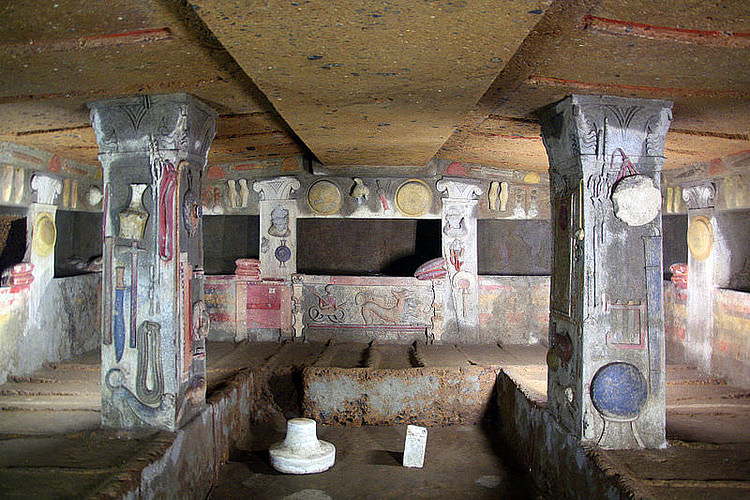 Tomb of the Reliefs, Cerveteri Roberto Ferrari (CC BY-SA) ](https://www.worldhistory.org/image/6274/tomb-of-the-reliefs-cerveteri/ "Tomb of the Reliefs, Cerveteri")Objects from the tombs of Cerveteri include many examples of exquisite gold jewellery pieces – bracelets, buckles, earrings, rings, pins, necklaces, and pendants – many of which display the most difficult goldwork techniques. There are *bucchero* wares, painted pottery (both locally produced and imported, especially from [Corinth](https://www.worldhistory.org/corinth/) and Athens), terracotta sculptures, and sarcophagi decorated with relief sculptures. One outstanding example of the latter, now in the Louvre museum, has a married couple figure [sculpture](https://www.worldhistory.org/disambiguation/Sculpture/) on its lid and dates to c. 530-520 BCE. The terracotta coffin contained a cremation and was once brightly painted. Finally, many tombs contained painted terracotta plaques depicting scenes from mythology, especially. Fragments of these found scattered across Cerveteri would suggest that they were also used to decorate the interiors of private houses and public buildings.
### The Regolini-Galassi Tomb
The most spectacular tomb in terms of finds at Cerveteri is the Tomba Regolini-Galassi, named after the priest and general, respectively, who discovered it in 1836 CE. The pair discovered the tomb intact and came face to face with the skeleton, bedecked in fine jewellery, of the tomb's female occupant. She wore a gold pectoral 42 cm across decorated with animals and plants, a symbol of her high social status. The woman also wore a belt with a magnificent gold fibula made with repoussé and granulation techniques. It is decorated with five lions on its upper disk and 50 minute ducks in three-dimensions on the lower disk. Whatever the role of this person was in life, we do know her name, Larthia, inscribed on an eleven-piece silver service set found at her feet. Neither was she interred alone in the tomb, for there was a second chamber containing the ashes of a male.
[ 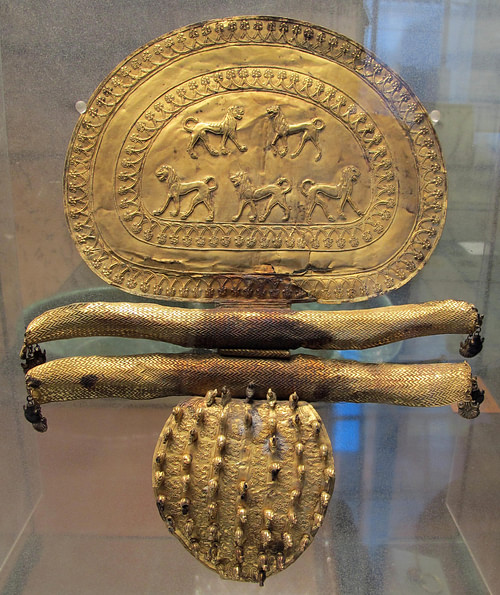 Etruscan Gold Fibula, Cerveteri Sailko (CC BY-SA) ](https://www.worldhistory.org/image/6276/etruscan-gold-fibula-cerveteri/ "Etruscan Gold Fibula, Cerveteri")Other items in the tomb, many with near Eastern-like decoration include a large bronze couch; round shields, incense burners, cauldrons, and a throne in the same material; silver cups and dishes; and *bucchero* wares in the form of bowls, pitchers, and beakers. There were large terracotta vases which once contained food for the deceased (wheat, oil, honey, and eggs). Finally, there was a four-wheeled bed-carriage on which lay the woman of the tomb and another two-wheeled [chariot](https://www.worldhistory.org/chariot/). The contents of the tomb, dated to c. 680-660 BCE, can be seen today in its own dedicated room in the Vatican Museums, Rome.
#### Editorial Review
This human-authored definition has been reviewed by our editorial team before publication to ensure accuracy, reliability and adherence to academic standards in accordance with our [editorial policy](https://www.worldhistory.org/static/editorial-policy/).
## Bibliography
- Bagnall, R.S. *The Encyclopedia of Ancient History.* Wiley-Blackwell, 2012
- [Haynes, S. *Etruscan Civilization.* J. Paul Getty Museum, 2005.](https://www.worldhistory.org/books/0892366001/)
- [Herodotus. *The Landmark Herodotus Publisher.* Anchor, 2017.](https://www.worldhistory.org/books/B004OP2S8E/)
- [Heurgon, J. *Daily Life of the Etruscans.* Phoenix, 2017.](https://www.worldhistory.org/books/B01K06LN8G/)
- [Hornblower, S. *The Oxford Classical Dictionary.* Oxford University Press, 2012.](https://www.worldhistory.org/books/0199545561/)
- [Keller, W. *The Etruscans.* Random House Inc (T), 1974.](https://www.worldhistory.org/books/0394473019/)
- [Spivey, N.J. *Etruscan Art.* Thames & Hudson, 1997.](https://www.worldhistory.org/books/0500203040/)
- [Thomson de Grummond, N. *The Religion of the Etruscans.* University of Texas Press, 2006.](https://www.worldhistory.org/books/0292721463/)
## About the Author
Mark is WHE’s Publishing Director and has an MA in Political Philosophy (University of York). He is a full-time researcher, writer, historian and editor. Special interests include art, architecture and discovering the ideas that all civilizations share.
## Timeline
- **700 BCE - 300 BCE**: The [Etruscan](https://www.worldhistory.org/Etruscan_Civilization/) [city](https://www.worldhistory.org/city/) of [Cerveteri](https://www.worldhistory.org/Cerveteri/) flourishes as a trading and manufacturing centre.
- **c. 680 BCE - c. 660 BCE**: The [Etruscan](https://www.worldhistory.org/Etruscan_Civilization/) [Regolini-Galassi Tomb](https://www.worldhistory.org/article/1020/regolini-galassi-tomb/) is constructed at [Cerveteri](https://www.worldhistory.org/Cerveteri/).
- **675 BCE**: First instances of [Etruscan](https://www.worldhistory.org/Etruscan_Civilization/) [bucchero](https://www.worldhistory.org/Bucchero/) wares are found at [Cerveteri](https://www.worldhistory.org/Cerveteri/).
- **c. 550 BCE**: The square stone tombs at [Cerveteri](https://www.worldhistory.org/Cerveteri/) are constructed.
- **540 BCE**: A joint Carthaginian and [Cerveteri](https://www.worldhistory.org/Cerveteri/) force wins the [Battle](https://www.worldhistory.org/disambiguation/battle/) of the Sardinian Sea against the Phocaeans.
- **474 BCE**: An [Etruscan](https://www.worldhistory.org/Etruscan_Civilization/) fleet is defeated by the navy of [Syracuse](https://www.worldhistory.org/syracuse/) at the [Battle](https://www.worldhistory.org/disambiguation/battle/) of Cumae.
- **384 BCE**: [Syracuse](https://www.worldhistory.org/syracuse/) attacks the ports of the [Etruscan](https://www.worldhistory.org/Etruscan_Civilization/) [city](https://www.worldhistory.org/city/) of [Cerveteri](https://www.worldhistory.org/Cerveteri/).
- **325 BCE - 300 BCE**: The [Etruscan](https://www.worldhistory.org/Etruscan_Civilization/) [Tomb](https://www.worldhistory.org/tomb/) of the Reliefs is constructed at [Cerveteri](https://www.worldhistory.org/Cerveteri/).
- **273 BCE**: [Rome](https://www.worldhistory.org/Rome/) conquers the [Etruscan](https://www.worldhistory.org/Etruscan_Civilization/) town of [Cerveteri](https://www.worldhistory.org/Cerveteri/).
## Cite This Work
### APA
Cartwright, M. (2017, January 19). Cerveteri. *World History Encyclopedia*.
### Chicago
Cartwright, Mark. "Cerveteri." *World History Encyclopedia*, January 19, 2017. .
### MLA
Cartwright, Mark. "Cerveteri." *World History Encyclopedia*, 19 Jan 2017, .
## License & Copyright
Submitted by [Mark Cartwright](https://www.worldhistory.org/user/markzcartwright/ "User Page: Mark Cartwright"), published on 19 January 2017. The copyright holder has published this content under the following license: [Creative Commons Attribution-NonCommercial-ShareAlike](https://creativecommons.org/licenses/by-nc-sa/4.0/deed.en). This license lets others remix, tweak, and build upon this content non-commercially, as long as they credit the author and license their new creations under the identical terms. When republishing on the web a hyperlink back to the original content source URL must be included. Please note that content linked from this page may have different licensing terms.