---
title: Cernunnos: The Ancient Celtic Nature God
author: Mark Cartwright
source: https://www.worldhistory.org/Cernunnos/
format: machine-readable-alternate
license: Creative Commons Attribution-NonCommercial-ShareAlike (https://creativecommons.org/licenses/by-nc-sa/4.0/)
updated: 2025-04-18
---
# Cernunnos: The Ancient Celtic Nature God
_Authored by [Mark Cartwright](https://www.worldhistory.org/user/markzcartwright/)_
Cernunnos was an ancient [Celtic](https://www.worldhistory.org/celt/) [god](https://www.worldhistory.org/God/) who represented nature, flora and fauna, and fertility. He is frequently depicted in [Celtic art](https://www.worldhistory.org/disambiguation/Celtic_Art/) wearing stag antlers or horns and usually a torc around his neck. Few details are known about him but celebrated representations of the god in Celtic art include the Val Camonica rock painting, the [Gundestrup Cauldron](https://www.worldhistory.org/Gundestrup_Cauldron/), the [bronze](https://www.worldhistory.org/disambiguation/bronze/) deity-figure from Bouray, and the Nautae Parisiaci monument. Cernunnos may have been one of the inspirations for depictions of Satan in Christian art and hero figures in the [medieval literature](https://www.worldhistory.org/Medieval_Literature/) of Wales and [Ireland](https://www.worldhistory.org/disambiguation/Ireland/).
### Name & Associations
The meaning of the name Cernunnos is unclear, the common interpretation associating the name with the Celtic word for ‘horn’ is disputed amongst scholars. That the Celtic horned god was known by this name is attested by only a single instance, an inscription and image on the 1st-century CE Nautae Parisiaci monument (see below). It is also true that there were other Celtic gods with horns whose significance and associations remain unknown.
Cernunnos was perhaps the most important deity in the [Celtic religion](https://www.worldhistory.org/disambiguation/Celtic_Religion/) if we consider the frequency he is represented in [ancient Celtic art](https://www.worldhistory.org/Ancient_Celtic_Art/) from Ireland to Romania. Known as ‘the horned one’, he represented nature, fruit, grain, animals, fertility, and prosperity. He may also have been regarded as an ancestor deity. However, the [Celts](https://www.worldhistory.org/celt/) left very few written records and so it is not clear how specific Celtic gods were worshipped or even what exactly they represented. [Julius Caesar](https://www.worldhistory.org/Julius_Caesar/) (d. 44 BCE) gave an account of Celtic gods in his *Gallic Wars,* but he is there comparing them with reference to the [Roman](https://www.worldhistory.org/disambiguation/Roman/) world. [Caesar](https://www.worldhistory.org/disambiguation/caesar/) equates Cernunnos with Dis Pater, a Roman god of [death](https://www.worldhistory.org/disambiguation/Death/) and the Underworld who is perhaps an aspect of [Pluto](https://www.worldhistory.org/Pluto/). From other ancient authors and Celtic art, it seems likely that sacrifices of animals and perhaps even humans (prisoners of [war](https://www.worldhistory.org/disambiguation/War/)) were given in Cernunnos’ and other gods’ honour. Votive offerings were made in the form of food, precious manufactured goods such as highly decorated [metal](https://www.worldhistory.org/disambiguation/metal/) cauldrons, fine [pottery](https://www.worldhistory.org/pottery/), and small monuments such as pillars and relief tablets.
[ 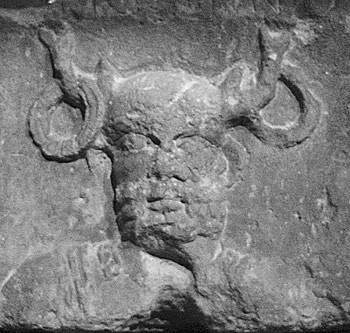 Cernunnos, Nautae Parisiaci ChrisO (CC BY-SA) ](https://www.worldhistory.org/image/13496/cernunnos-nautae-parisiaci/ "Cernunnos, Nautae Parisiaci")It is important to restate that so little is known of Cernunnos that it is possible we are entirely misinterpreting representations of him in Celtic art. As the historian J. MacKillop notes: "our knowledge of Cernunnos is so tenuous that he may not be a divinity at all but rather a shaman-like priest with antlers affixed to his head" (2006, 19).
### Representations in Art
The horned god Cernunnos is one of the most easily identified and common figures in Celtic art. He frequently wears stag antlers or horns and may have hooves, the stag being the lord of the forest and symbolic of strength, speed, and virility. Antlers, which are shed annually, represented regeneration and they were often carved into phallic amulets. Cernunnos’ frequent posture of sitting cross-legged has led some commentators to somehow associate the figure with the [Buddha](https://www.worldhistory.org/Siddhartha_Gautama/), but it may merely be a reflection of the Celtic habit of sitting in such a way at meals since stools or chairs were not used. Sometimes, Celtic sculptures have holes in the heads of figures, perhaps to receive real stag antlers. One of the earliest representations of a horned figure is a rock painting from Val Camonica in northern [Italy](https://www.worldhistory.org/italy/). It shows a tall figure with stag antlers holding torcs and is thought to date to the 5th century BCE. The figure is accompanied by sun imagery substantiating claims by some scholars that Cernunnos was a sun deity.
[ 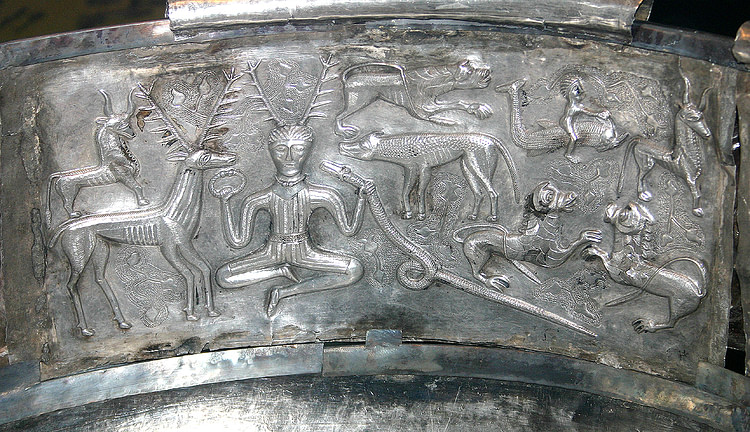 Horned-Figure Panel, Gundestrup Cauldron Malene Thyssen. (CC BY-SA) ](https://www.worldhistory.org/image/13426/horned-figure-panel-gundestrup-cauldron/ "Horned-Figure Panel, Gundestrup Cauldron")Cernunnos appears on a relief panel of the famous Gundestrup Cauldron. This [silver](https://www.worldhistory.org/Silver/) and partially gilded cauldron was discovered in Denmark in 1891 CE but was likely made in the Balkans, perhaps in the 1st century BCE. It shows a clear influence from Celtic art and [mythology](https://www.worldhistory.org/mythology/), even if other motifs seem to be Near Eastern. One relief panel shows a seated god, legs crossed, with stag’s antlers who is often identified as Cernunnos. The figure wears a torc around his neck and he holds another one in his hand. In the figure’s other hand is a long snake with a ram’s head. Both the torc and the snake likely signify strength and abundance. Cernunnos is surrounded by a stag (who, curiously, has exactly the same form of antlers as Cernunnos), a deer, five strange animals, and a small figure riding what may be a dolphin.
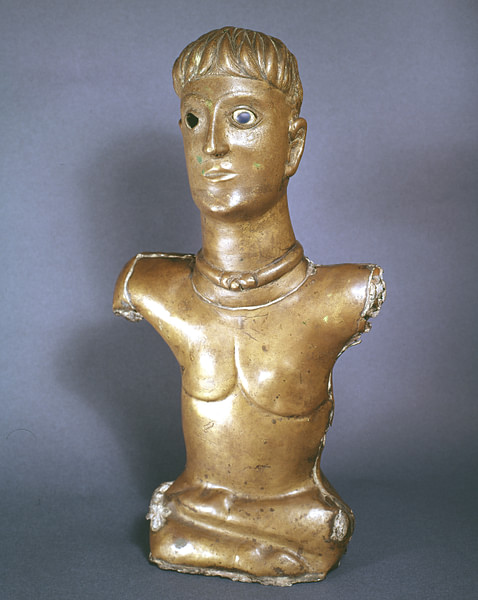
Another possible depiction of Cernunnos, this time in the form of a 1st-century BCE bronze figure found in the Juine river at Bouray near [Paris](https://www.worldhistory.org/disambiguation/paris/) in 1845 CE, has him wearing a thick torc around his neck. The figure is again sat cross-legged and his oddly shortened legs end in hooves. The figure's hair is Roman in style. The eyes are made of glass inlay but only one of these survives. The figure is not large, only 42 centimetres tall, and is now on display in the Archaeological Museum of Château de Saint-Germain-en-Laye, Yvelines, France.
[  Cernunnos Bouray Figure Françoise Foliot (CC BY) ](https://www.worldhistory.org/image/13469/cernunnos-bouray-figure/ "Cernunnos Bouray Figure")Cernunnos appears on the 1st-century CE Gallo-Roman Nautae Parisiaci monument. The monument’s name translates as the ‘seamen of the [city](https://www.worldhistory.org/city/) of Paris’ and is taken from the votive inscription which indicates who dedicated the pillar to [Jupiter](https://www.worldhistory.org/jupiter/) and when: the reign of the [Roman emperor](https://www.worldhistory.org/Roman_Emperor/) [Tiberius](https://www.worldhistory.org/Tiberius/) (14-37 CE). Found in pieces beneath Paris’ cathedral of Notre-Dame, the monument once consisted of perhaps eight blocks piled on top of each other to create a [column](https://www.worldhistory.org/column/). Unfortunately, three blocks are missing. The blocks have relief panels on each face, and one shows Cernunnos, who is named by an inscription. The god is depicted from the shoulders up with a beard, stag horns, and stag ears. A wide torc hangs from each of his horns. The lower portion of the panel is missing and so the god could well be in his familiar cross-legged sitting position. The presence of Cernunnos on a monument dedicated to Jupiter is curious and may be a case of the monument's dedicators making an auspicious association of two gods of equal importance in two different cultures. Meanwhile, the other panels show various Greco-Roman deities which include Jupiter, [Mars](https://www.worldhistory.org/Mars/), and [Venus](https://www.worldhistory.org/venus/). The monument is now on display in the Musée de Cluny in Paris.
[ 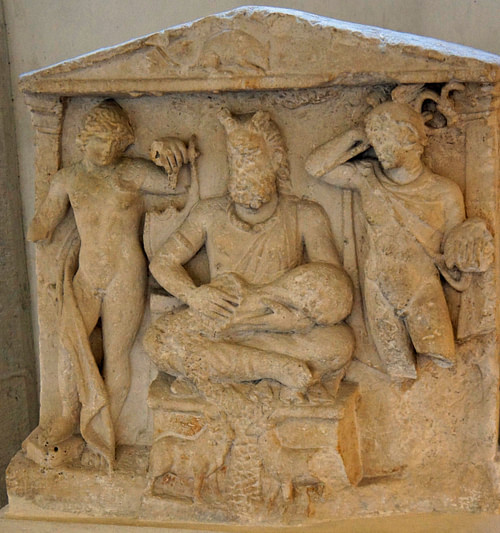 Cernunnos Rheims Relief G. Garitan (CC BY-SA) ](https://www.worldhistory.org/image/13497/cernunnos-rheims-relief/ "Cernunnos Rheims Relief")Also from the 1st century CE, and illustrating how Celtic [religion](https://www.worldhistory.org/religion/) and art was influenced by contact with the Romans, is a bas-relief from Rheims in northern France. Cernunnos is again shown with his legs crossed beneath him. Seated on some sort of pedestal, he is also sporting a beard and horns. There is the familiar stag, this time alongside a bull and both these animals are eating from an overflowing sack of plenty held in the god's arms. This may well be another Roman association with the god Pluto who could represent wealth. On either side of Cernunnos are standing figures of two Greco-Roman gods. [Apollo](https://www.worldhistory.org/apollo/) is on the left and Mercury is on the right, identified by their [lyre](https://www.worldhistory.org/Lyre/) and caduceus, respectively. The relief is now in the Musée Saint-Remi, Rheims.
### Legacy
Cernunnos’ worship as a major god and his depiction with horns may well have been one of the inspirations for the imagery associated with the figure of Satan in the Christian religion. Another cultural offshoot was Korneli, a pseudo-saint in the folklore of Brittany who is sometimes regarded as the patron of horned creatures. Cernunnos appears in the literary traditions of both Wales and Ireland and the cultural hero Conall Cernach of the Ulster Cycle, compiled in the Middle Ages but based on older oral traditions, may be a euphemism for him.
#### Editorial Review
This human-authored definition has been reviewed by our editorial team before publication to ensure accuracy, reliability and adherence to academic standards in accordance with our [editorial policy](https://www.worldhistory.org/static/editorial-policy/).
## Bibliography
- [Ellis, Peter Berresford. *The Mammoth Book of Celtic Myths and Legends.* Constable & Robinson Ltd, 2003.](https://www.worldhistory.org/books/1841192481/)
- [Farley, Julia & Fraser, Hunter. *Celts - Art and Identity.* British Museum Press, 2015.](https://www.worldhistory.org/books/0714128368/)
- [MacKillop, James. *A Dictionary of Celtic Mythology .* Oxford University Press, 2017.](https://www.worldhistory.org/books/0198804849/)
- [MacKillop, James. *Myths and Legends of the Celts.* Penguin UK, 2006.](https://www.worldhistory.org/books/0141017945/)
- [Maier, Bernhard. *Dictionary of Celtic Religion and Culture .* BOYE6, 2000.](https://www.worldhistory.org/books/0851156606/)
## About the Author
Mark is WHE’s Publishing Director and has an MA in Political Philosophy (University of York). He is a full-time researcher, writer, historian and editor. Special interests include art, architecture and discovering the ideas that all civilizations share.
## Timeline
- **c. 100 BCE**: Approximate date for the manufacture of the [Gundestrup Cauldron](https://www.worldhistory.org/Gundestrup_Cauldron/).
- **c. 100 BCE**: The [bronze](https://www.worldhistory.org/disambiguation/bronze/) figure known as the '[God](https://www.worldhistory.org/God/) of Bouray', likely a representation of the [Celtic](https://www.worldhistory.org/celt/) [Cernunnos](https://www.worldhistory.org/Cernunnos/), is made.
- **14 CE - 37 CE**: The Gallo-[Roman](https://www.worldhistory.org/disambiguation/Roman/) Nautae Parisiaci monument is made which includes a panel showing the [Celtic](https://www.worldhistory.org/celt/) [god](https://www.worldhistory.org/God/) [Cernunnos](https://www.worldhistory.org/Cernunnos/).
## Cite This Work
### APA
Cartwright, M. (2021, March 01). Cernunnos: The Ancient Celtic Nature God. *World History Encyclopedia*.
### Chicago
Cartwright, Mark. "Cernunnos: The Ancient Celtic Nature God." *World History Encyclopedia*, March 01, 2021. .
### MLA
Cartwright, Mark. "Cernunnos: The Ancient Celtic Nature God." *World History Encyclopedia*, 01 Mar 2021, .
## License & Copyright
Submitted by [Mark Cartwright](https://www.worldhistory.org/user/markzcartwright/ "User Page: Mark Cartwright"), published on 01 March 2021. The copyright holder has published this content under the following license: [Creative Commons Attribution-NonCommercial-ShareAlike](https://creativecommons.org/licenses/by-nc-sa/4.0/deed.en). This license lets others remix, tweak, and build upon this content non-commercially, as long as they credit the author and license their new creations under the identical terms. When republishing on the web a hyperlink back to the original content source URL must be included. Please note that content linked from this page may have different licensing terms.