---
title: Caryatid
author: Mark Cartwright
source: https://www.worldhistory.org/Caryatid/
format: machine-readable-alternate
license: Creative Commons Attribution-NonCommercial-ShareAlike (https://creativecommons.org/licenses/by-nc-sa/4.0/)
updated: 1970-01-01
---
# Caryatid
_Authored by [Mark Cartwright](https://www.worldhistory.org/user/markzcartwright/)_
Caryatid is the name given to an architectural [column](https://www.worldhistory.org/column/) which takes the form of a standing female figure. The first examples come from ancient [Greek architecture](https://www.worldhistory.org/Greek_Architecture/) and indeed, the most celebrated examples are found in the south porch of the [Erechtheion](https://www.worldhistory.org/Erechtheion/) on the [acropolis](https://www.worldhistory.org/Acropolis/) of [Athens](https://www.worldhistory.org/Athens/), the originals of which are now in the [city](https://www.worldhistory.org/city/)'s Acropolis Museum.
### Naming & Origins
The term Caryatid first appears in the 4th century BCE and was coined by [Vitruvius](https://www.worldhistory.org/Vitruvius/) in reference to Karyai in Laconia where [women](https://www.worldhistory.org/disambiguation/women/) often danced balancing a basket on their heads in honour of [Artemis](https://www.worldhistory.org/artemis/) and where Caryatids were used in [Archaic](https://www.worldhistory.org/disambiguation/Archaic/) [architecture](https://www.worldhistory.org/disambiguation/architecture/). They were an evolution of the earlier *korai* statues of both male and female figures prevalent throughout the [Archaic period](https://www.worldhistory.org/Archaic_Period/) and used as columns in Ionian architecture. These were themselves an evolution of Persian columns which often employed animal figures within the column design.
Archaic Caryatids of the 6th century BCE were usually used in the porches of Treasury buildings which were built to house offerings from specific states at religious sanctuaries such as [Delphi](https://www.worldhistory.org/delphi/) and [Olympia](https://www.worldhistory.org/Olympia/). The most important treasury at Delphi was from the Siphnians (c. 525 BCE) and this and at least two other treasuries had Caryatids. Caryatids of this period often have a short column drum above the head in order to facilitate the join with the column capital.
### The Erechtheion
The most famous Caryatids are the six which support the roof of the false south porch of the Erechtheion on the Athenian acropolis. This building was constructed between 421 and 406 BCE as part of [Pericles](https://www.worldhistory.org/pericles/)' great project to rejuvenate the architecture of the great city. The Erechtheion was built to house the ancient wooden cult statue of [Athena](https://www.worldhistory.org/athena/) but also served as a centre for the cults of Erechtheus (a mythical king of Athens), his brother Boutes, [Hephaistos](https://www.worldhistory.org/Hephaistos/) and [Poseidon](https://www.worldhistory.org/poseidon/). The Caryatids display features which would become staple elements of Classical [sculpture](https://www.worldhistory.org/disambiguation/Sculpture/): clothes which cling to the body (the 'wet look') and a bold and more dynamic positioning of the hips and legs. Although each Caryatid wears the same robe - a belted Doric *peplos* and short *himation* - each is uniquely rendered, a feature particularly noticeable in their intricate plaited hairstyles (best seen from the rear). The arms of the figures have unfortunately been lost but [Roman](https://www.worldhistory.org/disambiguation/Roman/) copies show them holding in their right hands *phialai* - shallow vessels for pouring libations - whilst their left hand raised slightly their robe. Scholars believe them to be carved by different artists, most probably from the workshop of Alcamenes, student and colleague of [Phidias](https://www.worldhistory.org/Phidias/).
[ 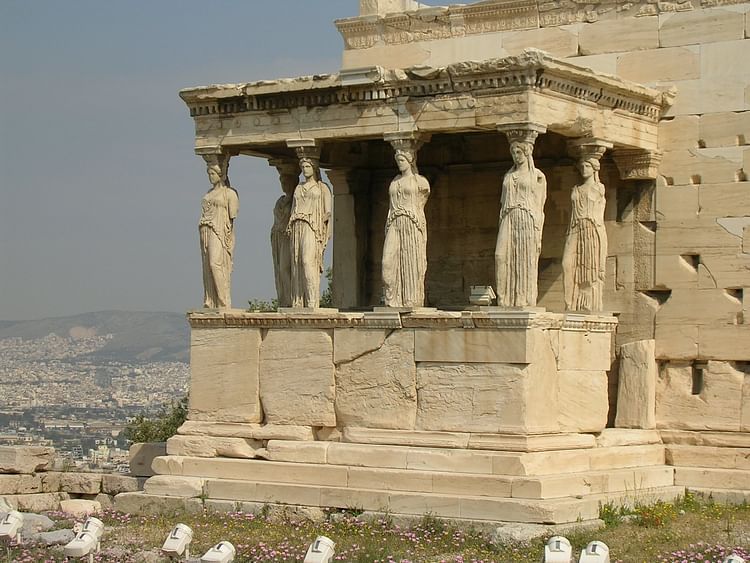 The Erechtheion, Athens Mark Cartwright (CC BY-NC-SA) ](https://www.worldhistory.org/image/389/the-erechtheion-athens/ "The Erechtheion, Athens")Interestingly, the porch of the Erechtheion stands over what was believed to be the [tomb](https://www.worldhistory.org/tomb/) of the mythical king Kekrops and perhaps the Caryatids and their libation vessels are a tribute to this fact - libations were poured into the ground as an offering to the dead during religious festivals. The Caryatid columns now on the acropolis are copies, five of the originals reside in the Acropolis Museum of Athens and the other is in the British Museum, London.
#### Editorial Review
This human-authored definition has been reviewed by our editorial team before publication to ensure accuracy, reliability and adherence to academic standards in accordance with our [editorial policy](https://www.worldhistory.org/static/editorial-policy/).
## Bibliography
- Boardman, J. *Greek Sculpture The Archaic Period.* Thames & Hudson, London, 2005
- Boardman, J. *Greek Sculpture The Classical Period.* Thames & Hudson, London, 2005
- Green, P. *The Parthenon.* Newsweek Book Division, New York, 1973
- Papathanassopoulos, G. *The Acropolis.* Krene Editions, Psychico, 2006
- [Servi, K. *The Acropolis.* Ekdotike Athenon, 2011.](https://www.worldhistory.org/books/9602134526/)
## About the Author
Mark is WHE’s Publishing Director and has an MA in Political Philosophy (University of York). He is a full-time researcher, writer, historian and editor. Special interests include art, architecture and discovering the ideas that all civilizations share.
## Timeline
- **c. 525 BCE**: The Treasury of the Siphnians is built at [Delphi](https://www.worldhistory.org/delphi/) which included [Caryatid](https://www.worldhistory.org/Caryatid/) [architecture](https://www.worldhistory.org/disambiguation/architecture/).
- **421 BCE - 406 BCE**: The [Erechtheion](https://www.worldhistory.org/Erechtheion/) of [Athens](https://www.worldhistory.org/Athens/) [acropolis](https://www.worldhistory.org/Acropolis/) is constructed with six Caryatids in the south porch.
## External Links
- [What Are Caryatids? Exploring The Unique Sculpture's History](https://mymodernmet.com/caryatids/)
## Cite This Work
### APA
Cartwright, M. (2012, October 29). Caryatid. *World History Encyclopedia*.
### Chicago
Cartwright, Mark. "Caryatid." *World History Encyclopedia*, October 29, 2012. .
### MLA
Cartwright, Mark. "Caryatid." *World History Encyclopedia*, 29 Oct 2012, .
## License & Copyright
Submitted by [Mark Cartwright](https://www.worldhistory.org/user/markzcartwright/ "User Page: Mark Cartwright"), published on 29 October 2012. The copyright holder has published this content under the following license: [Creative Commons Attribution-NonCommercial-ShareAlike](https://creativecommons.org/licenses/by-nc-sa/4.0/deed.en). This license lets others remix, tweak, and build upon this content non-commercially, as long as they credit the author and license their new creations under the identical terms. When republishing on the web a hyperlink back to the original content source URL must be included. Please note that content linked from this page may have different licensing terms.