---
title: Calypso: The Nymph Who Kept Odysseus Prisoner
author: Liana Miate
source: https://www.worldhistory.org/Calypso/
format: machine-readable-alternate
license: Creative Commons Attribution-ShareAlike (https://creativecommons.org/licenses/by-sa/4.0)
updated: 2026-07-17
---
# Calypso: The Nymph Who Kept Odysseus Prisoner
_Authored by [Liana Miate](https://www.worldhistory.org/user/lianamiate/)_
In [Greek mythology](https://www.worldhistory.org/Greek_Mythology/), Calypso, whose name means "to hide" or "to conceal," is a [nymph](https://www.worldhistory.org/nymph/) best known from [Homer](https://www.worldhistory.org/homer/)'s (c.750 BCE) epic *The [Odyssey](https://www.worldhistory.org/Odyssey/)* for falling in love with [Odysseus](https://www.worldhistory.org/odysseus/) and imprisoning him on her island, Ogygia, for seven years (or five years, depending on the source), during his long voyage home.
Becoming enamoured with the Ithacan king, Calypso wanted to make Odysseus immortal, so he would stay with her forever. However, at the command of [Zeus](https://www.worldhistory.org/zeus/) and [Hermes](https://www.worldhistory.org/Hermes/), she lets him leave her island. She is often listed as being the daughter of the [Titan](https://www.worldhistory.org/Titan/) [Atlas](https://www.worldhistory.org/Atlas/) and is commonly described in the *Odyssey* as “the nymph with lovely braids” (Homer, *The Odyssey*, 5.33).
### Family
According to most ancient sources, Calypso is the daughter of the Titan Atlas, who was made to hold up the heavens for eternity as punishment after the Titanomachy (the [war](https://www.worldhistory.org/disambiguation/War/) between the Titans and the Olympian gods). However, according to other sources, she may also be the daughter of the Titan [Oceanus](https://www.worldhistory.org/Oceanus/) and the sea nymph [Thetis](https://www.worldhistory.org/Thetis/), or even of the pre-Olympian [god](https://www.worldhistory.org/God/) Nereus, known as "the old man of the sea." Her mother is rarely mentioned.
### Ogygia
Calypso's island, Ogygia, was covered in dense forests of cypress, alders, and poplars, where her grotto-[palace](https://www.worldhistory.org/disambiguation/palace/) stood hidden in a grove. The entrance to her palace was entwined with vines full of clusters of [gold](https://www.worldhistory.org/gold/) and purple grapes. The air was filled with the song of birds and the splashing of springs, and everywhere you stepped, there was a carpet of violets, moss, and parsley. It was here on this beautiful but wild and isolated island that Calypso kept Odysseus prisoner for years.
### [Athena](https://www.worldhistory.org/athena/) Implores Zeus to Rescue Odysseus
We first learn about Odysseus being kept prisoner by Calypso in Book 1 of the *Odyssey* during the Assembly of the Gods, when Athena pleads with Zeus to rescue Odysseus from Calypso's clutches. She agrees with Zeus that some of the men who fought in the [Trojan War](https://www.worldhistory.org/Trojan_War/) deserved their fate, but that Odysseus was not one of them.
[ 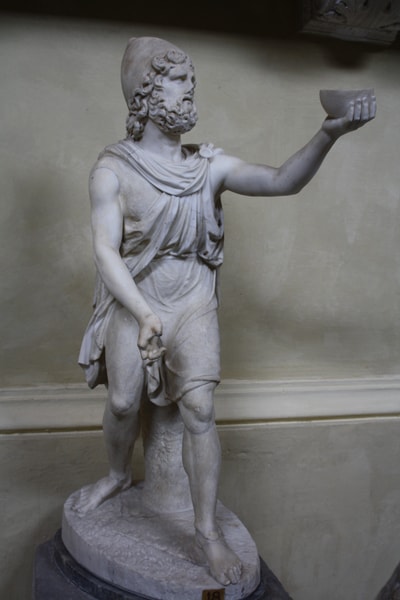 Odysseus Mark Cartwright (CC BY-NC-SA) ](https://www.worldhistory.org/image/1201/odysseus/ "Odysseus")She tells Zeus that her heart breaks for Odysseus as he is held captive by Atlas' daughter on a wave-washed island in the centre of the seas. He tries to forget about Ithaca, his home, but inside he wants to die. Zeus reassures Athena that he could never forget about the wise and brave Odysseus and agrees that he needs to find his way home. Athena suggests that they send Hermes, the messenger of the gods, to inform Calypso that it is time to free Odysseus.
### Hermes's Message for Calypso
In Book 5 of Homer's *Odyssey*, Athena is still tormented by Odysseus's long ordeal and by the fact that he remains captive on Calypso's island. Odysseus is all alone with no way to journey back to Ithaca, no boat or crew to assist him.
Zeus instructs his son Hermes to take Calypso a message that Odysseus must return home to Ithaca, but not with help from the gods or mortal men, but on a crudely built raft in which it would take him a rough 20 days to reach land once again. Hermes obeys Zeus and takes off for the island of Ogygia. Hermes finds Calypso in her grotto, where she sings in a breathtaking voice as she moves before her loom. Hermes is spellbound by Calypso's beauty and the wonder of Ogygia. Calypso instantly recognises Hermes as a fellow immortal and god and welcomes him, offering him a polished chair to sit on, ambrosia, and deep-red nectar.
> God of the golden wand, why have you come?
> A beloved, honoured friend,
> but it's been so long, your visits much too rare.
> Tell me what's on your mind. I'm eager to do it,
> whatever I can do… whatever can be done.
> (5.99-102)
Once Hermes has fortified himself with refreshments, he answers Calypso's questions and tells her that he is there at Zeus's orders; otherwise, he would not have bothered travelling to her isolated island. He tells Calypso that the only reason Odysseus ended up on her island was that his men had angered Athena, who took vengeance by unleashing a wild storm from which only Odysseus emerged. He says that Odysseus's fate is not to die there, but to return home to see his loved ones once again.
[ 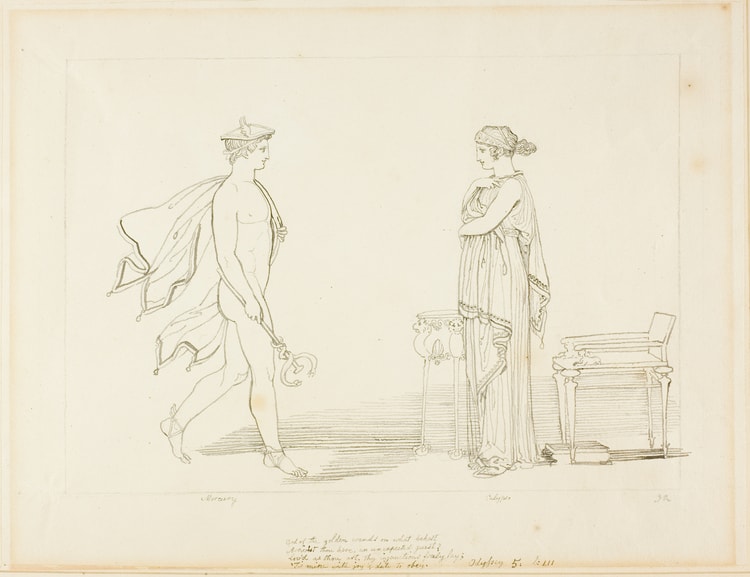 Hermes and Calypso John Flaxman (Public Domain) ](https://www.worldhistory.org/image/21954/hermes-and-calypso/ "Hermes and Calypso")Calypso fights back against his words, stating that the gods were hard-hearted and were always scandalised when a goddess slept with a mortal man, even when that man was her husband, and now they had turned their anger towards her.
> So, now at last, you gods, you train your spite on me
> for keeping a mortal man beside me. The man I saved,
> riding astride his keel-board, all alone, when Zeus
> with one hurl of a white-hot bolt had crushed
> his racing warship down the wine-dark sea.
> There all the rest of his loyal shipmates died
> but the wind drove him on, the current bore him here.
> And I welcomed him warmly, cherished him, even vowed
> to make the man immortal, ageless, all his days…
> (5.143-151)
Calypso knows that she has to obey Zeus's orders, as no immortal could go against his wishes. However, she would send Odysseus on his way alone and without a ship or crew to aid him. Instead, she would advise him on how to safely reach Ithaca. Hermes agrees that it would be wise not to disobey Zeus; otherwise, Zeus would take out his anger on her.
### Calypso & Odysseus
Once Hermes has departed Ogygia, Calypso goes to find Odysseus and finds him sitting on the headland, weeping for his home and his family. In the darkness of night, he would begrudgingly sleep with Calypso in her grotto-palace, but in the light of day, he would sit alone on the beach and sob for all he had lost. Calypso approaches Odysseus and tells him that there is no need to cry anymore and that she is finally willing to let him go.
[ 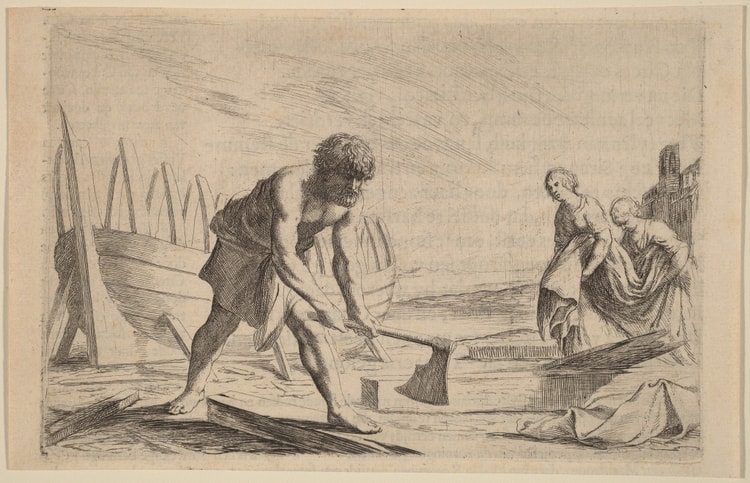 Odysseus Constructs a Raft to Depart the Island of Ogygia Willem Basse (Public Domain) ](https://www.worldhistory.org/image/21953/odysseus-constructs-a-raft-to-depart-the-island-of/ "Odysseus Constructs a Raft to Depart the Island of Ogygia")She instructs Odysseus to cut down timber and build a raft with a deck high enough to sweep him through the rough seas, while she promises to give him food, water, and the ruddy wine he loved, and to clothe him well. A weary Odysseus is hesitant to believe Calypso would help him leave the island and refuses to get on a raft until she swears a binding oath that she will not trick him. Calypso swears on the vaulting sky and the dark waters of the Styx that she would never plot to harm him and that if she were in his place, she would plan the same escape for herself. They retreat to Calypso's grotto, where they feast on nectar and ambrosia. A cunning Calypso tries one last time to get Odysseus to stay with her:
> So then, royal son of Laertes, Odysseus, man of exploits,
> still eager to leave at once and hurry back
> to your own home, your beloved native land?
> good luck to you, even so. Farewell!
> But if you only knew, deep down, what pains
> are fated to fill your cup before you reach that shore.
> you'd stay right here, preside in our house with me
> and be immortal. Much as you long to see your wife,
> the one you pine for all your days… and yet
> I just might claim to be nothing less than she,
> neither in face nor figure. Hardly right, is it,
> for mortal woman to rival immortal goddess?
> How, in build? in beauty?
> (5. 224-237)
Odysseus asks Calypso not to be angry with him and tells her that she is right: [Penelope](https://www.worldhistory.org/Penelope/) cannot compare to Calypso's beauty, since Penelope is mortal, whereas Calypso is immortal and never ages. Despite that, he yearns to go home to Penelope more than anything. As the night falls, they retreat deep in the cavern and lose themselves in love. The next morning, the work begins to get Odysseus home. Calypso gives Odysseus a [bronze](https://www.worldhistory.org/disambiguation/bronze/) axe and then leads him to where the trees grow sky-high. As Odysseus cuts down the timber and builds a raft, Calypso reappears with drills and bolts of cloth to make the sail.
After four days of hard work, the raft is finally finished, and Odysseus is ready to leave Ogygia. On the fifth day, Calypso bathes Odysseus and clothes him in fine, fragrant clothes. She supplies his raft with wine, water, and meat, and summons forth a gentle wind to send him on his way.
### Odysseus Recounts His Time with Calypso
In Book 7 of the *Odyssey*, Odysseus recounts his time with Calypso to Queen Arete of Phaeacia after he is shipwrecked once again. He describes the island of Ogygia as lying far at sea and Calypso as a 'seductive nymph' with lovely braids, who, despite her beautiful appearance, is also a danger, which is why both gods and mortals alike do not dare to venture to her island. Before arriving on Ogygia, he survived at sea for nine days by clutching onto his ship's keel, and on the tenth day, the gods delivered him to Calypso, who took him in out of kindness and cherished him, offering to make him immortal. But despite her kindness and promises of immortality, he could never love her. He stayed with her for seven years, most of his days spent in tears. In the eighth year, on Zeus's orders and due to a change of heart, she finally let him leave Ogygia, providing him with supplies, helping him build a raft from timber on her island, and summoning a fair wind to set him on his way.
[ 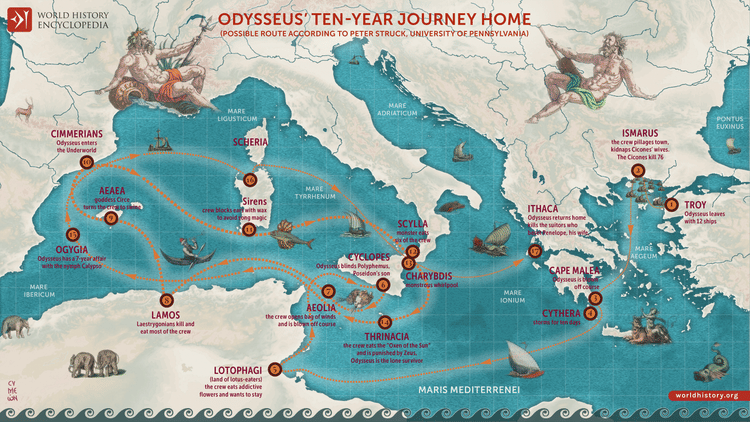 Map of Odysseus’ 10-year Journey Home Simeon Netchev (CC BY-NC-ND) ](https://www.worldhistory.org/image/15906/map-of-odysseus-10-year-journey-home/ "Map of Odysseus’ 10-year Journey Home")
### Different Narratives
Although Homer's *Odyssey* is by far the most famous account of Odysseus's time with Calypso, and it never mentions any children, other sources report otherwise. According to the [Greek](https://www.worldhistory.org/disambiguation/greek/) scholar and historian Apollodorus (circa 180 BCE), Odysseus and Calypso had a son named Latinus together (other sources list [Circe](https://www.worldhistory.org/Circe/) as his mother), while in [Hesiod](https://www.worldhistory.org/hesiod/)'s (circa 776 BCE) *[Theogony](https://www.worldhistory.org/Theogony/)*, he writes that Odysseus and Calypso had two sons: Nausithous and Nausinous. While Calypso's appearance in the *Odyssey* ends with Odysseus leaving Ogygia, other ancient sources, such as the *Fabulae* by the ancient writer Hyginus, mention that Calypso kills herself out of love for Odysseus after he leaves her island.
### Legacy
Like Circe, Calypso is often portrayed as a beautiful yet cunning woman who initially serves as an obstacle to Odysseus's return home but ultimately helps him in the end. Her love for Odysseus is a double-edged sword: she loves him so much that she cannot let him leave her island, despite how much it hurts him to stay. Odysseus is often seen as the victim during their time together, while Calypso is seen as the enchanting seductress who tricks him and keeps him hostage, away from his family and home. However, the English poet Letitia Landon (1802-1838) painted a more sympathetic picture of Calypso in her poem *Calypso Watching the Ocean* (1830s), in which she beautifully describes a heartbroken Calypso sitting alone, watching the ocean, wishing she could weep or leave her lonely island.
In Christopher Nolan's epic production of *The Odyssey* (2026), Calypso is played by the A-list South African and American actress Charlize Theron.
#### Editorial Review
This human-authored definition has been reviewed by our editorial team before publication to ensure accuracy, reliability and adherence to academic standards in accordance with our [editorial policy](https://www.worldhistory.org/static/editorial-policy/).
## Bibliography
- [Apollodorus & Hard, Robin. *The Library of Greek Mythology.* Oxford University Press, 2008.](https://www.worldhistory.org/books/0199536325/)
- [Calypso Watching the Ocean by Letitia Elizabeth Landon - Famous poems, famous poets. - All Poetry](https://allpoetry.com/poem/15073734-Calypso-Watching-the-Ocean-by-Letitia-Elizabeth-Landon "Calypso Watching the Ocean by Letitia Elizabeth Landon - Famous poems, famous poets. - All Poetry"), accessed 14 Jul 2026.
- [Graves, Robert. *The Greek Myths\[May 15, 2018\] Graves, Robert.* Viking, 2018.](https://www.worldhistory.org/books/0241982359/)
- [Hesiod & Theognis & Wender, Dorothea & Wender, Dorothea. *Hesiod and Theognis.* Penguin Classics, 1976.](https://www.worldhistory.org/books/0140442839/)
- [Homer & Robert Fagles & Bernard Knox. *The Odyssey.* Penguin Classics, 1997.](https://www.worldhistory.org/books/0140268863/)
- [Hyginus, Fabulae (Hyg.Fab.)](https://topostext.org/work/206 "Hyginus, Fabulae (Hyg.Fab.)"), accessed 14 Jul 2026.
- [Saïd, Suzanne & Webb, Ruth. *Homer and the Odyssey.* Oxford University Press, 2011.](https://www.worldhistory.org/books/0199542856/)
- [Schwab, Gustav & Siebler, Michael & Harper, Clifford. *Greek Myths.* TASCHEN, 2021.](https://www.worldhistory.org/books/3836584727/)
## About the Author
Liana is the Social Media Editor for Ancient History Encyclopedia. She holds a Bachelor of Arts Degree with a major in ancient Greece, Rome & Late Antiquity. She is particularly passionate about Rome and Greece, and anything to do with mythology or wo
- [Linkedin Profile](https://www.linkedin.com/in/lian)
## Timeline
- **c. 800 BCE - c. 700 BCE**: [Homer](https://www.worldhistory.org/homer/) of [Greece](https://www.worldhistory.org/greece/) writes his *[Iliad](https://www.worldhistory.org/iliad/)* and *[Odyssey](https://www.worldhistory.org/Odyssey/)*.
## Cite This Work
### APA
Miate, L. (2026, July 17). Calypso: The Nymph Who Kept Odysseus Prisoner. *World History Encyclopedia*.
### Chicago
Miate, Liana. "Calypso: The Nymph Who Kept Odysseus Prisoner." *World History Encyclopedia*, July 17, 2026. .
### MLA
Miate, Liana. "Calypso: The Nymph Who Kept Odysseus Prisoner." *World History Encyclopedia*, 17 Jul 2026, .
## License & Copyright
Submitted by [Liana Miate](https://www.worldhistory.org/user/lianamiate/ "User Page: Liana Miate"), published on 17 July 2026. The copyright holder has published this content under the following license: [Creative Commons Attribution-ShareAlike](https://creativecommons.org/licenses/by-sa/4.0deed.en). This license lets others remix, tweak, and build upon a work even for commercial reasons, as long as they credit the author and license their new creations under the identical terms. When republishing on the web a hyperlink back to the original content source URL must be included. Please note that content linked from this page may have different licensing terms.