---
title: Calliope
author: Liana Miate
source: https://www.worldhistory.org/Calliope/
format: machine-readable-alternate
license: Creative Commons Attribution-NonCommercial-ShareAlike (https://creativecommons.org/licenses/by-nc-sa/4.0/)
updated: 2022-11-22
---
# Calliope
_Authored by [Liana Miate](https://www.worldhistory.org/user/lianamiate/)_
Calliope (also spelt Kalliope) is the [Muse](https://www.worldhistory.org/muse/) of epic poetry and heroic song in [Greek mythology](https://www.worldhistory.org/Greek_Mythology/). She is considered the leader of the [Muses](https://www.worldhistory.org/muse/) and the most honoured of them all. She is often represented in art with a tablet on her knee and a stylus in her hand.
[Homer](https://www.worldhistory.org/homer/) (c. 750 BCE) was said to be directly inspired by Calliope to write the *[Iliad](https://www.worldhistory.org/iliad/)* and the *[Odyssey](https://www.worldhistory.org/Odyssey/)*, two of the most famous epic poems of all time. His great talent for epic poetry meant that he was also referred to as Calliope's son (in a symbolic sense).
### Birth & Family
Calliope is the daughter of [Zeus](https://www.worldhistory.org/zeus/) and Mnemosyne (goddess of memory). She is one of the nine canonical Muses, with the others being Clio (history), Euterpe (flute-playing), Thalia (comedy), Melpomene (tragedy), Terpsichore (dancing), Erato (lyric and love poetry), Polyhymnia (sacred song) and Urania (astronomy). According to [Hesiod](https://www.worldhistory.org/hesiod/) (c. 700 BCE), Calliope is the most important Muse.
> So sang the Muses of Olympus, nine
> Daughters begotten by almighty Zeus,
> Cleio, Euterpe, and Melpomene,
> Thalia, Erato and Terpsichore,
> Polymnia, Urania, and most
> Important one of all, Calliope,
> For she attends upon respected lords.
> (Hesiod, *[Theogony](https://www.worldhistory.org/Theogony/)*, 77-83)
### The Muses
The Muses were the patron goddesses of [literature](https://www.worldhistory.org/literature/) and the arts and inspired all artistic activity in the ancient world. They held a distinguished position in [Greek](https://www.worldhistory.org/disambiguation/greek/) [mythology](https://www.worldhistory.org/mythology/) and were honoured by both mortals and [immortals](https://www.worldhistory.org/disambiguation/immortals/) alike. [Apollo](https://www.worldhistory.org/apollo/), the Greek [god](https://www.worldhistory.org/God/) of [music](https://www.worldhistory.org/disambiguation/Music/) and dance and a patron of the arts, was a leader of the Muses.
Over time, each of the nine Muses came to represent a specific art form. As a group, they were called the *Heliconiades* and the *Olympiades* in reference to the various places they frequented, including Mount Olympus and Mount Helicon in Boeotia.
According to Homer, the Muses lived on Mount Olympus, where they entertained the Olympian gods with their singing and inspired the poets. On Mount Helicon, they were said to dance around the sacred fountain of Hippocrene and the altar of Zeus.
### Calliope as the Muse of Epic Poetry
Calliope ('beautiful voiced') was widely considered the leader of the Muses and was the greatest and wisest of them. She began as a Muse of poetry, which later developed into epic poetry (tales of the legendary adventures of a people, its myth, and heroes). As a Muse of epic poetry, she inspired the great epic poets throughout history, including Homer, [Virgil](https://www.worldhistory.org/virgil/) (70-19 BCE), [Ovid](https://www.worldhistory.org/ovid/) (43 BCE to 17 CE) and [Dante Alighieri](https://www.worldhistory.org/Dante_Alighieri/) (1265-1321 CE). She also determined the standards by which epic poetry was judged and was regularly called on for help when poets were writing their work.
[ 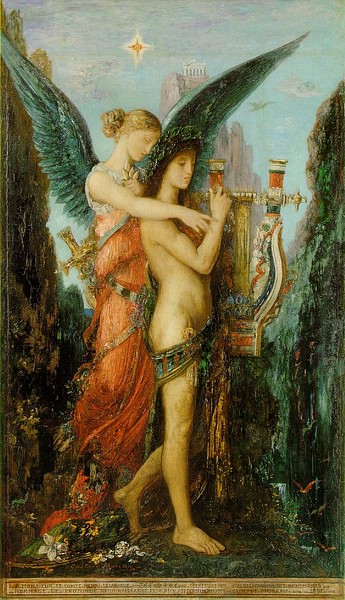 Hesiod and the Muse MobyDick (Public Domain) ](https://www.worldhistory.org/image/200/hesiod-and-the-muse/ "Hesiod and the Muse")Calliope was often represented in art as a seated or standing figure, holding a writing tablet and a stylus, as if she were getting ready to write the next great epic poem.
### Calliope's Children
Calliope was the mother of [Orpheus](https://www.worldhistory.org/Orpheus/), the most famed musician in all of Greek mythology. He was said to have received his gift of music from his father, Apollo. However, in some traditions, his father is listed as the mortal King Oeagrus of Thrace. In Ovid's *Metamorphoses*, Orpheus calls to his mother in song: "Let Jove be the start of my song, Callíope – Muse and mother!" (Ovid, *Metamorphoses*, 10.148)
Calliope and Apollo, or King Oeagrus, were also said to be the parents of Linus, another great musician in Greek mythology and an eloquent public speaker. Some sources state that Calliope is also the mother of Rhesus, a king of Thrace, with the river god Strymon, and that she bore the Korybantes (worshippers of [Cybele](https://www.worldhistory.org/Cybele/)) with her father, Zeus.
### Calliope as Judge
In some traditions, Calliope was the mediator for a conflict that took place between Adonis, Aphrodite and Persephone. Adonis was born out of a tree after his mother, Smyrna, tricked her father into an incestuous relationship (helped by the influence of Aphrodite) and fell pregnant. To escape her father's wrath, the gods transformed her into a myrrh tree, and the tree split open ten months later to reveal Adonis.
Adonis' beauty was legendary and did not escape the attention of Aphrodite, who stole him and hid him away in a chest that she entrusted to Persephone. Persephone opened the box and witnessed Adonis' beauty for herself, refusing to give the box back to Aphrodite.
[ 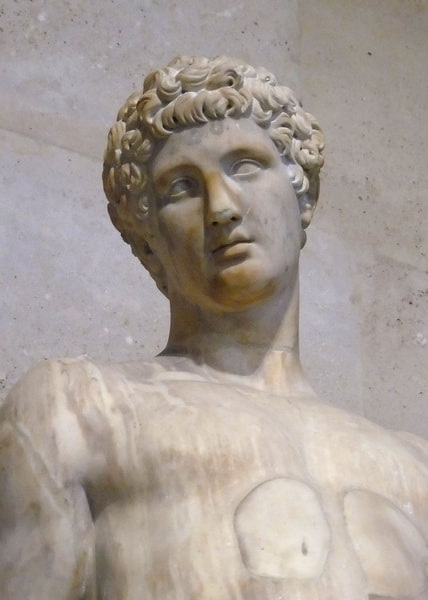 Adonis Mary Harrsch (Photographed at the Musée Louvre, Paris) (CC BY-NC-SA) ](https://www.worldhistory.org/image/4557/adonis/ "Adonis")Zeus employed the help of Calliope to judge who would get to keep Adonis. Calliope decided that Aphrodite and Persephone would spend equal parts of the year with Adonis, with Aphrodite in the celestial realm and Persephone in the underworld. Furious with this decision, Aphrodite causes the [death](https://www.worldhistory.org/disambiguation/Death/) of Calliope's son Orpheus by inciting the Thracian [women](https://www.worldhistory.org/disambiguation/women/) to attack him while they were in a trance. In their frenzy, they end up tearing Orpheus limb from limb.
### Challenging the Muses
Like all Greek deities, the Muses can become competitive when their artistic talents and powers are challenged. This combativeness can best be seen in the myth of Thamyris. Thamyris was a bard from Thrace who met the Muses on his travels. He foolishly boasted to them that he could outperform them at singing. In anger, the Muses struck him blind, took away his musical ability and made him forget he could sing.
Another example is the tale of the Pierides. The Pierides, nine daughters of the wealthy landowner Pierus (sometimes confused with the Muses), also claimed that they could outsing the Muses. In Ovid's *Metamorphoses*, the Muse Urania tells [Minerva](https://www.worldhistory.org/Minerva/) of the competition. She claims that the Pierides offered the Muses their home in Emathia's plains if they were victorious. But if the Muses lost, then they would have to gift the Pierides their two sacred Boeotian fountains. The nymphs were selected as judges and swore to judge fairly. Calliope was chosen to sing on behalf of the Muses.
> She, with her flowing hair in an ivy wreath, rose up and strummed a few plangent chords to test her [lyre](https://www.worldhistory.org/Lyre/) strings,
> then firmly plucked them to launch at once on the
> following lay.
> (Ovid, *Metamorphoses*, 5.338-340).
Calliope invoked the goddess [Ceres](https://www.worldhistory.org/Ceres/) and then sang about the rape of Proserpina (Persephone) in three parts. The first part told the tale of how [Pluto](https://www.worldhistory.org/Pluto/)'s rape and abduction of Proserpina caused Ceres to neglect the earth for half of the year. The river [nymph](https://www.worldhistory.org/nymph/) Arethusa relayed that she had seen Proserpina, still sad and scared but well-established as the queen of the underworld. Ceres travelled to the realms of the sky, where she pleaded for her daughter's return. [Jupiter](https://www.worldhistory.org/jupiter/) settled the conflict by splitting the year into two equal parts where she could spend half the year with her mother and the other half with her husband.
[ 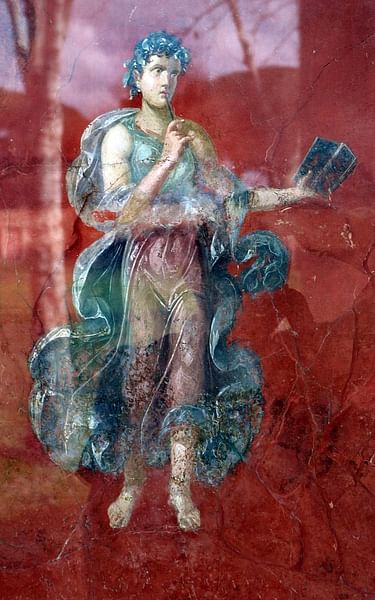 Calliope Fresco Sailko (CC BY-SA) ](https://www.worldhistory.org/image/16596/calliope-fresco/ "Calliope Fresco")The song's second half recounted how Arethusa was almost raped by the river god Alpheüs and fled her birthplace, offering some insight into Proserpina's ordeal. The last part of the song tells how Ceres gave Triptólemus (king of [Eleusis](https://www.worldhistory.org/Eleusis/)) seeds to sow. He landed on [Scythian](https://www.worldhistory.org/Scythians/) land and entered the [palace](https://www.worldhistory.org/disambiguation/palace/) of King Lyncus, who he ordered to plant the seeds from Ceres. The king, wanting to take credit for the seeds himself, waited for Triptólemus to fall asleep and attempted to attack him before Ceres turned him into a lynx.
The nymphs ruled in the Muses' favour and the Pierides, angered by their loss, started abusing the Muses. As they continued their shouting and brandishing of fists, they noticed feathers sprouting on their skin and beaks protruding from their faces. Finally, they took to the sky, and to this day, you can still hear them chattering away.
According to [Pausanias](https://www.worldhistory.org/disambiguation/Pausanias/) (c. 115 to c. 180 CE), the Sirens also challenged the Muses to a singing competition after being persuaded by [Hera](https://www.worldhistory.org/Hera/) to do so. But, as always, the Muses could not be beaten, and they crowned themselves as the victors with the Sirens' feathers.
### Worship & Legacy
Pierus, the king of Emathia (in Macedonia), is believed to have offered the first sacrifices to the Muses and helped their worship spread from Thrace to Thespiae, located at the foot of Mount Helicon, where they had a [temple](https://www.worldhistory.org/temple/) and statues. Near Mount Helicon, there was a sanctuary with sculptures and sacred wells dedicated to them. On Mount Libethrion, there was a holy grotto of the Muses. The Thespians celebrated a "feast of the Muses" (Musea) on Mount Helicon, where libations of milk, honey and water were offered to them.
[ 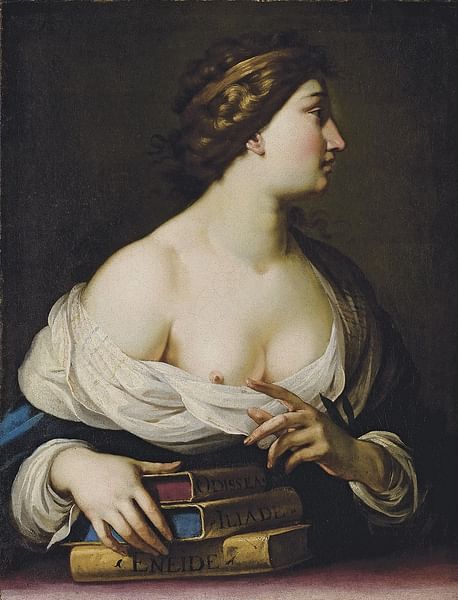 Calliope, muse de l'éloquence et de la poésie épique by Cesare Dandini Cesare Dandini (Public Domain) ](https://www.worldhistory.org/image/16597/calliope-muse-de-leloquence-et-de-la-poesie-epique/ "Calliope, muse de l'éloquence et de la poésie épique by Cesare Dandini")Calliope's influence on poets and writers was still evident during the Middle Ages, with Italian poet [Dante](https://www.worldhistory.org/Dante_Alighieri/) Alighieri invoking her in his *Divine Comedy* in both the second canto of *Hell* (*Inferno*) and in the first Canto of *Purgatory* (*Purgatorio*). In addition, English poet [Geoffrey Chaucer](https://www.worldhistory.org/Geoffrey_Chaucer/) (c. 1343-1400) mentions her in his poem *House of Fame* (the only Muse to be mentioned by name). She is also invoked in Chaucer's epic poem *Troilus and Criseyde*, where he calls for the help of Calliope and [Venus](https://www.worldhistory.org/venus/) in the opening lines of Book 3 to help him describe the great joy that Troilus and Criseyde felt when they finally became lovers.
More recently, a steam piano called Calliope was patented in 1855 by J.C. Stoddard. It became a fixture on riverboats, showboats, and circuses during the late 1800s. In 2020, famed rocker Bob Dylan released a song called "Mother of Muses," where he proclaimed, "I'm falling in love with Calliope." (Bob Dylan, "Mother of Muses"). In honour of the famed Muse, the smallest hummingbird in the United States is called the Calliope hummingbird.
#### Editorial Review
This human-authored definition has been reviewed by our editorial team before publication to ensure accuracy, reliability and adherence to academic standards in accordance with our [editorial policy](https://www.worldhistory.org/static/editorial-policy/).
## Bibliography
- [Bane, Theresa. *Encyclopedia of Fairies in World Folklore and Mythology.* McFarland & Company, 2013.](https://www.worldhistory.org/books/0786471115/)
- [Berens, E. M. *Myths and Legends of Ancient Greece and Rome - Being a Popular Account of Greek..* Quinn Press, 2014.](https://www.worldhistory.org/books/1447402685/)
- [Billboard - Google Books](https://books.google.com.au/books?id=2SMEAAAAMBAJ&pg=PA1&dq=calliope+instrument&hl=en&sa=X&ved=2ahUKEwjS6s3BiPv6AhWc1jgGHXJIC0g4ChDoAXoECAIQAg#v=onepage&q=calliope%20instrument&f=false "Billboard - Google Books"), accessed 25 Oct 2022.
- [Browning, Gary & Sandis, Constantine. *Dylan at 80.* Imprint Academic, 2021.](https://www.worldhistory.org/books/1788360451/)
- [Coulter, Charles Russell & Turner, Patricia. *Encyclopedia of Ancient Deities.* McFarland, 2020.](https://www.worldhistory.org/books/1476685568/)
- [Giesecke, Annette & Tierney, Jim. *Classical Mythology A to Z & Goddesses, Heroes & Heroines, Nymphs, Spirits, Monsters..* Black Dog & Leventhal, 2020.](https://www.worldhistory.org/books/0762470011/)
- [Hesiod & Theognis & Wender, Dorothea & Wender, Dorothea. *Hesiod and Theognis.* Penguin Classics, 1976.](https://www.worldhistory.org/books/0140442839/)
- [Liveley, Genevieve. *Ovid's 'Metamorphoses'.* Continuum, 2012.](https://www.worldhistory.org/books/1441100849/)
- [Ovid & Raeburn, David & Feeney, Denis. *Metamorphoses.* Penguin Classics, 2004.](https://www.worldhistory.org/books/014044789X/)
- [Papachristos, Maria. *Muses - Nymphs - Other Gods.* Edizioni R.E.I. France, 2019.](https://www.worldhistory.org/books/B07P5DYCFB/)
- [Rossignol, Rosalyn. *Critical Companion to Chaucer.* Facts on File, 2007.](https://www.worldhistory.org/books/0816061939/)
- [Spentzou, Efrossini & Fowler, the late Don. *Cultivating the Muse.* Oxford University Press, 2002.](https://www.worldhistory.org/books/0199240043/)
- Thomas Swinburne CARR. *A New Classical Lexicon of Biography, Mythology, and Geography, including the pronunciation of proper names supported by authorities, etc.* Simpkin, Marshall & Company, 1858
- [William Smith. *A classical dictionary of biography \[&c.\]. 1858 \[Leather Bound\].* Generic, 2022.](https://www.worldhistory.org/books/B07QVPLZ9N/)
## About the Author
Liana is the Social Media Editor for Ancient History Encyclopedia. She holds a Bachelor of Arts Degree with a major in ancient Greece, Rome & Late Antiquity. She is particularly passionate about Rome and Greece, and anything to do with mythology or wo
- [Linkedin Profile](https://www.linkedin.com/in/lian)
## Questions & Answers
### What does Calliope mean?
Calliope means 'beautiful voiced' and is the name of one of the nine Muses.
### What was Calliope known for?
In Greek mythology, Calliope was known as the Muse of epic poetry. Poets throughout the ancient world and medieval history would invoke her for help and inspiration when writing their epic poems.
### Why is the instrument called a Calliope?
The instrument known as the Calliope was named after Calliope, the Muse. However, its sound can not be compared to the 'beautiful-voiced' Calliope.
### What is the symbol of Calliope?
Calliope is often portrayed in art carrying a writing tablet and stylus.
## Cite This Work
### APA
Miate, L. (2022, November 01). Calliope. *World History Encyclopedia*.
### Chicago
Miate, Liana. "Calliope." *World History Encyclopedia*, November 01, 2022. .
### MLA
Miate, Liana. "Calliope." *World History Encyclopedia*, 01 Nov 2022, .
## License & Copyright
Submitted by [Liana Miate](https://www.worldhistory.org/user/lianamiate/ "User Page: Liana Miate"), published on 01 November 2022. The copyright holder has published this content under the following license: [Creative Commons Attribution-NonCommercial-ShareAlike](https://creativecommons.org/licenses/by-nc-sa/4.0/deed.en). This license lets others remix, tweak, and build upon this content non-commercially, as long as they credit the author and license their new creations under the identical terms. When republishing on the web a hyperlink back to the original content source URL must be included. Please note that content linked from this page may have different licensing terms.