---
title: Cahuachi
author: Mark Cartwright
source: https://www.worldhistory.org/Cahuachi/
format: machine-readable-alternate
license: Creative Commons Attribution-NonCommercial-ShareAlike (https://creativecommons.org/licenses/by-nc-sa/4.0/)
updated: 1970-01-01
---
# Cahuachi
_Authored by [Mark Cartwright](https://www.worldhistory.org/user/markzcartwright/)_
Cahuachi, located on the southern coast of Peru, was the most important sacred site of the [Nazca civilization](https://www.worldhistory.org/Nazca_Civilization/). The [Nazca](https://www.worldhistory.org/Nazca_Civilization/) flourished between 200 BCE and 600 CE, and Cahuachi covers a similar time period. The site, which was used for harvest festivals, ancestor worship, and burials, is dominated by a series of huge ceremonial mounds and plazas. These have been a rich source of Nazca artefacts ranging from mummies to textiles, all well-preserved in the arid climate.
### Location & Function
In a particular spot of the southern Nazca Valley the Nazca River flows underground for a short stretch, and it was at this place, on the south bank, that Cahuachi was built. The water table here would have survived most droughts and so was considered a sacred place or *huaca* by the Nazca. The water was managed using underground [aqueducts](https://www.worldhistory.org/aqueduct/) and cisterns with terraced entrances to irrigate the surrounding area and ensure a constant supply. The sacred nature of the site is further indicated by the high number of lines or geoglyphs on the surrounding desert floor. In another attempt to incorporate nature into their urban landscape the Nazca built huge mounds on top of a close grouping of around 40 hills. The site was linked to the other important Nazca centre Ventilla by a sacred road which crosses the San José desert.
There is no archaeological evidence of a residential area at Cahuachi (refuse, plain [pottery](https://www.worldhistory.org/pottery/) etc.), and pilgrims to the site probably stayed in tents for their brief visit. There are, though, some buildings which were probably used for storage or as workshops connected to the religious activities of the site. The presence of plazas suggests regular gatherings of a large number of people with the largest space measuring 47 x 75 metres. These plazas, in places, have holes and the remains of wooden posts suggesting large canopies were erected over them. The entire sacred area is enclosed by a 40 cm high [wall](https://www.worldhistory.org/wall/). Cahuachi, then, was a site of pilgrimage, worship, and [burial](https://www.worldhistory.org/burial/), and it eventually spread to cover over 150 ha.
### Burial Mounds
The 40 burial mounds at Cahuachi were built using earth and adobe bricks. The earliest structures date to before 100 BCE while the latest were constructed c. 550 CE, consistent with the timeframe of the Nazca in general. Mounds were used as a place of burial for family or kin groups, with each mound containing the tombs of specific groups. This is a typical feature of the Nazca: shared cultural practices but carried out on an individual basis without any discernible influence from an integrated political power. In many Andean cultures ancestor worship was prevalent, and so we can imagine that pilgrims visited Cahuachi with that aim, regularly reopening tombs to add new mummies.
[ 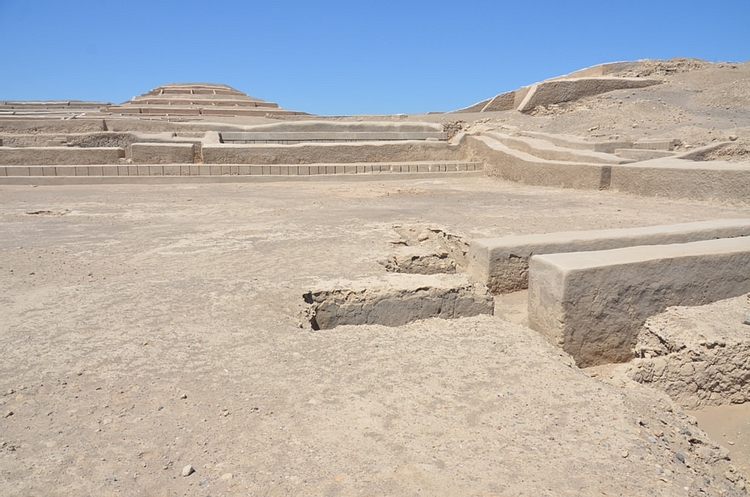 Ceremonial Plaza, Cahuachi Antoine 49 (CC BY-NC-ND) ](https://www.worldhistory.org/image/5296/ceremonial-plaza-cahuachi/ "Ceremonial Plaza, Cahuachi")The largest mound, known as the 'Great [Temple](https://www.worldhistory.org/temple/)' consists of six or seven terraces made from earth set on top of a natural hill and contained within adobe brick supporting walls. It reaches a height of 30 metres. Besides tombs in its interior, there are also small chambers in which were placed large numbers of clay [panpipes](https://www.worldhistory.org/Panpipes/), indicating [music](https://www.worldhistory.org/disambiguation/Music/) was an important part of Nazca ceremonies. The best-preserved [tomb](https://www.worldhistory.org/tomb/) is at another mound and is referred to as the Room of Posts. It contains a central altar surrounded by columns supporting a roof. The walls are decorated with inscribed images of panpipes and faces with shining rays.
### Archaeological Finds
Although many of the tombs of Cahuachi have been looted, occasional finds of intact burials have revealed mummies wrapped in fine textiles. Some of these mummies - of men, [women](https://www.worldhistory.org/disambiguation/women/) and children - show signs of being sacrificed. The individuals were Nazca people, not captured enemies for example, and they display such typical features of Andean burials as a perforated skull, removal of the tongue and placing it in a pouch, excrement in the mouth, and eyes and lips sealed using cactus spines. Some tombs contain evidence of animal sacrifice.
[ 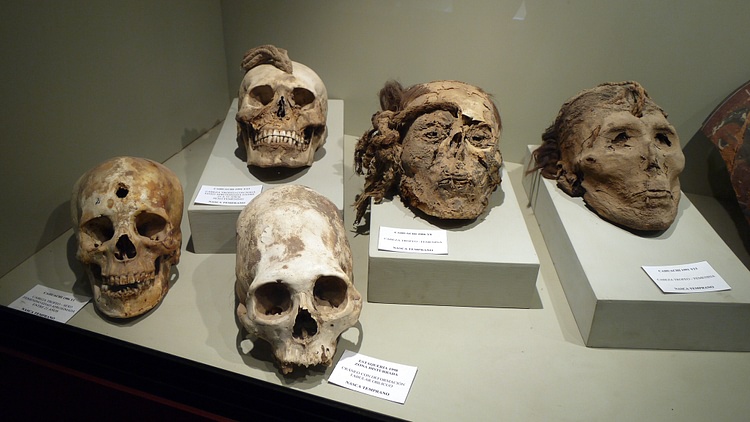 Mummy Skulls, Cahuachi Jean Robert Thibault (CC BY-SA) ](https://www.worldhistory.org/image/5297/mummy-skulls-cahuachi/ "Mummy Skulls, Cahuachi")Other finds at the site include pottery, typically of finer quality than those for daily use, and painted with animals and hybrid human-animal figures, especially felines, monkeys, birds, lizards, and spiders with human faces. Textiles were often buried inside large ceramic jars. The images woven into or sometimes painted on the cloth show similar themes to the pottery decoration, along with scenes of bountiful harvests and [agriculture](https://www.worldhistory.org/disambiguation/Agriculture/). Many textiles have borders depicting staring human skulls. Two extraordinary finds are a single length of cloth measuring 7 metres by 60 metres and a store of 50 women's wrap dresses. These latter have images of hummingbirds very similar to those depicted in the famous [Nazca lines](https://www.worldhistory.org/article/665/nazca-lines/) geoglyphs across the nearby desert floor. Finally, in one specific area of Cahuachi, perhaps a workshop for weaving, excavations have found various instruments and tools used to make textiles such as spindles, dyes, cotton threads, and looms.
### Abandonment
Cahuachi was abandoned from the mid-6th century CE, perhaps due to climate change as the local environment became more arid. Earthquakes, too, may have been a contributing factor to the centre's decline. It is interesting to note that the number of geoglyphs created at this time increased, perhaps indicating the urgent need for divine help to meet the crisis. The mounds were systematically covered with earth and so the abandonment of Cahuachi was both planned and deliberate. The site did continue to receive votive offerings and burials for centuries after, though, indicating that local peoples continued to ascribe a sacred nature to Cahuachi long after the Nazca [culture](https://www.worldhistory.org/disambiguation/culture/) had disappeared.
#### Editorial Review
This human-authored definition has been reviewed by our editorial team before publication to ensure accuracy, reliability and adherence to academic standards in accordance with our [editorial policy](https://www.worldhistory.org/static/editorial-policy/).
## Bibliography
- [Alden Mason, J. *Ancient Civilizations of Peru.* Viking Penguin, 1975.](https://www.worldhistory.org/books/B003F9528I/)
- [Jones, D.M. *Mythology of the Incas.* Southwater, 2007.](https://www.worldhistory.org/books/1844763382/)
- [Jones, D.M. *The Complete Illustrated History of the Inca Empire.* Lorenz Books, 2012.](https://www.worldhistory.org/books/075482358X/)
- [Kubler, G. *The Art and Architecture of Ancient America.* Yale University Press, 1984.](https://www.worldhistory.org/books/0300053258/)
- [Moseley, M.E. *The Incas and Their Ancestors.* Thames & Hudson, 2001.](https://www.worldhistory.org/books/0500282773/)
- [Stone, R.R. *Art of the Andes.* Thames & Hudson, 2012.](https://www.worldhistory.org/books/0500204152/)
## About the Author
Mark is WHE’s Publishing Director and has an MA in Political Philosophy (University of York). He is a full-time researcher, writer, historian and editor. Special interests include art, architecture and discovering the ideas that all civilizations share.
## Timeline
- **c. 550 BCE**: The sacred [Nazca](https://www.worldhistory.org/Nazca_Civilization/) site of [Cahuachi](https://www.worldhistory.org/Cahuachi/) is abandoned, probably due to climate change and [earthquake](https://www.worldhistory.org/disambiguation/earthquake/).
- **200 BCE - 600 CE**: The [Nazca civilization](https://www.worldhistory.org/Nazca_Civilization/) flourishes in ancient Peru.
## Cite This Work
### APA
Cartwright, M. (2016, July 08). Cahuachi. *World History Encyclopedia*.
### Chicago
Cartwright, Mark. "Cahuachi." *World History Encyclopedia*, July 08, 2016. .
### MLA
Cartwright, Mark. "Cahuachi." *World History Encyclopedia*, 08 Jul 2016, .
## License & Copyright
Submitted by [Mark Cartwright](https://www.worldhistory.org/user/markzcartwright/ "User Page: Mark Cartwright"), published on 08 July 2016. The copyright holder has published this content under the following license: [Creative Commons Attribution-NonCommercial-ShareAlike](https://creativecommons.org/licenses/by-nc-sa/4.0/deed.en). This license lets others remix, tweak, and build upon this content non-commercially, as long as they credit the author and license their new creations under the identical terms. When republishing on the web a hyperlink back to the original content source URL must be included. Please note that content linked from this page may have different licensing terms.