---
title: Byodo-in
author: Mark Cartwright
source: https://www.worldhistory.org/Byodo-in/
format: machine-readable-alternate
license: Creative Commons Attribution-NonCommercial-ShareAlike (https://creativecommons.org/licenses/by-nc-sa/4.0/)
updated: 1970-01-01
---
# Byodo-in
_Authored by [Mark Cartwright](https://www.worldhistory.org/user/markzcartwright/)_
Byodo-in is a [Buddhist](https://www.worldhistory.org/buddhism/) [temple](https://www.worldhistory.org/temple/) complex at Uji, south of Kyoto, which was founded in 1052 CE by the important court official and regent [Fujiwara](https://www.worldhistory.org/Fujiwara_Clan/) no Yorimichi. The large Phoenix Hall is one of the finest surviving examples of [architecture](https://www.worldhistory.org/disambiguation/architecture/) from the [Heian Period](https://www.worldhistory.org/Heian_Period/) (794-1185 CE) and is often referred to as the most beautiful building in [Japan](https://www.worldhistory.org/disambiguation/Japan/). Byodo-in is listed as a National Treasure of Japan and is a UNESCO World Heritage Site.
### Foundation & Purpose
The temple was founded in 1052 CE by Fujiwara no Yorimichi (992-1074 CE), leader of the powerful [Fujiwara clan](https://www.worldhistory.org/Fujiwara_Clan/) which dominated Japanese government in the Heian Period. Yorimichi actually built on one of the estates of his famous father Fujiwara no Michinaga (966-1028 CE), who had turned to [Buddhism](https://www.worldhistory.org/buddhism/) late in his life and built an opulent villa there in 998 CE. The date is a significant one in Buddhism as it was believed that year marked the end of an era and the beginning of a new period when decadence among the ruling class would adversely affect the appeal of Buddhism and cause a feeling of pessimism amongst the populace. Now, more than ever, an impressive Buddhist temple would be needed.
### The Temple Complex
The site is located to the south of Kyoto, then known as [Heiankyo](https://www.worldhistory.org/Heiankyo/) and the capital of Japan, in a popular area for aristocrats eager to escape the bustle of the [city](https://www.worldhistory.org/city/). Byodo-in was originally dedicated to the Buddhist bodhisattva Amida (aka Amitabha), who welcomed all comers to Paradise no matter what their branch of Buddhism. Hence, the name *Byodo*, which means 'equal'. The site today is a joint Jodo-Tendai temple. There were around 30 buildings at the complex at one time, but these were destroyed by fire so that only the Phoenix Hall, a bell tower whose bell is listed as a National Treasure, and the Kannon-do Hall with its wooden statue of an eleven-faced Kannon, survive from the Heian Period today. The gardens of the complex are listed as a historic site and beauty spot of Japan.
### The Phoenix Hall
The Phoenix Hall (*Hoo-do*), which was commissioned in 1053 CE, was originally called the Amida Hall but acquired its new name because of the resemblance of the building's tiled curving roofs to the wings of a bird. A [sculpture](https://www.worldhistory.org/disambiguation/Sculpture/) of a gilded [bronze](https://www.worldhistory.org/disambiguation/bronze/) phoenix bird stands at each end of the central roof; both are National Treasures. The large central building, which has only one floor, even if it appears from outside that there are two storeys, houses a massive gilded wood statue of Amida Nyorai (Amitabha Tathagata). The figure is 2.4 metres (7.8 ft) high and depicted seated surrounded by sculptures of 52 of his followers, bodhisattvas praying, dancing and playing musical instruments, and gilded angels attached to the white walls of the room. The sculptures were created by Jocho, a famous sculptor of the Heian Period, and the Amida is another National Treasure of Japan.
Decorative door panels and murals, 14 in total and again listed as National Treasures, display varying scenes of Amida's descent to earth and welcoming of dead souls to Paradise. Amida is accompanied by a large entourage of saints and guardian figures and the art displays the typical mix of Chinese-style figures and Japanese landscapes. Finally, the ceiling of the Hall is dominated by a large central bronze mirror made to resemble a flower with eight petals and another 86 smaller bronze mirrors.
[ 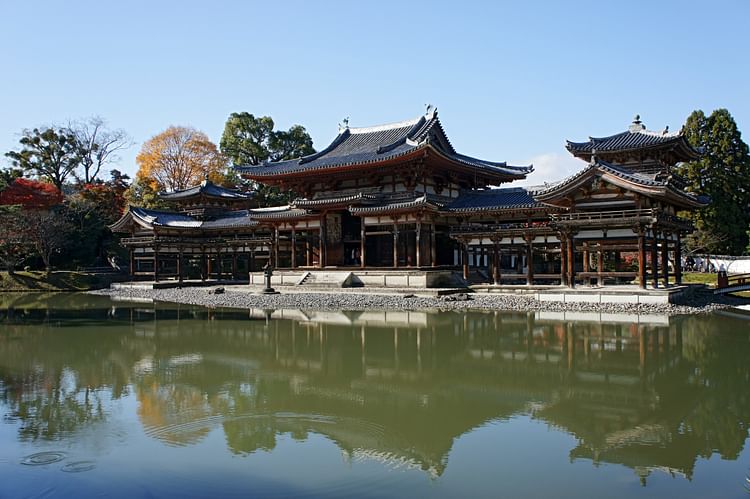 Phoenix Hall, Byodo-in 663highland (CC BY-SA) ](https://www.worldhistory.org/image/6584/phoenix-hall-byodo-in/ "Phoenix Hall, Byodo-in")From the central building, two wings (*Yokuro*) form covered and raised walkways which extend symmetrically along the edge of a lotus pond. There is a third, shorter wing, the *Biro*, leading from the rear of the central hall. The Phoenix Hall is 47 metres (154 ft) in length and 13.5 metres (44 ft) tall. The building faces the east, traditionally the direction of Amida's Pure Land paradise.
The overall and intentional effect of all this architectural and artistic magnificence was to replicate, to some degree, the splendours imagined present in Paradise. The harmony of the architectural design, the reflection in the lotus pond, the gilded statues and reflected candle light in the ceiling mirrors were all produced for a certain aesthetic effect. As one Heian Period book noted, "if you are suspicious about the existence of Gokuraku \[heaven\], pray at the Temple in Uji." (*Zoku Honcho Orai Den*). The Phoenix Hall became a model for many subsequent Amida temples and Pure Land gardens across Japan and it remains today one of the most recognisable and esteemed buildings in the country appearing, as it does, on the Y10 coins of Japan.
This content was made possible with generous support from the [Great Britain Sasakawa Foundation](http://www.gbsf.org.uk/?utm_source=ancient.eu&utm_medium=link&utm_campaign=ancient.eu).
#### Editorial Review
This human-authored definition has been reviewed by our editorial team before publication to ensure accuracy, reliability and adherence to academic standards in accordance with our [editorial policy](https://www.worldhistory.org/static/editorial-policy/).
## Bibliography
- [Byodo-in Offficial Site](http://www.byodoin.or.jp/en/about.html "Byodo-in Offficial Site"), accessed 25 May 2017.
- [Beasley, W.G. *The Japanese Experience A Short History of Japan.* University of California, 1999.](https://www.worldhistory.org/books/B000ORKKBI/)
- [Dougill, J. *Japan's World Heritage Sites.* Tuttle Publishing, 2014.](https://www.worldhistory.org/books/4805312858/)
- [Mason, R.H.P. *A History of Japan.* Tuttle Publishing, 1997.](https://www.worldhistory.org/books/080482097X/)
## About the Author
Mark is WHE’s Publishing Director and has an MA in Political Philosophy (University of York). He is a full-time researcher, writer, historian and editor. Special interests include art, architecture and discovering the ideas that all civilizations share.
## Timeline
- **1052 CE**: The [Buddhist](https://www.worldhistory.org/buddhism/) [temple](https://www.worldhistory.org/temple/) site [Byodo-in](https://www.worldhistory.org/Byodo-in/) is founded in [Japan](https://www.worldhistory.org/disambiguation/Japan/) by [Fujiwara](https://www.worldhistory.org/Fujiwara_Clan/) no Yorimichi.
## Cite This Work
### APA
Cartwright, M. (2017, May 26). Byodo-in. *World History Encyclopedia*.
### Chicago
Cartwright, Mark. "Byodo-in." *World History Encyclopedia*, May 26, 2017. .
### MLA
Cartwright, Mark. "Byodo-in." *World History Encyclopedia*, 26 May 2017, .
## License & Copyright
Submitted by [Mark Cartwright](https://www.worldhistory.org/user/markzcartwright/ "User Page: Mark Cartwright"), published on 26 May 2017. The copyright holder has published this content under the following license: [Creative Commons Attribution-NonCommercial-ShareAlike](https://creativecommons.org/licenses/by-nc-sa/4.0/deed.en). This license lets others remix, tweak, and build upon this content non-commercially, as long as they credit the author and license their new creations under the identical terms. When republishing on the web a hyperlink back to the original content source URL must be included. Please note that content linked from this page may have different licensing terms.