---
title: Butrint
author: Mark Cartwright
source: https://www.worldhistory.org/Butrint/
format: machine-readable-alternate
license: Creative Commons Attribution-NonCommercial-ShareAlike (https://creativecommons.org/licenses/by-nc-sa/4.0/)
updated: 1970-01-01
---
# Butrint
_Authored by [Mark Cartwright](https://www.worldhistory.org/user/markzcartwright/)_
Butrint (ancient name Buthrotum) is located on the fertile coast of Epirus in present-day Albania and was an important settlement in [Hellenistic](https://www.worldhistory.org/Hellenic_World/) and [Roman](https://www.worldhistory.org/disambiguation/Roman/) times due to its position on the route from [Italy](https://www.worldhistory.org/italy/) to mainland [Greece](https://www.worldhistory.org/greece/) down the Ionian Sea, its safe anchorage, inland access via Lake Butrint and its proximity to [Corcyra](https://www.worldhistory.org/corcyra/) ([Corfu](https://www.worldhistory.org/corcyra/)). Butrint is a UNESCO World Heritage Site.
### [Greek](https://www.worldhistory.org/disambiguation/greek/) Butrint
Settled since the [Bronze Age](https://www.worldhistory.org/disambiguation/Bronze_Age/), the site was certainly in contact with the Greek [civilization](https://www.worldhistory.org/civilization/) from the 7th century BCE as [pottery](https://www.worldhistory.org/pottery/) finds from [Corinth](https://www.worldhistory.org/corinth/) and Attica attest. Indeed, archaeological remains suggest that an [archaic](https://www.worldhistory.org/disambiguation/Archaic/) [temple](https://www.worldhistory.org/temple/) sanctuary was present on the site from the 5th century BCE, possibly in honour of [Zeus](https://www.worldhistory.org/zeus/) Soter. Polygonal fortification walls also remain from this period. In all probability, Butrint was at one time a colony of the ancient [city](https://www.worldhistory.org/city/) of Corcyra, just a few kilometres across the sea on the island of Corfu. From the 4th century BCE, it is likely that Butrint became subject to the Chaonians, who controlled the Epirus region and had their capital at Phoenice.
### [Hellenistic Period](https://www.worldhistory.org/Hellenistic_Period/)
In Hellenistic times from the 4th to 3rd century BCE, fortifications consisting of a circuit [wall](https://www.worldhistory.org/wall/) of large rectangular cut blocks was constructed with various monumental gates. A large sanctuary to [Asclepius](https://www.worldhistory.org/Asclepius/) was also constructed on the southern slopes of the [acropolis](https://www.worldhistory.org/Acropolis/), probably around a sacred spring. In the 2nd century BCE, the site was extensively developed with funding from offerings made at the sanctuary and many buildings were constructed including a [theatre](https://www.worldhistory.org/disambiguation/theatre/) and [agora](https://www.worldhistory.org/agora/) with stoas.
### Roman Period
Butrint came under Roman control in 167 BCE but maintained a high degree of autonomy. The Romans gave Butrint particular importance via the *Aeneid* of Virgil which had the hero Aeneas stay at the site and attributed a Trojan ancestry to the town, claiming the settlement was founded by the seer Helenus, son of the Trojan King Priam. [Julius Caesar](https://www.worldhistory.org/Julius_Caesar/) visited Butrint in 44 BCE and in 48 BCE it formally became a Roman colony. Butrint was not only strategically important in controlling local sea routes but was also of commercial interest in terms of [agriculture](https://www.worldhistory.org/disambiguation/Agriculture/). Indeed, the millionaire [Titus](https://www.worldhistory.org/disambiguation/Titus/) Pomponius Atticus had owned property in the area from c. 68 BCE.
[ 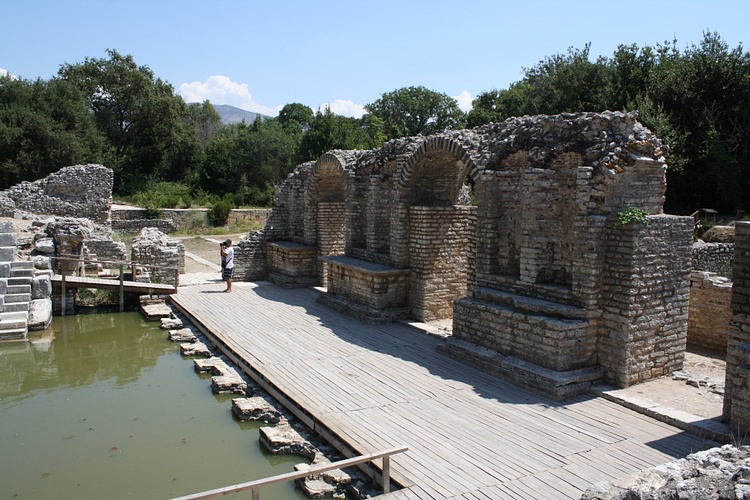 Stage Buildings of the Theatre of Butrint Mark Cartwright (CC BY-NC-SA) ](https://www.worldhistory.org/image/859/stage-buildings-of-the-theatre-of-butrint/ "Stage Buildings of the Theatre of Butrint")The town once again received Roman investment in the Augustan period after [Augustus](https://www.worldhistory.org/augustus/)' victory in 31 BCE over [Mark Antony](https://www.worldhistory.org/Mark_Antony/) and [Cleopatra](https://www.worldhistory.org/disambiguation/cleopatra/) at the [Battle of Actium](https://www.worldhistory.org/Battle_of_Actium/), just 100 km to the south. Butrint officially adopted the Latin language, established a senate and was given the right to mint coins. Various building projects were instigated including [Roman baths](https://www.worldhistory.org/Roman_Baths/) with underfloor heating, a road bridge, a nymphaeum (public decorative fountain), an [aqueduct](https://www.worldhistory.org/aqueduct/), three shrines - one dedicated to [Minerva](https://www.worldhistory.org/Minerva/) Augusta - and the paving of the agora and adaptation into a [Roman forum](https://www.worldhistory.org/Roman_Forum/). From the 1st century CE, the outer suburbs of the town were also further developed and its grid road system was typical of Roman town planning.
In the 2nd century CE, the theatre was expanded with the stage area being monumentalised and the forum was further beautified with shrines and dedicatory statues. From the 2nd to the 3rd centuries BCE the outer suburbs of the ancient city saw the construction of large private villas with large central peristyle courts, ornamental pools, and fine [mosaic](https://www.worldhistory.org/Mosaic/) floors. Extensive architectural damage occurred to various buildings on the site sometime in the 4th century CE and may have been caused by the large [earthquake](https://www.worldhistory.org/disambiguation/earthquake/) of 365 CE which struck the whole Balkan area. Despite some evidence of reconstruction attempts, the site never recaptured its former prominence and, from the 5th century CE, Christian buildings were constructed including a large basilica and baptistery.
#### Editorial Review
This human-authored definition has been reviewed by our editorial team before publication to ensure accuracy, reliability and adherence to academic standards in accordance with our [editorial policy](https://www.worldhistory.org/static/editorial-policy/).
## Bibliography
- [Inge Lyse Hansen. *Hellenistic and Roman Butrint (Nga E Njejta Seri/in the Same Series).* The Butrint Foundation, 2009.](https://www.worldhistory.org/books/0953555682/)
## About the Author
Mark is WHE’s Publishing Director and has an MA in Political Philosophy (University of York). He is a full-time researcher, writer, historian and editor. Special interests include art, architecture and discovering the ideas that all civilizations share.
## Timeline
- **167 BCE**: [Butrint](https://www.worldhistory.org/Butrint/) becomes subject to [Roman](https://www.worldhistory.org/disambiguation/Roman/) control.
- **48 BCE**: [Butrint](https://www.worldhistory.org/Butrint/) formally becomes a [Roman](https://www.worldhistory.org/disambiguation/Roman/) colony.
- **365 CE**: [Butrint](https://www.worldhistory.org/Butrint/) severely damaged by [earthquake](https://www.worldhistory.org/disambiguation/earthquake/).
## External Links
- [Buthrotum (Butrint) – following hadrian photography](https://followinghadrianphotography.com/2019/01/15/buthrotum/)
## Cite This Work
### APA
Cartwright, M. (2012, August 23). Butrint. *World History Encyclopedia*.
### Chicago
Cartwright, Mark. "Butrint." *World History Encyclopedia*, August 23, 2012. .
### MLA
Cartwright, Mark. "Butrint." *World History Encyclopedia*, 23 Aug 2012, .
## License & Copyright
Submitted by [Mark Cartwright](https://www.worldhistory.org/user/markzcartwright/ "User Page: Mark Cartwright"), published on 23 August 2012. The copyright holder has published this content under the following license: [Creative Commons Attribution-NonCommercial-ShareAlike](https://creativecommons.org/licenses/by-nc-sa/4.0/deed.en). This license lets others remix, tweak, and build upon this content non-commercially, as long as they credit the author and license their new creations under the identical terms. When republishing on the web a hyperlink back to the original content source URL must be included. Please note that content linked from this page may have different licensing terms.