---
title: Bucchero
author: Mark Cartwright
source: https://www.worldhistory.org/Bucchero/
format: machine-readable-alternate
license: Creative Commons Attribution-NonCommercial-ShareAlike (https://creativecommons.org/licenses/by-nc-sa/4.0/)
updated: 1970-01-01
---
# Bucchero
_Authored by [Mark Cartwright](https://www.worldhistory.org/user/markzcartwright/)_
Bucchero wares are a shiny dark grey to black [pottery](https://www.worldhistory.org/pottery/) produced by the [Etruscans](https://www.worldhistory.org/Etruscan_Civilization/) of central [Italy](https://www.worldhistory.org/italy/) from the 7th to 4th century BCE. Used for everyday purposes and as funerary and votive objects, bucchero incorporates many forms from simple jugs to highly decorative pieces of [sculpture](https://www.worldhistory.org/disambiguation/Sculpture/).
### Evolution
In the 8th century BCE, the Etruscans were already producing a rather crude pottery known as *impasto* which was made of clay containing impurities of mica or stone. Although potters managed to improve the quality of *impasto* through long practice, it was replaced as the daily pottery of choice by an intermediary type known as *buccheroid impasto* and then bucchero proper sometime in the early 7th century BCE. Turned on the wheel, this new type had a more even firing and, using a process of reducing oxygen in the kiln, gave a consistent and distinctive glossy dark grey to black finish (the clay's red ferric oxide being turned into black ferrous oxide).
The earliest known examples come from [Cerveteri](https://www.worldhistory.org/Cerveteri/) (aka Cisra or Caera) and date to c. 675 BCE. Bucchero was produced in many [Etruscan](https://www.worldhistory.org/Etruscan_Civilization/) centres (notably Cerveteri, [Tarquinia](https://www.worldhistory.org/Tarquinia/), [Veii](https://www.worldhistory.org/Veii/), and [Vulci](https://www.worldhistory.org/Vulci/)) and has become a hallmark of Etruscan presence at archaeological sites in central and northern Italy. The Etruscans were [Mediterranean](https://www.worldhistory.org/disambiguation/mediterranean/)-wide traders, too, and bucchero was thus exported beyond Italy to places afar afield as [Iberia](https://www.worldhistory.org/disambiguation/iberia/) and the [Levant](https://www.worldhistory.org/levant/).
[ 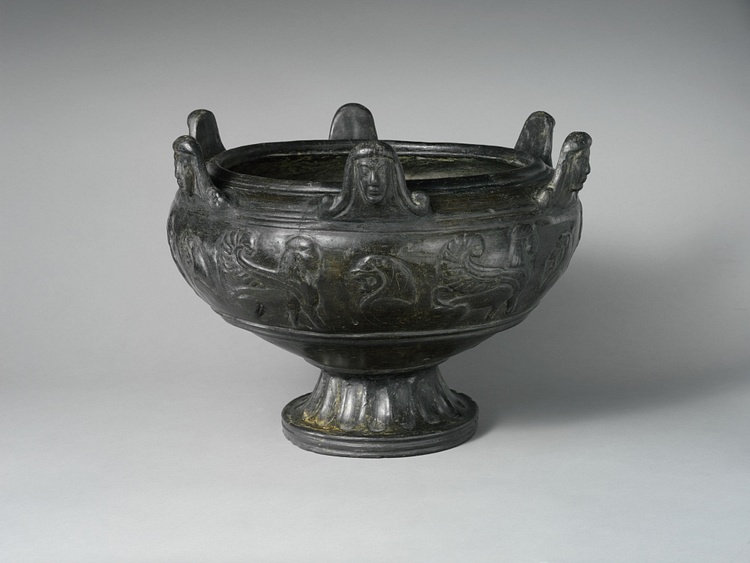 Bucchero Krater Metropolitan Museum of Art, N.Y: (Copyright) ](https://www.worldhistory.org/image/6279/bucchero-krater/ "Bucchero Krater")Curiously, bucchero wares display the reverse trend of refinement seen in many other pottery type evolutions. The early period wares are finer with much thinner walls and more carefully made; these are known as *sottile* (fine). There is then an intermediary stage known as *transizionale* (transitional) before a final phase when wares are described as *pesante* (heavy). Finer wares are generally associated with the southern Etruscans [cities](https://www.worldhistory.org/city/) and the heavier type in the northern. [Chiusi](https://www.worldhistory.org/Chiusi/) became a particularly noted centre for *pesante* wares, most of them being funerary objects. The dates for each style are usually cited as follows:
- **Fine bucchero**: 675-626 BCE
- **Transitional bucchero**: 625-575 BCE
- **Heavy bucchero**: 575-480 BCE
Eventually, by the early 5th century BCE, bucchero was replaced by finer [Etruscan pottery](https://www.worldhistory.org/Etruscan_Pottery/) such as black and red-glazed wares, and by imported [Greek](https://www.worldhistory.org/disambiguation/greek/) vessels which were specifically made in [Greece](https://www.worldhistory.org/greece/) to suit Etruscan tastes or made by local and immigrant potters in imitation of popular Greek styles.
[  Bucchero Jug The British Musuem (Copyright) ](https://www.worldhistory.org/image/6278/bucchero-jug/ "Bucchero Jug")### Forms
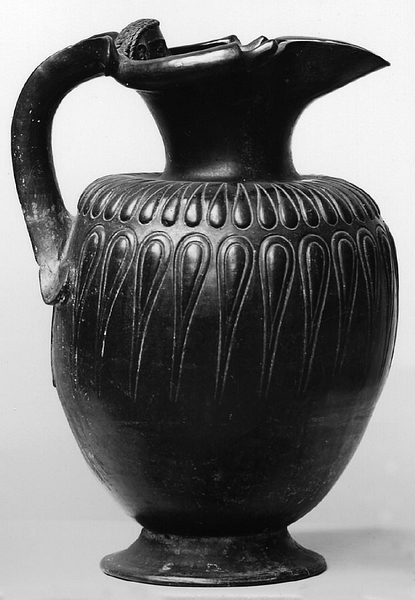
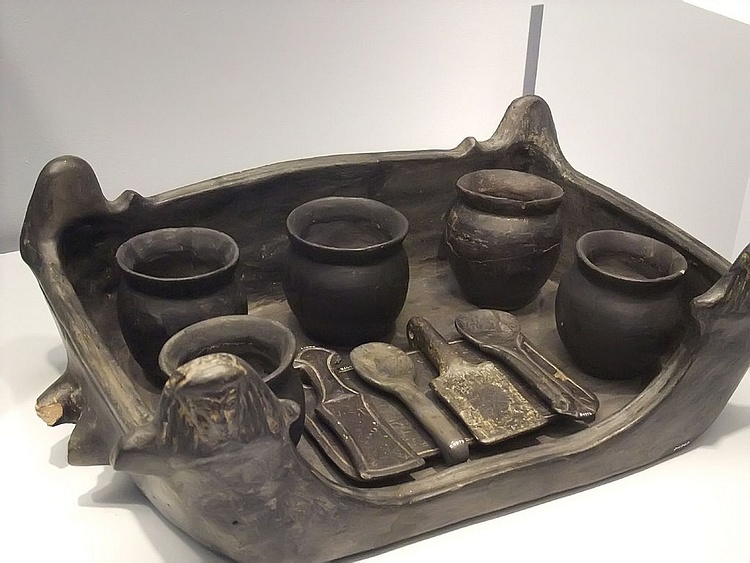
Etruscan potters were not without ambition and besides making vessels for ordinary daily use such as bowls, single and two-handled cups, chalices, and jugs, they also made more elaborate pieces with the addition of three-dimensional figures of both humans (especially female heads) and animals. Greek influence is seen in such choices as the ubiquitous [amphora](https://www.worldhistory.org/Amphora/) and two-handle cup or *kantharos*. Other forms include votive offerings and wares placed in tombs to accompany the dead into the next life. A common example of the latter are the plain service trays (known as *focolare*) complete with bowls, plates, cups, and utensils. Another form of votive offerings was figurines. These are closer to sculpture than pure pottery, as are the anthropomorphic vessels such as the cockerel from Viterbo which has a small lid and, if its inscription of the Etruscan [alphabet](https://www.worldhistory.org/alphabet/) is anything to go by, functioned as an ink pot.
The forms of bucchero were also influenced by contemporary metalwork, especially [bronze](https://www.worldhistory.org/disambiguation/bronze/) goods, and the pottery was probably esteemed for its shiny finish so like burnished [metal](https://www.worldhistory.org/disambiguation/metal/). Indeed, this imitation sometimes went so far as to manifest itself in some bucchero vases being covered in [gold](https://www.worldhistory.org/gold/) or [silver](https://www.worldhistory.org/Silver/) leaf, sometimes also a thin layer of tin. Decorations of ridges and applied sculpted pieces can complete the illusion of embossed metalwork.
[  Bucchero Dinner Set Mary Harrsch (Photographed at the Art Institute of Chicago) (CC BY-SA) ](https://www.worldhistory.org/image/6277/bucchero-dinner-set/ "Bucchero Dinner Set")### Decoration
Many bucchero wares were left plain, but decoration, when it occurs, can take the form of simple lines, spirals, and dotted fans incised onto the surface. Red ochre was sometimes painted in these incisions, but very few examples survive with their paint intact. Another decoration is the application of geometric shapes arranged symmetrically around the vessel, giving the illusion the vessel has been pressed from the inside. Many decorative motifs and scenes were influenced, as with other branches of [Etruscan art](https://www.worldhistory.org/Etruscan_Art/), by Ionian and Near Eastern art. Greek decorated pottery from Attica and [Corinth](https://www.worldhistory.org/corinth/) was especially popular in [Etruria](https://www.worldhistory.org/Etruscan_Civilization/) and incised scenes from [Greek mythology](https://www.worldhistory.org/Greek_Mythology/) are a popular choice for bucchero artists. Patterns and scenes could be applied to the pot before firing using a stamp, either fixed or a roller.
#### Editorial Review
This human-authored definition has been reviewed by our editorial team before publication to ensure accuracy, reliability and adherence to academic standards in accordance with our [editorial policy](https://www.worldhistory.org/static/editorial-policy/).
## Bibliography
- [Haynes, S. *Etruscan Civilization.* J. Paul Getty Museum, 2005.](https://www.worldhistory.org/books/0892366001/)
- [Heurgon, J. *Daily Life of the Etruscans.* Phoenix, 2002.](https://www.worldhistory.org/books/1842125923/)
- [Keller, W. *The Etruscans.* Random House Inc (T), 1974.](https://www.worldhistory.org/books/0394473019/)
- [Spivey, N.J. *Etruscan Art.* Thames & Hudson, 1997.](https://www.worldhistory.org/books/0500203040/)
## About the Author
Mark is WHE’s Publishing Director and has an MA in Political Philosophy (University of York). He is a full-time researcher, writer, historian and editor. Special interests include art, architecture and discovering the ideas that all civilizations share.
## Timeline
- **675 BCE**: First instances of [Etruscan](https://www.worldhistory.org/Etruscan_Civilization/) [bucchero](https://www.worldhistory.org/Bucchero/) wares are found at [Cerveteri](https://www.worldhistory.org/Cerveteri/).
- **675 BCE - 626 BCE**: Fine [bucchero](https://www.worldhistory.org/Bucchero/) [pottery](https://www.worldhistory.org/pottery/) style in [Etruria](https://www.worldhistory.org/Etruscan_Civilization/).
- **625 BCE - 575 BCE**: Transitional [bucchero](https://www.worldhistory.org/Bucchero/) [pottery](https://www.worldhistory.org/pottery/) style in [Etruria](https://www.worldhistory.org/Etruscan_Civilization/).
- **575 BCE - 480 BCE**: Heavy [bucchero](https://www.worldhistory.org/Bucchero/) [pottery](https://www.worldhistory.org/pottery/) style in [Etruria](https://www.worldhistory.org/Etruscan_Civilization/).
## Cite This Work
### APA
Cartwright, M. (2017, January 20). Bucchero. *World History Encyclopedia*.
### Chicago
Cartwright, Mark. "Bucchero." *World History Encyclopedia*, January 20, 2017. .
### MLA
Cartwright, Mark. "Bucchero." *World History Encyclopedia*, 20 Jan 2017, .
## License & Copyright
Submitted by [Mark Cartwright](https://www.worldhistory.org/user/markzcartwright/ "User Page: Mark Cartwright"), published on 20 January 2017. The copyright holder has published this content under the following license: [Creative Commons Attribution-NonCommercial-ShareAlike](https://creativecommons.org/licenses/by-nc-sa/4.0/deed.en). This license lets others remix, tweak, and build upon this content non-commercially, as long as they credit the author and license their new creations under the identical terms. When republishing on the web a hyperlink back to the original content source URL must be included. Please note that content linked from this page may have different licensing terms.