---
title: Brundisium
author: Mark Cartwright
source: https://www.worldhistory.org/Brundisium/
format: machine-readable-alternate
license: Creative Commons Attribution-NonCommercial-ShareAlike (https://creativecommons.org/licenses/by-nc-sa/4.0/)
updated: 2025-01-28
---
# Brundisium
_Authored by [Mark Cartwright](https://www.worldhistory.org/user/markzcartwright/)_
Brundisium (modern Brindisi), located on the Adriatic coast of southern [Italy](https://www.worldhistory.org/italy/), was a Messapian and then [Roman](https://www.worldhistory.org/disambiguation/Roman/) town of great strategic importance throughout antiquity. Although architectural remains are sparse, the [city](https://www.worldhistory.org/city/) has several claims to fame. Brundisium is the end of the road for the Appian Way, was a traditional launching point for armies and travellers to the East, and played a pivotal role in both the [Punic wars](https://www.worldhistory.org/Punic_Wars/) and Roman civil wars. Amongst its more impressive artefacts are many examples of [Hellenistic](https://www.worldhistory.org/Hellenic_World/) and Roman [bronze](https://www.worldhistory.org/disambiguation/bronze/) statuary which have been rescued from the town's harbour.
### Early Settlement
The area of Brindisi was inhabited in Palaeolithic times some 12,000 years ago and the site of Torre Testa just 7 km to the north was the most important settlement in the region at that time. Thousands of stone tools and other artefacts have been discovered which belonged to the hunter-gatherers of the period. A continued presence in the [Neolithic period](https://www.worldhistory.org/Neolithic/) and [Bronze Age](https://www.worldhistory.org/disambiguation/Bronze_Age/) is attested by additional finds.
### Messapian & [Greek](https://www.worldhistory.org/disambiguation/greek/) Town
Located at the very bottom of the Italian peninsula, in local [mythology](https://www.worldhistory.org/mythology/) Brundisium was first settled by either [Diomedes](https://www.worldhistory.org/Diomedes/), a hero of the [Trojan War](https://www.worldhistory.org/Trojan_War/), or Phalanthus, the Spartan who was also credited with founding nearby [Tarentum](https://www.worldhistory.org/tarentum/) (modern Taranto). Yet other sources suggest Brundisium was founded by settlers from [Crete](https://www.worldhistory.org/crete/). Certainly, a Greek influence, if not actually full [Greek colonization](https://www.worldhistory.org/Greek_Colonization/), is indicated in the cemetery at Tor Pisani. Little is known today regarding the town when it was inhabited by the Messapians, one of the tribes who lived in the 'heel' of Italy which constitutes modern Apulia. Their name for the town was Brentesion which may derive from the Messapian *brentos*, meaning 'deer's head', which describes the form of the harbour with its two distinctive promontories.
[ 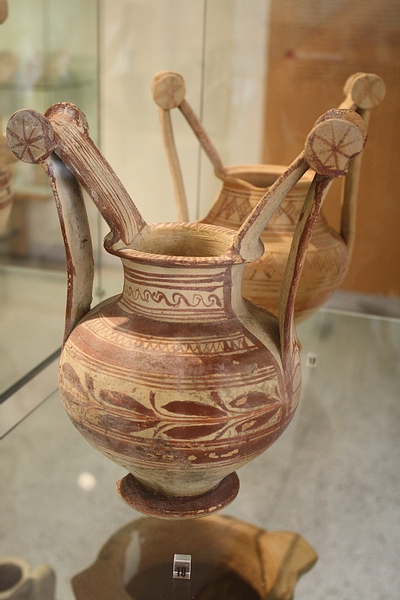 Two-handled Vase, Brundisium Mark Cartwright (CC BY-NC-SA) ](https://www.worldhistory.org/image/7085/two-handled-vase-brundisium/ "Two-handled Vase, Brundisium")The best surviving examples of Messapian [culture](https://www.worldhistory.org/disambiguation/culture/) are ceramics. In particular, the high-handled [amphorae](https://www.worldhistory.org/Amphora/) known as *trozella* are unique to the region and have geometrical and plant motif decorative designs. There is evidence of a long and bitter rivalry with Tarentum (modern Taranto), the Spartan colony some 75 kilometres to the west on Italy's southern coast. Brundisium minted its own [coinage](https://www.worldhistory.org/coinage/) and formed an alliance with Thurii c. 440 BCE, another Greek colony to the west built on the site of old Sybaris.
### Roman Brundisium
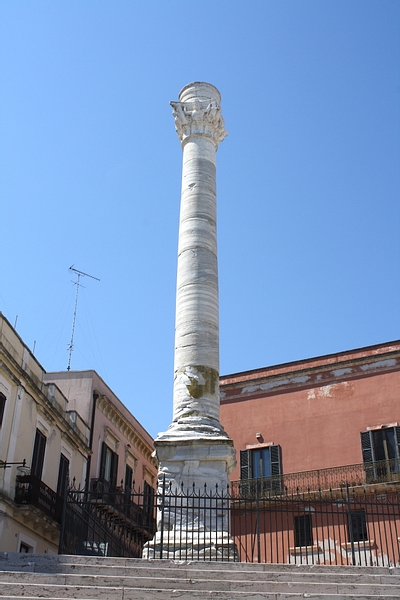
Brundisium started to take on a greater regional significance only from the 3rd century BCE onwards when [Rome](https://www.worldhistory.org/Rome/) began to expand throughout the Italian peninsula. The Romans conquered the city in 266 BCE and a colony was formally established at Brundisium in 247 or 244 BCE. The city was then fortified in order to ensure the Romans kept hold of the excellent double harbour they had acquired. Around the same time, the great Roman road the Via Appia (Appian Way) was extended to reach the city, connecting it with Rome itself and bringing its total paved length to 569 km or 385 Roman miles. Brundisium consequently became the main point of departure for anyone travelling to [Greece](https://www.worldhistory.org/greece/) and the East and usurped Tarentum's position as the most important port in the south. Today a 19.2 m tall single marble [column](https://www.worldhistory.org/column/) stands near the waterfront which was traditionally thought to [mark](https://www.worldhistory.org/disambiguation/Mark/) the spot where the road finally ends. In fact, inscriptions reveal that the column once belonged to a building with a religious or commemorative function connected to the sea.
[  End of the Appian Way Column Marker Mark Cartwright (CC BY-NC-SA) ](https://www.worldhistory.org/image/7081/end-of-the-appian-way-column-marker/ "End of the Appian Way Column Marker")During the [First Punic War](https://www.worldhistory.org/First_Punic_War/) (264-241 BCE) the Carthaginian general [Hamilcar Barca](https://www.worldhistory.org/Hamilcar_Barca/) had attacked several Roman coastal [cities](https://www.worldhistory.org/city/) in search of booty for his mercenaries and one of them was Brundisium in 247 BCE. These skirmishes, though, were largely a minor distraction from the main battlefront in [Sicily](https://www.worldhistory.org/sicily/). The city became more directly embroiled in the [Second Punic War](https://www.worldhistory.org/Second_Punic_War/) (218-201 BCE) when [Hannibal](https://www.worldhistory.org/hannibal/) invaded Italy and encamped in the southern corner of the peninsula. The Carthaginian general desperately needed a port through which he could receive reinforcements and supplies from [Africa](https://www.worldhistory.org/disambiguation/africa/) but the Romans successfully blockaded the harbours of the southern coast.
[Sulla](https://www.worldhistory.org/sulla/) gave Brundisium an exemption from the *portoria*, the tax duty imposed on the import and export of goods at ports, and the town was given *municipium* status around 89 BCE, which granted its citizens [Roman citizenship](https://www.worldhistory.org/article/859/roman-citizenship/). However, the city's fortunes would soon suffer a dramatic downturn during the violent final stages of the [Roman Republic](https://www.worldhistory.org/Roman_Republic/). In the civil war of the 1st century BCE, Brundisium would, once again, find itself centre stage in the theatre of a bloody and brutal war. [Julius Caesar](https://www.worldhistory.org/Julius_Caesar/) captured the city in 49 BCE so that he could prevent his great rival [Pompey](https://www.worldhistory.org/pompey/) from fleeing Italy. Then it was attacked again in 40 BCE, this time by [Mark Antony](https://www.worldhistory.org/Mark_Antony/). The city's handy location at the foot of Italy was proving something of a liability for the local residents. Brundisium was also the site of the accord, known as the Treaty of Brundisium, between [Antony](https://www.worldhistory.org/Mark_Antony/) and [Octavian](https://www.worldhistory.org/augustus/) to carve up the [Roman Empire](https://www.worldhistory.org/Roman_Empire/) between themselves. When Octavian won the war and became the first [Roman Emperor](https://www.worldhistory.org/Roman_Emperor/) as [Augustus](https://www.worldhistory.org/augustus/), a [triumphal arch](https://www.worldhistory.org/Triumphal_Arch/) was set up in the city in his honour.
Yet another historical event linked to the city is the [death](https://www.worldhistory.org/disambiguation/Death/) of [Virgil](https://www.worldhistory.org/virgil/) there in 19 BCE, shortly after the writer returned from a trip to Greece. The city would continue to exist as a minor Roman town in the imperial period with the slave [trade](https://www.worldhistory.org/disambiguation/trade/), fishing and shipbuilding providing plenty of employment and wealth for some as evidenced in the large villas of the period. A Christian community was founded by Saint Leucius of [Alexandria](https://www.worldhistory.org/alexandria/) in the second half of the 2nd century CE.
Unfortunately, the continual inhabitation of the site and constant reuse of ancient building materials has obscured its development in later times and left few standing remains. Excavations have revealed traces of all the usual features one would expect to find in a Roman town: a [Roman forum](https://www.worldhistory.org/Roman_Forum/), market square, [Roman baths](https://www.worldhistory.org/Roman_Baths/), [aqueducts](https://www.worldhistory.org/aqueduct/), [amphitheatre](https://www.worldhistory.org/amphitheatre/), necropolis, and regular town plan. There was also an *armamentarium* or arsenal and several warehouses, both indicative of Brundisium's primary function as a gateway to Roman Italy for goods and troops.
[  Terracotta Aphrodite, Brundisium Mark Cartwright (CC BY-NC-SA) ](https://www.worldhistory.org/image/7086/terracotta-aphrodite-brundisium/ "Terracotta Aphrodite, Brundisium")### Artefacts
While little remains of the ancient buildings of Brundisium, the city, and especially its harbour, has provided some outstanding examples of Greek and [Roman art](https://www.worldhistory.org/Roman_Art/) for posterity. Amongst these survivors are many bronze statues. Unfortunately, most are incomplete but some of them remain sufficiently intact to still instil awe at the skills of ancient metalworkers. A notable piece is the head and torso of a figure known as the Hellenistic Prince which dates to the 2nd or 1st century BCE. Another fine head has been identified as a Greek philosopher, possibly Antisthenes, and dates to the 4th century BCE. Besides many examples of *trozella* already mentioned, the town's archaeological museum possesses a fine collection of [Greek pottery](https://www.worldhistory.org/Greek_Pottery/) and terracotta figurines including a charming depiction of a crouched [Aphrodite](https://www.worldhistory.org/Aphrodite/) emerging from her shell.
#### Editorial Review
This human-authored definition has been reviewed by our editorial team before publication to ensure accuracy, reliability and adherence to academic standards in accordance with our [editorial policy](https://www.worldhistory.org/static/editorial-policy/).
## Bibliography
- Bagnall, R. *The Encyclopedia of Ancient History.* Wiley-Blackwell, 2012
- [Hornblower, S. *The Oxford Classical Dictionary.* Oxford University Press, 2012.](https://www.worldhistory.org/books/0199545561/)
- [Hoyos, D. *A Companion to the Punic Wars.* Wiley-Blackwell, 2015.](https://www.worldhistory.org/books/1119025508/)
## About the Author
Mark is WHE’s Publishing Director and has an MA in Political Philosophy (University of York). He is a full-time researcher, writer, historian and editor. Special interests include art, architecture and discovering the ideas that all civilizations share.
## Timeline
- **440 BCE**: [Brundisium](https://www.worldhistory.org/Brundisium/) and Thurii form an alliance in southern [Italy](https://www.worldhistory.org/italy/).
- **247 BCE**: [Hamilcar Barca](https://www.worldhistory.org/Hamilcar_Barca/) raids southern [Italy](https://www.worldhistory.org/italy/) and then lands on [Sicily](https://www.worldhistory.org/sicily/) during the [First Punic War](https://www.worldhistory.org/First_Punic_War/).
- **c. 244 BCE**: The Romans form a colony at [Brundisium](https://www.worldhistory.org/Brundisium/) in southern [Italy](https://www.worldhistory.org/italy/).
- **207 BCE**: [Hannibal](https://www.worldhistory.org/hannibal/), harassed by [Roman](https://www.worldhistory.org/disambiguation/Roman/) forces, is reduced to controlling only Bruttium in southern [Italy](https://www.worldhistory.org/italy/).
- **89 BCE**: [Sulla](https://www.worldhistory.org/sulla/) awards [Brundisium](https://www.worldhistory.org/Brundisium/) municipium status.
- **49 BCE**: [Julius Caesar](https://www.worldhistory.org/Julius_Caesar/) captures [Brundisium](https://www.worldhistory.org/Brundisium/) in southern [Italy](https://www.worldhistory.org/italy/).
- **40 BCE**: [Mark Antony](https://www.worldhistory.org/Mark_Antony/) attacks [Brundisium](https://www.worldhistory.org/Brundisium/) in southern [Italy](https://www.worldhistory.org/italy/).
## Cite This Work
### APA
Cartwright, M. (2017, August 28). Brundisium. *World History Encyclopedia*.
### Chicago
Cartwright, Mark. "Brundisium." *World History Encyclopedia*, August 28, 2017. .
### MLA
Cartwright, Mark. "Brundisium." *World History Encyclopedia*, 28 Aug 2017, .
## License & Copyright
Submitted by [Mark Cartwright](https://www.worldhistory.org/user/markzcartwright/ "User Page: Mark Cartwright"), published on 28 August 2017. The copyright holder has published this content under the following license: [Creative Commons Attribution-NonCommercial-ShareAlike](https://creativecommons.org/licenses/by-nc-sa/4.0/deed.en). This license lets others remix, tweak, and build upon this content non-commercially, as long as they credit the author and license their new creations under the identical terms. When republishing on the web a hyperlink back to the original content source URL must be included. Please note that content linked from this page may have different licensing terms.