---
title: Bhubaneshwar
author: Mark Cartwright
source: https://www.worldhistory.org/Bhubaneswar/
format: machine-readable-alternate
license: Creative Commons Attribution-NonCommercial-ShareAlike (https://creativecommons.org/licenses/by-nc-sa/4.0/)
updated: 1970-01-01
---
# Bhubaneshwar
_Authored by [Mark Cartwright](https://www.worldhistory.org/user/markzcartwright/)_
Bhubaneshwar (also spelt Bhubaneswar, Bhubanesar, and Bhuvanesvar) is a [city](https://www.worldhistory.org/city/) located in the Orissa district of north-eastern [India](https://www.worldhistory.org/india/) and flourished as a centre of [Hindu](https://www.worldhistory.org/hinduism/) worship from the 7th century CE. Its mass of well-preserved sandstone temples, all oriented around the sacred lake Bindusarowar, make it one of the most impressive ancient [temple](https://www.worldhistory.org/temple/) sites in the whole of India.
### Architectural Highlights
**The Parasuramesvara & Other Early Temples**
Orissan [architecture](https://www.worldhistory.org/disambiguation/architecture/) greatly benefitted from a royal marriage between the Western Chalukya rulers and Orissan royalty which brought to the region elements of [Gupta architecture](https://www.worldhistory.org/Gupta_Architecture/) and its sophisticated temples. The Orissa then developed this canon into their own distinctive temple style. The oldest structures at Bhubaneswar are probably the three small Satrughnesvara shrines which are set in a line and date to perhaps the late 6th century CE.
The Parasuramesvara temple is of similar date, perhaps a little later, in the early 7th century CE, and built by the Shailodbhava kings. Dedicated to [Shiva](https://www.worldhistory.org/shiva/) it has a *sikhara* (tower, also called *deul* in Orissan architecture) with a central projecting [column](https://www.worldhistory.org/column/) on each face. It is topped with a usually large *amalaka* (ribbed circular stone). The rectangular *mukhasala* has, again unusually, an entrance at the front and side. The interior is lit with natural light from a row of small apertures in the roof and pierced stone screens. The temple is covered with decorative [sculpture](https://www.worldhistory.org/disambiguation/Sculpture/) of palms, rosettes, and foliage, as well as statues, especially of Kartikeya and [Ganesha](https://www.worldhistory.org/Ganesha/).
Other early buildings at Bhubaneswar include the Svarnjalesvara, Gauri-Sankara, Mohini, Paschimesvara, and Uttaresvara temples. Two almost identical temples are the slightly later Markandesvara and Sisiresvara. Both have sculpture directly carved from the building stonework, as opposed to later temples when decorative sculpture was carved separately and added later.
[ 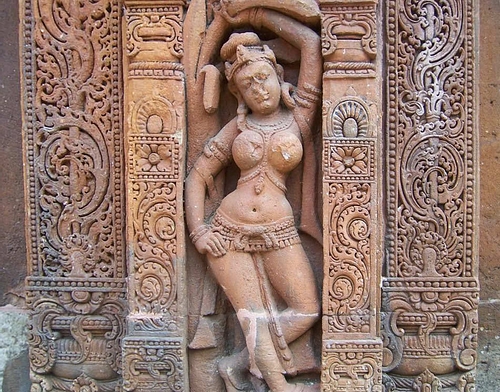 Dancer, Vaital Deul, Bhubaneswar Sujit Kumar (CC BY-SA) ](https://www.worldhistory.org/image/3994/dancer-vaital-deul-bhubaneswar/ "Dancer, Vaital Deul, Bhubaneswar")**The Vaital Deul**
The squat Vaital Deul temple, used for tantric worship and dedicated to Chamunda, is located next to the Sisiresvara. The temple was built in the late 8th century CE under the Bhauma Kara kings. It has a two-columned entrance porch and a barrel-vaulted roof (*sala*) with three *amalakas*. It is the only structure at Bhubaneswar with figure sculpture in the interior of the *garbhagriha* (sacred shrine). Indicating the temple's connection with demons and ghosts, these sculptures show Shiva as fearsome Bhairava along with corpses and decapitated heads. The exterior has many *kanyas* figures – seductive female dancers employed in dressing and beautifying themselves – and a Shiva Nataraja.
[  Gateway, Muktesvara Temple, Bhubaneshwar Subhasisa Panigahi (CC BY-SA) ](https://www.worldhistory.org/image/3995/gateway-muktesvara-temple-bhubaneshwar/ "Gateway, Muktesvara Temple, Bhubaneshwar")**The Muktesvara**
Built in the 9th-10th century CE under the rule of the Sovamashi, the red sandstone Muktesvara has a square entrance hall (*mandapa* or *jagamohana* in Orissa temples) with a tiered (*pida*) roof. Above the sacred shrine is a tower or *sikhara* which has *amalakas* running up the four corners and topped by a single large example, as is typical in Hindu temples across India. On top of the *amalaka* is a decorative element known as a *khapuris*, a flat bell-shaped adornment which is topped by either a trident or *linga*. The tower is punctuated in the middle of each face by protruding crouching lions (*dopicchas*).
The temple is decorated on the exterior with figures of *kanyas*, ascetics, and demons all set in individual frames of dots and foliage. Untypically, the ceiling of the mandapa has relief carvings which depict the mythical warrior Virabhadra and the Seven Mothers. The entire building is surrounded by a low [wall](https://www.worldhistory.org/wall/) or parapet carved in relief which has a single ornate gateway with two columns supporting an intricately carved arch. The temple is the greatest example of the mature Orissan architectural style.
[  Muktesvara Temple, Bhubaneshwar Amartyabag (CC BY-SA) ](https://www.worldhistory.org/image/3993/muktesvara-temple-bhubaneshwar/ "Muktesvara Temple, Bhubaneshwar")**The Lingaraja**
Built around 1100 CE in the reign of the [Ganga](https://www.worldhistory.org/Ganges/) kings the massive Lingaraja temple was originally known as the *Tribhuvanesvara* or the Lord of the Three Worlds, one of the many guises of Shiva. The main temple is composed of four connected chambers: the sacred shrine (*deul*), entrance hall (*jagamohana*), dance hall (*nata-mandira*), and offerings hall (*bhoga-mandira*). Each supports its own ceiling with four massive pillars. The tower is 45 metres high and even the *jagamohana* rises an impressive 30 metres. The latter also has two windows with balustrades. Decorative sculpture on the building exteriors includes [Yama](https://www.worldhistory.org/Yama/) and [Indra](https://www.worldhistory.org/Indra/) in their role as *dikpalas* (cardinal directions), Ganesha, Parvati, *vyalas* stamping on elephants, friezes of military episodes, and a multitude of *kanyas*. The walled compound also contains many subsidiary shrines.
**The Rajarani & Other Later Temples**
The Rajarani temple was constructed in the 11th to 12th centuries CE in the reign of the Somavamshis on a diamond plan. Similar to temples at [Khajuraho](https://www.worldhistory.org/Khajuraho/), the tower is surrounded by many smaller towers of different heights creating a mass of rising curves. The lower part of the tower is decorated with sculpture of all eight *dikpalas* (a rarity) and various female figures.
The Brahmesvara was constructed c. 1061 CE and helps to date the Lingaraja on stylistic grounds. The Ananta Vasudeva was built in 1275 CE and is the only major temple at the site which is dedicated to [Vishnu](https://www.worldhistory.org/Vishnu/). Finally, the Meghesvara was erected in the final quarter of the 12th century CE and has an unusually curved tower.
#### Editorial Review
This human-authored definition has been reviewed by our editorial team before publication to ensure accuracy, reliability and adherence to academic standards in accordance with our [editorial policy](https://www.worldhistory.org/static/editorial-policy/).
## Bibliography
- [Craven, R.C. *Indian Art.* Thames & Hudson, 1997.](https://www.worldhistory.org/books/0500203024/)
- [Harle, J.C. *The Art and Architecture of the Indian Subcontinent, Second Edition.* Yale University Press, 1994.](https://www.worldhistory.org/books/0300062176/)
- [Michell, G. *Hindu Art and Architecture.* Thames & Hudson, 2000.](https://www.worldhistory.org/books/0500203377/)
- [Mitter, P. *Indian Art.* Oxford University Press, 2001.](https://www.worldhistory.org/books/0192842218/)
## About the Author
Mark is WHE’s Publishing Director and has an MA in Political Philosophy (University of York). He is a full-time researcher, writer, historian and editor. Special interests include art, architecture and discovering the ideas that all civilizations share.
## Timeline
- **c. 750 CE**: The Parasurameshvara [Temple](https://www.worldhistory.org/temple/) is built at [Bhubaneswar](https://www.worldhistory.org/Bhubaneswar/).
- **c. 950 CE**: The Mukteshvara [Temple](https://www.worldhistory.org/temple/) is built at [Bhubaneswar](https://www.worldhistory.org/Bhubaneswar/).
- **c. 1050 CE**: The Lingaraja [Temple](https://www.worldhistory.org/temple/) is built at [Bhubaneswar](https://www.worldhistory.org/Bhubaneswar/).
- **c. 1050 CE**: The Rajarani [Temple](https://www.worldhistory.org/temple/) is built at [Bhubaneswar](https://www.worldhistory.org/Bhubaneswar/).
## Cite This Work
### APA
Cartwright, M. (2015, July 10). Bhubaneshwar. *World History Encyclopedia*.
### Chicago
Cartwright, Mark. "Bhubaneshwar." *World History Encyclopedia*, July 10, 2015. .
### MLA
Cartwright, Mark. "Bhubaneshwar." *World History Encyclopedia*, 10 Jul 2015, .
## License & Copyright
Submitted by [Mark Cartwright](https://www.worldhistory.org/user/markzcartwright/ "User Page: Mark Cartwright"), published on 10 July 2015. The copyright holder has published this content under the following license: [Creative Commons Attribution-NonCommercial-ShareAlike](https://creativecommons.org/licenses/by-nc-sa/4.0/deed.en). This license lets others remix, tweak, and build upon this content non-commercially, as long as they credit the author and license their new creations under the identical terms. When republishing on the web a hyperlink back to the original content source URL must be included. Please note that content linked from this page may have different licensing terms.