---
title: Bellerophon
author: Mark Cartwright
source: https://www.worldhistory.org/Bellerophon/
format: machine-readable-alternate
license: Creative Commons Attribution-NonCommercial-ShareAlike (https://creativecommons.org/licenses/by-nc-sa/4.0/)
updated: 2023-01-27
---
# Bellerophon
_Authored by [Mark Cartwright](https://www.worldhistory.org/user/markzcartwright/)_
Bellerophon (aka Bellerophontes) is the Corinthian hero of [Greek mythology](https://www.worldhistory.org/Greek_Mythology/) who famously battled and killed the fantastical Chimera monster, a fearsome fire-breathing mix of lion, goat, and snake. Bellerophon was the son of [Poseidon](https://www.worldhistory.org/poseidon/) and he is also noted for taming the winged horse [Pegasus](https://www.worldhistory.org/Pegasus/), a gift from his father.
Other adventures include famous fights and victories over the warlike Solymoi, the [Amazons](https://www.worldhistory.org/amazon/), and Carian pirates - all tasks set him by Iobates, the king of [Lycia](https://www.worldhistory.org/lycia/). The hero then pushed his luck too far, and, riding Pegasus high in the sky in a vain and foolish attempt to join the gods on Mount Olympus, Bellerophon fell to the ground and was killed.
### Bellerophon & Pegasus
In [Greek](https://www.worldhistory.org/disambiguation/greek/) [mythology](https://www.worldhistory.org/mythology/), Bellerophon was the son of Poseidon, although his natural father is usually cited as Glaucus, making him the grandson of [Sisyphus](https://www.worldhistory.org/sisyphus/), the king of [Corinth](https://www.worldhistory.org/corinth/) who was punished by [Zeus](https://www.worldhistory.org/zeus/) for his trickery and had to endlessly roll a huge stone up a hill down in [Hades](https://www.worldhistory.org/Hades/), the Greek underworld. According to [Homer](https://www.worldhistory.org/homer/) (c. 750 BCE), Bellerophon gained rather more divine favour than his grandfather as "the gods granted him beauty and all that is lovely in manhood" (*[Iliad](https://www.worldhistory.org/iliad/),* 6:155). The [god](https://www.worldhistory.org/God/) of the sea also gave his son a magnificent gift, Pegasus, the winged horse which had been born from the severed head of the Gorgon [Medusa](https://www.worldhistory.org/Medusa/) when she was killed by the hero [Perseus](https://www.worldhistory.org/Perseus/). In other accounts, Bellerophon found the horse at the sacred spring of Pirene near Corinth, and the Greek writer [Hesiod](https://www.worldhistory.org/hesiod/) (c. 700 BCE) suggests this fact explains the name Pegasus, which derived from 'water'- *pēgē.* Taming the horse with the help of the goddess [Athena](https://www.worldhistory.org/athena/), Bellerophon was able to ride and fly Pegasus, a skill that would come in handy in his later adventures when he killed various exotic creatures. Indeed, the historian Robin Lane Fox notes that the hero's very name indicates his past and future career, -*phontes* meaning 'killer'. Bellerophon was said to have killed a man called Bellerus and then his brother Deliades which explains why he left Corinth and began his adventures in [Tiryns](https://www.worldhistory.org/tiryns/), which ultimately led to more killings.
### Bellerophon & the Chimera
Bellerophon was involved in a famous [battle](https://www.worldhistory.org/disambiguation/battle/) with the Chimera (Chimaera or Chimaira). This happened after Proitos, the king of Tiryns (aka Proetus) became outraged with the hero following accusations made by his wife Stheneboia (called Anteia in some versions) that Bellerophon had tried to rape her. She had fallen in love with our hero, but Bellerophon, being a good guest and not wishing to dishonour his host, would not encourage her. Proitos believed his wife and sent Bellerophon to serve his father-in-[law](https://www.worldhistory.org/disambiguation/law/) (or brother in other versions) Iobates, the king of Lycia (in modern [Turkey](https://www.worldhistory.org/Asia_Minor/)). Proitos even gave our hero a tablet to be delivered to Isoabates which was inscribed with instructions to do away with Bellerophon at any opportunity. The precise wording of this poison pen letter was:
> Pray remove the bearer from this world; he has tried to violate my wife, your daughter.
> (Graves, 75a)
[  Chimera, Corinthian Plate Carole Raddato (CC BY-SA) ](https://www.worldhistory.org/image/3358/chimera-corinthian-plate/ "Chimera, Corinthian Plate")Iobates first welcomed his guest with all due honours, arranging a round of feasts that lasted nine days. Then the king asked to see the tablet from his son-in-law. After reading the dastardly instructions scratched into the wax, Iobates set our hero the impossibly dangerous task of killing the Chimera - a fantastic fire-breathing creature which had a lion's body, a snake as a tail, and a goat's head protruding from its back. Hesiod gives the following description in his *[Theogony](https://www.worldhistory.org/Theogony/)*:
> \[The\] Chimaera, who breathed invincible fire, terrible and great and swift-footed and mighty. She had three heads: one was a fierce-eyed lion's, one a she-goat's, one a snake's, a mighty dragon's.
> (319).
This bizarre concoction of creatures was considered the offspring of [Typhon](https://www.worldhistory.org/Typhon/), the monster with 100 fire-breathing heads which made all the sounds of the animal kingdom, and Echidna, the half-snake, half-woman monster who also gave birth to [Cerberus](https://www.worldhistory.org/Cerberus/), the three-headed hound that guarded the gates of Hades. In alternative versions, notably in Homer's *Iliad*, the Chimera was reared by Amisodarus.
[ YouTube Follow us on YouTube!](https://link.worldhistory.org/youtube_intext)
Bellerophon was able to use his winged horse Pegasus and he thus managed to fly above the Chimera, repeatedly firing arrows into the back of the monster with his bow. The weakened Chimera was finally killed when Bellerophon attached a lump of lead to the end of his spear and thrust this into the monster's mouth. The flaming breath of the creature melted the lead which then poured down its throat and solidified in its vital organs.
[  Chimera, Black-Figure Amphora Carole Raddato (CC BY-SA) ](https://www.worldhistory.org/image/3357/chimera-black-figure-amphora/ "Chimera, Black-Figure Amphora")### Interpretation of the Chimera Myth
It is possible that the myth of Bellerophon was based on some sort of historical reality. The slopes of Mount Olympus in Lycia still burn today with flames from outpourings of natural gas (the *yanar* in Turkish). Further, it is possible that a local hunter did indeed kill a troublesome lion and snake, thus spawning the legend of a hero-killer where the animals were combined into one. Robin Lane Fox also notes that the root word for fire in Semitic languages was *chmr*. Did this fire-creature become the Chimera? An alternative theory is that the Chimera represented an ancient goddess who herself represented the Sacred Year which was divided into three parts, each with its own symbol: a lion for spring, a goat for summer and a snake for winter. Bellerophon, representing the Greeks, may also symbolise the historical [conquest](https://www.worldhistory.org/warfare/) of ancient Carian peoples, who worshipped a moon goddess whose calendar symbol was the Chimera. Finally, Bellerophon's taming of Pegasus may reflect another aspect of the same story, as the horse was a symbol of this moon goddess.
### The Solymoi, Amazons, & [Death](https://www.worldhistory.org/disambiguation/Death/)
To return to the mythology, when Bellerophon returned triumphantly to Iobates, he was promptly told to go off and fight the fearsome Solymoi (aka Solymi), an infamously warlike people. Once again, Pegasus allowed the hero to fly above his enemy and this time he dropped large boulders on to them. Again, Bellerophon returned in [triumph](https://www.worldhistory.org/Roman_Triumph/) but again Iobates set him a seemingly impossible task, this time to fight the Amazons, the legendary fighting [women](https://www.worldhistory.org/disambiguation/women/) who lived on the shores of the Black Sea. Naturally, the Greek hero, still riding Pegasus, won the day using the same strategy he had employed against the Solymoi. A fourth task involved Bellerophon defeating a band of Carian pirates led by one Cheirmarrhus.
[ 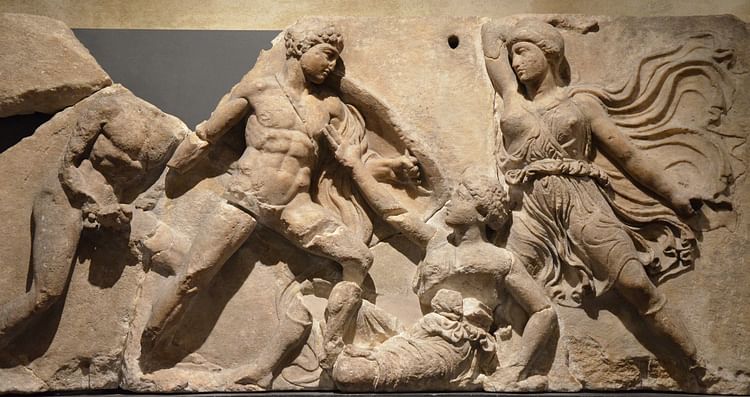 Greek & Amazons, Frieze from Bassae Carole Raddato (CC BY-SA) ](https://www.worldhistory.org/image/5292/greek--amazons-frieze-from-bassae/ "Greek & Amazons, Frieze from Bassae")Iobates' final challenge was to rouse his fighting men and have them ambush the all-conquering hero. Bellerophon dispatched the lot, helped by his father Poseidon who flooded the Xanthian Plain. Finally, the king, seeing that this youth was indeed blessed by the gods and now believing his version of the Stheneboia affair, relented and made him heir to his kingdom. In addition, the hero married Iobates' daughter, Philonoe, and was given vast estates rich in vines and fertile land for [agriculture](https://www.worldhistory.org/disambiguation/Agriculture/), no less than half the kingdom. Bellerophon thus raised three children: Isandros, Hippolochos, and Laodameia (mother of the hero warrior [Sarpedon](https://www.worldhistory.org/Sarpedon/)).
However, becoming rather boastful and thinking he could fly high enough on his winged steed to take his place amongst the immortal gods on Mount Olympus, Bellerophon was thrown by Pegasus and so fell unceremoniously back to earth. Pegasus had been disturbed by a gadfly biting his rear, the insect having been sent by Zeus. The demise of the hero, who is now described by Homer as 'hated by all the gods', was a warning for humanity of the dangers of *hybris* (hubris). In some versions of the story, Bellerophon lands safely to the ground in [Cilicia](https://www.worldhistory.org/Cilicia/) (southern Turkey) and founds the [city](https://www.worldhistory.org/city/) of [Tarsus](https://www.worldhistory.org/Tarsus/). In a third version, the hero is crippled and wanders the earth in accursed solitude until his death. Meanwhile, Pegasus kept on flying and, on reaching Mt. Olympus, he was given the task of carrying Zeus' supply of thunderbolts and then looked after by [Eos](https://www.worldhistory.org/Eos/) who was responsible for bringing Dawn across the sky each day.
### Depiction in Art
Bellerophon, Pegasus, and the Chimera appeared first on Corinthian [pottery](https://www.worldhistory.org/pottery/) from the mid-7th century BCE. All three are shown together on a red-figure plate by the Baltimore painter from Apulia in southern [Italy](https://www.worldhistory.org/italy/) and dating to the second half of the 4th century BCE, indicating the story's longevity in art. The Chimera appears alone on Corinthian wares of the 7th to 6th century BCE and on 6th-century BCE black-figured [amphorae](https://www.worldhistory.org/Amphora/) from southern [Etruria](https://www.worldhistory.org/Etruscan_Civilization/). The Chimera, like Medusa, was also a common decorative motif in art and [architecture](https://www.worldhistory.org/disambiguation/architecture/). Pegasus, meanwhile, famously appeared on the coins of Corinth in the 6th and 5th century BCE. Intriguingly, there are no surviving depictions on [Greek pottery](https://www.worldhistory.org/Greek_Pottery/) of Bellerophon fighting the Amazons or the Solymoi. The Bellerophon story was the main theme of three plays by two of the great writers of [Greek tragedy](https://www.worldhistory.org/Greek_Tragedy/), [Sophocles](https://www.worldhistory.org/sophocles/) (l. c. 496 - c. 406 BCE - *Iobates*) and [Euripides](https://www.worldhistory.org/Euripides/) (l. c. 484 - 407 BCE - *Sthenoboia* and *Bellerophon*) but only an outline or fragments remain of all three works.
Bellerophon remained popular with artists of the [Etruscan civilization](https://www.worldhistory.org/Etruscan_Civilization/) of central Italy (8th-3rd century BCE). One of the most famous of all [Etruscan](https://www.worldhistory.org/Etruscan_Civilization/) [bronze](https://www.worldhistory.org/disambiguation/bronze/) sculptures is the [Chimera of Arezzo](https://www.worldhistory.org/article/1006/chimera-of-arezzo/) which dates to the 5th-4th century BCE. Now in the National Archaeological Museum of Florence, the life-size creature stands 78.5 cm (31 inches) high and measures 129 cm (50 ¾ inches) in length. It was cast in bronze, using the lost wax technique. The goat's head protruding from its back lurches to one side from a bleeding wound and a second wound can be seen on the creature's rear leg. These details strongly suggest that the piece was probably part of a larger composition which included Bellerophon and Pegasus. Finally, the Bellerophon and Pegasus myth was a popular subject in [Roman art](https://www.worldhistory.org/Roman_Art/) - especially engraved semi-precious stone cameos and floor mosaics - where the winged horse became symbolic of immortality. A fine [mosaic](https://www.worldhistory.org/Mosaic/) from Parundorf dating to the 3rd century CE shows a mounted Bellerophon spearing the Chimera in a pose remarkably like later depictions of Saint George slaying the dragon.
#### Editorial Review
This human-authored definition has been reviewed by our editorial team before publication to ensure accuracy, reliability and adherence to academic standards in accordance with our [editorial policy](https://www.worldhistory.org/static/editorial-policy/).
## Bibliography
- Bagnall, R. (ed). *The Encyclopedia of Ancient History.* Wiley-Blackwell, 2012
- [Carabatea, Marilena. *Greek Mythology.* Adam Editions, 1997.](https://www.worldhistory.org/books/9605001020/)
- [Carpenter, Thomas H. *Art and Myth in Ancient Greece.* Thames & Hudson, 1991.](https://www.worldhistory.org/books/0500202362/)
- [Fox, Robin Lane. *Travelling Heroes.* Penguin UK, 2009.](https://www.worldhistory.org/books/0140244999/)
- [Graves, Robert. *The Greek Myths\[May 15, 2018\] Graves, Robert.* Viking, 2018.](https://www.worldhistory.org/books/0241982359/)
- [Graziosi, Barbara. *The Gods of Olympus.* Picador Paper, 2015.](https://www.worldhistory.org/books/1250062349/)
- [Hesiod. *Hesiod - Theogony & Works and Days.* Harvard University Press, 2018.](https://www.worldhistory.org/books/0674997204/)
- [Homer. *The Iliad.* Penguin Classics, 1998.](https://www.worldhistory.org/books/0140275363/)
- [Hornblower, Simon. *The Oxford Classical Dictionary.* Oxford University Press, 2012.](https://www.worldhistory.org/books/0199545561/)
## About the Author
Mark is WHE’s Publishing Director and has an MA in Political Philosophy (University of York). He is a full-time researcher, writer, historian and editor. Special interests include art, architecture and discovering the ideas that all civilizations share.
## Timeline
- **c. 800 BCE - c. 700 BCE**: [Homer](https://www.worldhistory.org/homer/) of [Greece](https://www.worldhistory.org/greece/) writes his *[Iliad](https://www.worldhistory.org/iliad/)* and *[Odyssey](https://www.worldhistory.org/Odyssey/)*.
- **c. 700 BCE**: [Greek](https://www.worldhistory.org/disambiguation/greek/) poet [Hesiod](https://www.worldhistory.org/hesiod/) writes his *[Theogony](https://www.worldhistory.org/Theogony/)* and *[Works and Days](https://www.worldhistory.org/Works_and_Days/)*.
## Questions & Answers
### What was Bellerophon the god of?
Bellerophon was not a Greek god but a mythological hero.
### Why did the gods punish Bellerophon?
The gods punished Bellerophon because he thought he could fly high enough on his winged horse Pegasus to take his place amongst the immortal gods on Mount Olympus.
### What does Bellerophon symbolize?
The adventures of Bellerophon may symbolize the Greek conquest of the ancient Carian people.
## Cite This Work
### APA
Cartwright, M. (2020, March 27). Bellerophon. *World History Encyclopedia*.
### Chicago
Cartwright, Mark. "Bellerophon." *World History Encyclopedia*, March 27, 2020. .
### MLA
Cartwright, Mark. "Bellerophon." *World History Encyclopedia*, 27 Mar 2020, .
## License & Copyright
Submitted by [Mark Cartwright](https://www.worldhistory.org/user/markzcartwright/ "User Page: Mark Cartwright"), published on 27 March 2020. The copyright holder has published this content under the following license: [Creative Commons Attribution-NonCommercial-ShareAlike](https://creativecommons.org/licenses/by-nc-sa/4.0/deed.en). This license lets others remix, tweak, and build upon this content non-commercially, as long as they credit the author and license their new creations under the identical terms. When republishing on the web a hyperlink back to the original content source URL must be included. Please note that content linked from this page may have different licensing terms.