---
title: Bede
author: Wesley Fiorentino
source: https://www.worldhistory.org/Bede/
format: machine-readable-alternate
license: Creative Commons Attribution-NonCommercial-ShareAlike (https://creativecommons.org/licenses/by-nc-sa/4.0/)
updated: 2023-05-08
---
# Bede
_Authored by [Wesley Fiorentino](https://www.worldhistory.org/user/wfiorentino36/)_
Bede (c. 673-735 CE) was an English monk, historian, and scholar who lived in the [Kingdom of Northumbria](https://www.worldhistory.org/Kingdom_of_Northumbria/). He is at times referred to as the Venerable Bede or Bede the Venerable. He was a monk at the double monastery of Monkwearmouth-Jarrow. Bede was a prolific writer and many of his works have survived to the present day. His work was extremely influential in the generations after his [death](https://www.worldhistory.org/disambiguation/Death/). His most famous work, the *Historia Ecclesiastica Gentis Anglorum* (*Ecclesiastical History of the English People*), has been a vital source for the study of early English history for centuries. For this reason, he is remembered by some as the 'Father of English History.'
### Life
Very little is known about Bede's life outside of what he himself writes in the final chapter of the *Historia Ecclesiastica*. Bede was born in either 672 or 673 CE; he claims to have been born on the very grounds of the monastery of Jarrow. This would mean he was born in Bernicia, the northernmost of the two Northumbrian kingdoms (Bernicia and Deira were already united into the Kingdom of [Northumbria](https://www.worldhistory.org/Kingdom_of_Northumbria/) by the time of his birth), in what is now Sunderland. Bede says virtually nothing about his early life and very little external evidence exists. There seems to be some likelihood that he came from a noble family. Throughout his life, he had connections with the wealthy and powerful in Northumbria. In addition to this, some scholars have pointed to the name Beda (Old English for Bede) in a list of Kings of Lindsey (adjacent to Northumbria) as evidence that he was born to a wealthy or influential family.
Bede claims to have been sent to the monastery of Monkwearmouth on the River Wear to be educated by the abbot Benedict Biscop (c. 628 CE - 690 CE). Bede was raised at Monkwearmouth until about 682 CE when he was transferred to the new abbey at Jarrow, founded by Saint Ceolfrith (c. 642-716 CE). Bede was made a deacon at the age of 19, several years prior to the canonical age of 25, which may be a sign of his exceptional abilities. He was fully ordained as a priest at the age of 30, and he seems to have written his earliest works around the turn of the 8th century CE for use in teaching in the monastery. His works cover the subjects of history, theology, and [science](https://www.worldhistory.org/science/), as well as a range of exegesis and hagiography. Bede is widely credited with helping to spread the use of the *anno domini* dating method, discussed in his work on chronology, *De Temporum Ratione*. Bede's adoption of the AD system, used at times in his *Historia Ecclesiastica*, popularized it for his contemporaries and subsequent generations.
[ 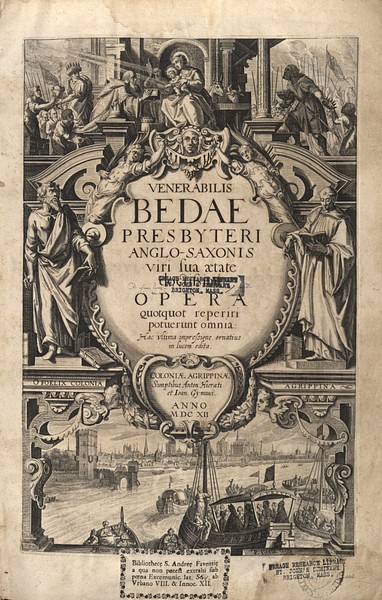 Collected Works of Bede Burns Library, Boston College (CC BY-NC-ND) ](https://www.worldhistory.org/image/6603/collected-works-of-bede/ "Collected Works of Bede")Bede knew and communicated with many of the prominent clergymen and laymen of his day. As a young man he met Adomnan, then abbot of the important monastery of Iona. He was educated by Saints Benedict Biscop and Ceolfrith, who played crucial roles in the formation of the Church in northern [England](https://www.worldhistory.org/disambiguation/england/). He was ordained as a deacon and later as a full priest by Saint John of Beverley, who was the bishop of Hexham and of York at different points in his life and founded the town of Beverley in modern-day East Yorkshire. He regularly communicated with Saint Ecgbert of York, and correspondence between the two of them still survives today. Nothelm, an Archbishop of Canterbury, helped Bede find source material for the *Historia Ecclesiastica*. On a number of occasions, Bede encountered Wilfrid, the controversial Bishop of York. At one point, he wrote a letter to Wilfrid defending himself against an accusation of heresy. Bede was clearly known to the Northumbrian royalty as well, and he dedicated his greatest work to King Ceolwulf (reigned c. 729-737 CE) who consulted him regularly.
Bede died in May of 735 CE. According to one of his disciples who wrote an account of Bede's final days, he died singing a hymn. The account of Bede's death is quite detailed, describing Bede's illness, his last wishes, and his interactions with those around him. He apparently composed poetry on his deathbed as well. Following his death, he was buried at Jarrow. Though he was considered a saint soon after his death, he was not formally canonised until the end of the 19th century CE. However, he was also named a Doctor of the Church, the only native of [Britain](https://www.worldhistory.org/disambiguation/Britain/) to hold this title.
### *Historia Ecclesiastica Gentis Anglorum*
Bede's most well-known work is a history of the Christian Church in England. While Bede also provides an in-depth history of England up to his own lifetime, his main focus is the spread of [Christianity](https://www.worldhistory.org/christianity/) in his native country. A lengthy discussion of the development of Anglo-[Saxon](https://www.worldhistory.org/Saxons/) kingdoms up to the 8th century CE is complemented with a catalogue of saints, converted kings, and miracles. Bede pays particular attention to the rivalry between [Rome](https://www.worldhistory.org/Rome/)-centered Church practice and the [Celtic](https://www.worldhistory.org/celt/) Christian communities which had been present in Britain and [Ireland](https://www.worldhistory.org/disambiguation/Ireland/) for centuries before the arrival of the Anglo-[Saxons](https://www.worldhistory.org/Saxons/). Bede's work is considered one of the most important sources of Anglo-Saxon history for modern-day scholarship. It is a major source for political, social, and religious history in England during the early Anglo-Saxon age.
Bede had an exceptionally wide array of sources available to him while [writing](https://www.worldhistory.org/writing/) the *Historia Ecclesiastica*. The monastery at Jarrow had a famous library which gave the monastic community a reputation as a centre of learning in Northumbria. For the earliest parts of his work, Bede follows classical authors such as Pliny, Eutropius, and [Orosius](https://www.worldhistory.org/Orosius/), while his account of the invasions of the Anglo-Saxons is drawn largely from [Gildas](https://www.worldhistory.org/Gildas/)' *De Excidio et Conquestu Britanniae* (*On the Ruin and [Conquest](https://www.worldhistory.org/warfare/) of Britain*). For the history of the early English kingdoms up until his own lifetime, Bede relies heavily on more contemporary sources such as Eddius Stephanus' *Life of Saint Wilfrid*, which contains important accounts of events in the late 7th century CE. He also clearly draws on correspondence and interviews with witnesses of the great events of his own lifetime.
The major subject of Bede's history is the growth of the Church in the English, i.e. Anglo-Saxon, kingdoms up to the 8th century CE. Religious figures and events throughout this period are described, often in great detail. The lives and careers of secular rulers are recounted as well, though largely in relation to their roles in the spread of Christianity in England. Bishops, monks, saints, and martyrs are profiled throughout the work, as are the kings who sponsored them. A common theme in the *Historia Ecclesiastica* is the responsibility of kings in the religious issues within their domains. Bede is clearly biased toward the kings of his own homeland of Northumbria. He has particularly strong praise for Edwin and [Oswald of Northumbria](https://www.worldhistory.org/Oswald_of_Northumbria/) while also writing largely favourable portrayals of other Northumbrian kings including Æthelfrith and Oswiu.
[ 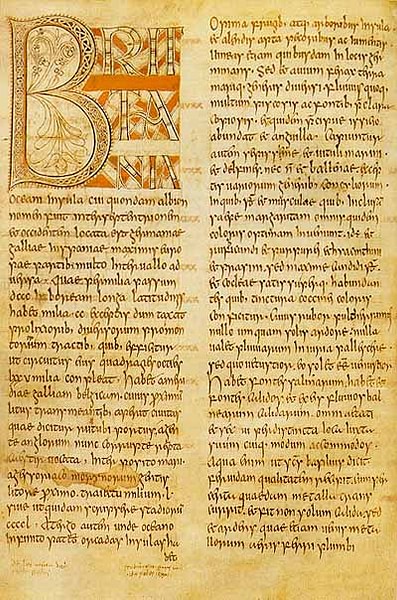 St. Petersburg Bede GDK (Public Domain) ](https://www.worldhistory.org/image/6602/st-petersburg-bede/ "St. Petersburg Bede")The *Historia Ecclesiastica* is comprised of five separate books, with a preface in which Bede dedicates his work to Ceolwulf, King of Northumbria at the time of his writing. The first book is largely concerned with the arrival of the Romans in Britain beginning with [Caesar](https://www.worldhistory.org/disambiguation/caesar/)'s invasion in 55 BCE. Much of the book details the spread of Christianity in Britain, and Bede recounts the stories of early martyrs like Saint Alban. He also writes of Britain's struggles in the 4th and 5th centuries CE, describing in detail numerous imperial usurpations that shook Romano-British society. He describes heresies such as Arianism and Pelagianism, which took root in Britain and caused significant social upheaval. The book ends with the arrival of [Augustine](https://www.worldhistory.org/disambiguation/Augustine/) of Canterbury, sent by Pope Gregory the Great in 597 CE to convert King Æthelberht of Kent to Christianity.
> Augustine sent to Æthelberht to say that he had come from Rome bearing the best of news, namely the sure and certain promise of eternal joys in heaven and an endless kingdom with the living and true [God](https://www.worldhistory.org/God/) to those who received it - Bede, *Historia Ecclesiastic*, 39 (Oxford: Oxford University Press, 2009)
The next two books chronicle the spread and setbacks of Augustine's [Roman](https://www.worldhistory.org/disambiguation/Roman/) mission and the coinciding political and military events that often determined the fate of the Church in different places and times. Æthelberht's heirs abandoned the Christian faith for the pagan deities of their ancestors. This is a pattern in a number of Anglo-Saxon kingdoms throughout the *Historia Ecclesiastica*. Bede heaps scorn on these apostate kings and he simultaneously praises kings like Edwin and Oswald of Northumbria, two of the heroes of his history. Both adopted Christianity and vigorously spread the faith in Northumbria, both also died in [battle](https://www.worldhistory.org/disambiguation/battle/) and were venerated as martyrs soon after their deaths. The third book culminates in the [Synod of Whitby](https://www.worldhistory.org/Synod_of_Whitby/), in 664 CE, where King Oswiu of Northumbria settled the [Easter](https://www.worldhistory.org/Easter/) Controversy. He decided to follow the Roman practice in the dating of the holiday and against the conflicting native Celtic practice.
> King Oswiu began by declaring that it was fitting that those who served one God should observe one rule of life and not differ in the celebration of the heavenly sacraments - *Historia Ecclesiastica*, 154
The fourth and fifth books detail the reign of Ecgfrith and the decline of the Northumbrian supremacy. Bede also recounts the careers of famous churchmen of the late 7th century CE such as Theodore of [Tarsus](https://www.worldhistory.org/Tarsus/), the Northumbrian bishop Wilfrid of Ripon, and the great Northumbrian [Saint Cuthbert](https://www.worldhistory.org/Saint_Cuthbert/) of Lindisfarne. The fifth and final book of the *Historia Ecclesiastica* covers missionary efforts overseas to regions such as Frisia. Here Bede also provides a detailed history of the Easter Controversy. He vigorously denounces the Celtic practice in dating Easter, even going so far as to criticise Saint Cuthbert himself for following it. Bede writes of his own relief that, by the time he was writing, the Irish had been saved from the egregious error of celebrating Easter on the wrong day.
### Legacy
Bede's work was widely renowned almost immediately after his death. He was venerated as a saint in the Jarrow monastic community and his posthumous reputation spread throughout neighbouring Anglo-Saxon territories. He was remembered as an authority on theological doctrine as well as for his history and was extremely influential in terms of the chronological systems used by future historians. His work was also looked to by later generations of English scholars, clergy, and statesmen as a foundational text of English identity. [ 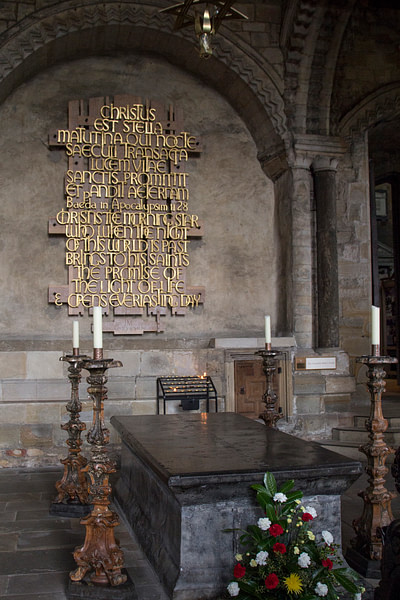 Shrine of Saint Bede the Venerable Fr Lawrence Lew, O.P. (CC BY-NC-ND) ](https://www.worldhistory.org/image/6604/shrine-of-saint-bede-the-venerable/ "Shrine of Saint Bede the Venerable")
The translation of the *Historia Ecclesiastica* into Old English at the court of [Alfred the Great](https://www.worldhistory.org/Alfred_the_Great/) in the 9th century CE has been seen as an important step in the development of English identity, as opposed to the number of unique regional identities of the earlier Anglo-Saxon kingdoms. The use of the term 'English' in Bede's work is a sign of his own notion of a wider cultural identity shared by those living in the southern Anglo-Saxon kingdoms with those living in Northumbria.
#### Editorial Review
This human-authored definition has been reviewed by our editorial team before publication to ensure accuracy, reliability and adherence to academic standards in accordance with our [editorial policy](https://www.worldhistory.org/static/editorial-policy/).
## Bibliography
- [Anonymous. *St. Augustine and the Conversion of England.* Sutton Pub Ltd, 2000.](https://www.worldhistory.org/books/0750920874/)
- [Bede. *Bede's Ecclesiastical History of the English People.* Oxford University Press, 1993.](https://www.worldhistory.org/books/0198221738/)
- [Bede. *The Ecclesiastical History of the English People; The Greater Chronicle; Bede's Letter..* Oxford University Press, 2009.](https://www.worldhistory.org/books/0199537232/)
- [D. P. Kirby. *The Earliest English Kings.* Routledge, 2000.](https://www.worldhistory.org/books/0415242118/)
- [N. J. Higham. *An English Empire.* Manchester Univ Pr, 1995.](https://www.worldhistory.org/books/0719044243/)
## About the Author
Wesley Fiorentino is an archivist, historian, and scholar currently located in Boston, Massachusetts. His areas of study include Old English literature and Late Antiquity.
## Timeline
- **c. 450 CE - c. 600 CE**: Anglo-[Saxon](https://www.worldhistory.org/Saxons/) settlement in [Britain](https://www.worldhistory.org/disambiguation/Britain/).
- **597 CE**: [Augustine](https://www.worldhistory.org/disambiguation/Augustine/) Mission arrives in Kent.
- **664 CE**: [Hilda of Whitby](https://www.worldhistory.org/Hilda_of_Whitby/) host the [Synod of Whitby](https://www.worldhistory.org/Synod_of_Whitby/); Oswiu of [Northumbria](https://www.worldhistory.org/Kingdom_of_Northumbria/) decides in favor of [Roman](https://www.worldhistory.org/disambiguation/Roman/) Catholicism over [Celtic](https://www.worldhistory.org/celt/) [Christianity](https://www.worldhistory.org/christianity/).
- **c. 673 CE - 735 CE**: Life of [Bede](https://www.worldhistory.org/Bede/) the Venerable.
## Cite This Work
### APA
Fiorentino, W. (2017, May 10). Bede. *World History Encyclopedia*.
### Chicago
Fiorentino, Wesley. "Bede." *World History Encyclopedia*, May 10, 2017. .
### MLA
Fiorentino, Wesley. "Bede." *World History Encyclopedia*, 10 May 2017, .
## License & Copyright
Submitted by [Wesley Fiorentino](https://www.worldhistory.org/user/wfiorentino36/ "User Page: Wesley Fiorentino"), published on 10 May 2017. The copyright holder has published this content under the following license: [Creative Commons Attribution-NonCommercial-ShareAlike](https://creativecommons.org/licenses/by-nc-sa/4.0/deed.en). This license lets others remix, tweak, and build upon this content non-commercially, as long as they credit the author and license their new creations under the identical terms. When republishing on the web a hyperlink back to the original content source URL must be included. Please note that content linked from this page may have different licensing terms.