---
title: Battle of Shiloh: The Turning Point of the Civil War
author: Joshua J. Mark
source: https://www.worldhistory.org/Battle_of_Shiloh/
format: machine-readable-alternate
license: Creative Commons Attribution-NonCommercial-ShareAlike (https://creativecommons.org/licenses/by-nc-sa/4.0/)
updated: 2026-11-18
---
# Battle of Shiloh: The Turning Point of the Civil War
_Authored by [Joshua J. Mark](https://www.worldhistory.org/user/JPryst/)_
The [Battle](https://www.worldhistory.org/disambiguation/battle/) of Shiloh (6-7 April 1862, also known as the Battle of Pittsburg Landing) was the bloodiest engagement of the [American Civil War](https://www.worldhistory.org/American_Civil_War/) up to that point. Fought at Shiloh Church and Pittsburg Landing in Hardin County, Tennessee, Confederate forces under [Albert Sidney Johnston](https://www.worldhistory.org/Albert_Sidney_Johnston/) and [P. G. T. Beauregard](https://www.worldhistory.org/P._G._T._Beauregard/) were defeated by Union armies under [Ulysses S. Grant](https://www.worldhistory.org/Ulysses_S._Grant/) and [William Tecumseh Sherman](https://www.worldhistory.org/William_Tecumseh_Sherman/), supported by Don Carlos Buell and Lew Wallace.
The battle was a devastating loss for the Confederacy. Johnston was mortally wounded, dying on the first day of battle, and, after Grant led a successful counterattack on the second day, the Confederates were driven from the field, and their defeat would lead to the fall of [Corinth](https://www.worldhistory.org/corinth/), Mississippi, a vital supply depot.
In the immediate aftermath of the battle, Grant was again hailed as a national hero until news of the casualty count began circulating through newspaper reports. The combined casualties of the two-day struggle were almost 24,000, while the dead and wounded from the [First Battle of Bull Run (First Manassas)](https://www.worldhistory.org/First_Battle_of_Bull_Run_(First_Manassas)/) on 21 July 1861 had been roughly 4,800 – and people had found that shocking.
Shiloh is often referred to as a turning point in the [war](https://www.worldhistory.org/disambiguation/War/) because it drove home to both North and South how brutal the war had become, what other horrors might be waiting in future engagements, and how there seemed no end to the conflict. As far as the Union war effort was concerned, however, it was a decisive victory that gave the North control of the key [railroad](https://www.worldhistory.org/disambiguation/Railroad/) junctions at Corinth and allowed for troop and supply movements for Grant's Vicksburg Campaign.
### Background
The second year of the American Civil War opened with the Union victory of General [George H. Thomas](https://www.worldhistory.org/George_H._Thomas/) at the [Battle of Mill Springs](https://www.worldhistory.org/Battle_of_Mill_Springs/) (19 January 1862) followed by the victories of General Ulysses S. Grant and Flag Officer Andrew H. Foote at the [Battle of Fort Henry](https://www.worldhistory.org/Battle_of_Fort_Henry/) (6 February 1862) and the [Battle of Fort Donelson](https://www.worldhistory.org/Battle_of_Fort_Donelson/) (11-16 February 1862).
Grant's victories opened the Tennessee and Cumberland rivers to Union traffic and led to the fall of the Confederate industrial center at Nashville. He wanted to continue his campaign and win the western theater of the war but was sidelined by his superior, General Henry Halleck, who was jealous of Grant's success and sudden celebrity status and so proceeded against him with trumped-up charges.
Grant's and Thomas's victories had broken the defensive lines of Albert Sidney Johnston's forces across Southern Kentucky and Northern Tennessee, opening these regions to Union control. Johnston withdrew and joined with the army under P. G. T. Beauregard at the railroad junction of Corinth, Mississippi.
Halleck replaced Grant with General Charles F. Smith, who led troops toward Pittsburg Landing in Tennessee for an assault on Corinth. Smith injured his leg on 12 March 1862; the wound became infected, and he was incapacitated (later dying). Grant was reinstated as a field commander after the Lincoln administration challenged Halleck's decision, and so Grant assumed command of the forces gathering at Pittsburg Landing and the church known as Shiloh, meaning "place of peace." Here, he planned to wait until reinforced by Don Carlos Buell and then strike at Corinth.
### Lead-up to Battle
From Pittsburg Landing to Shiloh Church, the Union army's five divisions were scattered about casually. As Sherman observed, they were an invading force, gathering for an assault on Corinth, and so there was no need to entrench, form a defensive line, or place pickets, as he believed the Confederates were busy working on their defenses and would not attack.
[ 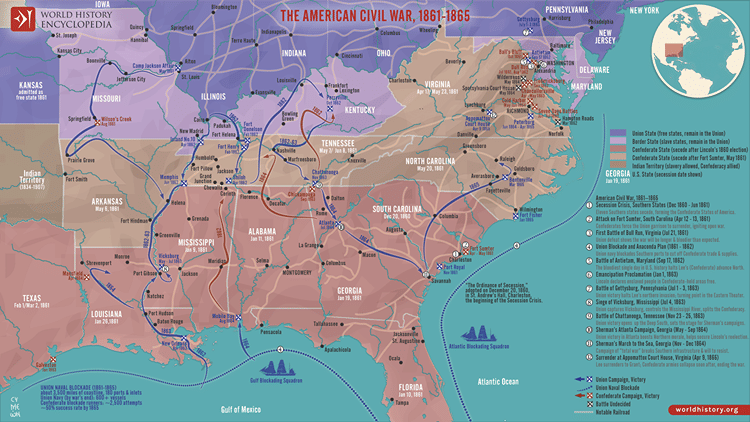 Map of the American Civil War, 1861-1865 Simeon Netchev (CC BY-NC-ND) ](https://www.worldhistory.org/image/21119/map-of-the-american-civil-war-1861-1865/ "Map of the American Civil War, 1861-1865")Prior to his injury, Smith had told Sherman that the largely inexperienced troops had been marshalled there to fight, not dig trenches, and if orders were given to entrench, it might make the men think they faced an enemy worth that amount of effort. Scholar James Lee McDonough writes:
> Neither Grant nor Sherman nor any other senior Federal officer seemed concerned that the enemy might advance and attack the Union forces at Pittsburg. They completely misinterpreted the purpose of the Rebel buildup at Corinth, convinced that the Confederates were marshalling their forces to defend the [Memphis](https://www.worldhistory.org/Memphis_(Ancient_Egypt)/) & Charleston and the Mobile and Ohio crossroads.
> (315)
The Confederate high command actually had another goal in mind, as explained by scholar Donald L. Miller:
> As Grant prepared to strike the rebels, the rebels prepared to strike him. [Jefferson Davis](https://www.worldhistory.org/Jefferson_Davis/) was determined to win back – in one lightning counterstroke – all that the Confederacy had lost in the black days of February. Reacting with unusual urgency, he called on nearly every Confederate garrison in the Mississippi Valley to concentrate at Corinth for the first great rebel counteroffensive of the war. By April 1, \[Johnston and Beauregard\] had assembled a resupplied and reanimated army of approximately forty thousand troops.
> (64)
Johnston began marching from Corinth on 3 April. Delayed by heavy rains and muddy roads, he arrived four miles (6.4 km) in front of the Union position on the evening of 5 April.
Earlier that day, rumors had begun circulating throughout the Union encampment that a large Confederate force was approaching, and these 'rumors' were confirmed by Confederate prisoners in the camp who "told any and every Northerner who spoke to them that in a few [hours](https://www.worldhistory.org/Horae/) the Union army would be destroyed, because the Confederates were about to strike" (Cunningham, 136).
These reports were relayed to the inexperienced Brigadier General Benjamin M. Prentiss, who dismissed them, and to Sherman, who angrily ordered the arrest of the sergeant who brought the news for spreading false information. Scholar O. Edward Cunningham comments:
> As Grant, Sherman, and the other Union generals settled down for the night, the Southerners were making their final preparations for their attack, which would come early Sunday morning.
> (137)
### Battle of Shiloh
**6 April**
**Fraley's Field**
Among the Union officers who had not settled quietly down for the night was Colonel Everett Peabody, who, ignoring Prentiss' orders, sent out a reconnaissance patrol under Major James E. Powell shortly after midnight. Powell's men advanced down a road through the cotton fields of the plantation owned by James J. Fraley, completely unaware they were walking toward the pickets of a massive Confederate army.
As dawn was breaking, a shot rang out – and then another – and Powell's men understood their position quickly. Confederate pickets kept up fire, which was returned, beginning the Fight at Fraley's Field. In the Confederate camp, Johnston heard the shots and ordered the attack to begin. In the Union camp, the firing was interpreted as some skirmishers or perhaps some troops at early morning target practice.
Powell sent a message back to Peabody that he was facing a large enemy force and required reinforcements. Peabody reported this to Prentiss, who, enraged that Peabody had defied orders and sent out an unauthorized patrol, refused the request – until he understood the Confederate army, en masse, was in front of him. He then sent the men Powell had asked for. Peabody's decision to send Powell out that morning was the only reason the Union forces at Shiloh were not taken completely by surprise.
**Opening Confederate Attack**
Johnston had ordered a general attack to begin at 5:30, but it took two hours before this could be launched. He told Beauregard to remain in the rear and coordinate the operation while he led the men from the front. Beauregard formed a line of assault under generals [Braxton Bragg](https://www.worldhistory.org/Braxton_Bragg/), John C. Breckinridge, William J. Hardee, and [Leonidas](https://www.worldhistory.org/disambiguation/Leonidas/) Polk. Although the original plan called for a maneuver to turn the Union left flank, the attack was launched as a frontal assault, which struck the divisions of Prentiss and Sherman head-on.
Many of the soldiers on both sides were inexperienced, and some of those under Prentiss and Sherman broke ranks and fled. Sherman, who had fought at the Battle of First Bull Run and had done his best to steady the retreating troops there, remained as calm at Shiloh, rallying his men and forming a defensive position at Shiloh Church.
[  William Tecumseh Sherman Mathew Brady (Public Domain) ](https://www.worldhistory.org/image/21106/william-tecumseh-sherman/ "William Tecumseh Sherman")Prentiss' camp was overrun, and Peabody was killed in the assault. Sherman's camp had also been taken quickly but, instead of pressing on with the attack, Confederate soldiers paused at both sites to loot the tents. Many of these soldiers had begun the day without any kind of weapon and now were able to arm themselves with rifles. Further, many had not eaten since leaving Corinth and so fell quickly on any foodstuffs, pausing the attack and allowing Prentiss and Sherman to reform their commands.
Sherman was now reinforced by Major General John A. McClernand and established a position further back from the church and held it against repeated attacks from 10:00 to 11:30 before falling back in the direction of Pittsburg Landing.
**Grant & the Defensive Line**
Grant was 9 miles (14 km) away from Shiloh when the battle began, recovering from an injury after falling from his horse. He heard far-off cannon fire while eating breakfast with his staff and instantly hobbled aboard the steamboat Tigress and was taken to Crump's Landing, where Lew Wallace was encamped. He ordered Wallace to prepare his forces and then went on to Pittsburg Landing.
He found his forces in disarray, many soldiers hiding under river bluffs at the landing, and ordered them rounded up and returned to the front. Despite the injury to his foot, Grant remained in constant motion around the field, steadying his commanders and organizing a defensive line.
[ 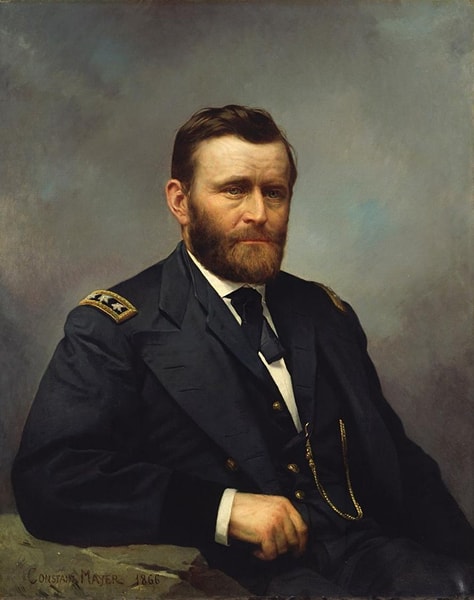 General Ulysses S. Grant Constant Mayer (CC BY-NC-SA) ](https://www.worldhistory.org/image/21462/general-ulysses-s-grant/ "General Ulysses S. Grant")The center of this line was a farm road (later famous as the Sunken Road) where he placed divisions under Prentiss and Brigadier General William H. L. Wallace. He told Prentiss to hold that position "at all hazards" to buy him time to form his line and, having sent word to Lew Wallace to hurry to the field, fired off a similar message to Don Carlos Buell.
**Johnston's [Death](https://www.worldhistory.org/disambiguation/Death/) & the Hornet's Nest**
Prentiss and W. H. L. Wallace held the center, but Sherman and McClernand were steadily pushed back toward Pittsburg Landing. Union and Confederate forces took, lost, and retook the same positions on the Union right, which steadily retreated in order, while the Union left was driven back to the Peach Orchard.
Albert Sidney Johnston, commanding against the Union left, was wounded in his right leg but, owing to an earlier injury that caused nerve damage, did not feel it. The bullet had severed the popliteal artery, and he bled to death at 2:30 in the afternoon. The Confederates, exhausted, momentarily stalled in their attack, even as the gunboats USS *Lexington* and USS *Tyler* opened fire on them from their position off Pittsburg Landing.
[  Death of Albert Sidney Johnston Henry Mosler (Public Domain) ](https://www.worldhistory.org/image/20537/death-of-albert-sidney-johnston/ "Death of Albert Sidney Johnston")At the center of the Union line, Prentiss and W. H. L. Wallace still held their position, driving back eight Confederate charges. Confederate soldiers called the position the "Hornet's Nest" because the sound of flying shot was so intense it sounded like a swarm of hornets. Beauregard was now in full command of the Confederate assault and, as it seemed the Union right and left were defeated, concentrated his attack on the center.
Confederate Brigadier General Daniel Ruggles drew up a battery of 53 artillery pieces to shell the Hornet's Nest while other forces began to surround the position. W. H. L. Wallace ordered his men to retreat and was mortally wounded leading them out. Prentiss continued to hold until his position became clearly untenable; he surrendered along with over 2,000 Union soldiers.
[  Ruggles' Battery at Shiloh National Military Park Shiloh National Military Park (CC BY-NC-SA) ](https://www.worldhistory.org/image/22358/ruggles-battery-at-shiloh-national-military-park/ "Ruggles' Battery at Shiloh National Military Park")The men under Prentiss and Wallace, however, had bought Grant the time he needed to form his defensive line across Pittsburg Landing, placing Sherman on the right. Grant ordered the line to keep up fire against advancing Confederates and received support from the gunboats.
As the sun began to set, Beauregard called off the attack, believing Grant was defeated and the Union army would easily be destroyed the next day. He sent a message to that effect to Jefferson Davis, claiming Shiloh had been a tremendous Confederate victory.
**"Lick 'em Tomorrow Though"**
Lew Wallace, who was supposed to have arrived on the field as quickly as possible, misunderstood his orders and became lost. He did not arrive at Pittsburg Landing until around 7:00 in the evening. Don Carlos Buell's troops had begun arriving while Grant's defensive line was repelling the last Confederate attack, and the rest would stream in throughout the night of the 6th and the early morning of the 7th.
Beauregard had called off the attack thinking Grant was putting up a last-ditch, feeble attempt at defense – but Grant was only getting started. Scholar Ron Chernow relates the famous exchange that night between Sherman and Grant:
> Wrapped in his greatcoat, Grant returned to the haven of the nearby oak tree with its spreading canopy of branches. Sherman found him standing there, streaming with rain, hat pulled low over his face, collar upturned, holding a lantern and chewing a cigar.
> "Well, Grant, we've had the devil's own day, haven't we?" Sherman remarked.
> "Yes," replied Grant, with a drag on his cigar. "Lick 'em tomorrow though."
> The statement expressed Grant's intestinal fortitude, which communicated itself to his officers. He had already told Sherman that, when both sides seem defeated in battle, the first to assume the offensive would surely win. (205)
**7 April**
Beauregard had no knowledge of Lew Wallace's troops, which had never engaged on the first day, or the arrival of Don Carlos Buell. He believed he would be facing a worn-out, defeated force on the morning of the 7th and Grant's army would be destroyed. Consequently, he did not order any breastworks or defensive positions the evening of the 6th. These would not be necessary as he planned to attack Grant at dawn the next morning.
Grant struck first, combining his army with the fresh forces under Buell and Wallace, taking the Confederate force by surprise and driving them from the field. By noon, Confederate forces had been pushed back, and by 1:00 p.m., Beauregard understood he would not be reinforced and needed to withdraw. The Confederates began the retreat to Corinth around 3:00 p.m. Grant had won the Battle of Shiloh, but at the cost of almost 24,000 casualties.
### Aftermath
Beauregard's early claim of a 'complete victory' had been picked up by Southern newspapers and spread quickly. Johnston's death was widely mourned but, at first, it was thought he had given his life to successfully destroy Grant's army, and Beauregard's retreat to Corinth was characterized as a strategic relocation of forces. All of this was good news to the South – until the facts came to light and the Confederate casualty count of 10,699.
[  Casualties at Shiloh Adolph Metzner (Public Domain) ](https://www.worldhistory.org/image/20911/casualties-at-shiloh/ "Casualties at Shiloh")The defeat at Shiloh demoralized the Confederacy. The New Orleans writer [George Washington](https://www.worldhistory.org/George_Washington/) Cable expressed this through his famous line, "The South never smiled again after Shiloh" (McDonough, 321).
In the North, the victory was celebrated widely and Grant, "the hero of Fort Donelson," was again the people's champion – until the Union casualty counts of 13,047 were reported – along with 'rumors' that Grant had been surprised on the morning of the 6th, contributing to the high casualties.
Many called for Grant to be fired, but Lincoln refused with his now-famous line, "I can't spare this man; he fights" (Chernow, 211). Still, Halleck removed him from field command, replacing him with George H. Thomas for the assault on Corinth.
That assault never came. Halleck approached Corinth so slowly and cautiously that Beauregard had time to escape to Tupelo, Mississippi. Halleck had ordered the Siege of Corinth (29 April to 30 May 1862) but, when Union forces entered the [city](https://www.worldhistory.org/city/), they found it abandoned. Halleck, promoted to chief of staff in Washington, D.C., went back east, and Grant was again a field commander by July 1862.
### Conclusion
The significance of the Union victory at Shiloh was far-reaching. Grant had turned back a major Confederate offensive, retaining the positions won in February, and providing him with a clear path to take Vicksburg and open the Mississippi River to Union traffic. The Confederate loss at Shiloh was also keenly felt, for those same reasons, as well as having sacrificed Johnston's leadership for nothing.
Both sides, whether civilian or military, were stunned by Shiloh, having never known anything like it. No battle in the war so far had seen such carnage on such a large scale. Chernow writes:
> Shiloh peeled away any lingering aura of romance from the war, showing the sheer destructive power of modern combat. An array of technical advances, such as the conical minie ball that ripped through flesh and bone or rifled muskets and cannon that displayed greater accuracy and range, ensured bloodier battles than ever before…Combat had been pushed to extremes of cruelty that banished any remnant of civilized behavior.
> (207)
After Shiloh, Grant and Sherman would conclude that the war could not be won playing by the established rules of the past. This was a whole new kind of war, they realized, and required new rules. Implementing this understanding, Grant – and especially Sherman – would move ahead with the concept of 'hard war,' eventually crippling the Confederacy and winning the deadliest military conflict in American history.
#### Editorial Review
This human-authored definition has been reviewed by our editorial team before publication to ensure accuracy, reliability and adherence to academic standards in accordance with our [editorial policy](https://www.worldhistory.org/static/editorial-policy/).
## Bibliography
- [Chernow, R. *Grant.* Penguin Books, 2017.](https://www.worldhistory.org/books/B0BBSKFHGM/)
- [Cunningham, O. E. *Shiloh and the Western Campaign of 1862.* Savas Beatie, 2009.](https://www.worldhistory.org/books/B0047T7JUO/)
- [Gott, K. D. *Where the South Lost the War: An Analysis of the Fort Henry-Fort Donelson Campaign, February 1862.* Stackpole Books, 2023.](https://www.worldhistory.org/books/B00AVZSQ78/)
- [McDonough, J. L. *William Tecumseh Sherman: In The Service Of My Country, A Life.* W. W. Norton & Company, 2017.](https://www.worldhistory.org/books/0393354202/)
- [Miller, D. L. *Vicksburg: Grant's Campaign That Broke the Confederacy.* Simon & Schuster, 2020.](https://www.worldhistory.org/books/1451641397/)
- [Taylor, A. *American Civil Wars: A Continental History, 1850-1873.* W. W. Norton & Company, 2024.](https://www.worldhistory.org/books/1324035285/)
## About the Author
Joshua J. Mark is World History Encyclopedia's co-founder and Content Director. He was previously a professor at Marist College (NY) where he taught history, philosophy, literature, and writing. He has traveled extensively and lived in Greece and Germany.
- [Linkedin Profile](https://www.linkedin.com/pub/joshua-j-mark/38/614/339)
## Timeline
- **Feb 1862 CE**: [Ulysses S. Grant](https://www.worldhistory.org/Ulysses_S._Grant/)'s victories in the western theater of the [American Civil War](https://www.worldhistory.org/American_Civil_War/) drive Confederate forces from Kentucky and Tennessee.
- **Mar 1862 CE - Apr 1862 CE**: Confederate generals [Albert Sidney Johnston](https://www.worldhistory.org/Albert_Sidney_Johnston/) and [P. G. T. Beauregard](https://www.worldhistory.org/P._G._T._Beauregard/) gather troops at [Corinth](https://www.worldhistory.org/corinth/), Mississippi, preparing for a counteroffensive.
- **Mar 1862 CE - Apr 1862 CE**: Union troops under General Charles F. Smith, then [Ulysses S. Grant](https://www.worldhistory.org/Ulysses_S._Grant/), and [William Tecumseh Sherman](https://www.worldhistory.org/William_Tecumseh_Sherman/) are transported to Pittsburg Landing in Tennessee for an assault on the Confederate position at [Corinth](https://www.worldhistory.org/corinth/).
- **3 Apr 1862 CE**: [Albert Sidney Johnston](https://www.worldhistory.org/Albert_Sidney_Johnston/) and [P. G. T. Beauregard](https://www.worldhistory.org/P._G._T._Beauregard/) march out of [Corinth](https://www.worldhistory.org/corinth/) to attack the Union position at Shiloh Church near Pittsburg Landing.
- **5 Apr 1862 CE**: Confederate forces under [Albert Sidney Johnston](https://www.worldhistory.org/Albert_Sidney_Johnston/) and [P. G. T. Beauregard](https://www.worldhistory.org/P._G._T._Beauregard/) arrive in front of the Union position at night for a surprise attack the next day.
- **6 Apr 1862 CE - 7 Apr 1862 CE**: The [Battle](https://www.worldhistory.org/disambiguation/battle/) of Shiloh (Battle of Pittsburg Landing) is fought during the [American Civil War](https://www.worldhistory.org/American_Civil_War/). Confederates are defeated by [Ulysses S. Grant](https://www.worldhistory.org/Ulysses_S._Grant/) on the second day.
- **29 Apr 1862 CE - 30 May 1862 CE**: The Siege of [Corinth](https://www.worldhistory.org/corinth/) during the [American Civil War](https://www.worldhistory.org/American_Civil_War/); Union forces enter the [city](https://www.worldhistory.org/city/) to find [P. G. T. Beauregard](https://www.worldhistory.org/P._G._T._Beauregard/) abandoned it.
## Questions & Answers
### What was the Battle of Shiloh during the American Civil War?
The Battle of Shiloh (6-7 April 1862) was the bloodiest battle of the American Civil War up to that point, with casualties numbering almost 24,000 in two days. It was fought at Shiloh Church and Pittsburg Landing in Tennessee, and although the Confederates did well on the first day, they were driven from the field by Ulysses S. Grant on 7 April.
### Why is the Battle of Shiloh considered the turning point in the Civil War?
The Battle of Shiloh is considered the turning point in the Civil War because no battle so far had been so bloody or seen so much carnage. Both the North and the South were stunned by Shiloh, realized the war would not end soon, and feared what was to come next. It also encouraged Grant and Sherman to adopt their later policies of 'hard war' in defeating the Confederacy.
### Who won the Battle of Shiloh during the American Civil War?
The Battle of Shiloh was won by the Union Army under General Ulysses S. Grant, supported by William Tecumseh Sherman, Don Carlos Buell, and Lew Wallace. Confederate General Albert Sidney Johnston was killed on the first day, and Confederate General P. G. T. Beauregard retreated on the second.
### Why was the center of the Union line at the Battle of Shiloh called the Hornet's Nest?
Confederate soldiers called the center of the Union defensive line at the Battle of Shiloh the Hornet's Nest because the intense volley of shot whizzing sounded like an angry swarm of hornets.
## External Links
- [American Battlefield Trust/Shiloh Battle Facts and Summary](https://www.battlefields.org/learn/civil-war/battles/shiloh)
- [Scots in the American Civil War/Timeline of the Battle of Shiloh](https://www.acwscots.co.uk/Shotguns/timelineshiloh.htm)
- [National Park Civil War Series/The Battle of Shiloh](https://npshistory.com/publications/civil_war_series/22/sec3.htm)
- [Ulysses S. Grant Presidential Library/Grant at Shiloh, Issue 1 (Oct. 1972)](https://www.usgrantlibrary.org/usga/newsletter/volume-10-pre-1973/issue-1-oct-1972)
## Cite This Work
### APA
Mark, J. J. (2026, November 18). Battle of Shiloh: The Turning Point of the Civil War. *World History Encyclopedia*.
### Chicago
Mark, Joshua J.. "Battle of Shiloh: The Turning Point of the Civil War." *World History Encyclopedia*, November 18, 2026. .
### MLA
Mark, Joshua J.. "Battle of Shiloh: The Turning Point of the Civil War." *World History Encyclopedia*, 18 Nov 2026, .
## License & Copyright
Submitted by [Joshua J. Mark](https://www.worldhistory.org/user/JPryst/ "User Page: Joshua J. Mark"), published on 18 November 2026. The copyright holder has published this content under the following license: [Creative Commons Attribution-NonCommercial-ShareAlike](https://creativecommons.org/licenses/by-nc-sa/4.0/deed.en). This license lets others remix, tweak, and build upon this content non-commercially, as long as they credit the author and license their new creations under the identical terms. When republishing on the web a hyperlink back to the original content source URL must be included. Please note that content linked from this page may have different licensing terms.