---
title: Bassae
author: Mark Cartwright
source: https://www.worldhistory.org/Bassae/
format: machine-readable-alternate
license: Creative Commons Attribution-NonCommercial-ShareAlike (https://creativecommons.org/licenses/by-nc-sa/4.0/)
updated: 2023-06-23
---
# Bassae
_Authored by [Mark Cartwright](https://www.worldhistory.org/user/markzcartwright/)_
Bassae (Bassai), located in south-west Arcadia on the slopes of Mt. Kotilion, was an important [temple](https://www.worldhistory.org/temple/) site in the [Archaic](https://www.worldhistory.org/disambiguation/Archaic/) and Classical periods. Its large 5th-century BCE temple of [Apollo](https://www.worldhistory.org/apollo/), now covered with a permanent roof, is one of the best-preserved temples in [Greece](https://www.worldhistory.org/greece/) and displays important innovations in [Greek architecture](https://www.worldhistory.org/Greek_Architecture/). Bassae is listed by UNESCO as a World Heritage Site.
### Historical Overview
The name Bassae derives from the many small ravines (*bassae* or *bissae*) amongst the rocks of Mt. Kotilion. The sanctuary, which developed its own small settlement, was connected to the nearest town, Phigaleia, via a sacred way. The settlers of Bassae were also responsible for another sanctuary higher up the mountain dedicated to [Artemis](https://www.worldhistory.org/artemis/) and [Aphrodite](https://www.worldhistory.org/Aphrodite/).
The first votive offerings at the sanctuary site of Bassae date to the last quarter of the 8th century BCE. Four temples were built to Apollo, starting in the 7th century BCE and ending in the 5th century BCE, each replacing and larger than its predecessor. The sanctuary was not only dedicated to Apollo, though, as one inscribed vessel reports a cult to Aphaea, the fertility and agricultural goddess, and there was a precinct dedicated to [Pan](https://www.worldhistory.org/Pan/), the pastoral [god](https://www.worldhistory.org/God/). Next to the famous temple of Apollo there is a sacred building, or *sekos*, with two chambers and evidence of a metallurgy workshop. Finds at the site include votive offerings of fine [pottery](https://www.worldhistory.org/pottery/) from [Corinth](https://www.worldhistory.org/corinth/) and Laconia, ceramic figures, jewellery, a tortoise-shell [lyre](https://www.worldhistory.org/Lyre/), and many small [bronze](https://www.worldhistory.org/disambiguation/bronze/) figurines. Bassae's importance began to fade from the 4th century BCE with the founding of the Arcadian League and Megalopolis by [Thebes](https://www.worldhistory.org/disambiguation/Thebes/) in 371-370 BCE, which meant the site received fewer and fewer dedicatory offerings and was eventually abandoned.
### The Temple of Apollo
The large temple of Bassae was dedicated to Apollo Epicurius (or 'Apollo the Helper') which may refer, not to any medicinal connotation, but to the fact that many Arcadians fought as mercenaries for Messenia against [Sparta](https://www.worldhistory.org/sparta/). In [Greek](https://www.worldhistory.org/disambiguation/greek/), an *epikouros* was both an ally and mercenary. Certainly, the site received an unusual amount of dedicatory weapons and armour, typically made in miniature. Another epithet of Apollo, the local 'Bassitas', is found on a bronze tablet inscribed with details of a manumission.
The temple was completed, after an interruption caused by the [Peloponnesian War](https://www.worldhistory.org/Peloponnesian_War/), in the latter decades of the 5th century BCE. According to the 2nd-century CE Greek travel writer [Pausanias](https://www.worldhistory.org/disambiguation/Pausanias/), it was designed by Ictinus, who was also the architect of the [Parthenon](https://www.worldhistory.org/parthenon/). There is no supporting evidence for this claim, and elements of the [architecture](https://www.worldhistory.org/disambiguation/architecture/) of the temple do display a local influence. It is a unique combination of all three Classical Greek architectural orders with, for example, a Doric columned exterior, an interior Ionic decorative frieze, and a single Corinthian [column](https://www.worldhistory.org/column/) and capital inside.
[  Plan, Temple of Apollo, Bassae Napoleon Vier (GNU FDL) ](https://www.worldhistory.org/image/5293/plan-temple-of-apollo-bassae/ "Plan, Temple of Apollo, Bassae")The temple was built on the site of an earlier, smaller version (600-570 BCE) and is, likewise, aligned to the north. Most Greek temples were constructed on an east-west axis. Consequently, there is an opening in the east [wall](https://www.worldhistory.org/wall/) to permit morning sunlight to enter and light the interior. The exterior had 6 columns on the facades and 15 on the long sides. Instead of a sculptural frieze, the exterior decoration is provided by alternating plain metopes and triglyphs.
Inside, the side walls of the cella have tall engaged Ionic columns (five on each side) while the adytum room (which housed the cult statue of the god) is separated from the cella by a single Corinthian column, centrally placed. The temple is the first known building to use a Corinthian capital. Another indicator of a master architect at work is the interior ceiling, which is composed of marble coffers (sunken square panels) with purposely cambered (curved) backs to increase their load-bearing strength. Unusually, there were no wooden elements to the interior ceiling, and all beams and rafters were made using stone. The roof of the temple was made with marble slabs and shows signs of later [Hellenistic period](https://www.worldhistory.org/Hellenistic_Period/) repairs using terracotta.
[ 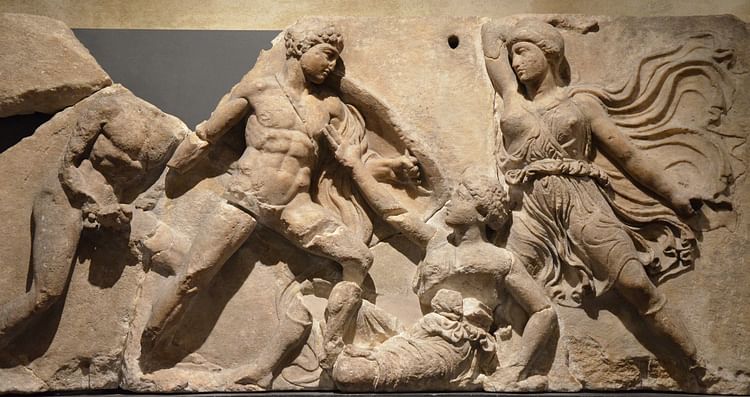 Greek & Amazons, Frieze from Bassae Carole Raddato (CC BY-SA) ](https://www.worldhistory.org/image/5292/greek--amazons-frieze-from-bassae/ "Greek & Amazons, Frieze from Bassae")While the exterior of the temple is rather austere, shorn as it is of any decoration, the interior has figure [sculpture](https://www.worldhistory.org/disambiguation/Sculpture/). This is rendered in marble while the rest of the temple is of local limestone. The slabs of the frieze, now in the British Museum in London, depict battles involving centaurs fighting Lapiths and Greeks battling [Amazons](https://www.worldhistory.org/amazon/). Originally there were 23 slabs creating 31 metres of frieze. The metopes of the pronaos (the interior entrance space) also carried sculpture. These depicted two mythological scenes: the [Dioskouroi](https://www.worldhistory.org/Castor_and_Pollux/) ([Castor and Pollux](https://www.worldhistory.org/Castor_and_Pollux/)) raping the daughters of Leucippus, a king of Messenia, and Apollo returning from Mt. Olympus.
#### Editorial Review
This human-authored definition has been reviewed by our editorial team before publication to ensure accuracy, reliability and adherence to academic standards in accordance with our [editorial policy](https://www.worldhistory.org/static/editorial-policy/).
## Bibliography
- [Ananiadis, D. *Ancient Greece - Temples & Sanctuaries.* Toubis Editions, 2016.](https://www.worldhistory.org/books/9605409291/)
- Bagnall, R. et al. *The Encyclopedia of Ancient History.* Wiley-Blackwell, 2012
- [Hornblower, S. *The Oxford Classical Dictionary.* Oxford University Press, 2012.](https://www.worldhistory.org/books/0199545561/)
- [Kinzl, H. *A Companion to the Classical Greek World.* Wiley-Blackwell; 1 edition (2006-12-22), 2016.](https://www.worldhistory.org/books/B01A64N0RY/)
- [Oleson, J.P. *THe Oxford Handbook of Engineering & Technology in the Classical World by Oleson, John..* OUP, Paperback(2009), 2016.](https://www.worldhistory.org/books/B008AUIXNS/)
## About the Author
Mark is WHE’s Publishing Director and has an MA in Political Philosophy (University of York). He is a full-time researcher, writer, historian and editor. Special interests include art, architecture and discovering the ideas that all civilizations share.
## Timeline
- **c. 420 BCE - c. 400 BCE**: The [Temple](https://www.worldhistory.org/temple/) of [Apollo](https://www.worldhistory.org/apollo/) is built at [Bassae](https://www.worldhistory.org/Bassae/).
## Cite This Work
### APA
Cartwright, M. (2016, July 07). Bassae. *World History Encyclopedia*.
### Chicago
Cartwright, Mark. "Bassae." *World History Encyclopedia*, July 07, 2016. .
### MLA
Cartwright, Mark. "Bassae." *World History Encyclopedia*, 07 Jul 2016, .
## License & Copyright
Submitted by [Mark Cartwright](https://www.worldhistory.org/user/markzcartwright/ "User Page: Mark Cartwright"), published on 07 July 2016. The copyright holder has published this content under the following license: [Creative Commons Attribution-NonCommercial-ShareAlike](https://creativecommons.org/licenses/by-nc-sa/4.0/deed.en). This license lets others remix, tweak, and build upon this content non-commercially, as long as they credit the author and license their new creations under the identical terms. When republishing on the web a hyperlink back to the original content source URL must be included. Please note that content linked from this page may have different licensing terms.