---
title: Baekje
author: Mark Cartwright
source: https://www.worldhistory.org/Baekje/
format: machine-readable-alternate
license: Creative Commons Attribution-NonCommercial-ShareAlike (https://creativecommons.org/licenses/by-nc-sa/4.0/)
updated: 2024-08-20
---
# Baekje
_Authored by [Mark Cartwright](https://www.worldhistory.org/user/markzcartwright/)_
Baekje (Paekche) was one of the Three Kingdoms which ruled over ancient [Korea](https://www.worldhistory.org/Korea/) from the 1st century BCE to the 7th century CE. Controlling territory in the south-western part of the peninsula the kingdom was in constant rivalry with the other two kingdoms of the period: [Silla](https://www.worldhistory.org/Silla/) and [Goguryeo](https://www.worldhistory.org/Goguryeo/), and the neighbouring [Gaya](https://www.worldhistory.org/Gaya/) confederation. The Baekje kingdom was noted for its high [culture](https://www.worldhistory.org/disambiguation/culture/), many aspects of which it exported to its ally [Japan](https://www.worldhistory.org/disambiguation/Japan/). However, when the Silla joined forces with [China](https://www.worldhistory.org/china/)'s ambitious [Tang dynasty](https://www.worldhistory.org/Tang_Dynasty/), the kingdom of Baekje was crushed and turned into a Chinese province before eventually being incorporated into the [Unified Silla Kingdom](https://www.worldhistory.org/Unified_Silla_Kingdom/).
### The Foundation of Baekje
The Baekje kings considered themselves descendants of the Buyeo (Puyo) tribes of north-east Manchuria. The traditional founding date of the kingdom is 18 BCE according to the 12th century CE *Samguk sagi* ('Historical Records of the Three States'), but this is unlikely to be accurate. The same source informs us that the founder was Onjo, son of Dongmyeong who had founded the Goguryeo ([Koguryo](https://www.worldhistory.org/Goguryeo/)) kingdom. Onjo and his brother Biryu established their capital at Wirye-song (modern Seoul). The name Baekje means 'rule over 100 people' indicating the first group of followers who migrated with Onjo.
Modern historians, however, credit King Goi (r. 234-286 CE) with founding the kingdom of Baekje and forming a centralised state. Goi established a cabinet of six officials (*naesin*) to administer the newly-centralised state and a system of officer ranks with 16 levels. Goi also sought to reduce state corruption in 262 CE by imposing triple fines and exclusion from office of any official caught of improper conduct. The kingdom prospered due to its fertile agricultural lands and grew through the acquisition of neighbouring territories such as the fortified towns of Mahan and the Taebang commando (the former Chinbon state) in 314 CE.
### Social Classes
Eventually, an aristocracy of eight clans (Sa, Yon, Hyop, Hae, Chin, Kuk, Mok, and Paek) would dominate all official positions in the kingdom. The aristocrats were themselves divided into three levels and distinguished by the colour of their robes. At the top were the purple-wearing *chwapyong* (who formed the *naesin* cabinet), in the middle the scarlet *tok ranks, and at the bottom the blue-robed *mun-dok and *mudok*. Only members of a particular level could access certain positions in the government administration. The higher officials wore [silk](https://www.worldhistory.org/Silk/) caps with [silver](https://www.worldhistory.org/Silver/) flowers while the king had a similar hat but with [gold](https://www.worldhistory.org/gold/) flower decoration.
In the provinces, local chiefs ruled over villages which were also overseen by a state-appointed magistrate (*kunjang*). The majority of the population were farmers, and they were expected to pay tribute to the state, sometimes even offer their labour or perform military service. Below the peasant class were slaves (mostly prisoners of [war](https://www.worldhistory.org/disambiguation/War/) and criminals) who served on the estates of the aristocracy.
[  Three Kingdoms of Korea Map Ashraf Kamel (CC BY-NC-SA) ](https://www.worldhistory.org/image/5790/three-kingdoms-of-korea-map/ "Three Kingdoms of Korea Map")### Chinese & Japanese Relations
Chinese influence is evidenced in the Baekje monarch's adoption of the title *wang* (king) from the late 3rd century CE. Other instances of Chinese influence are seen in education, [writing](https://www.worldhistory.org/writing/) (adapted to the Korean language), poetry, the arts, and [burial](https://www.worldhistory.org/burial/) practices, amongst others. Another area was the early popularity of [Taoism](https://www.worldhistory.org/Taoism/) and, even more so, [Confucianism](https://www.worldhistory.org/Confucianism/). In 384 CE, during the reign of king Chimnyu, [Buddhism](https://www.worldhistory.org/buddhism/) was adopted as the state [religion](https://www.worldhistory.org/religion/) by the Baekje kingdom after it was introduced there by the Indian ir Serindian monk Marananta. This replaced the former belief system based on the idea that the king was a son of [God](https://www.worldhistory.org/God/). Similarly, Baekje culture was exported abroad, especially via teachers, scholars and artists travelling to Japan and with them went Chinese culture such as classic Confucian texts but also elements of Korean culture, for example, as seen in the wooden buildings constructed there by Korean architects.
### Expansion & Rivalries
The 4th to 6th centuries CE saw a long-standing and bloody rivalry with the other two kingdoms of the peninsula: Goguryeo and Silla. The Baekje king Geunchogo (r. 346-375 CE) conquered the Mahan federation and attacked [Pyongyang](https://www.worldhistory.org/Pyongyang/), killing his Goguryeo counterpart king Gogugwon in 371 CE. During Geunchogo's reign diplomatic and cultural links were established with the Chinese Eastern Jin dynasty and the Wa (Wae) in Japan. There is evidence that the Wa was actually a feudal state ruled by the Baekje kings who now possessed a modern sailing fleet and controlled the lucrative trading areas around the Yellow and South Seas. Geunchogo also established inheritance of the throne in the male line, established the convention that queens were selected from the Chin family, and commissioned the writing of the *Sogi*, a history of Baekje, in 375 CE. Unfortunately, the work has not survived but is is referenced in the later *Samguk sagi*.
The Baekje kingdom covered the south-western half of ancient Korea but was constantly rebuffed by the more dominant Goguryeo. In 475 CE an attack from the northern kingdom resulted in the [death](https://www.worldhistory.org/disambiguation/Death/) of King Gaero (who had reigned from 455 CE) and the abandonment of Hansong (modern Gwangju), his capital. A new capital was established (475 CE) at Ungjin (modern Gongju/Kongju) but was replaced by the more favourably positioned Sabi (modern Buyeo/Puyo) in 538 CE. The kingdom was redivided into 22 regions or *tamno*, with each governed by a member of the royal family.
Baekje formed an alliance with the Silla kingdom between 433 and 553 CE and enjoyed its greatest period of prosperity, but this came to a dramatic and violent end when the Silla occupied the lower [Han](https://www.worldhistory.org/Han_Dynasty/) River valley. Then, in a [battle](https://www.worldhistory.org/disambiguation/battle/) at Gwansan Fortress (modern Okcheon) to reclaim their lost territory, the 30,000 strong Baekje army was defeated and King Seong (r. 523-554 CE) killed.
### Collapse
In the following century, the Baekje and Goguryeo kingdoms joined forces against the Silla and went on the offensive, taking Taeya-song (modern Hapcheon) in 642 CE and around 40 border fortresses. The following year Baekje captured Tanghang-song, which was a vital Silla link with China. The Silla, though, now had concrete support from the Chinese [Tang](https://www.worldhistory.org/Tang_Dynasty/) dynasty (618-907 CE) who saw an opportunity to advance their interests in Korea and [conquer](https://www.worldhistory.org/warfare/) the weakened Baekje and Goguryeo kingdoms. Baekje failed to tempt aid from Japan and could not prevent the fall of Sabi when the kingdom was attacked by land and sea in 660 CE. A Silla army of 50,000 led by the general Kim Yushin and a naval force of 130,000 men sent by the Tang emperor Gaozong proved more than enough to crush the Baekje army. Uija (r. 641-660), who turned out to be the last Baekje king, was taken prisoner and shipped off to China along with 12,000 of his compatriots.
[ 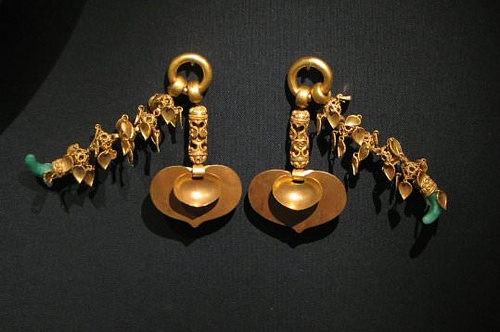 Baekje Gold Earrings Pressapochista (CC BY-SA) ](https://www.worldhistory.org/image/5735/baekje-gold-earrings/ "Baekje Gold Earrings")There was brief hope of a revival when rebel forces finally persuaded the Wa of Japan to intervene with a 30,000 man army, but this was wiped out by a joint Silla-Tang naval force on the Paekchon (modern Geum) River. Over the next few years rebel Baekje forces did harass [cities](https://www.worldhistory.org/city/) and even laid siege to Sabi and Ungjin but they were beset with leadership in-fighting and were finally crushed in 663 CE. The Baekje kingdom, thereafter, became a Chinese province.
The Silla eventually took over the entire peninsula and became known as the Unified Silla Kingdom, but following their slow collapse from the end of the 9th century CE, the state of Baekje, now known as Later Baekje to distinguish it from its predecessor, briefly rose again. The new state was founded in 892 CE by Gyeon Hwon, a peasant leader, but soon succumbed to the more powerful Later Goguryeo state which would itself morph into the much more enduring [Goryeo Dynasty](https://www.worldhistory.org/Goryeo/) (918-1392 CE).
### Baekje Art & [Architecture](https://www.worldhistory.org/disambiguation/architecture/)
The art and architecture of the Baekje kingdom are generally considered the finest of the Three Kingdoms, but unfortunately for posterity, these have also suffered the greatest destruction thanks to [warfare](https://www.worldhistory.org/warfare/) with the Silla, Goguryeo, and China over the centuries. One notable artistic contribution of the Baekje kingdom is their tiles decorated with fine landscape paintings. Also in the field of ceramics, Baekje potters produced two distinct types of wares: high-fired stoneware and low-fired [pottery](https://www.worldhistory.org/pottery/) light brown in colour. Bulbous jars, footed vessels, and tripods are common shapes. A typical Baekje decoration is the use of check stamps. Another product of the potter was roof tiles decorated with lotus petals. Baekje [sculpture](https://www.worldhistory.org/disambiguation/Sculpture/) is perhaps best seen in gilt-[bronze](https://www.worldhistory.org/disambiguation/bronze/) statues of the [Buddha](https://www.worldhistory.org/Siddhartha_Gautama/) and the carved stone cliff faces such as at Sosan.
Regarding architecture, the 7th-century CE Miruk [temple](https://www.worldhistory.org/temple/) at Iksan (now lost) was built by King Mu (r. 600-641 CE). It was the largest [Buddhist](https://www.worldhistory.org/buddhism/) temple in East Asia and had two stone pagodas and one in wood. One stone pagoda survives, albeit with only six of its original 7-9 storeys. The only other surviving Baekje pagoda is also of stone and located at the Chongnim temple at Buyeo. Finally, elements of Baekje architectural design can be seen in many surviving wooden buildings in Japan as a great number of Baekje craftsmen went there when Wa Japan was an ally.
[ 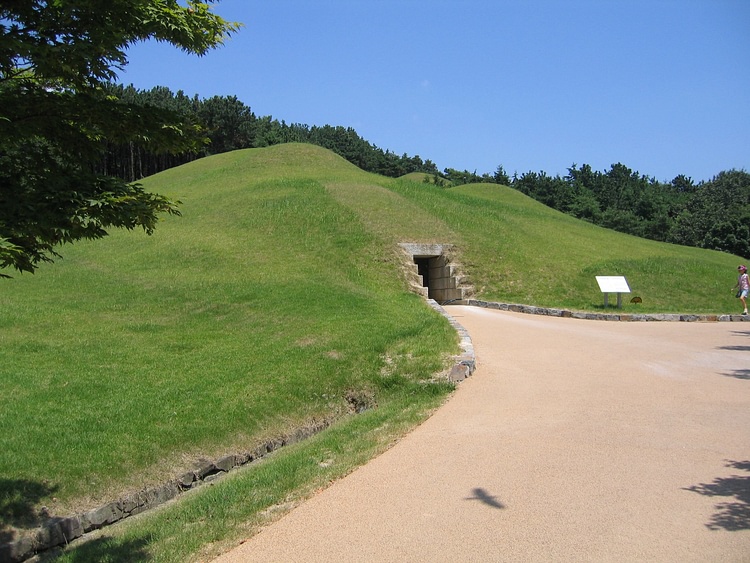 Tomb of Muryeong-Wang Straitgate (CC BY-SA) ](https://www.worldhistory.org/image/5736/tomb-of-muryeong-wang/ "Tomb of Muryeong-Wang")Baekje tombs were first [pyramid](https://www.worldhistory.org/pyramid/)-like structures made of stone, sometimes with the deceased placed inside two ceramic jars positioned mouth-to-mouth but, under the influence of China, these structures evolved into brick and stone-chambered tombs covered in earth mounds. Many of the interior walls were painted with murals. Perhaps one of the most impressive tombs is that of King Muryeong-Wang (r. 501-523 CE) which, within its huge earth mound, has a semi-circular vault lined with hundreds of moulded bricks, many decorated with lotus flower and geometric designs. The structure, located near Gongju, dates to 525 CE, as indicated by an inscription plaque inside the [tomb](https://www.worldhistory.org/tomb/). The queen joined her husband within the tomb in 529 CE.
Despite the exception of Muryeong's tomb, the horizontal entrances of Baekje tombs made their looting much easier than the fully-enclosed tombs of the Silla. As a result, there are, alas, frustratingly few outstanding surviving artefacts from one of Korea's most distinguished kingdoms. However, one superb piece which has survived as testimony to the skills of Baekje artists is the gilt-bronze incense burner from near Sabi, the only such example from ancient Korea. The foot is in the form of a dragon and supports a mountain in the shape of an egg which is decorated with heavenly beings and clouds. The whole is topped by a lid decorated with a phoenix.
This content was made possible with generous support from the [British Korean Society](http://www.britishkoreansociety.org.uk/?utm_source=ancient.eu&utm_medium=link&utm_campaign=ancient.eu).
#### Editorial Review
This human-authored definition has been reviewed by our editorial team before publication to ensure accuracy, reliability and adherence to academic standards in accordance with our [editorial policy](https://www.worldhistory.org/static/editorial-policy/).
## Bibliography
- [Jackson, B. *Korean Architecture.* Seoul Selection USA, Inc., 2013.](https://www.worldhistory.org/books/8997639234/)
- [Jinwung Kim. *A History of Korea"Land of the Morning Calm" to States in Conflict.* Indiana University Press, 2012.](https://www.worldhistory.org/books/0253000246/)
- [Kyung Hwang. *A History of Korea.* Palgrave Macmillan, 2010.](https://www.worldhistory.org/books/0230205461/)
- [Lee, Ki-baik. *A New History of Korea.* Harvard University Asia Center, 1984.](https://www.worldhistory.org/books/067461576X/)
- [Portal, J. *Korea: Art & Archaeology.* Thames & Hudson, 2000.](https://www.worldhistory.org/books/0500282021/)
- [Pratt, K. *Korea: A Historical & Cultural Dictionary.* Routledge, 1999.](https://www.worldhistory.org/books/0700704639/)
## About the Author
Mark is WHE’s Publishing Director and has an MA in Political Philosophy (University of York). He is a full-time researcher, writer, historian and editor. Special interests include art, architecture and discovering the ideas that all civilizations share.
## Timeline
- **57 BCE - 668 CE**: [Three Kingdoms Period in Korea](https://www.worldhistory.org/Three_Kingdoms_Period_in_Korea/) ([Silla](https://www.worldhistory.org/Silla/), [Goguryeo](https://www.worldhistory.org/Goguryeo/), and [Baekje](https://www.worldhistory.org/Baekje/)).
- **18 BCE**: Traditional founding date of the [Baekje](https://www.worldhistory.org/Baekje/) kingdom in [Korea](https://www.worldhistory.org/Korea/).
- **18 BCE - 660 CE**: The [Baekje](https://www.worldhistory.org/Baekje/) Kingdom rules in western [Korea](https://www.worldhistory.org/Korea/).
- **234 CE - 286 CE**: Reign of [Baekje](https://www.worldhistory.org/Baekje/) king Goi in western [Korea](https://www.worldhistory.org/Korea/).
- **314 CE**: [Baekje](https://www.worldhistory.org/Baekje/) conquers the Taebang commando in [Korea](https://www.worldhistory.org/Korea/).
- **346 CE - 375 CE**: Reign of the [Baekje](https://www.worldhistory.org/Baekje/) king Guenchogo in western [Korea](https://www.worldhistory.org/Korea/).
- **371 CE**: [Baekje](https://www.worldhistory.org/Baekje/) conquers the Mahan federation and attacks [Pyongyang](https://www.worldhistory.org/Pyongyang/), killing the [Goguryeo](https://www.worldhistory.org/Goguryeo/) king Gogugwon.
- **375 CE**: The Sogi, a history of the [Baekje](https://www.worldhistory.org/Baekje/) Kingdom in [Korea](https://www.worldhistory.org/Korea/), is written.
- **375 CE - 384 CE**: Reign of [Baekje](https://www.worldhistory.org/Baekje/) king Geungusu in western [Korea](https://www.worldhistory.org/Korea/).
- **384 CE**: [Buddhism](https://www.worldhistory.org/buddhism/) is adopted as the state [religion](https://www.worldhistory.org/religion/) by the [Baekje](https://www.worldhistory.org/Baekje/) kingdom of western [Korea](https://www.worldhistory.org/Korea/).
- **384 CE - 385 CE**: Reign of [Baekje](https://www.worldhistory.org/Baekje/) king Chimnyu in western [Korea](https://www.worldhistory.org/Korea/).
- **433 CE - 553 CE**: [Baekje](https://www.worldhistory.org/Baekje/) forms an alliance with the [Silla](https://www.worldhistory.org/Silla/) kingdom in [Korea](https://www.worldhistory.org/Korea/).
- **475 CE**: [Goguryeo](https://www.worldhistory.org/Goguryeo/) attacks the [Baekje](https://www.worldhistory.org/Baekje/) kingdom, killing the king Gaero and forcing the abandonment of Hansong, his capital.
- **475 CE**: A new [Baekje](https://www.worldhistory.org/Baekje/) capital is established at Ungjin (modern Gongju/Kongju).
- **479 CE - 501 CE**: Reign of [Baekje](https://www.worldhistory.org/Baekje/) king Dongseong in western [Korea](https://www.worldhistory.org/Korea/).
- **501 CE - 523 CE**: The [Baekje](https://www.worldhistory.org/Baekje/) king Muryeong reigns in western [Korea](https://www.worldhistory.org/Korea/).
- **523 CE - 554 CE**: Reign of [Baekje](https://www.worldhistory.org/Baekje/) king Seong in western Korean.
- **525 CE**: The [tomb of King Muryeong](https://www.worldhistory.org/article/963/the-tomb-of-king-muryeong/) of [Baekje](https://www.worldhistory.org/Baekje/) is built near Gongju, [Korea](https://www.worldhistory.org/Korea/).
- **538 CE**: A new [Baekje](https://www.worldhistory.org/Baekje/) capital is established at Sabi (modern Buyeo/Puyo).
- **554 CE**: The [Silla](https://www.worldhistory.org/Silla/) kingdom attacks the [Baekje](https://www.worldhistory.org/Baekje/) kingdom and occupies the lower [Han](https://www.worldhistory.org/Han_Dynasty/) River valley.
- **554 CE**: At the [battle](https://www.worldhistory.org/disambiguation/battle/) of Gwansan Fortress (modern Okcheon) the [Baekje](https://www.worldhistory.org/Baekje/) army is defeated by the [Silla](https://www.worldhistory.org/Silla/) and King Seong is killed.
- **600 CE - 641 CE**: The [Baekje](https://www.worldhistory.org/Baekje/) king Mu reigns in western [Korea](https://www.worldhistory.org/Korea/).
- **642 CE**: The [Baekje](https://www.worldhistory.org/Baekje/) and [Goguryeo](https://www.worldhistory.org/Goguryeo/) kingdoms join forces against the [Silla](https://www.worldhistory.org/Silla/) and [conquer](https://www.worldhistory.org/warfare/) Taeya-song (modern Hapchon).
- **660 CE**: The [Baekje](https://www.worldhistory.org/Baekje/) kingdom in [Korea](https://www.worldhistory.org/Korea/) falls to a joint [Silla](https://www.worldhistory.org/Silla/) and Chinese [Tang Dynasty](https://www.worldhistory.org/Tang_Dynasty/) army and naval attack.
- **663 CE**: A rebel [Baekje](https://www.worldhistory.org/Baekje/) army is finally crushed by the [Silla](https://www.worldhistory.org/Silla/) in [Korea](https://www.worldhistory.org/Korea/), ending the Baekje kingdom.
## External Links
- [List of Rulers of Korea | Lists of Rulers | Heilbrunn Timeline of Art History | The Metropolitan Museum of Art](https://www.metmuseum.org/toah/hd/koru/hd_koru.htm)
## Cite This Work
### APA
Cartwright, M. (2016, September 27). Baekje. *World History Encyclopedia*.
### Chicago
Cartwright, Mark. "Baekje." *World History Encyclopedia*, September 27, 2016. .
### MLA
Cartwright, Mark. "Baekje." *World History Encyclopedia*, 27 Sep 2016, .
## License & Copyright
Submitted by [Mark Cartwright](https://www.worldhistory.org/user/markzcartwright/ "User Page: Mark Cartwright"), published on 27 September 2016. The copyright holder has published this content under the following license: [Creative Commons Attribution-NonCommercial-ShareAlike](https://creativecommons.org/licenses/by-nc-sa/4.0/deed.en). This license lets others remix, tweak, and build upon this content non-commercially, as long as they credit the author and license their new creations under the identical terms. When republishing on the web a hyperlink back to the original content source URL must be included. Please note that content linked from this page may have different licensing terms.