---
title: Bacchae
author: Marissa Swan
source: https://www.worldhistory.org/Bacchae/
format: machine-readable-alternate
license: Creative Commons Attribution-NonCommercial-ShareAlike (https://creativecommons.org/licenses/by-nc-sa/4.0/)
updated: 1970-01-01
---
# Bacchae
_Authored by [Marissa Swan](https://www.worldhistory.org/user/mkhicks3/)_
The *Bacchae* is a [Greek tragedy](https://www.worldhistory.org/Greek_Tragedy/) written by the playwright [Euripides](https://www.worldhistory.org/Euripides/) (c. 484-406 BCE) in 407 BCE, which portrays Pentheus as an impious king*,* for the ruler of [Thebes](https://www.worldhistory.org/disambiguation/Thebes/) has denied the worship of [Dionysus](https://www.worldhistory.org/Dionysos/) within his [city](https://www.worldhistory.org/city/) walls. For Pentheus, the [god](https://www.worldhistory.org/God/) is a destroyer of social and moral values, and the former has returned from abroad only to have his conceptions of the god strengthened. He discovers that this false divinity has caused his [women](https://www.worldhistory.org/disambiguation/women/) to abandon their domestic roles for the freedom of Mt. Cithaeron in order to worship Dionysus. Despite Pentheus' diligent efforts to maintain control over his people, city, and self, Dionysus proves to be an unstoppable force that the King of Thebes is not able to keep under lock and key.
### Euripides
As with many individuals in antiquity, little is known about the life of Euripides (c. 484-406 BCE). It is speculated that the playwright was born in 484 BCE at [Salamis](https://www.worldhistory.org/disambiguation/Salamis/), and he first performed at the Great Dionysia in 455 BCE. Distancing himself from public life, Euripides, unlike both [Aeschylus](https://www.worldhistory.org/Aeschylus/) and [Sophocles](https://www.worldhistory.org/sophocles/), did not hold military or religious positions. Euripides wrote the *Bacchae* in 407 BCE, one year after he left [Athens](https://www.worldhistory.org/Athens/) to spend the final two years of his life in Pella at the court of King [Archelaus](https://www.worldhistory.org/disambiguation/Archelaus/). According to William Arrowsmith in his introduction to the text, Euripides' son brought the *Bacchae*, along with the plays *Iphigenia at Aulis* and *Alcmaeon at [Corinth](https://www.worldhistory.org/corinth/)*, back to Athens in order to be produced at the City Dionysia. Euripides' *Bacchae* is the only tragedy out of 18 surviving texts in which the [Greek](https://www.worldhistory.org/disambiguation/greek/) god Dionysus appears, the divinity whom the City Dionysia honors.
[ 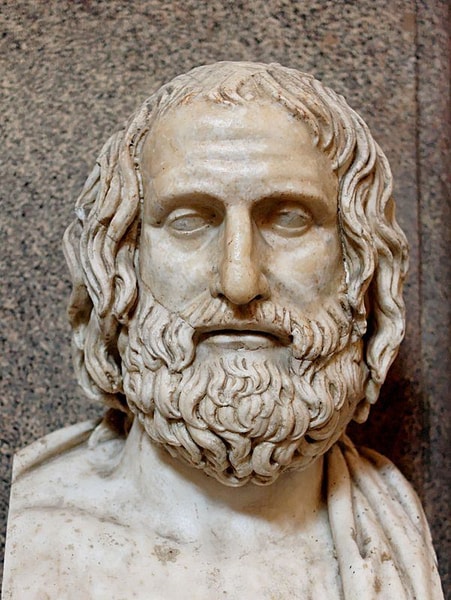 Euripides Jastrow (Public Domain) ](https://www.worldhistory.org/image/3761/euripides/ "Euripides")### Characters
The *Bacchae*, like most Greek tragedies, employs a short list of characters:
- Dionysus
- the chorus comprised of maenads
- [Cadmus](https://www.worldhistory.org/Cadmus/), the former king of Thebes
- Tiresias, the blind seer
- Pentheus, the current king of Thebes and the son of Agaue
- Pentheus' servant
- a herdsman
- Pentheus' attendant
- Agaue, the daughter of Cadmus and the sister of Semele
### The Birth of Dionysus
We learn from [Hesiod](https://www.worldhistory.org/hesiod/)'s *[Theogony](https://www.worldhistory.org/Theogony/)* (c. 8th century BCE) that Semele, the daughter of Cadmus (the king of Thebes), bore Dionysus prematurely upon having an affair with [Zeus](https://www.worldhistory.org/zeus/). Dionysus, in his prologue speech of the *Bacchae*, recounts how his mother was struck by Zeus' thunderbolt at the hands of a jealous and raging [Hera](https://www.worldhistory.org/Hera/). The chorus expands upon this in their first choral ode by singing of how Dionysus was:
> Born
> suddenly in labor
> pangs brought on by force:
> Zeus' thunderbolt took wing,
> struck him out the womb.
> His mother lost her life
> in the flash of lighting.
> (Woodruff 4-5)
Blasted from his mother's womb prematurely, the chorus then tells of how Zeus sowed Dionysus into his thigh in order to hide him from Hera. In *The Library*, a work attributed to Apollodorus from the 2nd century CE, it is said that Hera had tricked Semele into asking Zeus to appear to her as he would to Hera. Unable to refuse, Zeus threw a lightning bolt, which subsequently killed Semele and caused her and Zeus' unborn child to be hurled from the womb. Following Semele's [death](https://www.worldhistory.org/disambiguation/Death/), the writer of *The Library* claims that her sisters did not believe Semele's tale of having had an affair with Zeus, and it was her lie that caused her, in fact, to be struck down by a thunderbolt. In Euripides' *Bacchae*, it is for this questioning of his divinity that Dionysus has come to Thebes; he has made his way to the Greek [city-state](https://www.worldhistory.org/Polis/) in order to avenge his mother's defamed reputation and, most importantly, to assert his true identity as a divinity.
### Plot Overview
**Prologue**
Euripides' *Bacchae* takes place in the Greek city-state of Thebes, a location commonly used by ancient tragedians. Dionysus himself delivers the prologue speech, in which he reveals his true identity to the audience. Disguised as a stranger, he and his group of Maenads have traveled to Thebes from Asia, and he has chosen this city to be the first in [Greece](https://www.worldhistory.org/greece/) that worships him.
> I came here—my first Greek city—
> only after I had stated initiations there
> and set those places dancing, so that mortals
> would see me clearly as divine. Now Thebes,
> is my choice to be the first place I have filled
> with cries of ecstasy, clothed in fawnskin, put thyrsus
> in hand—this ivy-covered spear—because my mother's
> sisters—of all people, they should have known better—
> said Dionysus was no son of Zeus. (6)
Dionysus has already begun the process of initiation, and he has caused the Theban women to abandon their homes for Mt. Cithaeron in order to partake in the worshipping of the god. He then concludes his speech by establishing that he will reveal to Pentheus his divine status and that he will force the city of Thebes to accept and acknowledge him as the divinity which he is.
**Episode I**
Following the prologue, Cadmus and Tiresias appear on stage dressed as worshippers of Dionysus. They both have acknowledged his divine nature and accepted his cult into Thebes. In the opening dialogue of the first episode, they discuss with one another where they should perform their dances. Cadmus asks Tiresias:
> Where should we go to dance? Where plant
> plant our feet and toss our heads, gray as they are?
> By my guide in [religion](https://www.worldhistory.org/religion/), Tiresias, the old leading
> the old, since you're so wise. (8)
Pentheus then enters onto the stage with the seer and his uncle. Despite having been away from the city, he has heard about the shameful acts of the Theban women. According to the current king of Thebes, they are “pretending to be Bacchants,” but in fact, they are sleeping with other men instead of worshipping this fake god (9). Both Cadmus and Tiresias then plead with Pentheus to see reason, to proclaim that Dionysus is the son of Zeus. Tiresias criticizes the king:
> When a prudent speaker takes up a noble cause,
> he'll have no great trouble to speak well.
> You, on the other hand, have a tongue that runs on smoothly
> and sounds intelligent. But what it says is brainless. (11)
Cadmus echoes Tiresias' sentiment when he says:
> Tiresias' advice is excellent, my boy. Stay home
> with us, don't cross the threshold of [law](https://www.worldhistory.org/disambiguation/law/).
> You are flitting about, you know, so thoughtless,
> the way you think. (13)
Despite their attempts at persuasion and rationale, Pentheus refuses to acknowledge Dionysus as a god and the son of Zeus, and he vows to imprison the stranger that has infected his citizens with this madness.
**Episode II**
Pentheus and Dionysus meet on stage for the first time; however, Pentheus does not know that it is the god himself with whom he is speaking, and whom he has put in chains. Dionysus, as the stranger, informs Pentheus of his rituals. When Pentheus tells the stranger that he will remain under guard, the latter claims that Dionysus will release him from his imprisonment.
> **Dionysus**. The god himself will set me free, whenever I want.
> **Pentheus**. Sure he will, whenever you stand among your Bacchae and summon him.
> **Dionysus**. Even now he's very near, and he sees what I am suffering.
> **Pentheus**. Then where is he? He hasn't revealed himself to me.
> **Dionysus**. He is where I am. You do not see him because you lack reverence. (20)
Dionysus adheres to his promise, and in the following episode, he escapes from his chains, causing Pentheus' [palace](https://www.worldhistory.org/disambiguation/palace/) to crumble. Pentheus meets with the stranger outside of his home and demands to know how he escaped. Dionysus and Pentheus are interrupted when the herdsman appears on stage in order to relate to Pentheus what he had just witnessed on Mt. Cithaeron. He and others had attempted to capture Agaue in order to bring her to the king; however, they were spotted by the maenads and were forced to flee. The herdsman then recounts the maenads' tearing apart of animals limb from limb and their destruction of the two villages Hysiae and Erythrae. He concludes by urging Pentheus to accept the worship of Dionysus, just as Tiresias and Cadmus had done in the first episode.
[ 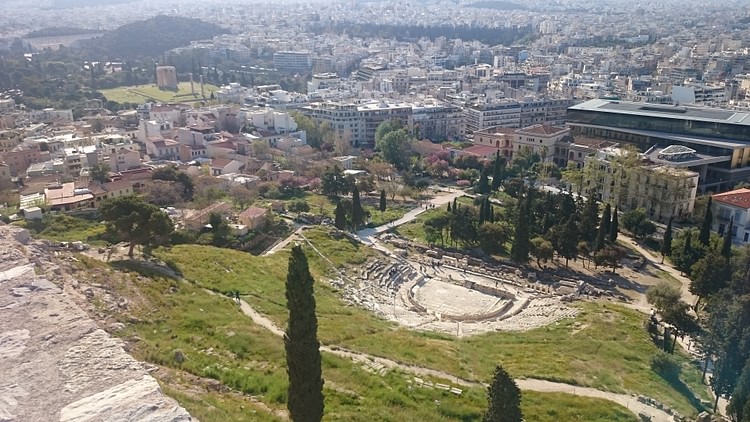 Theatre of Dionysus - Acropolis, Athens Spyros Kamilalis (CC BY-NC-SA) ](https://www.worldhistory.org/image/6801/theatre-of-dionysus---acropolis-athens/ "Theatre of Dionysus - Acropolis, Athens")**Episode III**
Pentheus, in a state of disgust and outrage at the behavior of his female citizens, commands members of his army to prepare to fight the maenads. As the stranger, Dionysus warns the king of his actions and proposes an alternative. Dionysus asks Pentheus, “Would you like to see the women gathered on the mountain?” (32). Surprisingly, Pentheus enthusiastically agrees to see the maenads, despite the condition that he has to dress as a woman. Just as the King of Thebes does not know the true identity of the stranger, he is also ignorant of Dionysus' forthcoming punishment for his lack of reverence. Dionysus exclaims:
> Now I'm off to get the fine clothes
> I will fit to Pentheus for his trip to [Hades](https://www.worldhistory.org/Hades/) when
> his mother kills him. Then he will know the son of Zeus,
> Dionysus, and realize that he was born a god, bringing
> terrors for initiation, and to the people, gentle grace. (35)
**Episode IV**
Dionysus and a maddened Pentheus arrive on Mt. Cithaeron. The god informs Pentheus, “Your mental state used to be unhealthy. Not it is as it should be” (39). Dionysus exits the stage and the chorus yell their orders to the Maenads:
> Run, swift hounds of madness, run to mountain!
> Find where Cadmus' daughters hold their celebration,
> Sting them to fury at the man
> who parties in a woman's outfit
> and spies in madness on Maenads. (41)
They then finish their choral ode by singing of the death of Pentheus.
**Episode V**
The fifth episode opens with Pentheus' servant delivering the second messenger speech. This time, however, it is not animals that are being torn apart by the hands of the Maenads, but Pentheus. The messenger tells of Agaue who, while believing her son to be a dangerous lion, tore his body to pieces. Just as Pentheus did not recognize the god Dionysus, his mother did not recognize her own son. The other Maenads, Agaue's sisters, joined in the king's destruction:
> Off went one with a forearm,
> another took his foot—with its hunting boot. And his ribs
> were stripped, flesh torn away. They all had blood on their
> hands. They tossed Pentheus' meat like balls in a game of catch. (45)
**Exodus**
Following the messenger's speech, Agaue enters the stage for the exodus. Still maddened and under the power of Dionysus, she carries Pentheus' head on a stick, proclaiming [triumph](https://www.worldhistory.org/Roman_Triumph/) over the lion which she believes she has killed. When Cadmus appears on stage he is shocked by the grisly image. He guides his daughter back to sanity, and Agaue truly sees what she is holding. Despite their worshipping of Dionysus, both Cadmus and Agaue are punished by the god, who banishes them from Thebes.
> **Agaue**. I weep for you, Father.
> **Cadmus**. And I for you, my child, and for your sisters. (47)
### Analysis
Dionysus, the god of wine in [Greek mythology](https://www.worldhistory.org/Greek_Mythology/), allows one to rid themselves of their inner inhibitions. In Euripides' *Bacchae*, he causes Pentheus to transcend both the physical boundaries of Thebes and those which he has placed around his mind. The king of Thebes works diligently to keep the corruption that Dionysus causes outside of his city, but not even he himself can resist its allure.
[  Dionysos from the Parthenon. James Lloyd (CC BY-NC-SA) ](https://www.worldhistory.org/image/3319/dionysos-from-the-parthenon/ "Dionysos from the Parthenon.")Many scholars have provided various readings of Euripides' tragedy. A.J. Podlecki describes the tragedy as follows:
> \[The *Bacchae* is a\] poetic statement of the tensions set up between an individual and a group when that individual, after being a member, or even standing as head, of the group, with whose collective aims his own individual desires have been identified, suddenly — as often happens in ordinary life — finds himself outside the group, his own will in stark and even disastrous conflict with theirs. (Podlecki, 144).
On the other hand, Christine M. Kalk analyzes the physical transformation that Pentheus undergoes throughout the tragedy, specifically how he metamorphizes from the King of Thebes into a symbol that represents the thyrsus. This transformation illustrates Dionysus' true power. Jean A. LaRue argues that Pentheus is controlled by his sexual obsession with the Maenads. To quote LaRue, “Pentheus' pride struggles with his lustful curiosity, and the latter wins” (LaRue, 212).
### Legacy
The influences of Euripides' corpus can be found not only in the tragedians of the 4th century BCE but also in the works of the [Greek comedy](https://www.worldhistory.org/Greek_Comedy/) playwrights of the 4th and 3rd centuries BCE. To quote Bernard Zimmermann, "Through the [Roman](https://www.worldhistory.org/disambiguation/Roman/) playwrights [Plautus](https://www.worldhistory.org/plautus/), Terence, and [Seneca](https://www.worldhistory.org/Seneca/) he left his [mark](https://www.worldhistory.org/disambiguation/Mark/) on the whole subsequent tradition of European drama," (Zimmermann, 87).
Euripides portrayed his characters in ways that closely resembled the individuals of his Athenian audience, and they continue to bear semblance to modern readers. With specific regard to the *Bacchae*, Euripides forces one to question who Dionysus and Pentheus truly are. What part of one's own inner being do both characters represent? How is one better able to understand their own self upon reading the tragedy?
#### Editorial Review
This human-authored definition has been reviewed by our editorial team before publication to ensure accuracy, reliability and adherence to academic standards in accordance with our [editorial policy](https://www.worldhistory.org/static/editorial-policy/).
## Bibliography
- [Euripides. *Euripides V.* The University of Chicago Press, 1959.](https://www.worldhistory.org/books/B000JMA680/)
- [Euripides (Translated by Paul Woodruff). *Bacchae.* Hackett Publishing Company, Inc., 1998.](https://www.worldhistory.org/books/0872203921/)
- [Hesiod. *Theogony & Works and Days.* Focus, 2008.](https://www.worldhistory.org/books/1585102881/)
- LaRue, J. A. "Prurience Uncovered: The Psychology of Euripides' Pentheus." *The Classical Journal*, 63, no. 5 (February 1968), pp. 209-214.
- Lynch, W. F. "Euripides." *CrossCurrents*, 25, no. 2 (Summer 1975), pp. 163-174.
- Podlecki, A. J. "Individual and Group in Euripides' Bacchae." *L' Antiquité Classique*, 43 (1974), pp. 143-165.
- [Trzaskoma, S. *Anthology Of Classical Myth.* Hackett Pub Co, 2016, 17-57.](https://www.worldhistory.org/books/0872207218/)
- [Zimmermann, B. *Greek Tragedy: An Introduction.* Johns Hopkins University Press, 1991.](https://www.worldhistory.org/books/0801841194/)
## About the Author
A first-generation student, I received my BA in Classics from Purdue University (2017), my MA in Classics from the University of Maryland - College Park (2019), and I am currently a second year PhD student in Classics at Columbia University.
## Timeline
- **c. 484 BCE - 407 BCE**: Life of [Greek tragedy](https://www.worldhistory.org/Greek_Tragedy/) poet [Euripides](https://www.worldhistory.org/Euripides/).
- **408 BCE - 406 BCE**: [Euripides](https://www.worldhistory.org/Euripides/)' tragedies '[Bacchae](https://www.worldhistory.org/Bacchae/)', 'Iphigenia at Aulis' are first performed.
## Cite This Work
### APA
Swan, M. (2018, July 03). Bacchae. *World History Encyclopedia*.
### Chicago
Swan, Marissa. "Bacchae." *World History Encyclopedia*, July 03, 2018. .
### MLA
Swan, Marissa. "Bacchae." *World History Encyclopedia*, 03 Jul 2018, .
## License & Copyright
Submitted by [Marissa Swan](https://www.worldhistory.org/user/mkhicks3/ "User Page: Marissa Swan"), published on 03 July 2018. The copyright holder has published this content under the following license: [Creative Commons Attribution-NonCommercial-ShareAlike](https://creativecommons.org/licenses/by-nc-sa/4.0/deed.en). This license lets others remix, tweak, and build upon this content non-commercially, as long as they credit the author and license their new creations under the identical terms. When republishing on the web a hyperlink back to the original content source URL must be included. Please note that content linked from this page may have different licensing terms.