---
title: Baalbek
author: Joshua J. Mark
source: https://www.worldhistory.org/Baalbek/
format: machine-readable-alternate
license: Creative Commons Attribution-NonCommercial-ShareAlike (https://creativecommons.org/licenses/by-nc-sa/4.0/)
updated: 1970-01-01
---
# Baalbek
_Authored by [Joshua J. Mark](https://www.worldhistory.org/user/JPryst/)_
Baalbek is an ancient Phoenician [city](https://www.worldhistory.org/city/) located in what is now modern-day Lebanon, north of Beirut, in the Beqaa Valley. Inhabited as early as 9000 BCE, Baalbek grew into an important pilgrimage site in the ancient world for the worship of the sky-[god](https://www.worldhistory.org/God/) [Baal](https://www.worldhistory.org/baal/) and his consort [Astarte](https://www.worldhistory.org/astarte/), the Queen of Heaven in [Phoenician religion](https://www.worldhistory.org/Phoenician_Religion/) (the name 'Baalbek' means Lord Baal of the Beqaa Valley). The center of the city was a grand [temple](https://www.worldhistory.org/temple/) dedicated to Astarte and Baal and the ruins of this early temple remain today beneath the later [Roman](https://www.worldhistory.org/disambiguation/Roman/) Temple of [Jupiter](https://www.worldhistory.org/jupiter/) Baal. Baalbek is listed by UNESCO as a World Heritage Site.
### Baalbek Stones
The cornerstones of the earlier temple at Baalbek have been found to weigh over 100 tons and the retaining [wall](https://www.worldhistory.org/wall/) monoliths weigh, each, 300 tons, leaving present-day archaeologists, scientists and historians mystified as to how the stones were moved, where from, and in what way they could have been manipulated into place. These blocks, and another one mile from Baalbek which weighs over 900 tons, are known today as the Baalbek Stones and have been the subject of much debate, study and conjecture over how they were moved and arranged. Further questions arise as to why such massive stones were necessary at the site and why the columns of the temple are also larger than they needed to be.
[ 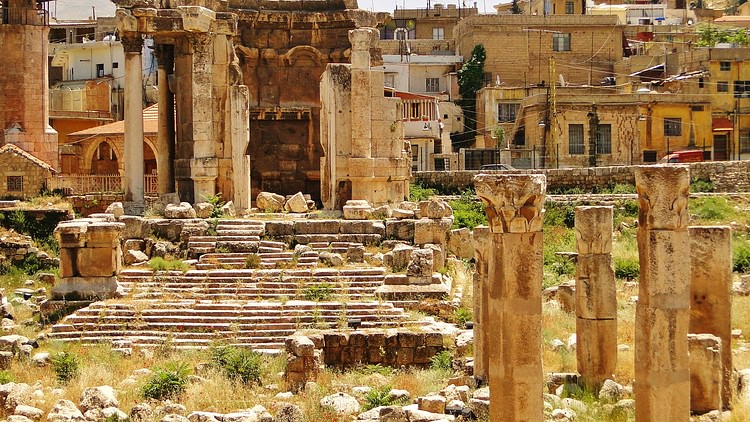 Temple of Venus, Baalbek Katarina Maruskinova (CC BY-NC-SA) ](https://www.worldhistory.org/image/4642/temple-of--venus-baalbek/ "Temple of Venus, Baalbek")Later builders at the site, such as the Romans, used these early stones as the foundations for their own temples but clearly did not move them in any way. The immense weight and mass of these stones has led to much speculation concerning ancient alien activity at Baalbek and even that the site was an ancient landing pad for spaceships. None of these theories is regarded as substantial by the prevailing scholarly community nor have they ever been.
### Heliopolis
[Alexander](https://www.worldhistory.org/disambiguation/Alexander/) the Great conquered Baalbek in 332 BCE and renamed it Heliopolis, 'City of the Sun', the name still in use in 64 BCE when [Pompey the Great](https://www.worldhistory.org/pompey/) annexed the region of [Phoenicia](https://www.worldhistory.org/phoenicia/) for [Rome](https://www.worldhistory.org/Rome/). This was still the designation for the city in 15 BCE when the city became a colony of the [Roman Empire](https://www.worldhistory.org/Roman_Empire/).
The Romans vastly improved the site with massive building projects, walkways, [aqueducts](https://www.worldhistory.org/aqueduct/), and roads. Under the reign of [Roman emperor](https://www.worldhistory.org/Roman_Emperor/) Septimus Severus (193-211 CE) the grand temple of Jupiter Baal was built and dedicated (the largest and most ornate religious building in the entire history of the Roman [Empire](https://www.worldhistory.org/empire/)) whose impressive ruins may still be seen today.
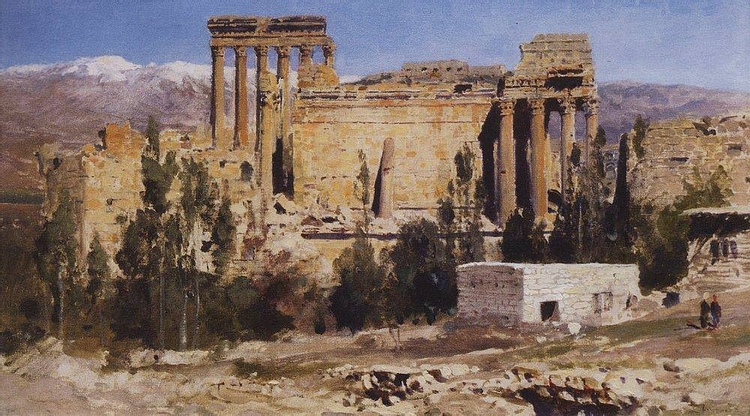
The city remained an oft-visited pilgrimage site until the legitimization of [Christianity](https://www.worldhistory.org/christianity/) in the Roman Empire by [Constantine the Great](https://www.worldhistory.org/Constantine_I/) (beginning in 313 CE with the Edict of Milan) after which, avoiding the fate of some pagan sites which were neglected or destroyed, it was Christianized. The Temple of [Bacchus](https://www.worldhistory.org/Bacchus/), still extant, is larger than the [Parthenon](https://www.worldhistory.org/parthenon/) of [Athens](https://www.worldhistory.org/Athens/) and all of the temples of the Roman complex (of Jupiter, Bacchus, [Venus](https://www.worldhistory.org/venus/), and Mercury) were spared destruction during the rise of Christianity through their use as churches; only the altar of Jupiter was torn down by Theodosius I. The temples continued in their role as Christian places of worship until the coming of the Muslim Arabs in 637 CE.
[  Baalbek Vasily Polenov (Public Domain) ](https://www.worldhistory.org/image/2201/baalbek/ "Baalbek")### Later History
Under Muslim rule, following their victory over the [Byzantine](https://www.worldhistory.org/disambiguation/Byzantine/) forces at the [Battle of Yarmouk](https://www.worldhistory.org/article/1563/battle-of-yarmouk/), the area was renamed Al-Qalaa (the fortress). Walls were strengthened for defense and the temples were fortified. A mosque was built amid the ancient Roman temples while the Christian additions were torn down and destroyed.
The Byzantine army sacked the city in 748 CE and, again, in 975 CE but could not hold it and, eventually, having survived the [Mongols](https://www.worldhistory.org/Mongol_Empire/) and further military campaigns, it passed into the [Ottoman Empire](https://www.worldhistory.org/Ottoman_Empire/) which largely ignored the city and allowed the ruins to crumble. A series of earthquakes over the centuries further damaged the site and nothing was done in the area of preservation or excavation until 1898 CE when the German Emperor Wilhelm II visited the area and sent a team of archaeologists to begin work there. Their efforts, along with later international teams, have preserved Baalbek for future generations.
#### Editorial Review
This human-authored definition has been reviewed by our editorial team before publication to ensure accuracy, reliability and adherence to academic standards in accordance with our [editorial policy](https://www.worldhistory.org/static/editorial-policy/).
## Bibliography
- [Baalbek - A Colossal Enigma](http://www.bibliotecapleyades.net/esp_baalbek_1.htm "Baalbek - A Colossal Enigma"), accessed 1 Dec 2016.
- [Baalbek: UNESCO](http://whc.unesco.org/en/list/294 "Baalbek: UNESCO"), accessed 1 Dec 2016.
- [Places of Peace and Power - Baalbek](http://sacredsites.com/middle_east/lebanon/baalbek.html "Places of Peace and Power - Baalbek"), accessed 1 Dec 2016.
- [Durant, W. *Our Oriental Heritage.* Simon & Schuster, 1954.](https://www.worldhistory.org/books/B00005WJGO/)
- [Worthington, I. *Alexander the Great.* Routledge, 2004.](https://www.worldhistory.org/books/140580162X/)
## About the Author
Joshua J. Mark is World History Encyclopedia's co-founder and Content Director. He was previously a professor at Marist College (NY) where he taught history, philosophy, literature, and writing. He has traveled extensively and lived in Greece and Germany.
- [Linkedin Profile](https://www.linkedin.com/pub/joshua-j-mark/38/614/339)
## Timeline
- **c. 2900 BCE - c. 2300 BCE**: First settlement of [Baalbek](https://www.worldhistory.org/Baalbek/).
- **332 BCE**: [Alexander the Great](https://www.worldhistory.org/Alexander_the_Great/) sacks [Baalbek](https://www.worldhistory.org/Baalbek/) and renames it Heliopolis.
- **c. 1 CE - c. 100 CE**: Construction of the [temple](https://www.worldhistory.org/temple/) of [Jupiter](https://www.worldhistory.org/jupiter/) [Baal](https://www.worldhistory.org/baal/) by the Romans at [Baalbek](https://www.worldhistory.org/Baalbek/).
## External Links
- [A Colossal Enigma](https://www.bibliotecapleyades.net/esp_baalbek_1.htm)
- [Baalbek](http://whc.unesco.org/en/list/294)
- [Moving the Stones of Baalbek–The Wonders of Roman Engineering](https://gilgamesh42.wordpress.com/2013/04/25/moving-the-stones-of-baalbek-the-wonders-of-roman-engineering/)
- [Baalbek Megaliths](http://www.ancient-hebrew.org/ancientman/1057.html)
- [Phoenician Encyclopedia: A Bequest Unearthed, Phoenicia and the Phoenicians, Punic, Canaanites -- Encyclopedia Phoeniciana](http://phoenicia.org/index.shtml)
## Cite This Work
### APA
Mark, J. J. (2009, September 02). Baalbek. *World History Encyclopedia*.
### Chicago
Mark, Joshua J.. "Baalbek." *World History Encyclopedia*, September 02, 2009. .
### MLA
Mark, Joshua J.. "Baalbek." *World History Encyclopedia*, 02 Sep 2009, .
## License & Copyright
Submitted by [Joshua J. Mark](https://www.worldhistory.org/user/JPryst/ "User Page: Joshua J. Mark"), published on 02 September 2009. The copyright holder has published this content under the following license: [Creative Commons Attribution-NonCommercial-ShareAlike](https://creativecommons.org/licenses/by-nc-sa/4.0/deed.en). This license lets others remix, tweak, and build upon this content non-commercially, as long as they credit the author and license their new creations under the identical terms. When republishing on the web a hyperlink back to the original content source URL must be included. Please note that content linked from this page may have different licensing terms.