---
title: Aulos
author: Mark Cartwright
source: https://www.worldhistory.org/Aulos/
format: machine-readable-alternate
license: Creative Commons Attribution-NonCommercial-ShareAlike (https://creativecommons.org/licenses/by-nc-sa/4.0/)
updated: 1970-01-01
---
# Aulos
_Authored by [Mark Cartwright](https://www.worldhistory.org/user/markzcartwright/)_
The aulos was a musical wind instrument played by the ancient Greeks. It was also known as the *kalamos* or *libykos lotos*, which referred to the material from which part of the instrument was made: respectively, the reed and the Libyan lotus plant. Perhaps the most commonly played instrument in [Greek music](https://www.worldhistory.org/Greek_Music/), the aulos was played in festivals, processions of births and deaths, athletic games - for the athletes to keep their exercises in rhythm, social occasions, and performances of tragedy in the [Greek theatre](https://www.worldhistory.org/Greek_Theatre/). It was associated with the [god](https://www.worldhistory.org/God/) [Dionysos](https://www.worldhistory.org/Dionysos/) and often played at private drinking parties.
### Features
Made from cane, boxwood, bone, ivory, or occasionally metals such as [bronze](https://www.worldhistory.org/disambiguation/bronze/) and [copper](https://www.worldhistory.org/copper/), the circular pipe (*bombyke*) was fitted with one, two or three bulbous mouthpieces which gave the instrument a different pitch. The pipe itself could be composed of up to five closely interlocking sections. Sound was produced by blowing and vibrating the single or double reed (*glottides*) within the mouthpiece. Seven holes (*tremata*) were cut down the length of the pipe with sometimes an additional hole to produce another octave of notes. Tonality could be adjusted through the turning of bronze rings between the mouthpiece and the pipe. Frequently, two *auloi* were fitted together (*diaulos*) at the mouthpiece to produce a richer sound or double melody. The sound produced by an *aulete* (player) was rhythmical and penetrating, and he often accompanied a male chorus.
*Aulos* players from [Thebes](https://www.worldhistory.org/disambiguation/Thebes/) (c. 400 BCE) are credited with inventing rings and keys (*pronomos*) made from [silver](https://www.worldhistory.org/Silver/) and bronze which could open or close various holes on the instrument, functioning much like keys on modern wind instruments such as the clarinet.
[ 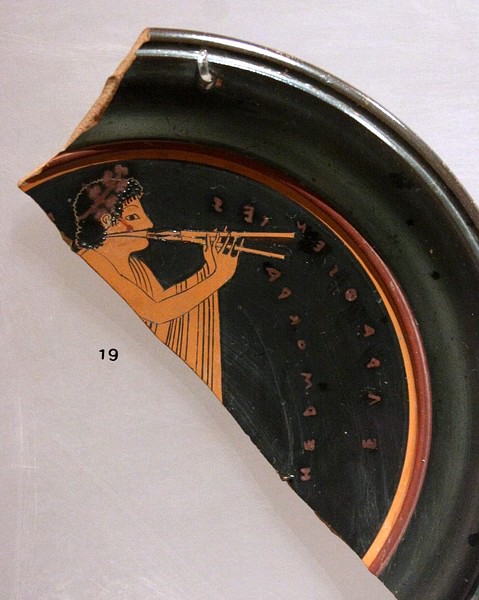 Aulos Player James Lloyd (Copyright, fair use) ](https://www.worldhistory.org/image/1017/aulos-player/ "Aulos Player")### Surviving Examples
The earliest surviving examples of *auloi* have been found at Koilada, [Thessaly](https://www.worldhistory.org/disambiguation/Thessaly/) and date from the [Neolithic period](https://www.worldhistory.org/Neolithic/) (c. 5000 BCE). These instruments are carved from bone and have five holes, irregularly placed down their length. A complete double *aulos* in bone with tonal bronze rings survives from 4th century BCE [Thessaloniki](https://www.worldhistory.org/Thessalonica/) and many fragmentary pieces have been excavated on [Delos](https://www.worldhistory.org/delos/) where there is also evidence of a workshop. The earliest representations in art come from small marble statues from Keros in the Cycladic islands (2700-2300 BCE). Aulos players, both male and female, are commonly depicted on Attic red- and black-figure vases from the 7th century BCE and include depictions of [Hercules](https://www.worldhistory.org/hercules/) and Satyrs playing the instrument. Decorated [pottery](https://www.worldhistory.org/pottery/) also, on occasion, depicts the leather strap (*phorbeia*) which held the instrument in position over the mouth and even the instrument case (*sybene*) over the shoulder of the player.
#### Editorial Review
This human-authored definition has been reviewed by our editorial team before publication to ensure accuracy, reliability and adherence to academic standards in accordance with our [editorial policy](https://www.worldhistory.org/static/editorial-policy/).
## Bibliography
- Andrikou E. (et al). *Gifts from the Muses.* Hellenic Ministry of Culture, Athens, 2004
- [Kostas Kotsanas. *THE MUSICAL INSTRUMENTS OF THE ANCIENT GREEKS.* Kostas Kotsanas, 2012.](https://www.worldhistory.org/books/960931614X/)
## About the Author
Mark is WHE’s Publishing Director and has an MA in Political Philosophy (University of York). He is a full-time researcher, writer, historian and editor. Special interests include art, architecture and discovering the ideas that all civilizations share.
## Timeline
- **c. 5000 BCE**: The first [aulos](https://www.worldhistory.org/Aulos/) musical instruments are carved from bone.
- **2700 BCE - 2300 BCE**: The first depiction in art of the [aulos](https://www.worldhistory.org/Aulos/) musical instrument appears in [Cycladic sculpture](https://www.worldhistory.org/article/457/cycladic-sculpture/).
- **c. 400 BCE**: Theban musicians invent a more sophisticated [aulos](https://www.worldhistory.org/Aulos/) with [metal](https://www.worldhistory.org/disambiguation/metal/) keys.
## External Links
- [Music and creativity in Ancient Greece - Tim Hansen](http://ed.ted.com/lessons/music-and-creativity-in-ancient-greece-tim-hansen)
## Cite This Work
### APA
Cartwright, M. (2012, June 12). Aulos. *World History Encyclopedia*.
### Chicago
Cartwright, Mark. "Aulos." *World History Encyclopedia*, June 12, 2012. .
### MLA
Cartwright, Mark. "Aulos." *World History Encyclopedia*, 12 Jun 2012, .
## License & Copyright
Submitted by [Mark Cartwright](https://www.worldhistory.org/user/markzcartwright/ "User Page: Mark Cartwright"), published on 12 June 2012. The copyright holder has published this content under the following license: [Creative Commons Attribution-NonCommercial-ShareAlike](https://creativecommons.org/licenses/by-nc-sa/4.0/deed.en). This license lets others remix, tweak, and build upon this content non-commercially, as long as they credit the author and license their new creations under the identical terms. When republishing on the web a hyperlink back to the original content source URL must be included. Please note that content linked from this page may have different licensing terms.