---
title: Athens
author: Joshua J. Mark
source: https://www.worldhistory.org/Athens/
format: machine-readable-alternate
license: Creative Commons Attribution-NonCommercial-ShareAlike (https://creativecommons.org/licenses/by-nc-sa/4.0/)
updated: 2023-04-06
---
# Athens
_Authored by [Joshua J. Mark](https://www.worldhistory.org/user/JPryst/)_
Athens, [Greece](https://www.worldhistory.org/greece/), with its famous [Acropolis](https://www.worldhistory.org/Acropolis/), has come to symbolize the whole of the country in the popular imagination, and not without cause. It not only has its iconic ruins and the famous port of [Piraeus](https://www.worldhistory.org/Piraeus/) but, thanks to ancient writers, its history is better documented than most other ancient [Greek](https://www.worldhistory.org/disambiguation/greek/) [city](https://www.worldhistory.org/city/)-states.
The city began as a small community of the [Mycenaean Civilization](https://www.worldhistory.org/Mycenaean_Civilization/) (c. 1700-1100 BCE) and grew into a city that, at its height, was associated with the development of democracy, [philosophy](https://www.worldhistory.org/philosophy/), [science](https://www.worldhistory.org/science/), mathematics, drama and [literature](https://www.worldhistory.org/literature/), art, and many other aspects of world [culture](https://www.worldhistory.org/disambiguation/culture/) and [civilization](https://www.worldhistory.org/civilization/) including the [Olympic Games](https://www.worldhistory.org/Olympic_Games/). The city was burned in the Persian invasion of 480 BCE, rebuilt by the statesman [Pericles](https://www.worldhistory.org/pericles/) (l. 495-429 BCE), and became the superpower of the ancient world through its formidable military and wealth.
It fell to [Sparta](https://www.worldhistory.org/sparta/) after the Second [Peloponnesian War](https://www.worldhistory.org/Peloponnesian_War/) (413-404 BCE) but again revived to assume a significant position of leadership among the city-states even after it was conquered by [Philip II of Macedon](https://www.worldhistory.org/Philip_II_of_Macedon/) (r. 359-336 BCE) in 338 BCE following his victory at the [Battle of Chaeronea](https://www.worldhistory.org/Battle_of_Chaeronea/). The city was taken as a province of [Rome](https://www.worldhistory.org/Rome/) after the [Battle of Actium](https://www.worldhistory.org/Battle_of_Actium/) in 31 BCE and became a favorite of a number of [Roman](https://www.worldhistory.org/disambiguation/Roman/) emperors, especially [Hadrian](https://www.worldhistory.org/hadrian/) (r. 117-138 CE) who contributed funds and building projects to beautify it. [Paul the Apostle](https://www.worldhistory.org/Paul_the_Apostle/) is depicted in the Book of Acts as preaching to the Athenians, and it would later develop into an important center of Christian theology.
After Greece was conquered by the [Ottoman Empire](https://www.worldhistory.org/Ottoman_Empire/) in 1458, Athens entered a long period of decline which was only reversed in the 19th century after the country won its independence from the Turks in 1821. Recognizing the importance of the past in maintaining national identity, the government focused on efforts to restore and preserve monuments and temples like the [Parthenon](https://www.worldhistory.org/parthenon/) as well as ancient locales like the [agora](https://www.worldhistory.org/agora/). Today, Athens is the capital of Greece and among the most often visited and highly regarded cultural centers in the world.
### Early Settlement & Legend
Evidence of human habitation on the Acropolis and, below, in the area around the agora, dates back to the [Neolithic Period](https://www.worldhistory.org/Neolithic/) with a more advanced culture developing clearly c. 5000 BCE and, probably, as early as 7000 BCE. According to legend, the Athenian King Cecrops wanted the city named for himself but the gods, seeing how beautiful it was, felt it deserved an immortal name. A contest was held among the gods on the Acropolis, with Cecrops and the citizenry looking on, to determine which deity would win the honor.
[Poseidon](https://www.worldhistory.org/poseidon/) struck a rock with his trident, and as water gushed forth, he assured the people that now they would never suffer drought. [Athena](https://www.worldhistory.org/athena/) was next in line and dropped a seed into the earth which sprouted swiftly as an olive tree. The people thought the olive tree more valuable than the water (as, according to some versions of the story, the water was salty, as was Poseidon's realm), and Athena was chosen as patron and the city named for her. According to scholar Robin Waterfield:
> This myth may reveal long-forgotten historical events. The ancient Greek name for Athens is a plural word, because once there were several villages which came together under the auspices of the goddess Athena – “the communities of Athena” – as it were. If the chief deity of one of these original villages was Poseidon, the myth reflects his losing out to Athena. (36)
[  The Acropolis and Ancient Athens Simeon Netchev (CC BY-NC-ND) ](https://www.worldhistory.org/image/16191/the-acropolis-and-ancient-athens/ "The Acropolis and Ancient Athens")The myth was also used, later, to justify the second-class status of Athenian [women](https://www.worldhistory.org/disambiguation/women/) since it was the women of Athens who chose Athena’s gift over Poseidon’s and, so this justification goes, to turn away Poseidon’s wrath from the city, women’s names were not recorded on birth records as mothers (the woman’s father’s name was given) and women were denied a political voice and civic rights outside of their participation in religious activities.
As the soil was not conducive to large-scale agricultural programs, Athens turned to [trade](https://www.worldhistory.org/disambiguation/trade/) for its livelihood and mainly to sea trade through its port at Piraeus. The early [Mycenaean period](https://www.worldhistory.org/Mycenaean_Civilization/) saw massive fortresses rise all over Greece, and Athens was no exception. The remains of a [Mycenaean](https://www.worldhistory.org/Mycenaean_Civilization/) [palace](https://www.worldhistory.org/disambiguation/palace/) can still be seen today on the Acropolis in the present day. [Homer](https://www.worldhistory.org/homer/)’s *[Iliad](https://www.worldhistory.org/iliad/)* and *[Odyssey](https://www.worldhistory.org/Odyssey/)* (8th century BCE) portray the Mycenaeans as great warriors and seafaring people trading widely throughout the [Aegean](https://www.worldhistory.org/aegean/) and the [Mediterranean](https://www.worldhistory.org/disambiguation/mediterranean/) region, and this became a point of pride for the Athenians who considered themselves direct descendants of the great Homeric heroes.
[  Some Active Trade Routes in the Bronze Age Mediterranean Kelly Macquire (CC BY-NC-SA) ](https://www.worldhistory.org/image/12695/some-active-trade-routes-in-the-bronze-age-mediter/ "Some Active Trade Routes in the Bronze Age Mediterranean")Around 1200 BCE the [Sea Peoples](https://www.worldhistory.org/Sea_Peoples/) invaded the Greek archipelago of the Aegean from the south while, simultaneously, the Dorians came down from the north into mainland Greece. While the Sea Peoples made definite incursions into Attica (the mainland region surrounding Athens) the Dorians bypassed the city, allowing the Mycenaean culture to survive (although, like the rest of Greece, there seems to have been an economic and cultural downturn following these invasions during the [Bronze Age Collapse](https://www.worldhistory.org/Bronze_Age_Collapse/)). The Athenians, afterward, claimed for themselves a special status in that they spoke Ionian, instead of Doric, Greek and held to customs they felt were more ancient and therefore superior to those of their neighbors.
### [Solon](https://www.worldhistory.org/solon/) & the [Law](https://www.worldhistory.org/disambiguation/law/)
The wealthy aristocrats held control of both the land and the [Greek government](https://www.worldhistory.org/Greek_Government/), and, in time, poorer landowners became enslaved (or nearly so) through debt to the wealthier citizens. Further, there was a perceived lack of consistency among the other laws of the city. The first series of laws written to address these problems were provided by the statesman Draco (also given as Dracon/Drakon) c. 621 BCE but were considered too severe (the penalty for most infractions was [death](https://www.worldhistory.org/disambiguation/Death/)), and so the great lawgiver Solon (l. c. 630 - c. 560 BCE) was called upon to modify and revise them. Solon, though an aristocrat himself, created a series of laws which equalized the political power of the citizenry and, in so doing, provided the groundwork for [Athenian democracy](https://www.worldhistory.org/Athenian_Democracy/) c. 594 BCE.
[  Solon Kpjas (Public Domain) ](https://www.worldhistory.org/image/4606/solon/ "Solon")Solon also devoted considerable effort to making the policies of Athens not only just but profitable. He legalized [prostitution in ancient Athens](https://www.worldhistory.org/article/28/prostitution-in-ancient-athens/) and taxed both individual prostitutes and brothels. As Athens was a popular and profitable trade center, many young men arrived in the city and sought the services of prostitutes while young Athenian males, who usually did not marry until after the age of 30, were provided with the means to gain sexual experience without running the risk of enraging the father and male relatives of a virgin female through pre-marital sex. By encouraging young men to visit prostitutes, Solon diffused one source of blood feuds in the city since young women of good families were understood to be off-limits to any males except the one chosen to be her husband.
After Solon resigned from public office, various factional leaders sought to seize power, and the ultimate victor, [Peisistratus](https://www.worldhistory.org/Pisistratus/) (d. c. 528 BCE), recognized the value of Solon's revisions and kept them, in a modified form, throughout his reign as a benevolent tyrant. His son, Hippias (r c. 528-510 BCE) continued his policies as co-ruler with his brother Hipparchus (r. c. 528-514 BCE) until Hipparchus was assassinated over a love affair in 514 BCE.
### The Tyrannicides & Democracy
Hipparchus was attracted to a young man named Harmodios, but his advances were rejected because Harmodios was already involved with another man, Aristogeiton. Hipparchus did not take the rejection well and so removed Harmodios’ sister from her highly visible and prestigious position among the [women of Athena's cult](https://www.worldhistory.org/article/74/the-women-of-athenas-cult/) who participated in the Panathenaic Festival honoring the goddess. As scholar Sarah B. Pomeroy notes, "to prevent a candidate from participating in this event was to cast aspersions on her reputation" (76). Hipparchus’ removal of the girl was tantamount to claiming she was not a virgin and so insulting both her and her family. Harmodius and Aristogeiton murdered Hipparchus during the festival, were caught afterwards, and executed.
After this, Hippias became increasingly paranoid and erratic in his reign which culminated in the Athenian Revolt of 510 BCE which was actually a military action by Sparta under their king Cleomenes I (r. c. 519 - c. 490 BCE) who was invited by the Athenians to rid them of Hippias. Afterwards, the Athenians, not wanting to be obliged to Sparta, rewrote their history casting Harmodios and Aristogeiton as "the tyrannicides" who had struck the first blow for freedom and restored the democratic ideals of the city. Actually, they had done neither; they were simply avenging a personal insult.
[  Caryatids of the Erechtheion Dennis Jarvis (CC BY-NC-SA) ](https://www.worldhistory.org/image/975/caryatids-of-the-erechtheion/ "Caryatids of the Erechtheion")In the aftermath of the coup, and after settling affairs with various factions, the statesman [Cleisthenes](https://www.worldhistory.org/Cleisthenes/) (l. 6th century BCE) was appointed to reform the government and the laws and, c. 507 BCE, he instituted a new form of government which today is recognized as democracy. Cleisthenes is regarded as the "Father of Athenian Democracy", but this form of government was significantly different from how democracy is understood in the present day. In Athenian democracy, only upper-class male citizens had a political voice, disenfranchising women, foreigners, and, of course, the many slaves who made up a large part of Athens’ population.
Even so, this new form of government involved the citizenry directly in political decisions, and even those who were not allowed to vote understood that decisions were being made now by a majority of informed citizens rather than a tyrant. Athenian democracy would provide the stability necessary to make Athens the cultural and intellectual center of the ancient world; a reputation that lasts even into the modern age. Waterfield comments:
> The pride that followed from widespread involvement in public life gave Athenians the energy to develop their city both internally and in relation to their neighbors. (62)
Believing themselves descended from great heroes, and with heroes in their midst like the tyrannicides, the Athenians understood they now had the best form of government which they should encourage elsewhere; so they decided to incite the Greek communities of [Asia Minor](https://www.worldhistory.org/Asia_Minor/), then under the control of the Persian [Achaemenid Empire](https://www.worldhistory.org/Achaemenid_Empire/) (c. 550-330 BCE) to revolt.
### The [Persian Wars](https://www.worldhistory.org/Persian_Wars/)
The [Persian Empire](https://www.worldhistory.org/disambiguation/Persian_Empire/) at this time was led by the emperor [Darius I](https://www.worldhistory.org/Darius_I/) (the Great, r. 522-486 BCE) who quickly crushed the rebellion and then sent a force against Athens. The Persians were defeated at the [Battle](https://www.worldhistory.org/disambiguation/battle/) of [Marathon](https://www.worldhistory.org/marathon/) in 490 BCE, losing over 6,000 men to the brilliant tactics of the Athenian general [Miltiades](https://www.worldhistory.org/Miltiades/) (l. 554-489 BCE) whose losses numbered only 192 soldiers. The Persian military was considered invincible at this time and so this victory increased the Athenians’ already high opinion of themselves.
In 480 BCE, however, [Darius](https://www.worldhistory.org/disambiguation/darius/) I’s son and successor, [Xerxes I](https://www.worldhistory.org/Xerxes_I/) (r. 486-465 BCE) assembled the largest army mustered in the world up to that time and launched an invasion of Greece, with Athens as the primary target, to avenge the insult to his father. His forces were held at [Thermopylae](https://www.worldhistory.org/thermopylae/) by the Spartan king [Leonidas](https://www.worldhistory.org/disambiguation/Leonidas/) (d. 480 BCE) and his famous 300 warriors but, after defeating and killing them, Greece lay open for [conquest](https://www.worldhistory.org/warfare/).
[  Battle of Salamis, 480 BCE Ancient Warfare Magazine / Karwansaray Publishers (Copyright) ](https://www.worldhistory.org/image/13635/battle-of-salamis-480-bce/ "Battle of Salamis, 480 BCE")The Persian navy was defeated by the Athenian-led forces at the [Battle of Salamis](https://www.worldhistory.org/Battle_of_Salamis/), however, when the Athenian general [Themistocles](https://www.worldhistory.org/Themistocles/) (l. 524-460 BCE) outmaneuvered and outfought them, and this defeat was followed by the land battles of [Plataea](https://www.worldhistory.org/Plataea/) and Mycale in 479 BCE which drove the Persians from Greece and established Athens as a superpower. Waterfield notes:
> This was Athens’ finest hour. Themistocles was the acknowledged savior of Greece, and the city expressly waved the banner of panhellenism, both by expressing what was common to all Greeks and by continuing the fight against the Persians. From obscure origins, a small and impoverished city had risen to power and prominence. (72)
Under Pericles, Athens formed the [Delian League](https://www.worldhistory.org/Delian_League/), ostensibly to create a cohesive Greek network among city-states to ward off further Persian attacks. The other city-states paid into the treasury of the Delian League and Athens agreed to protect them against Persian aggression in return. Pericles used the money from the league to beautify and fortify Athens and, under his leadership, the city grew so powerful that the Athenian [Empire](https://www.worldhistory.org/empire/) could effectively dictate the laws, customs, and trade of all its neighbors in Attica and the islands of the Aegean.
### The Golden Age
Under Pericles, Athens entered its golden age and great thinkers, writers, and artists flourished in the city. [Herodotus](https://www.worldhistory.org/herodotus/) (l. c. 484-425/423 BCE), the "father of history", lived and wrote in Athens. [Socrates](https://www.worldhistory.org/socrates/) (l. c. 470/469-399 BCE), the "father of philosophy", taught in the marketplace. [Hippocrates](https://www.worldhistory.org/Hippocrates/) (l. c. 460-370 BCE), 'the father of [medicine](https://www.worldhistory.org/disambiguation/medicine/)', practiced there. [Phidias](https://www.worldhistory.org/Phidias/) (l. 480-430 BCE) created his great works of [Greek sculpture](https://www.worldhistory.org/Greek_Sculpture/) for the Parthenon on the Acropolis and the [Statue of Zeus at Olympia](https://www.worldhistory.org/Statue_of_Zeus_at_Olympia/), one of [the Seven Wonders](https://www.worldhistory.org/The_Seven_Wonders/) of the ancient world.
[  Map of the Greek City-states c. 500 BCE Simeon Netchev (CC BY-NC-ND) ](https://www.worldhistory.org/image/14624/map-of-the-greek-city-states-c-500-bce/ "Map of the Greek City-states c. 500 BCE")[Democritus](https://www.worldhistory.org/Democritus/) (l. c. 460 - c. 370 BCE) envisioned an atomic universe. [Aeschylus](https://www.worldhistory.org/Aeschylus/) (l. c. 525 - c. 456 BCE) [Euripides](https://www.worldhistory.org/Euripides/) (l. c. 484-407 BCE), [Aristophanes](https://www.worldhistory.org/Aristophanes/) (l. c. 460 - c. 380 BCE) and [Sophocles](https://www.worldhistory.org/sophocles/) (l. 496 - c. 406 BCE) made [Greek drama](https://www.worldhistory.org/Greek_Theatre/), both comedy and tragedy, famous, and the lyric poet [Pindar](https://www.worldhistory.org/Pindar/) (l. c. 518 - c. 448 BCE) another important figure of [Greek literature](https://www.worldhistory.org/Greek_Literature/), wrote his *Odes*. This legacy would continue as [Plato](https://www.worldhistory.org/plato/) (l. 424/423-348/347 BCE) would found his Academy outside the walls of Athens in 385 BCE and, later, [Aristotle](https://www.worldhistory.org/aristotle/) (l. 384-322 BCE) would establish his school of the Lyceum in the city center.
The might of the Athenian Empire encouraged an arrogance in the policymakers of the day which grew intolerable to its neighbors. When Athens sent troops to help Sparta put down a Helot rebellion, the Spartans refused the gesture and sent the Athenian force back home in dishonor, thus provoking a [war](https://www.worldhistory.org/disambiguation/War/) which had long been brewing. Later, when Athens sent their fleet to help defend its ally [Corcyra](https://www.worldhistory.org/corcyra/) ([Corfu](https://www.worldhistory.org/corcyra/)) against a Corinthian invasion during the Battle of Sybota in 433 BCE, their action was interpreted by Sparta as aggression instead of assistance, as [Corinth](https://www.worldhistory.org/corinth/) was an ally of Sparta.
### Conclusion
The First Peloponnesian War (431-404 BCE) between Athens and Sparta (though involving, directly or indirectly, all of Greece) ended in a truce between the parties involved, but Athens was defeated in the Second Peloponnesian War and fell from its height of power. The empire and the city’s wealth gone, the walls destroyed, only its reputation as a great seat of learning, [Greek philosophy](https://www.worldhistory.org/Greek_Philosophy/) and culture prevented the sack of the city and the enslavement of the populace. Athens struggled to throw off this condition as a subject state, and with some success, until they were defeated in 338 BCE by the Macedonian forces under [Philip II](https://www.worldhistory.org/disambiguation/Philip_II/) at Chaeronea.
Athens was then subject to Macedonian rule until their defeat by the Romans in 197 BCE at the Battle of Cynoscephalae after which Greece was methodically conquered by the [Roman Empire](https://www.worldhistory.org/Roman_Empire/). It is a tribute to the enduring reputation of Athens as a cultural center that the Roman general [Sulla](https://www.worldhistory.org/sulla/), who sacked the city in 87-86 BCE, slaughtered the people, destroyed the agora, and burned the port of Piraeus, always maintained his innocence, claiming he had ordered his men to treat the city well and they simply had failed to heed him.
[ 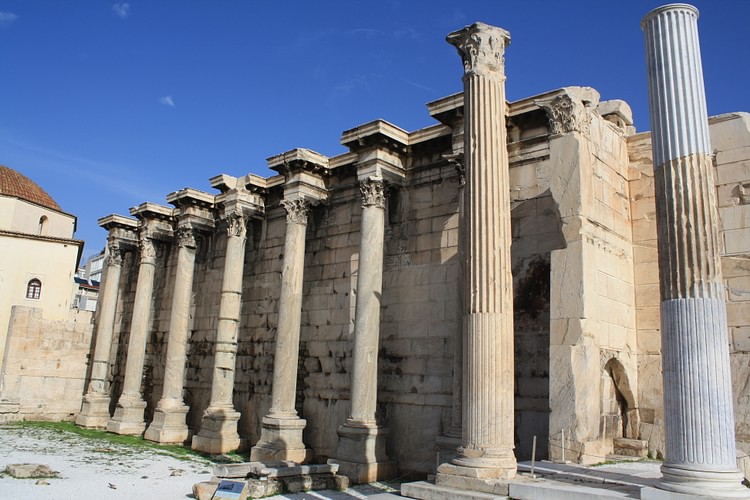 Facade, Library of Hadrian, Athens Mark Cartwright (CC BY-NC-SA) ](https://www.worldhistory.org/image/4133/facade-library-of-hadrian-athens/ "Facade, Library of Hadrian, Athens")According to the biblical Book of Acts, [Saint Paul](https://www.worldhistory.org/Paul_the_Apostle/) preached to the Athenians at the Areopagus (the hill of [Mars](https://www.worldhistory.org/Mars/)), praising their interest in [religion](https://www.worldhistory.org/religion/) and telling them about the new [god](https://www.worldhistory.org/God/) [Jesus Christ](https://www.worldhistory.org/Jesus_Christ/). After the rise of [Christianity](https://www.worldhistory.org/christianity/) following its adoption by the Roman Empire, Athens became an important center for the new faith and, in the 6th century CE, pagan schools were closed and temples either destroyed or converted into churches.
The city was sacked by a number of so-called "barbarian tribes" in Late Antiquity up through the Middle Ages until it was established as the Crusader State of the [Duchy of Athens](https://www.worldhistory.org/Duchy_of_Athens/) (1205-1458) after the [Fourth Crusade](https://www.worldhistory.org/Fourth_Crusade/) (1202-1204). Athens did well during this period until it was conquered by the Ottoman Empire in 1458. The Ottoman Turks had no respect for the ancient city, and it steadily declined under their control.
After Greece won its independence from the Turks in 1821, Athens again revived just as it had done many times in the past. Restoration and preservation efforts became a priority of the new government, and the city was restored to some semblance of its ancient grandeur. In the present day, the name of Athens still conjures to the mind images of the classical world and the heights of intellectual and poetic creativity, while the Parthenon on the Acropolis continues to symbolize the golden age of ancient Greece and the best of what it stood for.
#### Editorial Review
This human-authored definition has been reviewed by our editorial team before publication to ensure accuracy, reliability and adherence to academic standards in accordance with our [editorial policy](https://www.worldhistory.org/static/editorial-policy/).
## Bibliography
- [Cartledge, P. *Thermopylae: The Battle that Changed the World.* Vintage Books, 2006.](https://www.worldhistory.org/books/B01FIYVNRG/)
- [Eusebius & Maier, P. L. *Eusebius' Ecclesiastical History.* Kregel Academic & Professional, 2007.](https://www.worldhistory.org/books/082543307X/)
- [Grant, M. *Readings in the Classical Historians.* Scribners Publishing, 1993.](https://www.worldhistory.org/books/0684192454/)
- [Herodotus & Strassler, R. B. *The Landmark Herodotus.* Pantheon, 2007.](https://www.worldhistory.org/books/0375421092/)
- [Livingstone, R.W. *The Legacy of Greece.* Pinnacle Press, 2017.](https://www.worldhistory.org/books/1374929042/)
- [Mireaux, E. *Daily Life in the Time of Homer.* Macmillan Publishing, 2000.](https://www.worldhistory.org/books/B0006AVTT0/)
- [Nardo, D. *Exploring Cultural History - Living in Ancient Greece.* Greenhaven Press, 2003.](https://www.worldhistory.org/books/0737714557/)
- [Plutarch. *Plutarch's Lives, The Complete 48 Biographies .* Engage Classics, 2020.](https://www.worldhistory.org/books/1774760487/)
- [Pomeroy, S. B. *Goddesses, Whores, Wives, and Slaves.* Schocken, 1995.](https://www.worldhistory.org/books/080521030X/)
- [Waterfield, R. *Athens: A History From Ancient Ideal to Modern City.* Basic Books, 2004.](https://www.worldhistory.org/books/046509063X/)
## About the Author
Joshua J. Mark is World History Encyclopedia's co-founder and Content Director. He was previously a professor at Marist College (NY) where he taught history, philosophy, literature, and writing. He has traveled extensively and lived in Greece and Germany.
- [Linkedin Profile](https://www.linkedin.com/pub/joshua-j-mark/38/614/339)
## Timeline
- **c. 7000 BCE - 5000 BCE**: Human habitation on the [Acropolis](https://www.worldhistory.org/Acropolis/) and around the [Agora](https://www.worldhistory.org/agora/) of [Athens](https://www.worldhistory.org/Athens/) continues from [Neolithic Period](https://www.worldhistory.org/Neolithic/).
- **c. 1700 BCE - c. 1100 BCE**: [Mycenaean Period](https://www.worldhistory.org/Mycenaean_Civilization/). [Agora](https://www.worldhistory.org/agora/) established at [Athens](https://www.worldhistory.org/Athens/).
- **c. 1100 BCE - c. 600 BCE**: [Iron Age](https://www.worldhistory.org/disambiguation/Iron_Age/) Development, public buildings erected at the [Agora](https://www.worldhistory.org/agora/) in [Athens](https://www.worldhistory.org/Athens/).
- **683 BCE - 682 BCE**: List of annual archons at [Athens](https://www.worldhistory.org/Athens/) begins.
- **c. 600 BCE**: The Eleusinian Mysteries become part of the official Athenian religious calendar.
- **600 BCE - 550 BCE**: The Dionysia becomes a major Athenian festival in honour of [Dionysos](https://www.worldhistory.org/Dionysos/).
- **600 BCE - 480 BCE**: Attic [black-figure pottery](https://www.worldhistory.org/Black_Figure_Pottery/) dominates the [greek](https://www.worldhistory.org/disambiguation/greek/) ceramic market.
- **594 BCE - 593 BCE**: In [Athens](https://www.worldhistory.org/Athens/) the archon [Solon](https://www.worldhistory.org/solon/) lays the foundations for democracy.
- **c. 560 BCE**: [Pisistratos](https://www.worldhistory.org/Pisistratus/) becomes tyrant in [Athens](https://www.worldhistory.org/Athens/) for the first time.
- **c. 546 BCE**: [Pisistratus](https://www.worldhistory.org/Pisistratus/) lands his Argive mercenary force at [Marathon](https://www.worldhistory.org/marathon/) and with victory at Pallene establishes himself once again as tyrant of [Athens](https://www.worldhistory.org/Athens/).
- **c. 540 BCE**: [Athens](https://www.worldhistory.org/Athens/) removes and prohibits further burials on [Delos](https://www.worldhistory.org/delos/) to purify the sacred island.
- **525 BCE**: [Cleisthenes](https://www.worldhistory.org/Cleisthenes/) is made archon at [Athens](https://www.worldhistory.org/Athens/).
- **c. 524 BCE - c. 460 BCE**: Life of Athenian general and statesman [Themistocles](https://www.worldhistory.org/Themistocles/).
- **514 BCE**: Fall of the Peisistratid tyranny in [Athens](https://www.worldhistory.org/Athens/).
- **514 BCE**: The tyrant of [Athens](https://www.worldhistory.org/Athens/) Hipparchos is killed by Harmodios and Aristogeiton - the 'tyrannicides'.
- **c. 508 BCE**: According to [Aristotle](https://www.worldhistory.org/aristotle/), the institution of [ostracism](https://www.worldhistory.org/Ostracism/) is introduced in [Athens](https://www.worldhistory.org/Athens/) under [Cleisthenes](https://www.worldhistory.org/Cleisthenes/).
- **c. 508 BCE**: Reforms by [Cleisthenes](https://www.worldhistory.org/Cleisthenes/) establishes democracy in [Athens](https://www.worldhistory.org/Athens/).
- **c. 495 BCE**: Birth of [Pericles](https://www.worldhistory.org/pericles/).
- **493 BCE**: The first fortifications are constructed at [Athens](https://www.worldhistory.org/Athens/)' port of [Piraeus](https://www.worldhistory.org/Piraeus/).
- **493 BCE**: [Themistocles](https://www.worldhistory.org/Themistocles/) is made archon in [Athens](https://www.worldhistory.org/Athens/).
- **490 BCE**: [Athens](https://www.worldhistory.org/Athens/) builds a treasury at [Delphi](https://www.worldhistory.org/delphi/) following their victory at [Marathon](https://www.worldhistory.org/marathon/) against [Persia](https://www.worldhistory.org/Persia/).
- **490 BCE - 480 BCE**: A 1.4 m (4 ft 7 in) tall [Iris](https://www.worldhistory.org/Iris/) or [Nike](https://www.worldhistory.org/nike/) [sculpture](https://www.worldhistory.org/disambiguation/Sculpture/) is erected on the [Acropolis](https://www.worldhistory.org/Acropolis/) of [Athens](https://www.worldhistory.org/Athens/) in memory of the general Kallimachos, killed in the [Battle](https://www.worldhistory.org/disambiguation/battle/) of [Marathon](https://www.worldhistory.org/marathon/).
- **11 Sep 490 BCE**: A combined force of [Greek](https://www.worldhistory.org/disambiguation/greek/) hoplites defeat the Persians at [Marathon](https://www.worldhistory.org/marathon/).
- **487 BCE - 486 BCE**: Archons begin to be appointed by lot in [Athens](https://www.worldhistory.org/Athens/).
- **c. 483 BCE**: [Themistocles](https://www.worldhistory.org/Themistocles/) persuades the Athenians to significantly expand their fleet, which saves them at [Salamis](https://www.worldhistory.org/disambiguation/Salamis/) and becomes their source of power.
- **480 BCE**: The fortifications of [Piraeus](https://www.worldhistory.org/Piraeus/) instigated by [Themistocles](https://www.worldhistory.org/Themistocles/) are completed.
- **480 BCE**: Sack of [Athens](https://www.worldhistory.org/Athens/) by the Persians under [Xerxes](https://www.worldhistory.org/Xerxes_I/). The [Agora](https://www.worldhistory.org/agora/) is destroyed.
- **Aug 480 BCE**: The indecisive [battle](https://www.worldhistory.org/disambiguation/battle/) of Artemision between the [Greek](https://www.worldhistory.org/disambiguation/greek/) and Persian fleets of [Xerxes I](https://www.worldhistory.org/Xerxes_I/). The Greeks withdraw to [Salamis](https://www.worldhistory.org/disambiguation/Salamis/).
- **479 BCE**: [Xerxes](https://www.worldhistory.org/Xerxes_I/)' Persian forces are defeated by [Greek](https://www.worldhistory.org/disambiguation/greek/) forces at [Plataea](https://www.worldhistory.org/Plataea/) effectively ending [Persia](https://www.worldhistory.org/Persia/)'s imperial ambitions in [Greece](https://www.worldhistory.org/greece/).
- **479 BCE - 432 CE**: The period of [Thucydides](https://www.worldhistory.org/Thucydides/)' Pentecontaetia in ancient [Greece](https://www.worldhistory.org/greece/).
- **478 BCE - 454 BCE**: The treasury of the [Delian League](https://www.worldhistory.org/Delian_League/) is kept on [Delos](https://www.worldhistory.org/delos/) until its removal to [Athens](https://www.worldhistory.org/Athens/).
- **478 BCE - 404 BCE**: The [Delian League](https://www.worldhistory.org/Delian_League/) in [Greece](https://www.worldhistory.org/greece/), led by [Athens](https://www.worldhistory.org/Athens/).
- **476 BCE - 463 BCE**: [Delian League](https://www.worldhistory.org/Delian_League/) operations are led by Athenian commander [Cimon](https://www.worldhistory.org/cimon/)
- **c. 475 BCE**: Athenian general [Cimon](https://www.worldhistory.org/cimon/) drives the Dolopian pirates out of the [Aegean](https://www.worldhistory.org/aegean/) island of Scyros.
- **475 BCE**: [Cimon](https://www.worldhistory.org/cimon/) captures Eion in Thrace for [Athens](https://www.worldhistory.org/Athens/).
- **c. 471 BCE**: The general and statesman [Themistocles](https://www.worldhistory.org/Themistocles/) is voted in an [ostracism](https://www.worldhistory.org/Ostracism/) and exiled from [Athens](https://www.worldhistory.org/Athens/).
- **470 BCE**: Statue group of Harmodius and Aristogiton in [Athens](https://www.worldhistory.org/Athens/).
- **c. 469 BCE - 399 BCE**: Life of [Socrates](https://www.worldhistory.org/socrates/).
- **c. 466 BCE**: Athenian general [Cimon](https://www.worldhistory.org/cimon/) twice defeats the Persians at Eurymedon on the southern coast of [Asia Minor](https://www.worldhistory.org/Asia_Minor/).
- **c. 465 BCE**: Construction of the Long Walls fortifications joining [Athens](https://www.worldhistory.org/Athens/) to the port of [Piraeus](https://www.worldhistory.org/Piraeus/) are begun.
- **465 BCE - 463 BCE**: Athenian general [Cimon](https://www.worldhistory.org/cimon/) conquers Chersonesus in Thrace and the north-[Aegean](https://www.worldhistory.org/aegean/) island of Thasos.
- **462 BCE - 461 BCE**: Radicalisation of democracy in [Athens](https://www.worldhistory.org/Athens/); [Cimon](https://www.worldhistory.org/cimon/) exiled, [Pericles](https://www.worldhistory.org/pericles/) comes to exercise influence.
- **c. 462 BCE - 458 BCE**: [Pericles](https://www.worldhistory.org/pericles/) introduces democratic institutions in [Athens](https://www.worldhistory.org/Athens/).
- **461 BCE**: [Cimon](https://www.worldhistory.org/cimon/) is voted in an [ostracism](https://www.worldhistory.org/Ostracism/) in [Athens](https://www.worldhistory.org/Athens/) and exiled from the [city](https://www.worldhistory.org/city/).
- **461 BCE - 429 BCE**: [Pericles](https://www.worldhistory.org/pericles/) is ruler of [Athens](https://www.worldhistory.org/Athens/).
- **460 BCE - 445 BCE**: First [Peloponnesian War](https://www.worldhistory.org/Peloponnesian_War/).
- **460 BCE - 429 BCE**: The Age of [Pericles](https://www.worldhistory.org/pericles/). Athenian [Agora](https://www.worldhistory.org/agora/) is rebuilt, construction of [Parthenon](https://www.worldhistory.org/parthenon/).
- **c. 460 BCE - 403 BCE**: Life of [Critias](https://www.worldhistory.org/Critias/), one of [the Thirty Tyrants](https://www.worldhistory.org/The_Thirty_Tyrants/) of [Athens](https://www.worldhistory.org/Athens/).
- **c. 460 BCE - c. 320 CE**: Period of full and direct citizen democracy in [Athens](https://www.worldhistory.org/Athens/).
- **457 BCE**: [Sparta](https://www.worldhistory.org/sparta/) wins the [battle](https://www.worldhistory.org/disambiguation/battle/) of Tanagra during the 1st [Peloponnesian War](https://www.worldhistory.org/Peloponnesian_War/) with [Athens](https://www.worldhistory.org/Athens/).
- **457 BCE**: Hegemony of [Athens](https://www.worldhistory.org/Athens/) over central [Greece](https://www.worldhistory.org/greece/).
- **454 BCE**: The Athenians move the treasury of the [Delian League](https://www.worldhistory.org/Delian_League/) from [Delos](https://www.worldhistory.org/delos/) to [Athens](https://www.worldhistory.org/Athens/).
- **453 BCE**: [Pericles](https://www.worldhistory.org/pericles/) erects trophy at [Nemea](https://www.worldhistory.org/nemea/) after Athenian victory over the Sikyonians.
- **c. 451 BCE - c. 403 CE**: Life of Athenian statesman and general [Alcibiades](https://www.worldhistory.org/Alcibiades/).
- **450 BCE**: Athenian general [Cimon](https://www.worldhistory.org/cimon/) dies on [Cyprus](https://www.worldhistory.org/cyprus/) fighting the Persians.
- **449 BCE**: The Hephaisteion, [temple](https://www.worldhistory.org/temple/) to [Athena](https://www.worldhistory.org/athena/) & [Hephaistos](https://www.worldhistory.org/Hephaistos/), built in [Athens](https://www.worldhistory.org/Athens/).
- **447 BCE - 432 BCE**: The construction of the [Parthenon](https://www.worldhistory.org/parthenon/) in [Athens](https://www.worldhistory.org/Athens/) by the architects Iktinos and Kallikrates under the direction of [Phidias](https://www.worldhistory.org/Phidias/).
- **28 Jul 447 BCE**: Reconstruction and creation of the [Acropolis](https://www.worldhistory.org/Acropolis/) of the Classical Period begins under [Pericles](https://www.worldhistory.org/pericles/)' leadership.
- **446 BCE**: The Middle [Wall](https://www.worldhistory.org/wall/) fortifications are added to the Long Walls which connect [Athens](https://www.worldhistory.org/Athens/) and the port of [Piraeus](https://www.worldhistory.org/Piraeus/).
- **c. 443 BCE**: Thurii in [Magna Graecia](https://www.worldhistory.org/Magna_Graecia/) founded by Athenian settlers.
- **438 BCE**: The cult statue of [Athena](https://www.worldhistory.org/athena/) Parthenos is dedicated in the [Parthenon](https://www.worldhistory.org/parthenon/) of [Athens](https://www.worldhistory.org/Athens/).
- **c. 437 BCE - 431 BCE**: The [Propylaea](https://www.worldhistory.org/Propylaea/) is constructed on the [Acropolis](https://www.worldhistory.org/Acropolis/) of [Athens](https://www.worldhistory.org/Athens/) under the supervision of Mnesicles.
- **433 BCE**: A naval [battle](https://www.worldhistory.org/disambiguation/battle/) between the victorious combined forces of [Corcyra](https://www.worldhistory.org/corcyra/) and [Athens](https://www.worldhistory.org/Athens/) against [Corinth](https://www.worldhistory.org/corinth/).
- **433 BCE**: Alliance between [Athens](https://www.worldhistory.org/Athens/) and [Corcyra](https://www.worldhistory.org/corcyra/).
- **432 BCE**: [Sparta](https://www.worldhistory.org/sparta/) declares that [Athens](https://www.worldhistory.org/Athens/) has broken the Thirty Year Peace and prepares for [war](https://www.worldhistory.org/disambiguation/War/).
- **431 BCE**: [Athens](https://www.worldhistory.org/Athens/) invades [Megara](https://www.worldhistory.org/disambiguation/Megara/).
- **431 BCE - 404 BCE**: The 2nd [Peloponnesian War](https://www.worldhistory.org/Peloponnesian_War/) between [Athens](https://www.worldhistory.org/Athens/) and [Sparta](https://www.worldhistory.org/sparta/) (the [Delian League](https://www.worldhistory.org/Delian_League/) and the [Peloponnesian League](https://www.worldhistory.org/Peloponnesian_League/)) which involved all of [Greece](https://www.worldhistory.org/greece/).
- **431 BCE - 404 BCE**: The Peloponnesian Wars which leave [Athens](https://www.worldhistory.org/Athens/) defeated and the [Agora](https://www.worldhistory.org/agora/) damaged.
- **430 BCE**: The [plague](https://www.worldhistory.org/disambiguation/plague/) decimates [Athens](https://www.worldhistory.org/Athens/).
- **c. 430 BCE - 415 BCE**: The *Histories* of [Herodotus](https://www.worldhistory.org/herodotus/) is published. The work is divided into nine chapters, each dedicated to one of the [Muses](https://www.worldhistory.org/muse/).
- **430 BCE - c. 354 BCE**: Life of [Xenophon](https://www.worldhistory.org/xenophon/) of [Athens](https://www.worldhistory.org/Athens/).
- **429 BCE**: [Athens](https://www.worldhistory.org/Athens/) successfully campaigns in the Corinthian Gulf regions during the [Peloponnesian War](https://www.worldhistory.org/Peloponnesian_War/).
- **429 BCE**: Following attacks by [Sparta](https://www.worldhistory.org/sparta/), fortifications at the port of [Piraeus](https://www.worldhistory.org/Piraeus/) are extended to reduce the width of the harbour entrances.
- **427 BCE - 347 BCE**: Life of [Plato](https://www.worldhistory.org/plato/).
- **425 BCE**: [Pylos](https://www.worldhistory.org/Pylos/) campaign, under Cleon and [Demosthenes](https://www.worldhistory.org/Demosthenes/)' command [Athens](https://www.worldhistory.org/Athens/) defeats [Sparta](https://www.worldhistory.org/sparta/) at Pylos.
- **c. 425 BCE - c. 420 BCE**: The [Temple](https://www.worldhistory.org/temple/) dedicated to [Athena](https://www.worldhistory.org/athena/) [Nike](https://www.worldhistory.org/nike/) is constructed on the [acropolis](https://www.worldhistory.org/Acropolis/) of [Athens](https://www.worldhistory.org/Athens/).
- **424 BCE**: The Athenian expeditions against [Megara](https://www.worldhistory.org/disambiguation/Megara/) and Boeotia are a failure with a particularly heavy defeat near Delion.
- **424 BCE**: A force of Athenian peltasts defeat Spartan hoplites on Sphaktria in the [Peloponnese](https://www.worldhistory.org/Peloponnese/).
- **422 BCE**: Spartan general [Brasidas](https://www.worldhistory.org/Brasidas/) employs Myrkinian and Chalkidian peltasts to defeat a force of Athenian hoplites at [Amphipolis](https://www.worldhistory.org/Amphipolis/).
- **421 BCE - 406 BCE**: The [Erechtheion](https://www.worldhistory.org/Erechtheion/) of [Athens](https://www.worldhistory.org/Athens/) [acropolis](https://www.worldhistory.org/Acropolis/) is constructed with six Caryatids in the south porch.
- **c. 417 BCE**: In the last recorded [ostracism](https://www.worldhistory.org/Ostracism/) the demagogue Hyperbolos is exiled from [Athens](https://www.worldhistory.org/Athens/).
- **c. 415 BCE**: [Alcibiades](https://www.worldhistory.org/Alcibiades/) persuades the Athenian assembly to send a military expedition to [Sicily](https://www.worldhistory.org/sicily/).
- **415 BCE - 413 BCE**: Athenian expedition to attack [Syracuse](https://www.worldhistory.org/syracuse/).
- **414 BCE**: [Athens](https://www.worldhistory.org/Athens/) constructs fortifications at [Sounion](https://www.worldhistory.org/sounion/).
- **413 BCE**: On the advice of [Alcibiades](https://www.worldhistory.org/Alcibiades/) the Spartans take over the Athenian-held fort of Dekeleia.
- **413 BCE**: The Athenian expedition in [Sicily](https://www.worldhistory.org/sicily/) ends in disastrous defeat and the Athenian generals [Nicias](https://www.worldhistory.org/Nicias/) and [Demosthenes](https://www.worldhistory.org/Demosthenes/) are executed.
- **411 BCE**: The oligarchy of the 400 take over the democracy in [Athens](https://www.worldhistory.org/Athens/) and in a matter of months is replaced by an oligarchy of 5000.
- **410 BCE**: [Alcibiades](https://www.worldhistory.org/Alcibiades/) leads the Athenian fleet to victory over [Sparta](https://www.worldhistory.org/sparta/) at Cyzicus.
- **c. 407 BCE**: [Alcibiades](https://www.worldhistory.org/Alcibiades/) returns to [Athens](https://www.worldhistory.org/Athens/) in [triumph](https://www.worldhistory.org/Roman_Triumph/) and is made strategos autokrater.
- **c. 407 BCE**: The Athenian fleet is defeated by [Lysander](https://www.worldhistory.org/Lysander/) of [Sparta](https://www.worldhistory.org/sparta/) at Notium.
- **405 BCE**: [Athens](https://www.worldhistory.org/Athens/) grants Athenian citizenship to the population of [Samos](https://www.worldhistory.org/samos/).
- **404 BCE**: Spartan general [Lysander](https://www.worldhistory.org/Lysander/) attacks the Athenian port of [Piraeus](https://www.worldhistory.org/Piraeus/) destroying parts of the Long [Wall](https://www.worldhistory.org/wall/) fortifications.
- **404 BCE**: End of the [Peloponnesian war](https://www.worldhistory.org/Peloponnesian_War/), [Athens](https://www.worldhistory.org/Athens/) defeated By [Sparta](https://www.worldhistory.org/sparta/) at Aigospotamoi, Rule of [the Thirty Tyrants](https://www.worldhistory.org/The_Thirty_Tyrants/) in Athens.
- **403 BCE**: Restoration of the democracy in [Athens](https://www.worldhistory.org/Athens/), [death](https://www.worldhistory.org/disambiguation/Death/) of the tyrant [Critias](https://www.worldhistory.org/Critias/).
- **c. 402 BCE - 318 BCE**: Life of Athenian statesman and general [Phocion](https://www.worldhistory.org/Phocion/).
- **395 BCE - 386 BCE**: The Corinthian Wars between [Sparta](https://www.worldhistory.org/sparta/) and an alliance of [Athens](https://www.worldhistory.org/Athens/), [Corinth](https://www.worldhistory.org/corinth/), [Argos](https://www.worldhistory.org/argos/), Boeotia and [Thebes](https://www.worldhistory.org/disambiguation/Thebes/).
- **390 BCE**: Athenian leader Iphikrates employs peltasts to defeat Spartan hoplites at Lechaion near [Corinth](https://www.worldhistory.org/corinth/).
- **387 BCE**: [Sparta](https://www.worldhistory.org/sparta/) attacks the Athenian port of [Piraeus](https://www.worldhistory.org/Piraeus/).
- **384 BCE - 322 BCE**: Life of [Aristotle](https://www.worldhistory.org/aristotle/).
- **c. 384 BCE - 322 CE**: Life of Athenian statesman [Demosthenes](https://www.worldhistory.org/Demosthenes/).
- **380 BCE**: [Plato](https://www.worldhistory.org/plato/) founds his Academy outside of [Athens](https://www.worldhistory.org/Athens/).
- **366 BCE**: [Athens](https://www.worldhistory.org/Athens/) regains control of [Samos](https://www.worldhistory.org/samos/) from [Sparta](https://www.worldhistory.org/sparta/).
- **362 BCE**: Indecisive [Battle](https://www.worldhistory.org/disambiguation/battle/) of Matinea where [Thebes](https://www.worldhistory.org/disambiguation/Thebes/) fought against [Sparta](https://www.worldhistory.org/sparta/) and [Athens](https://www.worldhistory.org/Athens/). Theban general [Epaminondas](https://www.worldhistory.org/Epaminondas/) is killed.
- **c. 354 BCE**: [Xenophon](https://www.worldhistory.org/xenophon/) dies at [Corinth](https://www.worldhistory.org/corinth/).
- **338 BCE**: Philip of Macedonia defeats the [Greek](https://www.worldhistory.org/disambiguation/greek/) allied forces of [Athens](https://www.worldhistory.org/Athens/), [Thebes](https://www.worldhistory.org/disambiguation/Thebes/) and [Corinth](https://www.worldhistory.org/corinth/) in the [Battle](https://www.worldhistory.org/disambiguation/battle/) of Chaironeia.
- **2 Aug 338 BCE**: The [Battle](https://www.worldhistory.org/disambiguation/battle/) of Charonea gives [Athens](https://www.worldhistory.org/Athens/) to the Macedonian victors. [Agora](https://www.worldhistory.org/agora/) takes on Macedonian characteristics.
- **307 BCE**: Demetrius I frees [Athens](https://www.worldhistory.org/Athens/) from the tyrant Demetrius of Phaleron.
- **295 BCE**: Demetrius I campaigns in central [Greece](https://www.worldhistory.org/greece/), removes the tyrant Lachares from [Athens](https://www.worldhistory.org/Athens/) and defeats [Sparta](https://www.worldhistory.org/sparta/).
- **166 BCE**: [Rome](https://www.worldhistory.org/Rome/) puts [Delos](https://www.worldhistory.org/delos/) under the jurisdiction of [Athens](https://www.worldhistory.org/Athens/) and makes the island a free port.
- **166 BCE**: [Rome](https://www.worldhistory.org/Rome/) gives dominion over the [Cyclades](https://www.worldhistory.org/Cyclades/) to [Athens](https://www.worldhistory.org/Athens/).
- **159 BCE - 138 BCE**: King [Attalos](https://www.worldhistory.org/disambiguation/attalos/) II of [Pergamon](https://www.worldhistory.org/pergamon/) builds the great Stoa in the [Agora](https://www.worldhistory.org/agora/) of [Athens](https://www.worldhistory.org/Athens/).
- **86 BCE**: The [Roman](https://www.worldhistory.org/disambiguation/Roman/) general [Sulla](https://www.worldhistory.org/sulla/) sacks [Athens](https://www.worldhistory.org/Athens/) and the port of [Piraeus](https://www.worldhistory.org/Piraeus/).
- **86 BCE**: Siege of [Athens](https://www.worldhistory.org/Athens/) by the [Roman](https://www.worldhistory.org/disambiguation/Roman/) general [Sulla](https://www.worldhistory.org/sulla/). [Agora](https://www.worldhistory.org/agora/) is destroyed.
- **117 CE - 138 CE**: Rule of the [Roman Emperor](https://www.worldhistory.org/Roman_Emperor/) [Hadrian](https://www.worldhistory.org/hadrian/) who supports great building projects in and around the [Agora](https://www.worldhistory.org/agora/) of [Athens](https://www.worldhistory.org/Athens/).
- **267 CE**: The [Goths](https://www.worldhistory.org/Goths/) sack [Athens](https://www.worldhistory.org/Athens/), [Corinth](https://www.worldhistory.org/corinth/), [Sparta](https://www.worldhistory.org/sparta/), and [Argos](https://www.worldhistory.org/argos/).
- **267 CE**: [Agora](https://www.worldhistory.org/agora/) of [Athens](https://www.worldhistory.org/Athens/) burned by invading Herulians.
## Questions & Answers
### What is Athens famous for?
Athens is famous as the birthplace of democracy.
### When was Athens founded?
Athens was founded as a small community c. 1700-1100 BCE.
### Who were some of the most famous Athenians?
Famous Athenians include the statesman Pericles, the writer Aspasia, philosophers Socrates, Plato, and Antisthenes, playwrights Sophocles, Euripides, Aeschylus, the general Miltiades, among many others.
### Is Athens Greek or Roman?
Athens was a Greek city-state which became part of the Roman Empire and was favored by various Roman emperors.
## External Links
- [A day in the life of an ancient Athenian - Robert Garland](https://ed.ted.com/lessons/a-day-in-the-life-of-an-ancient-athenian-robert-garland)
- [HISTORY OF ATHENS](http://www.historyworld.net/wrldhis/PlainTextHistories.asp?historyid=ac45)
- [Athens in the Mycenaean Age](http://www.ancientathens.org/history/athens-mycenaean-age)
- [Internet History Sourcebooks Project](http://www.fordham.edu/halsall/ancient/eb11-pericles.asp)
- [Exploring Hadrian's Athens](https://followinghadrian.com/2014/04/29/exploring-hadrians-athens/)
- [The Ancient City of Athens:](http://www.stoa.org/athens/sites/acropolis.html)
- [Historical city travel guide: Athens, 5th century BC | British Museum](https://www.britishmuseum.org/blog/historical-city-travel-guide-athens-5th-century-bc)
## Cite This Work
### APA
Mark, J. J. (2021, July 06). Athens. *World History Encyclopedia*.
### Chicago
Mark, Joshua J.. "Athens." *World History Encyclopedia*, July 06, 2021. .
### MLA
Mark, Joshua J.. "Athens." *World History Encyclopedia*, 06 Jul 2021, .
## License & Copyright
Submitted by [Joshua J. Mark](https://www.worldhistory.org/user/JPryst/ "User Page: Joshua J. Mark"), published on 06 July 2021. The copyright holder has published this content under the following license: [Creative Commons Attribution-NonCommercial-ShareAlike](https://creativecommons.org/licenses/by-nc-sa/4.0/deed.en). This license lets others remix, tweak, and build upon this content non-commercially, as long as they credit the author and license their new creations under the identical terms. When republishing on the web a hyperlink back to the original content source URL must be included. Please note that content linked from this page may have different licensing terms.