---
title: Astrolabe
author: Mark Cartwright
source: https://www.worldhistory.org/Astrolabe/
format: machine-readable-alternate
license: Creative Commons Attribution-NonCommercial-ShareAlike (https://creativecommons.org/licenses/by-nc-sa/4.0/)
updated: 2023-08-31
---
# Astrolabe
_Authored by [Mark Cartwright](https://www.worldhistory.org/user/markzcartwright/)_
The astrolabe is an astronomical instrument used from around the 6th century to measure time and position by determining the altitude of heavenly bodies like the Sun and certain stars. Measurements were taken in reference to the viewer's horizon and the meridian and using a representation or map of the sky with a measuring scale engraved on the instrument itself.
### Ancient Origins of the Astrolabe
The origins of the astrolabe are obscure. The instrument likely evolved from small portable sundials in the ancient [Mediterranean](https://www.worldhistory.org/disambiguation/mediterranean/), which sometimes had multiple plate insertions to make them accurate in different locations. The earliest such dial survives from [Roman](https://www.worldhistory.org/disambiguation/Roman/) [Herculaneum](https://www.worldhistory.org/Herculaneum/), the town which was destroyed by the eruption of Vesuvius in 79 CE. The historian R. Hannah notes: "These dials foreshadow the astrolabe, the portable timepiece *par excellence* of the Middle Ages. While no ancient astrolabe survives, the instrument was most likely a late [Greek](https://www.worldhistory.org/disambiguation/greek/) invention. It utilized stereographic projection to represent the celestial hemisphere two-dimensionally" (Oleson, 751).
The great ancient astronomer [Ptolemy](https://www.worldhistory.org/disambiguation/Ptolemy/) (c. 100 to c. 170 CE) describes stereographic projection and a three-dimensional astrolabe made of rings akin to the armillary sphere in his 2nd-century work *Planisphaerium.* The device may have been invented by [Hipparchus of Nicea](https://www.worldhistory.org/Hipparchus_of_Nicea/) (c. 190 to c. 120 BCE) back in the 2nd century BCE. *The Oxford Classical Dictionary* notes that "It is probable that Hipparchus devised the plane astrolabe, the purpose of which was to tell the time at night from the stars' position" (188).
Certainly, the Greeks borrowed for their device the Babylonian idea of dividing a circle into 360 degrees. Other ancient writers who describe the astrolabe in detail include John Philoponus (c. 490 to c. 570) who wrote in the 6th century but who utilised the work of Theon of [Alexandria](https://www.worldhistory.org/alexandria/) written two centuries earlier. The absence of a physical example of an astrolabe from the ancient Greek world has led to speculation that the device could have been invented elsewhere. What is more certain is that our knowledge of ancient astronomy and instruments like the astrolabe is only possible because Greek texts by writers such as Philoponus and Theon survived in Arabic translations before they returned to [Europe](https://www.worldhistory.org/europe/) in the Middle Ages and then were translated into Latin.
That ancient Mediterranean peoples were adept at creating such complex astronomical devices was proved by the discovery of the 2nd-1st-century BCE [Antikythera mechanism](https://www.worldhistory.org/Antikythera_Mechanism/) in a shipwreck in 1901 near the Greek island of Antikythera. The mechanism is thought to have been capable of no less a feat than predicting the movements of the heavenly bodies once an accurate position in the present had been attained. Unlike the Antikythera mechanism, which is unique, the astrolabe became a relatively common device.
[ 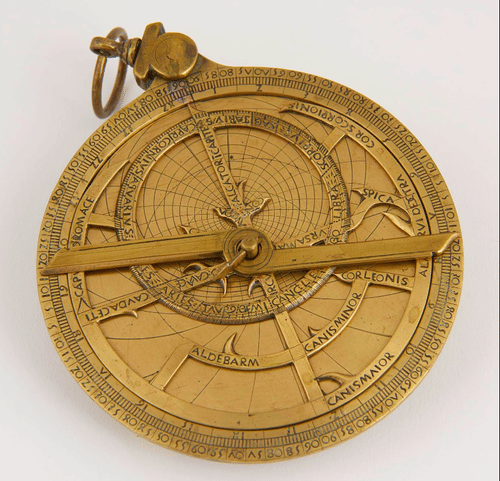 European Astrolabe Science Museum, London (CC BY-NC-SA) ](https://www.worldhistory.org/image/17846/european-astrolabe/ "European Astrolabe")We know that astrolabes were widely used from the 6th century CE onwards and became widespread in the Middle Ages in the Arab world, the [Byzantine Empire](https://www.worldhistory.org/Byzantine_Empire/), [India](https://www.worldhistory.org/india/), and Europe. The transfer of knowledge to Europe came through Islamic Spain from around 1000 CE. The astrolabe later became a crucial instrument to astronomical studies during the Renaissance and [Scientific Revolution](https://www.worldhistory.org/Scientific_Revolution/). Astrolabes were still being used in the 18th and 19th centuries.
### Purpose of the Astrolabe
The device known specifically as a planispheric astrolabe was used to measure the positions of the stars, Sun, and planets in the sky so that by finding one fixed point the user could then turn the dial of the astrolabe and have an accurate (if two-dimensional) view of the whole celestial hemisphere. The instrument can be used to determine the height of prominent geographical features such as mountains. The device can also be used to measure time. Astrolabes in the Muslim world were often fitted with a special map that permitted the user to find the exact location of Mecca.
The historian M. Latham gives the following, more comprehensive list of the possibilities of an astrolabe:
> The time of the day may be found…other matters as easily determined are the time of dawn and of sunrise for a given day; the meridian altitude of the sun, given the degree of the sun; and, conversely, the degree, when the meridian altitude is known; the latitude of any place; and the cardinal points of the compass. The curves of the unequal [hours](https://www.worldhistory.org/Horae/) on the back may also be used to find the time of the day.
> (167)
In the early modern period, navigators at sea used an adaptation of the astrolabe as a navigational aid by measuring celestial bodies so that they could calculate their latitude. This instrument, known as the marine astrolabe, is a simplified and heavier adaptation to compensate for the constant movement of a ship at sea. This version of the instrument usually had large spaces in the centre to allow the wind to blow through it and had thicker [metal](https://www.worldhistory.org/disambiguation/metal/) at the base to reduce the possibility of it swinging in the wind. Famous navigators who ensured they had a marine astrolabe on their ships include [Christopher Columbus](https://www.worldhistory.org/Christopher_Columbus/) (1451-1506) and Amerigo Vespucci (1451-1512).
[  The Ambassadors by Hans Holbein the Younger Google Cultural Institute (Public Domain) ](https://www.worldhistory.org/image/13075/the-ambassadors-by-hans-holbein-the-younger/ "The Ambassadors by Hans Holbein the Younger")The name astrolabe is appropriate for its function since, according to the curators of the British [Science](https://www.worldhistory.org/science/) Museum in London, the word 'astrolabe' means either "star-taker" or "the one that catches the heavenly bodies". (In a confusing misnomer, 'astrolabe' is also used by historians to describe ancient Babylonian [cuneiform](https://www.worldhistory.org/cuneiform/) texts on astronomy, but this has nothing to do with the instrument).
### How to Use an Astrolabe
Astrolabes were usually made of metal and were smaller than 50 cm (19.5 in) so that they could easily be held in one hand and carried anywhere. Brass is the most common material used, but some surviving examples are made of [copper](https://www.worldhistory.org/copper/) or iron. Finer pieces often have [gold](https://www.worldhistory.org/gold/) or [silver](https://www.worldhistory.org/Silver/) inlay and almost all are circular.
The most famous description (in English) of how to use an astrolabe is by [Geoffrey Chaucer](https://www.worldhistory.org/Geoffrey_Chaucer/) (c. 1343-1400). Chaucer wrote a simple explanation in a letter to his son Lewis who was ten years old at the time. The title of this work is *Tractatus de Conclusionibus Astrolabii,* and it was written around 1391; it is based on a 9th-century Latin treatise by Messanhallah titled *Compositio et Operatio Astrolabii*. Other authors who have described how to use an astrolabe include Christopher Clavius (1612) and Adriaan Metius (1626 and 1633), but it is Johannes Stoeffler's work *Elucidatio fabricae ususque astrolabii*, published in 1510, which is most often taken as the reference piece for all others.
The astrolabe is first suspended from the thumb using a ring and the viewer looks along a moveable sighting arm (the alidade) or through two aligned loops at the object desired such as a specific star. If measuring the angle of the Sun, then one looked at the beam of sunlight cast on the instrument after it passed through the loops. The altitude is then determined by referencing a measuring scale engraved on one side of the instrument. On the other side of the astrolabe is a map of the skies of the northern hemisphere. The stars are represented by a network or open pattern of pointers (the rete) which can be rotated around a central pin to match an engraved coordinate grid (the mater) underneath. The recess beneath the mater is known as the womb of the mater. More sophisticated models allowed the insertion of extra engraved coordinate plates (climates) which catered for variations in the observer's latitude. Once a reading of a particular star has been taken and one's position determined, the map can be used to give other useful astronomical and navigational information.
[  Disassembled Astrolabe Science Museum, London (CC BY-NC-SA) ](https://www.worldhistory.org/image/17847/disassembled-astrolabe/ "Disassembled Astrolabe")These intricate instruments with their minute engravings and interchangeable parts are often as beautiful as they were useful. The rete, in particular, often portrays the artistic fancy of the maker with ornate curved pointers, sometimes small images such as animals, and an intricate font for the text. Some astrolabes had useful extras added to them such as a tiny magnetic compass or a small gnomon to make it into a sundial.
### Legacy: The Sextant & Beyond
From the astrolabe, other instruments evolved such as the astrolabe-quadrant which was specifically designed to measure time and dates. The telescope, invented around 1608 in the Netherlands, revolutionised the observation of the skies and soon telescopic sights were being fitted to fixed observational instruments which could give much more accurate readings. It was the invention of the octant and then the sextant by the Englishman John Bird in the 1750s, though, which saw the gradual demise of the portable astrolabe. The sextant would hold sway until the arrival of GPS systems in the 1980s.
The astrolabe is important in the history of scientific instruments because it was designed for non-mathematicians to take precise readings. In addition, the astrolabe perpetuated the idea of precision as being paramount to a better understanding of our world and the universe around it. Now anyone, from a sailor to a cannon operator could use instruments without having to go through a long education in mathematics. In this sense, the astrolabe was the forerunner of the modern computer, a shortcut tool which had to be learnt to be used correctly but, once mastered, could provide quick and easy answers to tremendously complex questions.
#### Editorial Review
This human-authored definition has been reviewed by our editorial team before publication to ensure accuracy, reliability and adherence to academic standards in accordance with our [editorial policy](https://www.worldhistory.org/static/editorial-policy/).
## Bibliography
- Bagnall, R. (ed). *The Encyclopedia of Ancient History.* Wiley-Blackwell, 2012
- [Bynum, William F. & Browne, Janet & Porter, Roy. *Dictionary of the History of Science .* Princeton University Press, 1982.](https://www.worldhistory.org/books/0691082871/)
- [Campbell, Gordon. *The Oxford Illustrated History of the Renaissance.* Oxford University Press, 2021.](https://www.worldhistory.org/books/0198862660/)
- [Henry. *The Scientific Revolution and the Origins of Modern Science .* Red Globe Press, 2008.](https://www.worldhistory.org/books/0230574386/)
- Latham, Marcia. "The Astrolabe." *The American Mathematical Monthly*, Vol. 24, No. 4, April 1917, pp. 162-168 .
- Neugebauer, O. "The Early History of the Astrolabe." *Isis*, Vol. 40, No. 3, August 1949, pp. 240-256.
- [Oleson, Peter. *The Oxford Handbook of Engineering and Technology in the Classical World .* Oxford University Press, 2009.](https://www.worldhistory.org/books/0199734852/)
- [Pickthall, Barry. *A History of Sailing in 100 Objects.* Adlard Coles, 2016.](https://www.worldhistory.org/books/1472918851/)
## About the Author
Mark is WHE’s Publishing Director and has an MA in Political Philosophy (University of York). He is a full-time researcher, writer, historian and editor. Special interests include art, architecture and discovering the ideas that all civilizations share.
## Timeline
- **100 CE - 170 CE**: [Ptolemy](https://www.worldhistory.org/disambiguation/Ptolemy/) describes the principle of the [astrolabe](https://www.worldhistory.org/Astrolabe/) - sterographic projection.
- **c. 1000 CE**: Knoweldge of the [astrolabe](https://www.worldhistory.org/Astrolabe/) filters through Muslim Spain to the rest of [Europe](https://www.worldhistory.org/europe/).
- **1391 CE**: [Geoffrey Chaucer](https://www.worldhistory.org/Geoffrey_Chaucer/) wrties an explanation of how to use an [astrolabe](https://www.worldhistory.org/Astrolabe/) in his Tractatus de Conclusionibus Astrolabii.
- **1510 CE**: Johannes Stoeffler explains the [astrolabe](https://www.worldhistory.org/Astrolabe/) in Elucidatio fabricae ususque astrolabii.
## Questions & Answers
### What is an astrolabe used for?
The astrolabe was used to measure one's geographical position by measuring the altitude of heavenly bodies.
### Who invented the astrolabe?
It is not known by whom or when the astrolabe was invented, but one figure frequently credited by some historians as being the inventor of some form of the astrolabe is the Greek Hipparchus of Nicea in the 2nd century BCE.
### What was the astrolabe used by explorers?
The astrolabe was a device used by explorers like Christopher Columbus to help them navigate since with it they could measure the altitude of certain stars and so calculate their latitude.
## External Links
- [Medieval Astrolabe Shows Collaboration Between Different Cultures](https://mymodernmet.com/medieval-astrolabe-multicultural/)
## Cite This Work
### APA
Cartwright, M. (2023, August 31). Astrolabe. *World History Encyclopedia*.
### Chicago
Cartwright, Mark. "Astrolabe." *World History Encyclopedia*, August 31, 2023. .
### MLA
Cartwright, Mark. "Astrolabe." *World History Encyclopedia*, 31 Aug 2023, .
## License & Copyright
Submitted by [Mark Cartwright](https://www.worldhistory.org/user/markzcartwright/ "User Page: Mark Cartwright"), published on 31 August 2023. The copyright holder has published this content under the following license: [Creative Commons Attribution-NonCommercial-ShareAlike](https://creativecommons.org/licenses/by-nc-sa/4.0/deed.en). This license lets others remix, tweak, and build upon this content non-commercially, as long as they credit the author and license their new creations under the identical terms. When republishing on the web a hyperlink back to the original content source URL must be included. Please note that content linked from this page may have different licensing terms.