---
title: Asclepius
author: Mark Cartwright
source: https://www.worldhistory.org/Asclepius/
format: machine-readable-alternate
license: Creative Commons Attribution-NonCommercial-ShareAlike (https://creativecommons.org/licenses/by-nc-sa/4.0/)
updated: 2023-02-07
---
# Asclepius
_Authored by [Mark Cartwright](https://www.worldhistory.org/user/markzcartwright/)_
Asclepius was the ancient [Greek](https://www.worldhistory.org/disambiguation/greek/) [god](https://www.worldhistory.org/God/) of [medicine](https://www.worldhistory.org/disambiguation/medicine/), and he was also credited with powers of prophecy. The god had several sanctuaries across [Greece](https://www.worldhistory.org/greece/); the most famous was at [Epidaurus](https://www.worldhistory.org/epidaurus/) which became an important centre of healing in both ancient Greek and [Roman](https://www.worldhistory.org/disambiguation/Roman/) times and was the site of athletic, dramatic, and musical games held in Asclepius' honour every four years.
### Asclepius In [Mythology](https://www.worldhistory.org/mythology/)
In [Greek mythology](https://www.worldhistory.org/Greek_Mythology/), Asclepius (or Asklepios) was a demigod hero as he was the son of divine [Apollo](https://www.worldhistory.org/apollo/), and his mother was the mortal Koronis from [Thessaly](https://www.worldhistory.org/disambiguation/Thessaly/). In some accounts, Koronis abandoned her child near Epidaurus in shame for his illegitimacy and left the baby to be looked after by a goat and a dog. However, in a different version of the story Koronis was killed by Apollo for being unfaithful, whilst, in yet another version, the Messenian Arsinoe was the unfortunate mother of Asclepius.
The motherless Asclepius was then brought up by his father who gave him the gift of healing and the secrets of medicine using plants and herbs. Asclepius was also tutored by Cheiron, the wise [centaur](https://www.worldhistory.org/centaur/) who lived on Mt. Pelion. Asclepius had many children - two sons: Machaon and Podaleirios, and four daughters: Iaso, Panacea, Aceso, and Aglaia. In some traditions he was married to Hygeia, also a goddess of health; in another version she was his daughter and Asclepius married Epione. The descendants of Asclepius, who continued in the art of medicine and healing, were known as the Asclepiads. Machaon, for example, helped [Menelaos](https://www.worldhistory.org/Menelaus/) when he was wounded in the [Trojan War](https://www.worldhistory.org/Trojan_War/), but the most famous doctor of the family was undoubtedly [Hippocrates](https://www.worldhistory.org/Hippocrates/).
Asclepius met a tragic end when he was killed by a thunderbolt thrown by Zeus. This was because the father of the gods saw Asclepius and his art of healing as a threat to the eternal division between humanity and the gods, especially following rumours that Asclepius' healing powers were so formidable that he could even raise the dead (for which, in another medical association with snakes, he used the blood of [Medusa](https://www.worldhistory.org/Medusa/) given to him by [Athena](https://www.worldhistory.org/athena/)). Apollo protested against his son's treatment but was himself punished by Zeus for impiety and made to serve Admetos, the king of Thessaly, for one year. Asclepius himself was deified following his [death](https://www.worldhistory.org/disambiguation/Death/), and in some local myths, he also became the constellation Ophiuchus.
### Epidaurus
The god was particularly worshipped at the sanctuary of Epidaurus (founded in the 6th century BCE), known as the Asklepieion, because he was believed to have been born on the nearby Mt. Titthion. The site, the most important healing centre in the ancient world, was visited from all over Greece by those seeking alleviation of their ailments by either divine intervention or medicines administered by the resident priests and it had many important buildings. These included a large [temple](https://www.worldhistory.org/temple/) (380-375 BCE) which contained a larger than life-size statue of Asclepius by Thrasymedes and the Thymele (360-330 BCE) - a round marble building which had a mysterious underground [labyrinth](https://www.worldhistory.org/Labyrinth/), perhaps containing snakes. These were associated with Asclepius and symbolised regeneration, as snakes were thought to live both below and above ground and were also connected to prophetic powers as they knew the hidden secrets below ground.
At Epidaurus, there was also the columned Abato or Enkoimeterion in which patients, after having gone through several purification rituals, slept overnight and awaited dreams where the god would appear and offer cures and remedies. The cures would then later be self-administered or carried out by resident priests in the more complex cases. Thankful patients often left votive offerings at the site, sometimes depicting the body part which had been cured. The site also had a 6000-seat [Greek theatre](https://www.worldhistory.org/Greek_Theatre/) (340-330 BCE) which is the best-preserved [theatre](https://www.worldhistory.org/disambiguation/theatre/) in Greece and still in use today.
[ 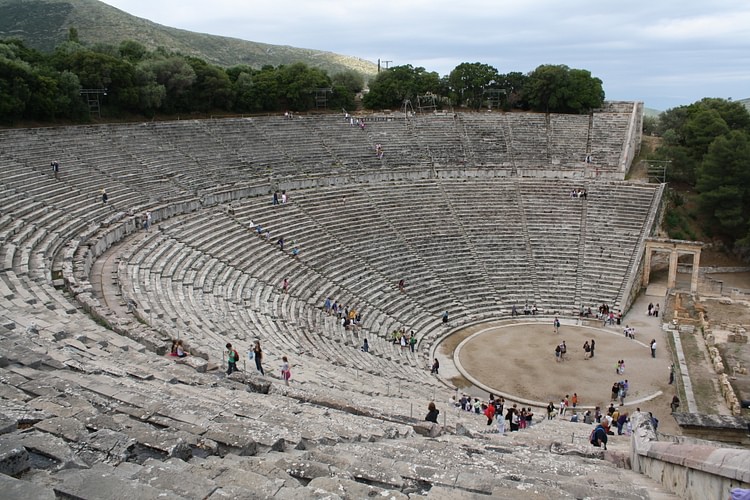 Seating of the Theatre of Epidaurus Mark Cartwright (CC BY-NC-SA) ](https://www.worldhistory.org/image/482/seating-of-the-theatre-of-epidaurus/ "Seating of the Theatre of Epidaurus")Epidaurus was also the site of the [pan](https://www.worldhistory.org/Pan/)-[Hellenic](https://www.worldhistory.org/greece/) Asklepieia festival, founded in the 5th century BCE and held every four years to celebrate theatre, sport, and [music](https://www.worldhistory.org/disambiguation/Music/) in honour of Asclepius. The site continued to be important in Roman times, and several buildings were added in the 2nd century CE under the auspices of the Roman senator Antonius. The sanctuary finally closed in 426 CE when [Roman emperor](https://www.worldhistory.org/Roman_Emperor/) Theodosius II decreed the closure of all pagan sites in Greece.
### Other Sanctuaries
Another important sanctuary in Asclepius' name was in [Athens](https://www.worldhistory.org/Athens/), situated just below the [Acropolis](https://www.worldhistory.org/Acropolis/) on the western slope. Tradition said that a priest named Telemachos brought the god to the site in the form of a sacred snake in 419 BCE. Strabo also mentions that the oldest sanctuary to Asclepius was at Tricca, where, in some accounts, the god was born, but the site has never been discovered. Messene does, however, have important archaeological remains attesting to the popularity of its Asclepian sanctuary in [Hellenistic](https://www.worldhistory.org/Hellenic_World/) times. Other sacred sites were located on the island of [Kos](https://www.worldhistory.org/Kos/) which also had an important school of physicians from the 5th century BCE, on, and at [Tegea](https://www.worldhistory.org/Tegea/). The cult of Asclepius was also transferred to [Pergamon](https://www.worldhistory.org/pergamon/) sometime in the 4th century BCE, possibly by a healed patient at Epidaurus named Archias. Finally, in 293 BCE the Romans were said to have taken the sacred snake from Epidaurus to the Tiber Island in order to cure a [plague](https://www.worldhistory.org/disambiguation/plague/), although there is evidence of the cult of Asclepius on the Italian mainland from as early as the 5th century BCE.
### Asclepius In Art
In ancient Greek art, Asclepius was portrayed in [sculpture](https://www.worldhistory.org/disambiguation/Sculpture/), on [pottery](https://www.worldhistory.org/pottery/), in mosaics, and on coins. Almost always, the god has a full beard, wears a simple himation robe, and holds a staff (the *bakteria*) with a sacred snake coiled around it, which has become the modern symbol of medicine. He is sometimes accompanied by Hygeia and occasionally has a dog at his feet, as these animals were sacred at some of the god's sanctuaries. The god was also associated with three types of tree: the cypress, pine, and olive. Artworks from as far afield as Dion, Kos, Athens, and [Rhodes](https://www.worldhistory.org/Rhodes/) dating from the 4th century BCE to the 3rd century CE attest to the god's widespread and long-lived popularity.
#### Editorial Review
This human-authored definition has been reviewed by our editorial team before publication to ensure accuracy, reliability and adherence to academic standards in accordance with our [editorial policy](https://www.worldhistory.org/static/editorial-policy/).
## Bibliography
- Ananiades, D. *Ancient Greece: Temples & Sanctuaries.* Toubis, Athens, 2010
- [Hornblower, S. *The Oxford Classical Dictionary.* Oxford University Press, USA, 2012.](https://www.worldhistory.org/books/0199545561/)
- [Iakovidis, S.E. *Mycenae Epidaurus.* World Art Group, 1995.](https://www.worldhistory.org/books/9602130350/)
## About the Author
Mark is WHE’s Publishing Director and has an MA in Political Philosophy (University of York). He is a full-time researcher, writer, historian and editor. Special interests include art, architecture and discovering the ideas that all civilizations share.
## Timeline
- **c. 700 BCE**: [Greek](https://www.worldhistory.org/disambiguation/greek/) poet [Hesiod](https://www.worldhistory.org/hesiod/) writes his *[Theogony](https://www.worldhistory.org/Theogony/)* and *[Works and Days](https://www.worldhistory.org/Works_and_Days/)*.
- **c. 500 BCE**: [Asclepius](https://www.worldhistory.org/Asclepius/) becomes principal [god](https://www.worldhistory.org/God/) of worship at [Epidaurus](https://www.worldhistory.org/epidaurus/).
- **400 BCE - 390 BCE**: A sanctuary to [Asclepius](https://www.worldhistory.org/Asclepius/) is built at [Agrigento](https://www.worldhistory.org/agrigento/).
- **c. 380 BCE - c. 375 BCE**: [Temple](https://www.worldhistory.org/temple/) to [Asclepius](https://www.worldhistory.org/Asclepius/) constructed at [Epidaurus](https://www.worldhistory.org/epidaurus/).
- **c. 350 BCE**: The Ascelpeion is built on [Kos](https://www.worldhistory.org/Kos/).
- **c. 340 BCE - c. 330 BCE**: [Theatre](https://www.worldhistory.org/disambiguation/theatre/) of [Epidaurus](https://www.worldhistory.org/epidaurus/) first constructed.
- **292 BCE**: The Romans adopt the [Greek](https://www.worldhistory.org/disambiguation/greek/) [god](https://www.worldhistory.org/God/) of [medicine](https://www.worldhistory.org/disambiguation/medicine/) [Asclepius](https://www.worldhistory.org/Asclepius/) by stealing his sacred snake from [Epidaurus](https://www.worldhistory.org/epidaurus/) and setting up a [temple](https://www.worldhistory.org/temple/) on the Tiber Island.
- **242 BCE**: The games held in honour of [Asclepius](https://www.worldhistory.org/Asclepius/) on [Kos](https://www.worldhistory.org/Kos/) are given Panhellenic status.
- **426 CE**: [Roman Emperor](https://www.worldhistory.org/Roman_Emperor/) Theodosius II orders closure of [Epidaurus](https://www.worldhistory.org/epidaurus/) sanctuary.
## Cite This Work
### APA
Cartwright, M. (2013, June 20). Asclepius. *World History Encyclopedia*.
### Chicago
Cartwright, Mark. "Asclepius." *World History Encyclopedia*, June 20, 2013. .
### MLA
Cartwright, Mark. "Asclepius." *World History Encyclopedia*, 20 Jun 2013, .
## License & Copyright
Submitted by [Mark Cartwright](https://www.worldhistory.org/user/markzcartwright/ "User Page: Mark Cartwright"), published on 20 June 2013. The copyright holder has published this content under the following license: [Creative Commons Attribution-NonCommercial-ShareAlike](https://creativecommons.org/licenses/by-nc-sa/4.0/deed.en). This license lets others remix, tweak, and build upon this content non-commercially, as long as they credit the author and license their new creations under the identical terms. When republishing on the web a hyperlink back to the original content source URL must be included. Please note that content linked from this page may have different licensing terms.