---
title: Artashat
author: Mark Cartwright
source: https://www.worldhistory.org/Artashat/
format: machine-readable-alternate
license: Creative Commons Attribution-NonCommercial-ShareAlike (https://creativecommons.org/licenses/by-nc-sa/4.0/)
updated: 1970-01-01
---
# Artashat
_Authored by [Mark Cartwright](https://www.worldhistory.org/user/markzcartwright/)_
Artashat (aka Artaxata) was the capital of Ancient [Armenia](https://www.worldhistory.org/armenia/) from 176 BCE and remained so for over 300 years of the kingdom's history. Located just south of Armenia's modern capital Yerevan, according to the ancient historian [Plutarch](https://www.worldhistory.org/plutarch/), the [city](https://www.worldhistory.org/city/)'s original fortifications were planned by the Carthaginian general [Hannibal](https://www.worldhistory.org/hannibal/). The city would need all the defences it could muster as it was attacked multiple times by [Roman](https://www.worldhistory.org/disambiguation/Roman/) armies throughout its history until it was eventually replaced by [Vagharshapat](https://www.worldhistory.org/Vagharshapat/) and [Dvin](https://www.worldhistory.org/Dvin/) as the country's first city.
### Foundation by Artaxias I
Around 200 BCE Artaxias I (aka Artashes or Artaxerxes), backed by the [Seleucid](https://www.worldhistory.org/Seleucid_Empire/) ruler Antiochus III (r. 222-187 BCE), was made the [Seleucid Empire](https://www.worldhistory.org/Seleucid_Empire/)'s [satrap](https://www.worldhistory.org/Persian_Governor/) in Armenia. Artaxias would reign until 165 or 160 BCE and found the [Artaxiad dynasty](https://www.worldhistory.org/Artaxiad_Dynasty/) which would rule Armenia until the first decade of the 1st century CE.
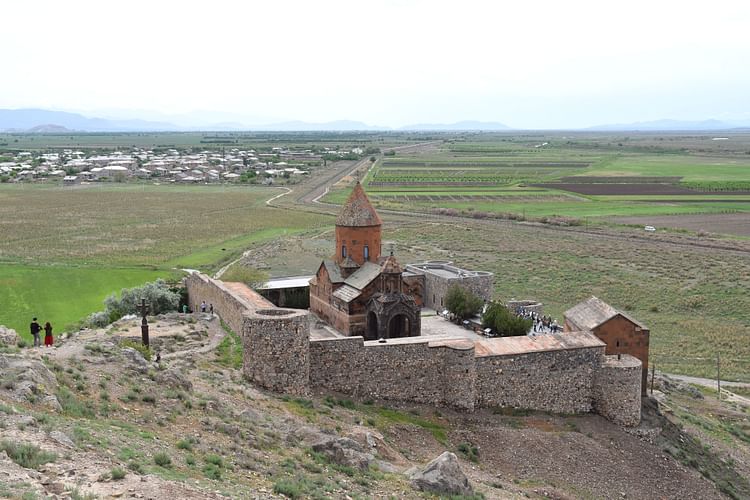
In 176 BCE Artaxias founded his new capital of Artashat on a peninsula of nine hills along the Aras (Araxes) river. Ideal for defence, it was surrounded by water on three sides and further protected by the nearby promontory of [Khor Virap](https://www.worldhistory.org/Khor_Virap/) (which was the site of an infamous prison and then monastery from the 3rd century CE). Aside from the prestige of building a brand new city, Artaxias was also motivated by the city's position to exploit regional trade, much better than the previous capital [cities](https://www.worldhistory.org/city/) of Armavir and Yervandashat. The proximity to local forests and quarries provided all the building material required for the new capital.
Hannibal, the great Carthaginian general, who was then escaping the Romans after his defeat at the [Battle](https://www.worldhistory.org/disambiguation/battle/) of Zama in 202 BCE which ended the [Second Punic War](https://www.worldhistory.org/Second_Punic_War/), was said to have designed the city's fortifications for Artaxias who then used the plans to build his city. The [Greek](https://www.worldhistory.org/disambiguation/greek/) historian Plutarch (c. 45 - c. 125 CE) gives the following version of events:
> It is said that Hannibal the Carthaginian, after Antiochus had been conquered by the Romans, left him and went to Artaxias the Armenian, to whom he gave many excellent suggestions and instructions. For instance, observing that a section of the country which had the greatest natural advantages and attractions was lying idle and neglected, he drew up a plan for a city there, and then brought Artaxias to the place and showed him its possibilities, and urged him to undertake the building. The king was delighted, and begged Hannibal to superintend the work himself, whereupon a very great and beautiful city arose there, which was named after the king, and proclaimed the capital of Armenia. (*Life of Lucullus*, Ch. 31)
[ 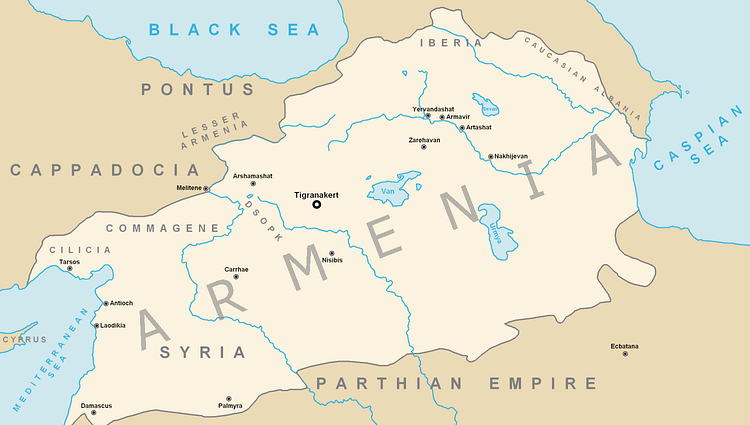 Tigranes the Great's Armenian Empire Aivazovsky (CC BY-SA) ](https://www.worldhistory.org/image/8163/tigranes-the-greats-armenian-empire/ "Tigranes the Great's Armenian Empire")Artashat was the first Armenian city to be built according to [Hellenistic](https://www.worldhistory.org/Hellenic_World/) planning, and it eventually became the largest city yet built on the Plain of Ararat. The city's fine features are listed here by the historian R. G. Hovannisian:
> The city contained a citadel on the height later called Xor Virap (Khor Virap) and was protected by extensive fortifications and a moat. Recent excavations have a revealed a major urban center with paved streets, public buildings, baths, shops, and workshops of various craftsmen…it rapidly became a major junction point between the trade route along the valley of the Araxes leading outward to Bactriaand [India](https://www.worldhistory.org/india/) and the one running northward to the Black Sea. (49)
Artaxias was said to have adorned the city with fine [bronze](https://www.worldhistory.org/disambiguation/bronze/) statues of Greek gods such as [Zeus](https://www.worldhistory.org/zeus/), [Artemis](https://www.worldhistory.org/artemis/), [Apollo](https://www.worldhistory.org/apollo/), and [Hercules](https://www.worldhistory.org/hercules/). The city's Greek and Persian cultural mix is attested by archaeological finds of Greek figurines and clay plaques with depictions of Iranian horse riders.
### Mithridatic Wars
Artashat was replaced as the Armenian capital when king [Tigranes the Great](https://www.worldhistory.org/Tigranes_the_Great/) (r. c. 95 - c. 56 BCE) founded the new and more centrally located city of [Tigranocerta](https://www.worldhistory.org/Tigranocerta/) (Tigranakert) in 83 BCE. Artashat regained its former status when a [Roman army](https://www.worldhistory.org/Roman_Army/) under the command of Licinius Lucullus sacked Tigranocerta in 69 BCE as part of a campaign to finally capture [Rome](https://www.worldhistory.org/Rome/)'s enemy no. 1: [Mithridates VI](https://www.worldhistory.org/Mithridates_VI/) of Pontus (r. 120-63 BCE), who went into hiding at Tigranes' capital, who was his son-in-[law](https://www.worldhistory.org/disambiguation/law/). When another army, this time led by [Pompey the Great](https://www.worldhistory.org/pompey/), attacked Armenia shortly after in 66 BCE, Artashat was besieged, but Tigranes capitulated, probably saving the city from destruction.
Between 36 and 34 BCE, [Mark Antony](https://www.worldhistory.org/Mark_Antony/) passed through the region on his way to fight the Parthians. The Roman general lost the battle and he invaded Armenia as a consolation prize on his way home to [Egypt](https://www.worldhistory.org/egypt/). Artashat was attacked and the Armenian king Artavasdes II (r. c. 56-34 BCE) was taken hostage to [Alexandria](https://www.worldhistory.org/alexandria/). [  Map Roman-Parthian War, 58-60 CE Cplakidas (CC BY-SA) ](https://www.worldhistory.org/image/566/map-roman-parthian-war-58-60-ce/ "Map Roman-Parthian War, 58-60 CE")
### [Roman-Parthian War 58-63 CE](https://www.worldhistory.org/article/1198/the-roman-parthian-war-58-63-ce/)
Between 58 and 60 CE, yet another Roman commander attacked the Armenian capital, this time Gnaeus Domitius Corbulo during the Roman-Parthian [war](https://www.worldhistory.org/disambiguation/War/) of 58 to 63 CE. Such was Corbulo's reputation for taking and destroying forts and settlements that the inhabitants of Artashat opened the city gates and surrendered without a fight in 58 CE. It is also worth noting that the commander first let the non-combatants flee the city before he torched it, as here described by the Roman historian [Tacitus](https://www.worldhistory.org/tacitus/) (c. 56 - c. 120 CE):
> \[Corbulo\] waited for daylight, and then sent on his light-armed troops, which were meanwhile to hover around the walls and begin the attack from a distance. The inhabitants, however, opened the gates of their own accord and surrendered themselves and their property to the Romans. This saved their lives; the city was fired, demolished and levelled to the ground, as it could not be held without a strong garrison from the extent of the walls, and we had not sufficient force to be divided between adequately garrisoning it and carrying on the war. If again the place were left untouched and unguarded, no advantage or glory would accrue from its capture. (*Annals*, Ch. 13:41)
The war finally ended with the 63 CE Treaty of Rhandia in which it was agreed that [Parthia](https://www.worldhistory.org/disambiguation/Parthia/) had the right to nominate Armenian kings, Rome the right to crown them, and both powers would rule equally over Armenia with the king as their representative. Once the new king Tiridates I (r. 63 to 75 or 88 CE) was crowned by [Roman emperor](https://www.worldhistory.org/Roman_Emperor/) [Nero](https://www.worldhistory.org/Nero/) in 66 CE, Artashat was rebuilt and, according to Roman writers, renamed Neronia.
[  Armenia's Khor Virap Monastery James Blake Wiener (CC BY-NC-SA) ](https://www.worldhistory.org/image/8347/armenias-khor-virap-monastery/ "Armenia's Khor Virap Monastery")### Later History
Roman emperor [Trajan](https://www.worldhistory.org/trajan/) (r. 98-117 CE) stationed two army divisions in Armenia and built a fort at Artashat to ensure Armenia stayed a Roman province and did not become absorbed into the [Persian empire](https://www.worldhistory.org/disambiguation/Persian_Empire/). A lengthy stone inscription in Latin survives from this period and list the various honorary titles of the Roman emperor.
Artashat was sacked again by the Romans (led by Avidius Cassius and Statius Priscus) in 166 CE before both Rome and [Persia](https://www.worldhistory.org/Persia/) agreed the city was to become one of the official trading points between their two empires. As a consequence, the city thrived thereafter, even if it was replaced as the royal residence by Vagharshapat and sacked by [Shapur II](https://www.worldhistory.org/Shapur_II/) (r. 309-379 CE) of the [Sasanian Empire](https://www.worldhistory.org/Sasanian_Empire/) in 368 CE. The city was by then eclipsed in importance by Dvin (Duin). Still, Artashat's continued prosperity is evidenced by an edict of 562 CE which confirmed the city as one of only three official trading points between the [Byzantine](https://www.worldhistory.org/disambiguation/Byzantine/) and Persian Empires. A customs post there was overseen by officials known as “commercial counts” or *comites commercium*.
Even into the period of Arab rule from the 7th century CE, the city was still a prosperous trade centre and became famous for its red [cochineal](https://www.worldhistory.org/Cochineal/) dye known as *kirmiz*, which was especially important in the carpet industry and textiles in general. Artashat's ultimate abandonment in the late medieval period was probably due to flooding from the Aras River.
This article was made possible with generous support from the [National Association for Armenian Studies and Research](https://naasr.org/?utm_source=ancient.eu&utm_medium=link&utm_campaign=ancient.eu) and the Knights of Vartan Fund for Armenian Studies.
#### Editorial Review
This human-authored definition has been reviewed by our editorial team before publication to ensure accuracy, reliability and adherence to academic standards in accordance with our [editorial policy](https://www.worldhistory.org/static/editorial-policy/).
## Bibliography
- [Plutarch - Lucullus](http://penelope.uchicago.edu/Thayer/E/Roman/Texts/Plutarch/Lives/Lucullus*.html "Plutarch - Lucullus"), accessed 20 Mar 2018.
- [Tacitus - Annals](http://www.perseus.tufts.edu/hopper/text?doc=Perseus%3Atext%3A1999.02.0078%3Abook%3D1%3Achapter%3D1 "Tacitus - Annals"), accessed 20 Mar 2018.
- [Adalian, R.P. *Historical Dictionary of Armenia.* Scarecrow Press, 2010.](https://www.worldhistory.org/books/0810860961/)
- [Hovannisian, R.G. *The Armenian People from Ancient to Modern Times.* Palgrave Macmillan, 2004.](https://www.worldhistory.org/books/1403964211/)
- [Kurkjian, V.M. *A History of Armenia.* IndoEuropeanPublishing.com, 2014.](https://www.worldhistory.org/books/1604447710/)
- [Payaslian, S. *The History of Armenia.* Palgrave Macmillan, 2008.](https://www.worldhistory.org/books/1403974675/)
## About the Author
Mark is WHE’s Publishing Director and has an MA in Political Philosophy (University of York). He is a full-time researcher, writer, historian and editor. Special interests include art, architecture and discovering the ideas that all civilizations share.
## Timeline
- **c. 200 BCE - c. 160 BCE**: Reign of Artaxias I, founder of the [Artaxiad dynasty](https://www.worldhistory.org/Artaxiad_Dynasty/) in [Armenia](https://www.worldhistory.org/armenia/).
- **c. 188 BCE**: Artaxata replaces [Erebuni](https://www.worldhistory.org/Erebuni/) as the Armenian capital.
- **176 BCE**: [Artashat](https://www.worldhistory.org/Artashat/) (Artaxata) is made the new capital of [Armenia](https://www.worldhistory.org/armenia/) by Artaxias I.
- **83 BCE**: Armenian king [Tigranes II](https://www.worldhistory.org/Tigranes_the_Great/) founds a new capital at [Tigranocerta](https://www.worldhistory.org/Tigranocerta/) (aka Tigranakert).
- **69 BCE**: Licinius Lucullus leads a [Roman army](https://www.worldhistory.org/Roman_Army/) which defeats Armenian king [Tigranes II](https://www.worldhistory.org/Tigranes_the_Great/) and his capital [Tigranocerta](https://www.worldhistory.org/Tigranocerta/) is captured. [Artashat](https://www.worldhistory.org/Artashat/) becomes the capital again.
- **66 BCE**: A [Roman army](https://www.worldhistory.org/Roman_Army/) led by [Pompey the Great](https://www.worldhistory.org/pompey/) besieges [Artashat](https://www.worldhistory.org/Artashat/) in [Armenia](https://www.worldhistory.org/armenia/).
- **c. 34 BCE**: [Roman](https://www.worldhistory.org/disambiguation/Roman/) general [Mark Antony](https://www.worldhistory.org/Mark_Antony/) attacks [Artashat](https://www.worldhistory.org/Artashat/) in [Armenia](https://www.worldhistory.org/armenia/).
- **58 CE**: The [Roman](https://www.worldhistory.org/disambiguation/Roman/) general Corbulo captures the Armenian capital [Artashat](https://www.worldhistory.org/Artashat/) without a fight.
- **166 CE**: A [Roman army](https://www.worldhistory.org/Roman_Army/) sacks the [Armenia](https://www.worldhistory.org/armenia/) capital of [Artashat](https://www.worldhistory.org/Artashat/).
- **368 CE**: The [Sasanian](https://www.worldhistory.org/Sasanian_Empire/) ruler [Shapur II](https://www.worldhistory.org/Shapur_II/) sacks the Armenian [city](https://www.worldhistory.org/city/) of [Artashat](https://www.worldhistory.org/Artashat/).
- **562 CE**: [Artashat](https://www.worldhistory.org/Artashat/) in [Armenia](https://www.worldhistory.org/armenia/) is confirmed as an official trading post between [Persia](https://www.worldhistory.org/Persia/) and the [Byzantine Empire](https://www.worldhistory.org/Byzantine_Empire/).
## Cite This Work
### APA
Cartwright, M. (2018, March 21). Artashat. *World History Encyclopedia*.
### Chicago
Cartwright, Mark. "Artashat." *World History Encyclopedia*, March 21, 2018. .
### MLA
Cartwright, Mark. "Artashat." *World History Encyclopedia*, 21 Mar 2018, .
## License & Copyright
Submitted by [Mark Cartwright](https://www.worldhistory.org/user/markzcartwright/ "User Page: Mark Cartwright"), published on 21 March 2018. The copyright holder has published this content under the following license: [Creative Commons Attribution-NonCommercial-ShareAlike](https://creativecommons.org/licenses/by-nc-sa/4.0/deed.en). This license lets others remix, tweak, and build upon this content non-commercially, as long as they credit the author and license their new creations under the identical terms. When republishing on the web a hyperlink back to the original content source URL must be included. Please note that content linked from this page may have different licensing terms.