---
title: Ariadne
author: Jennifer Saint
source: https://www.worldhistory.org/Ariadne/
format: machine-readable-alternate
license: Creative Commons Attribution-NonCommercial-ShareAlike (https://creativecommons.org/licenses/by-nc-sa/4.0/)
updated: 1970-01-01
---
# Ariadne
_Authored by [Jennifer Saint](https://www.worldhistory.org/user/jennifersaint/)_
Ariadne is a figure in [Greek mythology](https://www.worldhistory.org/Greek_Mythology/), best known for her role in helping [Theseus](https://www.worldhistory.org/Theseus/) to defeat the monstrous half-man half-bull [Minotaur](https://www.worldhistory.org/Minotaur/), her half-brother, and escape the [Labyrinth](https://www.worldhistory.org/Labyrinth/), the torturous maze beneath the [palace](https://www.worldhistory.org/disambiguation/palace/) of [Knossos](https://www.worldhistory.org/knossos/) in [Crete](https://www.worldhistory.org/crete/), ordered to be built by Ariadne's father, King Minos.
### Origins & Family
Ariadne comes from a powerful family in [Greek](https://www.worldhistory.org/disambiguation/greek/) [mythology](https://www.worldhistory.org/mythology/). Her mother is [Pasiphae](https://www.worldhistory.org/Pasiphae/), [daughter of the sun](https://www.worldhistory.org/article/2562/the-daughter-of-the-sun/)-[god](https://www.worldhistory.org/God/), [Helios](https://www.worldhistory.org/Helios/) and her father is King Minos of Crete. The [women](https://www.worldhistory.org/disambiguation/women/) of the family play significant roles in many important myths. Ariadne's aunt is [Circe](https://www.worldhistory.org/Circe/), the witch who turns [Odysseus](https://www.worldhistory.org/odysseus/)' men into swine in [Homer](https://www.worldhistory.org/homer/)'s *[Odyssey](https://www.worldhistory.org/Odyssey/)*. Her cousin is [Medea](https://www.worldhistory.org/Medea/), whose story mirrors Ariadne's in some ways. Like Ariadne, Medea enables a hero to accomplish his legendary feats – in her case, she gives [Jason and the Argonauts](https://www.worldhistory.org/article/425/jason--the-argonauts/) a magical salve and instructions so that they can steal the [Golden Fleece](https://www.worldhistory.org/Golden_Fleece/) from her father Aeëtes of Colchis – and is later deserted by him.
Ariadne's sister, [Phaedra](https://www.worldhistory.org/Phaedra/), grows up to marry Theseus later in life, but she falls in love with his son [Hippolytus](https://www.worldhistory.org/Hippolytus/) and so sets off a chain of tragic events which lead to Theseus bringing about the [death](https://www.worldhistory.org/disambiguation/Death/) of his own son in the [Greek tragedy](https://www.worldhistory.org/Greek_Tragedy/) *Hippolytus* by [Euripides](https://www.worldhistory.org/Euripides/).
The story of Ariadne's mother is perhaps the strangest and most shocking of all. When Ariadne's father, King Minos, offends the sea god [Poseidon](https://www.worldhistory.org/poseidon/) by refusing to sacrifice a beautiful [white bull](https://www.worldhistory.org/White_Bull/) to the god, Poseidon punishes him by causing his wife, Pasiphae, to fall in love with the animal. Pasiphae entreats the master craftsman [Daedalus](https://www.worldhistory.org/Daedalus/) to carve a realistic wooden cow in which she can hide to seduce the bull. The product of this union is the Minotaur, a monster with the body of a man but the head of a bull and an insatiable appetite for human flesh. The creature is Ariadne's half-brother and is consigned by her father to the dark depth of the Labyrinth from which it can never escape.
#### Author Promotion
[  ](https://www.worldhistory.org/books/B08FGV6R9D/ "Ariadne")### Ariadne
by Jennifer Saint Hypnotic, propulsive, and utterly transporting, Jennifer Saint's Ariadne forges a new epic, one that puts the forgotten women of Greek mythology back at the heart of the story, as they strive for a better world. [Learn More](https://www.worldhistory.org/books/B08FGV6R9D/)
.sponsor.book img.key_art {
box-shadow: none !important;
}
.button_container {
margin-top: 1em;
}
.sponsor.book h3 {
text-transform: none;
margin-top: 0px;
margin-bottom: 15px;
font-family: "Libre Baskerville", "Palatino Linotype", "Book Antiqua", Palatino, serif;
}
.sponsor_message {
margin-left: 190px;
font-family: Karla, Arial, Helvetica, sans-serif;
line-height: 140%;
min-height: 200px;
}
.sponsor.book {
padding: 20px;
margin: 25px 0px;
background-color: #f3f3f3;
}
.sponsor.book .key_art {
margin-top: 0px;
margin-bottom: 10px;
float: left;
}
.sponsor h4 {
font-weight: bold;
text-transform: uppercase;
color: #000;
margin-bottom: 10px;
margin-top: 0px;
font-family: Karla,Arial,Helvetica,sans-serif;
font-size: 13px;
padding: 0;
}
.sponsor_book_author {
color: #999;
margin: -10px 0px 20px;
}
@media (max-width: 1199px) {
.sponsor.book .key_art {
float: none;
width: 100%;
}
.sponsor.book .sponsor_message {
margin-left: 0px;
}
.sponsor.book h3 {
margin-top: 20px;
margin-bottom: 10px;
}
}
@media (max-width: 767px) {
}
### Theseus & the Labyrinth
Ariadne's father, Minos, imprisons the Minotaur in a labyrinth beneath the floors of the Cretan palace of Knossos. The Labyrinth in mythology is a complex underground maze designed by Daedalus who was cunning and clever enough to ensure that it was so bewildering that no one who entered could ever find their way out again. Once completed, Minos then imprisoned Daedalus in the palace to ensure that the secret of the maze would never be told.
At regular intervals – sometimes annually, at other times every seven or nine years – 14 hostages composed of seven Athenian maidens and seven Athenian youths are led into the Labyrinth as sacrifices to be fed alive to the creature. Theseus, who has come to [Athens](https://www.worldhistory.org/Athens/) to find his father, King Aegeus, volunteers himself as a tribute so that he can kill the Minotaur and bring an end to the grisly tradition.
[ 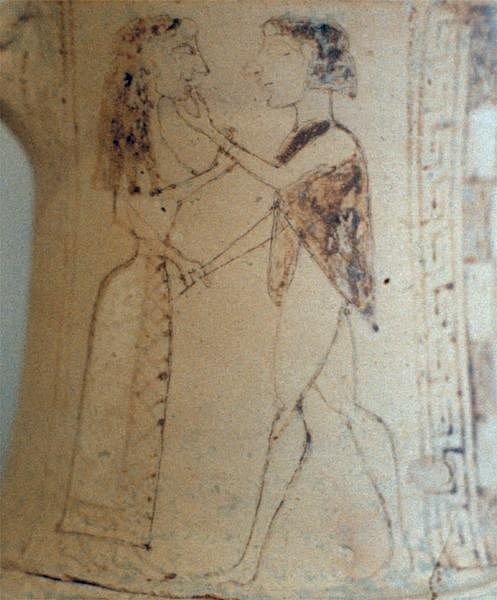 Ariadne & Theseus Zde (CC BY-SA) ](https://www.worldhistory.org/image/6226/ariadne--theseus/ "Ariadne & Theseus")When Theseus arrives in Crete, Ariadne falls in love with him and helps him by giving him his weapon and providing him with a red thread so that he can find his way out of the Labyrinth once he has killed the Minotaur. Ariadne is often described as having a special connection to the Minotaur and sympathising with the creature, but she decides that helping Theseus is more important – either because of her infatuation with him or out of horror at the ongoing slaughter of the innocent Athenians (or perhaps a mixture of the two).
### Abandonment on [Naxos](https://www.worldhistory.org/Naxos/)
Ariadne's actions meant that she had to flee her home with Theseus once she had enabled his victory. After betraying her father, Ariadne sails away to Naxos with Theseus who had promised to marry her. However, he leaves her sleeping on the island and returns to Athens without her. In some versions of the story, he left her by choice, which could be a callous act of egotism. Ariadne rages at him in her letter in [Ovid](https://www.worldhistory.org/ovid/)'s (43 BCE to 17 CE) *Heroides*, in which she accuses him of wanting to return to Athens and boast about his feats without acknowledging the crucial role she played in his success.
Perhaps his motivations were slightly different, though still dishonourable. In some versions of the myth, Theseus leaves her on Naxos as she is so plagued by sickness on the voyage back to Athens and cannot continue to travel. She then dies giving birth to Theseus' twins or is killed by [Artemis](https://www.worldhistory.org/artemis/). In yet other versions, she hangs herself in despair when she realises that Theseus is gone, for whatever reasons, and she is exiled on an unfamiliar island with no prospect of returning home to the family she betrayed.
[ 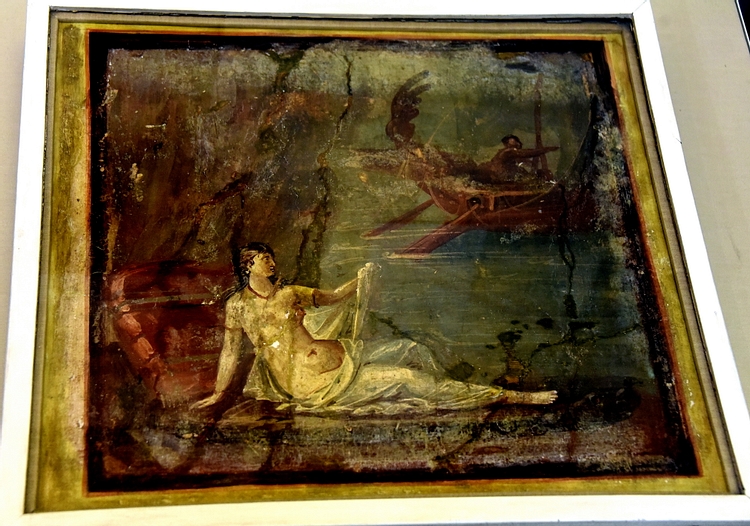 Fresco of Ariadne on Naxos Osama Shukir Muhammed Amin (Copyright) ](https://www.worldhistory.org/image/9432/fresco-of-ariadne-on-naxos/ "Fresco of Ariadne on Naxos")However, there are interpretations of the story which go some way to exonerate Theseus and make his actions less cruel. In these versions, the Olympian god of wine, [Dionysus](https://www.worldhistory.org/Dionysos/), orders Theseus to leave her as the god is captivated by her beauty and wants her for his own bride. Theseus cannot refuse the god, and so he gives Ariadne up. When Dionysus and Ariadne marry, he gives her a beautiful crown, which he later transforms into the constellation Corona Borealis. Ovid describes how the jewels of the crown are turned into burning stars in the *Metamorphoses*. Ariadne and Dionysus have a number of sons, variously reported as between one and six in different sources, though sometimes two of Ariadne's children are attributed to Theseus.
### Death & Immortality
In Homer's *Odyssey*, Odysseus sees the shade of Ariadne in the Underworld and learns that she has been killed by Artemis for unclear reasons on Naxos. [Plutarch](https://www.worldhistory.org/plutarch/) (c. 45/50 to c. 120/125 CE) writes that she dies in childbirth on Naxos after Theseus left her there pregnant. Many sources say that Dionysus made her immortal, either by retrieving her from the Underworld as he did with his own mortal mother, Semele, and ascending with her to Olympus or by making her crown a constellation in the heavens.
Older versions of Ariadne's story, however, do not include Theseus at all. In these stories, she precedes Theseus by several generations, goes to [war](https://www.worldhistory.org/disambiguation/War/) alongside Dionysus against the Argives, and is killed. In the *Dionysiaca*, Nonnus (5th century CE) tells of her petrification into stone in [battle](https://www.worldhistory.org/disambiguation/battle/) against the Argives when King [Perseus](https://www.worldhistory.org/Perseus/) shows her the head of [Medusa](https://www.worldhistory.org/Medusa/), much to Dionysus' fury and grief, who brings her back from the Underworld to make her a goddess.
### Symbols & Representations in Art
In Greek art, Ariadne is associated with the red thread that she gives to Theseus to lead him safely out of the Labyrinth. She is also associated with the dancing floor made for her by Daedalus, the famous inventor. Her dancing floor is described in the *[Iliad](https://www.worldhistory.org/iliad/)*, as part of the scene created on the shield of [Achilles](https://www.worldhistory.org/achilles/) by [Hephaestus](https://www.worldhistory.org/Hephaistos/). The twisting and intricate steps of the [Greek dance](https://www.worldhistory.org/Greek_Dance/) performed on the dancing floor reflect the idea of mazes and labyrinths, a symbol which is also closely linked to Ariadne.
In classical paintings and [Greek sculpture](https://www.worldhistory.org/Greek_Sculpture/), we often see Ariadne sleeping on Naxos before she wakes to discover that Theseus is gone or is discovered by Dionysus as well as images of her and Dionysus together. She is also depicted on [Greek pottery](https://www.worldhistory.org/Greek_Pottery/), such as vase paintings, with Dionysus and his maenads and satyrs as part of the scenes of Bacchic rites undertaken by his followers.
[  Minoan Bull-leaping Fresco Carole Raddato (CC BY-NC-SA) ](https://www.worldhistory.org/image/8458/minoan-bull-leaping-fresco/ "Minoan Bull-leaping Fresco")### Knossos
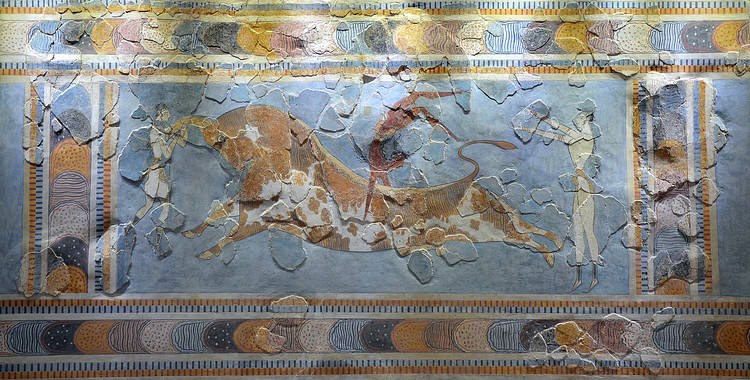
The ruins of the palace at Knossos in Crete are a large [Bronze Age](https://www.worldhistory.org/disambiguation/Bronze_Age/) archaeological site and reveal some connections to the myths associated with the place. The intricate design of the corridors has been suggested as giving rise to the story of the Labyrinth. Frescoes survive on the walls of Knossos depicting the ancient sport of bull-leaping, in which men would vault over bulls. This sport could be linked to the legend of the Minotaur, a mythical hybrid monster of man and bull, and so there are physical clues and links in the excavated remains of the palace to the mythical stories told about its legendary inhabitants.
#### Editorial Review
This human-authored definition has been reviewed by our editorial team before publication to ensure accuracy, reliability and adherence to academic standards in accordance with our [editorial policy](https://www.worldhistory.org/static/editorial-policy/).
## Bibliography
- [Higgins, Charlotte. *Red Thread.* Vintage, 2020.](https://www.worldhistory.org/books/1784702641/)
- [Homer & Robert Fagles & Bernard Knox. *The Iliad.* Penguin Classics, 1998.](https://www.worldhistory.org/books/0140275363/)
- [Hornblower, Simon & Spawforth, Antony & Eidinow, Esther. *The Oxford Classical Dictionary.* Oxford University Press, 2012.](https://www.worldhistory.org/books/0199545561/)
- [Ovid & Isbell, Harold & Isbell, Harold & Isbell, Harold. *Heroides .* Penguin Classics, 1990.](https://www.worldhistory.org/books/0140423559/)
- [Ovid & Raeburn, David & Feeney, Denis. *Metamorphoses .* Penguin Classics, 2004.](https://www.worldhistory.org/books/014044789X/)
## About the Author
Jennifer Saint is an author of Greek mythology retellings from the female perspective. The novels she has written so far are Ariadne (2021) and Elektra (2022).
- [X/Twitter Profile](https://twitter.com/jennysaint)
## Questions & Answers
### Who is Ariadne in Greek mythology?
Ariadne is the daughter of Pasiphae and King Minos of Crete, best known for her role in helping Theseus to defeat the Minotaur and escape the Labyrinth, the torturous maze beneath the palace of Knossos in Crete.
### Why did Ariadne not marry Theseus?
Theseus left Ariadne sleeping on the island of Naxos and returned to Athens without her. Different versions of the myth give various reasons for Theseus abandoning her, from sheer egotism to Theseus being compelled to give her up to Dionysus.
### What became of Ariadne after her abandonment?
In different versions of the myth, she either dies in childbirth, commits suicide, or marries Dionysus, who eventually makes her immortal.
## External Links
- [Theseus, Hero of Athens | Essay | The Metropolitan Museum of Art | Heilbrunn Timeline of Art History](https://www.metmuseum.org/toah/hd/thes/hd_thes.htm)
## Cite This Work
### APA
Saint, J. (2022, April 01). Ariadne. *World History Encyclopedia*.
### Chicago
Saint, Jennifer. "Ariadne." *World History Encyclopedia*, April 01, 2022. .
### MLA
Saint, Jennifer. "Ariadne." *World History Encyclopedia*, 01 Apr 2022, .
## License & Copyright
Submitted by [Jennifer Saint](https://www.worldhistory.org/user/jennifersaint/ "User Page: Jennifer Saint"), published on 01 April 2022. The copyright holder has published this content under the following license: [Creative Commons Attribution-NonCommercial-ShareAlike](https://creativecommons.org/licenses/by-nc-sa/4.0/deed.en). This license lets others remix, tweak, and build upon this content non-commercially, as long as they credit the author and license their new creations under the identical terms. When republishing on the web a hyperlink back to the original content source URL must be included. Please note that content linked from this page may have different licensing terms.