---
title: Apophis
author: Joshua J. Mark
source: https://www.worldhistory.org/Apophis/
format: machine-readable-alternate
license: Creative Commons Attribution-NonCommercial-ShareAlike (https://creativecommons.org/licenses/by-nc-sa/4.0/)
updated: 1970-01-01
---
# Apophis
_Authored by [Joshua J. Mark](https://www.worldhistory.org/user/JPryst/)_
Apophis (also known as Apep) is the Great Serpent, enemy of the sun [god](https://www.worldhistory.org/God/) Ra, in ancient [Egyptian religion](https://www.worldhistory.org/Egyptian_Religion/). The sun was Ra's great barge which sailed through the sky from dawn to dusk and then descended into the underworld. As it sailed through the darkness, it was attacked by Apophis who sought to kill Ra and prevent sunrise.
On board the great ship a number of different gods and goddesses are depicted in differing eras as well as the justified dead and all of these helped fend off the serpent. Ancient [Egyptian](https://www.worldhistory.org/disambiguation/Egyptian/) priests and laypeople would engage in rituals to protect Ra and destroy Apophis and, through these observances, linked the living with the dead and the natural order as established by the gods.
Apophis never had a formal cult and was never worshiped, but he would feature in a number of tales dealing with his efforts to destroy the sun god and return order to chaos. Apophis is associated with earthquakes, thunder, darkness, storms, and [death](https://www.worldhistory.org/disambiguation/Death/), and is sometimes linked to the god Set, also associated with chaos, disorder, storms, and darkness. Set was originally a protector god, however, and appears a number of times as the strongest of the gods on board the sun god's barque, defending the ship against Apophis.
Although there were probably stories about a great enemy-serpent earlier in [Egypt](https://www.worldhistory.org/egypt/)'s history, Apophis first appears by name in texts from the [Middle Kingdom](https://www.worldhistory.org/disambiguation/Middle_Kingdom/) (2040-1782 BCE) and is acknowledged as a dangerous force through the [Late Period of Ancient Egypt](https://www.worldhistory.org/Late_Period_of_Ancient_Egypt/) (525-332 BCE), especially, and on into the [Ptolemaic Period](https://www.worldhistory.org/Ptolemaic_Dynasty/) (323-30 BCE) and [Roman Egypt](https://www.worldhistory.org/Roman_Egypt/). Most of the texts which mention him come from the [New Kingdom](https://www.worldhistory.org/disambiguation/New_Kingdom/) (c. 1570-1069 BCE), including the one known as *The Book of Overthrowing Apophis* which contains the rituals and spells for defeating and destroying the serpent. This work is among the best known of the so-called *Execration Texts,* works written to accompany rituals denouncing and cursing a person or entity which remained in use throughout ancient Egypt's history.
[ 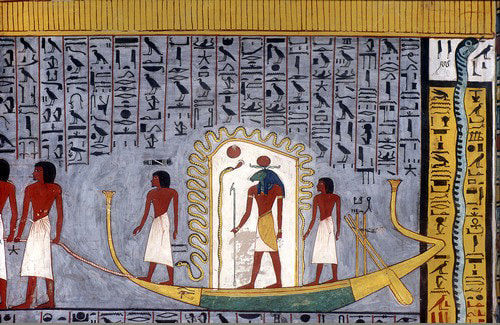 Ra Travelling Through the Underworld Unknown Artist (Public Domain) ](https://www.worldhistory.org/image/4543/ra-travelling-through-the-underworld/ "Ra Travelling Through the Underworld")Apophis is sometimes depicted as a coiled serpent but, often, as dismembered, being cut into pieces, or under attack. A famous depiction along these lines comes from Spell 17 of *The [Egyptian Book of the Dead](https://www.worldhistory.org/Egyptian_Book_of_the_Dead/)* in which the great cat Mau kills Apophis with a knife. Mau was the divine cat, a personification of the sun god, who guarded the Tree of Life which held the secrets of eternal life and divine knowledge. Mau was present at the act of creation, embodying the protective aspect of Ra, and was considered among his greatest defenders during the [New Kingdom of Egypt](https://www.worldhistory.org/New_Kingdom_of_Egypt/).
Egyptologist Richard H. Wilkinson reprints an image in his book *The Complete Gods and Goddesses of Ancient Egypt* from the [tomb](https://www.worldhistory.org/tomb/) of Inerkhau at [Deir el-Medina](https://www.worldhistory.org/Deir_el-Medina/) in which Mau is seen defending the Tree of Life from Apophis as he slices into the great serpent's head with his blade. The accompanying text, from Spell 17 of the *[Book of the Dead](https://www.worldhistory.org/disambiguation/Book_of_the_Dead/)*, relates how the cat defends Ra and also provides the origin of the cat in Egypt; it was divinely created at the beginning of time by the will of the gods.
### Mythological Origins
According to the most popular creation myth, the god Atum stood on the primordial mound, amidst the swirling waters of chaos, and began the work of creation. The god [Heka](https://www.worldhistory.org/Heka/), personification of magic, was with him, and it was through the agency of magic that order rose from chaos and the first sunrise appeared. A variation on this myth has the goddess [Neith](https://www.worldhistory.org/Neith/) emerge from the primal waters and, again with Heka, initiate creation. In both versions, which come from the *[Coffin Texts](https://www.worldhistory.org/article/1021/the-coffin-texts/)*, Apophis makes his earliest mythological appearance.
[  Book of the Dead Papyrus Mark Cartwright (CC BY-NC-SA) ](https://www.worldhistory.org/image/722/book-of-the-dead-papyrus/ "Book of the Dead Papyrus")In the story concerning Atum, Apophis has always existed and swam in the dark waters of undifferentiated chaos before the *ben-ben* (the primordial mound) rose from them. Once creation was begun, Apophis was angered because of the introduction of duality and order. Prior to creation, everything was a unified whole, but after, there were opposites such as water and land, light and dark, male and female. Apophis became the enemy of the sun god because the sun was the first sign of the created world and symbolized divine order, light, life, and if he could swallow the sun god, he could return the world to a unity of darkness.
The version in which Neith creates the ordered world is similar but with a significant difference: Apophis is a created being who is given life at the same moment as creation. He is, therefore, not the equal of the earliest gods but their subordinate. In this story, Neith emerges from the chaotic waters of darkness and spits some out as she steps onto the *ben-ben*. Her saliva becomes the [giant](https://www.worldhistory.org/Giants/) serpent who then swims away before it can be caught. When Neith was a part of the waters of darkness, as in the other tale, everything was unified; now, though, there was diversity. Apophis goal was to return the universe to its original, undifferentiated state.
### Order vs. Chaos
One of the most popular literary motifs of the [Middle Kingdom of Egypt](https://www.worldhistory.org/Middle_Kingdom_of_Egypt/) was order vs. chaos which can be seen in a number of the most famous works. *The [Admonitions of Ipuwer](https://www.worldhistory.org/article/981/the-admonitions-of-ipuwer/)*, for example, contrasts the chaos of the narrator's present with a perfect 'golden age' of the past and the *Discourse Between a Man and his Soul* does the same on a more personal level.
It is not surprising, therefore, to find the Apophis myth emerging during this period because it epitomizes this motif. The gods, the forces of order, enlist the aid of humanity to defend light against darkness and life against death; in essence, to maintain duality and individuality against unity and collectivity.
The personality of an individual was highly valued in [Egyptian culture](https://www.worldhistory.org/Egyptian_Culture/). All the gods were depicted with their own characters and even lesser deities and spirits had their own distinct personalities. The autobiographies inscribed on stelae and tombs was to ensure that the person buried there, that specific individual and their accomplishments, would never be forgotten. Apophis, then, represented everything the Egyptians feared: darkness, oblivion, and the loss of one's identity.
### Overthrowing Apophis
The Egyptians believed that all of nature was imbued with divinity and this, of course, included the sun which gave life. Eclipses and cloudy days were concerning because it was thought the sun god was having problems bringing his ship back up into the sky. The cause of these problems was always Apophis who had somehow gotten the better of the gods on board. During the latter part of the New Kingdom era, the text known as *The Book of Overthrowing Apophis* was set down from earlier oral traditions in which, according to Egyptologist Geraldine Pinch:
> The most terrifying deities in the Egyptian [pantheon](https://www.worldhistory.org/Pantheon/) were evoked to combat the chaos serpent and destroy all the aspects of his being, such as his body, his name, his shadow, and his magic. Priests acted out this unending [war](https://www.worldhistory.org/disambiguation/War/) by drawing pictures or making models of Apophis. These were cursed and then destroyed by stabbing, trampling, and burning. (108)
Long before the text was written, however, the ritual was enacted. No matter how many times Apophis was defeated and killed, he always rose again to life and attacked the sun god's boat. The most powerful gods and goddesses would defeat the serpent in the course of every night, but during the day, as the sun god sailed slowly across the sky, Apophis regenerated and was ready again by dusk to resume the war. In a text known as the *Book of Gates*, the goddesses [Isis](https://www.worldhistory.org/isis/), Neith, and [Serket](https://www.worldhistory.org/Serket/), assisted by other deities, capture Apophis and restrain him in nets held down by monkeys, the sons of [Horus](https://www.worldhistory.org/Horus/), and the great earth god Geb, where he is then chopped into pieces; the next night, though, the serpent is whole again and waiting for the barge of the sun when it enters the underworld.
[  Mehen Rob Koopman (CC BY-SA) ](https://www.worldhistory.org/image/6494/mehen/ "Mehen")Although the gods were all-powerful, they needed all the help they could get when it came to Apophis. The justified dead who had been admitted to paradise are often seen on the celestial ship helping to defend it. Spell 80 of the *Coffin Texts* enables the deceased to join in the defense of the sun god and his ship. Set, as noted earlier, is one of the first to drive Apophis off with his spear and club. The serpent god Mehen is also seen on board springing at Apophis to protect Ra. The Egyptian board game *mehen*, in fact, is thought to have originated from Mehen's role aboard the sun barque. Along with the souls of the dead, however, the living also played a part. Egyptologist Margaret Bunson describes the ritual:
> The Egyptians assembled in the temples to make images of the serpent in wax. They spat upon the images, burned them and mutilated them. Cloudy days or storms were signs that Apophis was gaining ground, and solar eclipses were particular times of terror for the Egyptians, as they were interpreted as a sign of Ra's demise. The sun god emerged victorious each time, however, and the people continued their prayers and anthems. (198)
Each morning the sun rose again and moved across the sky and, watching it, the people would know they had played a part in the gods' victory over the forces of darkness and chaos. The first act of the priests in the temples across Egypt was the ritual of *Lighting the Fire* which re-enacted the first sunrise. This was performed just before dawn in defiance of Apophis' desire to snuff out the light of creation and return all to darkness.
Following *Lighting the Fire* came the second most important morning ritual, *Drawing the Bolt*, in which the high priests unlocked and opened the doors to the inner sanctum where the god lived. These two rituals both had to do with Apophis: *Lighting the Fire* called upon the light of creation to empower Ra and *Drawing the Bolt* woke the god of the [temple](https://www.worldhistory.org/temple/) from sleep to join in defending the barque of the sun against the great serpent.
### Conclusion
Rituals surrounding Apophis continued through the Late Period, in which they seem to be taken more seriously than they were previously, and on through the [Roman](https://www.worldhistory.org/disambiguation/Roman/) Period. These rituals, in which the people struggled alongside the gods against the forces of darkness, were not particular only to Apophis. The festivals celebrating the resurrection of [Osiris](https://www.worldhistory.org/osiris/) included the entire community who participated as two [women](https://www.worldhistory.org/disambiguation/women/), playing the parts of Isis and [Nephthys](https://www.worldhistory.org/Nephthys/), called on Osiris to wake and return to life.
At the king's Sed Festival, and others, participants played the parts of the armies of Horus and Set in mock battles re-enacting the victory of Horus (order) over Set (chaos). At [Hathor](https://www.worldhistory.org/Hathor/)'s festival, people were encouraged to drink to excess in re-enacting the time of disorder and destruction when Ra sent Sekhmet to destroy humanity but then repented. He had a large vat of [beer](https://www.worldhistory.org/Beer/), dyed red, set down in Sekhmet's path at Dendera, and she, thinking it was blood, drank it, became drunk, and passed out. When she woke, she was the gentle Hathor who then restored order and became a friend to humanity.
[ 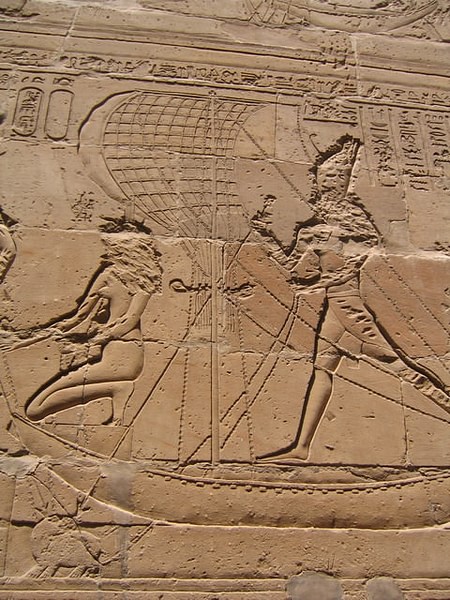 Set Defeated by Horus momo (CC BY) ](https://www.worldhistory.org/image/4588/set-defeated-by-horus/ "Set Defeated by Horus")These rituals encouraged the understanding that human beings played an important role in the workings of the universe. The sun was not just an impersonal object in the sky which appeared to rise every morning and set each evening but was imbued with character and purpose: it was the barge of the sun god who, throughout the day, ensured the continuation of life and, at night, required the prayers and support of the people to ensure they would see him the next day.
The rituals surrounding the overthrow of Apophis represented the eternal struggle between good and evil, order and chaos, light and darkness, and relied upon the daily attention and efforts of human beings to succeed. Humanity, then, was not just a passive recipient of the gifts of the gods but a vital component in the operation of the universe.
This understanding was maintained, and these rituals observed, until the rise of [Christianity](https://www.worldhistory.org/christianity/) in the 4th century CE. At this time, the old model of humanity as co-workers with the gods was replaced by a new one in which human beings were fallen creatures, unworthy of their deity, and utterly dependent upon their god's son and his sacrifice for their salvation.
Humans were now considered recipients of a gift they had not earned and did not deserve, and the sun lost its distinct personality and purpose to become another of the Christian god's creations. Apophis, however, would live on in Christian iconography and [mythology](https://www.worldhistory.org/mythology/), merged with other deities such as Set and the benign serpent Sata, as the adversary of God, Satan, who also worked tirelessly to overturn divine order and bring chaos.
#### Editorial Review
This human-authored definition has been reviewed by our editorial team before publication to ensure accuracy, reliability and adherence to academic standards in accordance with our [editorial policy](https://www.worldhistory.org/static/editorial-policy/).
## Bibliography
- [Bunson, M. *The Encyclopedia of Ancient Egypt.* Gramercy Books, 1991.](https://www.worldhistory.org/books/B01NH04966/)
- [David, R. *Religion and Magic in Ancient Egypt.* Penguin Books, 2003.](https://www.worldhistory.org/books/0140262520/)
- [Pinch, G. *Egyptian Mythology: A Guide to the Gods, Goddesses, and Traditions of Ancient Egypt.* Oxford University Press, 2004.](https://www.worldhistory.org/books/0195170245/)
- [Roberts, A. *Hathor Rising: The Power of the Goddess in Ancient Egypt.* Inner Traditions, 1997.](https://www.worldhistory.org/books/089281621X/)
- [Shaw, I. *The Oxford History of Ancient Egypt.* Oxford University Press, 2006.](https://www.worldhistory.org/books/B000OKSGJ8/)
- [Silverman, D. P. *Ancient Egypt.* Oxford University Press, 1997.](https://www.worldhistory.org/books/B01K3MRL10/)
- [Wilkinson, R. H. *The Complete Gods and Goddesses of Ancient Egypt.* Thames & Hudson, 2003.](https://www.worldhistory.org/books/0500284245/)
## About the Author
Joshua J. Mark is World History Encyclopedia's co-founder and Content Director. He was previously a professor at Marist College (NY) where he taught history, philosophy, literature, and writing. He has traveled extensively and lived in Greece and Germany.
- [Linkedin Profile](https://www.linkedin.com/pub/joshua-j-mark/38/614/339)
## Timeline
- **2040 BCE - 1782 BCE**: [Apophis](https://www.worldhistory.org/Apophis/) first mentioned by name in ancient [Egyptian](https://www.worldhistory.org/disambiguation/Egyptian/) texts.
- **c. 1570 BCE - 1069 BCE**: The text known as The Overthrowing of [Apophis](https://www.worldhistory.org/Apophis/) is written during the [Middle Kingdom of Egypt](https://www.worldhistory.org/Middle_Kingdom_of_Egypt/).
- **525 BCE - 332 BCE**: Rituals dedicated to defense against [Apophis](https://www.worldhistory.org/Apophis/) become more widespread during the [Late Period of Ancient Egypt](https://www.worldhistory.org/Late_Period_of_Ancient_Egypt/).
- **c. 300 CE**: Belief in [Apophis](https://www.worldhistory.org/Apophis/) declines with the rise of [Christianity](https://www.worldhistory.org/christianity/). Rituals are abandoned.
## Cite This Work
### APA
Mark, J. J. (2017, April 25). Apophis. *World History Encyclopedia*.
### Chicago
Mark, Joshua J.. "Apophis." *World History Encyclopedia*, April 25, 2017. .
### MLA
Mark, Joshua J.. "Apophis." *World History Encyclopedia*, 25 Apr 2017, .
## License & Copyright
Submitted by [Joshua J. Mark](https://www.worldhistory.org/user/JPryst/ "User Page: Joshua J. Mark"), published on 25 April 2017. The copyright holder has published this content under the following license: [Creative Commons Attribution-NonCommercial-ShareAlike](https://creativecommons.org/licenses/by-nc-sa/4.0/deed.en). This license lets others remix, tweak, and build upon this content non-commercially, as long as they credit the author and license their new creations under the identical terms. When republishing on the web a hyperlink back to the original content source URL must be included. Please note that content linked from this page may have different licensing terms.