---
title: Antioch
author: Donald L. Wasson
source: https://www.worldhistory.org/Antiochia/
format: machine-readable-alternate
license: Creative Commons Attribution-NonCommercial-ShareAlike (https://creativecommons.org/licenses/by-nc-sa/4.0/)
updated: 1970-01-01
---
# Antioch
_Authored by [Donald L. Wasson](https://www.worldhistory.org/user/DWasson/)_
Antioch or Antiochia was an ancient [city](https://www.worldhistory.org/city/) located on the Orontes River near the Amanus Mountains in [Syria](https://www.worldhistory.org/syria/). The “land of four [cities](https://www.worldhistory.org/city/)” - Seleucia, Apamea, Laodicea, and Antiochia - was founded by [Seleucus I Nicator](https://www.worldhistory.org/Seleucos_I/) (Victor) between 301 and 299 BCE. Some credit the city's initial founding as Antigoneia to [Antigonus I](https://www.worldhistory.org/Antigonus_I/) the One-Eyed who lost the area to Seleucus after the [Battle](https://www.worldhistory.org/disambiguation/battle/) of Ipsus in 301 BCE. According to some ancient sources, Seleucus was considered one of the more capable successors to the [empire](https://www.worldhistory.org/empire/) established by [Alexander the Great](https://www.worldhistory.org/Alexander_the_Great/). Seleucus was not one of the people in [Alexander](https://www.worldhistory.org/disambiguation/Alexander/)'s inner circle, serving as one of the commanders of the *hypaspists*, an elect guard that served as a buffer between Alexander's cavalry and infantry. Although little mention is made of him and his relationship to Alexander, he and his descendants would rule an empire which included Antioch for almost 250 years.
### Successor Wars
After Alexander's [death](https://www.worldhistory.org/disambiguation/Death/) in 323 BCE, his empire and its future lay in ruin. Because Alexander had not named a successor, one of his generals, [Perdiccas](https://www.worldhistory.org/Perdiccas/), wanted to delay any decision concerning the naming of a new leader until after the birth of Alexander and [Roxanne](https://www.worldhistory.org/Roxanne/)'s child. Another general, [Ptolemy I](https://www.worldhistory.org/Ptolemy_I/), on the other hand, wanted the empire divided immediately (he had his eye on [Egypt](https://www.worldhistory.org/egypt/)) - the [Wars of the Diadochi](https://www.worldhistory.org/Wars_of_the_Diadochi/) began and would continue for almost three decades. After [Ptolemy](https://www.worldhistory.org/disambiguation/Ptolemy/) stole Alexander's body on its way to Macedonia and took it to [Alexandria](https://www.worldhistory.org/alexandria/), Perdiccas and his army attacked Ptolemy and his forces in Egypt. Seleucus, although initially loyal to Perdiccas, turned and sided with Ptolemy. After the defeat and death of Perdiccas, Seleucus was rewarded for his loyalty with the territory surrounding [Babylon](https://www.worldhistory.org/babylon/), an area east of Syria.
Seleucus was unable to maintain control of his newly-acquired territory and when it was invaded by his nemesis [Antigonus](https://www.worldhistory.org/disambiguation/Antigonus/) the One-Eyed, he sought help from Ptolemy. In 312 BC Seleucus finally defeated Antigonus at the Battle of Gaza and regained his realm. After the Battle of Ipsus, he proved himself a very capable commander by expanding his empire into Syria, [Asia Minor](https://www.worldhistory.org/Asia_Minor/), and [India](https://www.worldhistory.org/india/). His son, Antiochus I (281-261 BCE) faced a series of revolts after his father's assassination in 281 BCE and was forced to concede territory in order to maintain peace. Unfortunately, his son, Antiochus II, (261-247 BCE) inherited a [war](https://www.worldhistory.org/disambiguation/War/) against the [Ptolemaic Dynasty](https://www.worldhistory.org/Ptolemaic_Dynasty/) of Egypt, the Second Syrian War, from his father.
In an attempt to make peace, Antiochus II agreed to divorce and exile his wife Laodice and their sons to marry [Ptolemy II](https://www.worldhistory.org/Ptolemy_II_Philadelphus/)'s daughter, [Berenice](https://www.worldhistory.org/disambiguation/Berenice/) Syra. When he died, his wife (Berenice) and ex-wife (Laodice) fought over whose son should be named heir. Berenice, who had the support of the people of Antioch, asked her brother and new ruler of Egypt, Ptolemy III, to help secure her infant son's right to sit on the throne. When Ptolemy arrived in Antioch, he found his sister and nephew had been assassinated. A war, the Third Syrian War or Laodicean War, erupted. Peace brought control of the port of Antioch, Seleucia, to Ptolemy, but Seleucus II (Antiochus and Laodice's son) inherited the throne and was able to retain Antioch, making it his empire's new capital.
[ 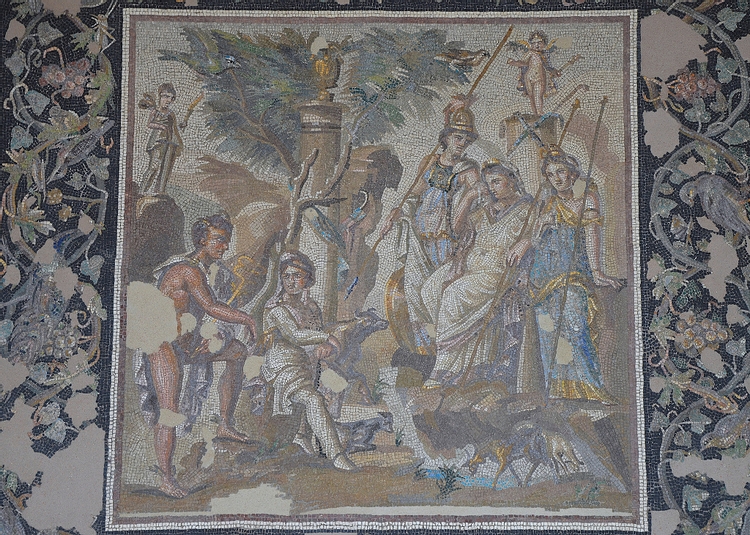 Mosaic of the Judgement of Paris Carole Raddato (CC BY-SA) ](https://www.worldhistory.org/image/5167/mosaic-of-the-judgement-of-paris/ "Mosaic of the Judgement of Paris")### [Roman](https://www.worldhistory.org/disambiguation/Roman/) Antioch
The city would maintain its status as a capital well into the time of the Roman Empire. Because of its location on several major [trade](https://www.worldhistory.org/disambiguation/trade/) routes (primarily the spice trade), the city and its international population served as a strategic, economic and intellectual center for both the [Seleucid Empire](https://www.worldhistory.org/Seleucid_Empire/) as well as [Rome](https://www.worldhistory.org/Rome/). The city's importance to the Roman Empire sometimes rivaled that of Egypt's chief city Alexandria.
Due to the reign of several feeble rulers, in 64 BCE [Pompey](https://www.worldhistory.org/pompey/) made the region a Roman province. As with other Roman cities, the city would benefit from Roman rule. Antioch would become Romanized containing [aqueducts](https://www.worldhistory.org/aqueduct/), [Roman baths](https://www.worldhistory.org/Roman_Baths/), and even an amphitheater. Its sumptuous palaces (built by the [Seleucid](https://www.worldhistory.org/Seleucid_Empire/) monarchs) became vacation residences of many Roman emperors. [Septimius Severus](https://www.worldhistory.org/Septimius_Severus/) took away the city's independence when they supported Pescennius Niger of Syria instead of him for [Roman emperor](https://www.worldhistory.org/Roman_Emperor/). Because it was located on a major fault, the city was damaged by both a great fire and several earthquakes (earthquakes occurred under [Tiberius](https://www.worldhistory.org/Tiberius/), [Caligula](https://www.worldhistory.org/Caligula/), [Hadrian](https://www.worldhistory.org/hadrian/), and [Diocletian](https://www.worldhistory.org/Diocletian/)).
[ 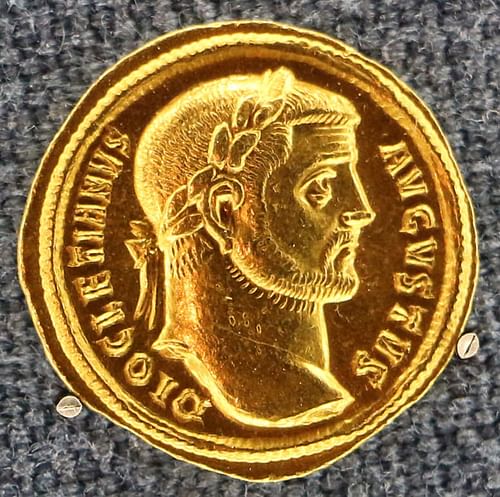 Aureus from Antioch Sailko (CC BY-SA) ](https://www.worldhistory.org/image/5168/aureus-from-antioch/ "Aureus from Antioch")Antioch was rebuilt by the Roman emperor [Trajan](https://www.worldhistory.org/trajan/), serving as the [Roman army](https://www.worldhistory.org/Roman_Army/)'s winter quarters. After the empire was divided during the reign of Diocletian, the city fell into the [Byzantine](https://www.worldhistory.org/disambiguation/Byzantine/) half or the [Eastern Roman Empire](https://www.worldhistory.org/Byzantine_Empire/). Under the rule of [Constantine](https://www.worldhistory.org/disambiguation/Constantine/), it would be a leading city in the rise of [Christianity](https://www.worldhistory.org/christianity/), even containing a school for biblical studies. When the last pagan emperor, Julian the Apostate (361-363 CE) passed through Syria on his way to fight the Persians, he stopped at Antioch in 362 CE. The city was forced to house and feed his army. The resulting crisis over the price of grain eventually led to both a famine and food riots. Later, it would be sacked by the [Huns](https://www.worldhistory.org/Huns/) in the 5th century CE and eventually captured by the Arabs in the 7th century CE.
#### Editorial Review
This human-authored definition has been reviewed by our editorial team before publication to ensure accuracy, reliability and adherence to academic standards in accordance with our [editorial policy](https://www.worldhistory.org/static/editorial-policy/).
## Bibliography
- Anonymous. *Encyclopedia of World History.*
- Bagnall, R.S. et al. *Encyclopedia of Ancient History.* Wiley-Blackwell, London, 2012
- Livius. *Articles on Ancient History.*
## About the Author
Donald has taught Ancient, Medieval and U.S. History at Lincoln College (Normal, Illinois)and has always been and will always be a student of history, ever since learning about Alexander the Great. He is eager to pass knowledge on to his students.
## Timeline
- **301 BCE - 299 BCE**: [Antioch](https://www.worldhistory.org/Antiochia/) founded by [Seleucos I](https://www.worldhistory.org/Seleucos_I/) Nicator.
- **40 CE**: [Paul](https://www.worldhistory.org/disambiguation/Paul/) and Barnabas visit [Antioch](https://www.worldhistory.org/Antiochia/).
- **c. 110 CE**: First documented martydom in the [Colosseum](https://www.worldhistory.org/Colosseum/) of [Rome](https://www.worldhistory.org/Rome/), that of St. Ignatius of [Antioch](https://www.worldhistory.org/Antiochia/).
## Cite This Work
### APA
Wasson, D. L. (2013, February 22). Antioch. *World History Encyclopedia*.
### Chicago
Wasson, Donald L.. "Antioch." *World History Encyclopedia*, February 22, 2013. .
### MLA
Wasson, Donald L.. "Antioch." *World History Encyclopedia*, 22 Feb 2013, .
## License & Copyright
Submitted by [Donald L. Wasson](https://www.worldhistory.org/user/DWasson/ "User Page: Donald L. Wasson"), published on 22 February 2013. The copyright holder has published this content under the following license: [Creative Commons Attribution-NonCommercial-ShareAlike](https://creativecommons.org/licenses/by-nc-sa/4.0/deed.en). This license lets others remix, tweak, and build upon this content non-commercially, as long as they credit the author and license their new creations under the identical terms. When republishing on the web a hyperlink back to the original content source URL must be included. Please note that content linked from this page may have different licensing terms.