---
title: Ankhsenamun
author: Joshua J. Mark
source: https://www.worldhistory.org/Ankhsenamun/
format: machine-readable-alternate
license: Creative Commons Attribution-NonCommercial-ShareAlike (https://creativecommons.org/licenses/by-nc-sa/4.0/)
updated: 2022-11-29
---
# Ankhsenamun
_Authored by [Joshua J. Mark](https://www.worldhistory.org/user/JPryst/)_
Ankhsenamun (born c. 1350 BCE and known as Ankhesenpaaten in youth) was the daughter of [Akhenaten](https://www.worldhistory.org/Akhenaten/) and [Nefertiti](https://www.worldhistory.org/Nefertiti/) of the 18th Dynasty of [Egypt](https://www.worldhistory.org/egypt/). She was married to her father and may have borne him one daughter, Ankhesenpaaten Tasherit ('Ankhesenpaaten the Younger'), before she was 13 years old.
While still a young girl, and possibly already married to Akhenaten, she was betrothed to her half-brother Tutankhaten who is better known as [Tutankhamun](https://www.worldhistory.org/Tutankhamun/). She survived both her father and her husband and is the first [Egyptian](https://www.worldhistory.org/disambiguation/Egyptian/) woman of royal blood known to have tried to marry a foreign prince and make him [pharaoh](https://www.worldhistory.org/pharaoh/). Her attempt failed, however, and what became of her afterwards is unknown, as is the year of her [death](https://www.worldhistory.org/disambiguation/Death/).
### Youth & Marriage
Akhenaten, possibly through religious conviction but probably for political reasons, outlawed the traditional [religion](https://www.worldhistory.org/religion/) of Egypt and suppressed religious practices. The popular worship of the [god](https://www.worldhistory.org/God/) [Amun](https://www.worldhistory.org/amun/) was especially targeted for persecution because the priests of the [temple](https://www.worldhistory.org/temple/) complexes of Amun had grown in wealth and power to rival that of the royal house. Land was the source of wealth in ancient Egypt and, by the time of Akhenaten's religious reforms, the priests owned more land than the pharaoh. In place of the traditional polytheism the Egyptians had always known, Akhenaten instituted a strict monotheism centered on the one supreme god Aten, represented by the sun disk.
Akhenaten moved the seat of power from the traditional [palace](https://www.worldhistory.org/disambiguation/palace/) at [Thebes](https://www.worldhistory.org/disambiguation/Thebes/) to a newly constructed complex at a [city](https://www.worldhistory.org/city/) he founded, Akhetaten (later known as [Amarna](https://www.worldhistory.org/Amarna/)), and it would have been here that Ankhsenamun grew up as a child-bride of her father and then the betrothed of her half-brother Tutankhaten. The Egyptologist Zahi Hawass notes that,
> the two children must have grown up together and perhaps playing together in the palace gardens. The royal children would have had lessons from teachers and scribes, who would have given them instruction in wisdom and knowledge about the new religion of the Aten. (50)
At some point, exactly when is not clear, she would have given birth to her daughter but it is possible that Ankhesenpaaten Tasherit was not her child but the daughter of Akhenaten and his lesser wife Kiya (Tutankhamun's mother). Ankhesenpaaten Tasherit is only known from damaged inscriptions which make determining her mother problematic. How long the child lived or when she died is unknown.
### Ankhsenamun & Tutankhamun
Akhenaten died in 1336 BCE and his son took the throne. Shortly after this, the boy-king known as Tutankhaten repealed his father's religious proscriptions and re-instated the traditional religious practices of Egypt. The temples were re-opened and the rites were again performed in accordance with tradition.
The Egyptians considered balance and harmony the most important aspects of life and honored those concepts through an eternal [law](https://www.worldhistory.org/disambiguation/law/) known as *[ma'at](https://www.worldhistory.org/Ma'at/)* (harmony). To the Egyptians, Akhenaten's monotheism and persecution of ancient [Egyptian religion](https://www.worldhistory.org/Egyptian_Religion/) had upset *ma'at* and it was the duty of the new king to restore order and balance. Tutankhaten and Ankhesenpaaten were married in a royal wedding and, as their first step in returning balance to Egypt, changed their names to Tutankhamun and Ankhsenamun; he was 8 or 9 years old at the time and she was 13 or 14.
[ 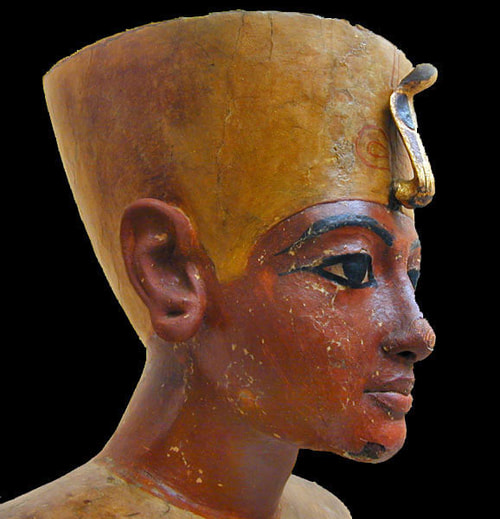 Tutankhamun Dalbera (CC BY) ](https://www.worldhistory.org/image/2479/tutankhamun/ "Tutankhamun")Tutankhamun moved the [Egyptian government](https://www.worldhistory.org/Egyptian_Government/) back to the traditional seat at Thebes and [Memphis](https://www.worldhistory.org/Memphis_(Ancient_Egypt)/) and set about trying to repair the damage his father's edicts had caused. With his advisors Ay and [Horemheb](https://www.worldhistory.org/Horemheb/) to guide him, Tutankhamun rebuilt temples and refurbished the old palace. Hawass notes that,
> At the major temples, Tutankhamun and his queen would have had a small ceremonial palace, complete with a reception area, throne room, and private chambers, including bathrooms for royal use. The `golden king' would have used his palace at Thebes for important religious festivals, and various rest-houses scattered around the country for hunting trips. (54)
It would seem, from paintings and inscriptions, that Ankhsenamun was his almost constant companion on these trips. Hawass writes,
> To judge from their portrayal in the art that fills the golden king's [tomb](https://www.worldhistory.org/tomb/), this was certainly the case \[that they loved one another\]. We can feel the love between them as we see the queen standing in front of her husband giving him flowers and accompanying him while he was hunting. (51)
They seem to have been inseparable until Tutankhamun died suddenly in 1327 BCE around the age of 18.
### Ankhsenamun & the [Hittite](https://www.worldhistory.org/hittite/) King
Horemheb, as commander-in-chief of the army, was campaigning against the [Hittites](https://www.worldhistory.org/hittite/) in the north when Tutankhamun died and so Ay assumed the traditional role of successor in burying the dead king. For his role to be recognized, the king's widow would have to be ceremonially betrothed to him for the funeral service, and it seems this is what happened. Ay and Ankhsenamun gave Tutankhamun the proper [Egyptian burial](https://www.worldhistory.org/Egyptian_Burial/) rites but do not seem to have been actually married. It was assumed, however, that Ay, as successor, would take Ankhsenamun for his royal bride to legitimize his rule.
The 23-year-old queen, however, had different plans in mind. She did not want to marry Ay, who was much older (and quite possibly her grandfather) and so she wrote to the Hittite king [Suppiluliuma I](https://www.worldhistory.org/Suppiluliuma_I/) asking for help. In her letter she states:
> My husband has died and I have no sons. They say about you that you have many sons. You might give me one of your sons to become my husband. Never shall I pick out a servant of mine and make him my husband.
This unprecedented request from an Egyptian queen made the Hittite king suspicious, and he sent an emissary to Egypt to meet with her. The man returned with another letter which read:
> Had I a son, would I have written about my own and my country's shame to a foreign land? You did not believe me and you have said as much to me. He who was my husband has died. A son I have not! Never shall I take a servant of mine and make him my husband. I have written to no other country; only to you have I written. They say your sons are many; so give me one of your sons. To me he will be husband, but in Egypt he will be King.
[  The Tomb of Horemheb Jean-Pierre Dalbéra (CC BY-NC-SA) ](https://www.worldhistory.org/image/2593/the-tomb-of-horemheb/ "The Tomb of Horemheb")[Suppiluliuma](https://www.worldhistory.org/Suppiluliuma_I/), once assured of the legitimacy of the offer, sent his son Zananza to Egypt to marry Ankhsenamun but the prince was killed before reaching the border. His murder has long been understood to be the work of the general Horemheb, possibly with the support or collusion of Ay. Hawass writes:
> Perhaps Ay told the commander of the army, Horemheb, what the young queen had done, or perhaps Ay and Horemheb were themselves involved in a struggle for the throne. Perhaps the two men decided together to stop the Hittite prince, because it would have brought shame on the nation for an Egyptian queen to marry a foreigner - such a thing would have reversed the proper order of things. Perhaps it was Ay, or his successor, Horemheb, who had the Hittite prince killed; and perhaps Ankhsenamun was forced, after all, to marry the aged Ay. In fact, we do not have any clues to her eventual fate. Her name is not mentioned in Ay's tomb, which is located in the Valley of the Kings, where we see only the name of his principal wife, [Tiye](https://www.worldhistory.org/tiye/). (68)
### Ankhsenamun's Disappearance
No more is known of Ankhsenamun after this incident. Ay ruled for three years but no mention is made of her as his wife nor in any other capacity except for a ring which might indicate she was married to Ay. The ring is considered inconclusive evidence, however, as it may simply reference the ceremonial marriage for Tutankhamun's funeral and not an actual marriage.
When Ay died, Horemheb took the throne and, to legitimize his rule, instituted religious orthodoxy, claiming that the old gods had chosen him to return the country to traditional values and to erase the name of the heretic king's family from history. All of the public monuments raised by Akhenaten during the [Amarna Period](https://www.worldhistory.org/Amarna_Period_of_Egypt/) were destroyed or defaced and Horemheb also tried to eliminate all trace of Tutankhamun. The young royal couple had ruled for ten years and, in that time, tried to restore Egypt to the glory it had known before Akhenaten's monotheistic reforms. It is very likely that there were inscriptions and stele erected which recorded the accomplishments of their short reign but these would have been destroyed under the edicts of Horemheb.
It is possible that Ay, or Horemheb, also had Ankhsenamun murdered for her daring to contact the Hittite king but, like everything else in her later life, this cannot be confirmed. All that is clearly known is that, after her letters to Suppiluliuma I, Ankhsenamun vanishes from history. It has been speculated that one of the two female mummies, found in KV 21 (tomb 21 of the Valley of the Kings), is Ankhsenamun based upon DNA testing in 2010 CE which matches this mummy's DNA to that of the two stillborn children of Tutankhamun and Ankhsenamun found in Tutankhamun's tomb; but the findings are inconclusive.
Akhenaten's mummy has been positively identified, and his DNA does not match that of the mummy thought to be Ankhsenamun's. It is also certain that Ankhsenamun was the daughter of Akhenaten and Nefertiti. As Tutankhamun was not known to have had any other wife, scholars are at a loss to explain who the KV21 mummy might be. The two conclusions the DNA presents are that either Ankhsenamun was not Akhenaten's daughter or Tutankhamun had another wife who is missing from the historical record. Neither of these possibilities seems plausible based on current information and so the final fate of Ankhsenamun remains a mystery.
#### Editorial Review
This human-authored definition has been reviewed by our editorial team before publication to ensure accuracy, reliability and adherence to academic standards in accordance with our [editorial policy](https://www.worldhistory.org/static/editorial-policy/).
## Bibliography
- [Bunson, M. *The Encyclopedia of Ancient Egypt.* Gramercy Press, 1991.](https://www.worldhistory.org/books/B008W3CSFM/)
- [Durant, W. *Our Oriental Heritage.* Simon & Schuster, 1954.](https://www.worldhistory.org/books/B00005WJGO/)
- [Hawass, Z. *The Golden King: The World of Tutankhamun.* National Geographic, 2004.](https://www.worldhistory.org/books/0792259149/)
- [Shaw, I. *The Oxford History of Ancient Egypt.* Oxford University Press, 2004.](https://www.worldhistory.org/books/0192804588/)
- [Watterson, B. *The Egyptians.* Blackwell Publishers, 1997.](https://www.worldhistory.org/books/B007S7DUGY/)
- [Wilkinson, T. *The Rise and Fall of Ancient Egypt.* Random House Trade Paperbacks, 2013.](https://www.worldhistory.org/books/0553384902/)
## About the Author
Joshua J. Mark is World History Encyclopedia's co-founder and Content Director. He was previously a professor at Marist College (NY) where he taught history, philosophy, literature, and writing. He has traveled extensively and lived in Greece and Germany.
- [Linkedin Profile](https://www.linkedin.com/pub/joshua-j-mark/38/614/339)
## Timeline
- **c. 1350 BCE**: Birth of [Ankhsenamun](https://www.worldhistory.org/Ankhsenamun/), daughter of [Akhenaten](https://www.worldhistory.org/Akhenaten/) and [Nefertiti](https://www.worldhistory.org/Nefertiti/), wife of [Tutankhamun](https://www.worldhistory.org/Tutankhamun/).
- **c. 1336 BCE**: Royal marriage of [Ankhsenamun](https://www.worldhistory.org/Ankhsenamun/) to [Tutankhamun](https://www.worldhistory.org/Tutankhamun/).
- **c. 1336 BCE - c. 1327 BCE**: Reign of [Tutankhamun](https://www.worldhistory.org/Tutankhamun/) with [Ankhsenamun](https://www.worldhistory.org/Ankhsenamun/) as queen.
- **1327 BCE**: [Death](https://www.worldhistory.org/disambiguation/Death/) of [Tutankhamun](https://www.worldhistory.org/Tutankhamun/) at the age of 18.
- **c. 1327 BCE - c. 1326 BCE**: [Ankhsenamun](https://www.worldhistory.org/Ankhsenamun/) writes to [Hittite](https://www.worldhistory.org/hittite/) King asking him to send a son to be her husband and King of [Egypt](https://www.worldhistory.org/egypt/).
- **c. 1327 BCE - c. 1326 BCE**: [Ankhsenamun](https://www.worldhistory.org/Ankhsenamun/) vanishes from the historical record.
## External Links
- [Ankhesenamun (Ankhesenpaaten)](http://ancientegyptonline.co.uk/ankhesenamun/)
- [The Story Of King Tut's Wife, Ankhesenamun — Who Was Also His Half-Sister](https://allthatsinteresting.com/ankhesenamun)
## Cite This Work
### APA
Mark, J. J. (2014, April 03). Ankhsenamun. *World History Encyclopedia*.
### Chicago
Mark, Joshua J.. "Ankhsenamun." *World History Encyclopedia*, April 03, 2014. .
### MLA
Mark, Joshua J.. "Ankhsenamun." *World History Encyclopedia*, 03 Apr 2014, .
## License & Copyright
Submitted by [Joshua J. Mark](https://www.worldhistory.org/user/JPryst/ "User Page: Joshua J. Mark"), published on 03 April 2014. The copyright holder has published this content under the following license: [Creative Commons Attribution-NonCommercial-ShareAlike](https://creativecommons.org/licenses/by-nc-sa/4.0/deed.en). This license lets others remix, tweak, and build upon this content non-commercially, as long as they credit the author and license their new creations under the identical terms. When republishing on the web a hyperlink back to the original content source URL must be included. Please note that content linked from this page may have different licensing terms.