---
title: Amphora
author: Mark Cartwright
source: https://www.worldhistory.org/Amphora/
format: machine-readable-alternate
license: Creative Commons Attribution-NonCommercial-ShareAlike (https://creativecommons.org/licenses/by-nc-sa/4.0/)
updated: 1970-01-01
---
# Amphora
_Authored by [Mark Cartwright](https://www.worldhistory.org/user/markzcartwright/)_
An amphora ([Greek](https://www.worldhistory.org/disambiguation/greek/): *amphoreus*) is a jar with two vertical handles used in antiquity for the storage and transportation of foodstuffs such as wine and olive oil. The name derives from the Greek *amphi-phoreus* meaning 'carried on both sides', although the Greeks had adopted the design from the eastern [Mediterranean](https://www.worldhistory.org/disambiguation/mediterranean/). Used by all the great trading nations from the [Phoenicians](https://www.worldhistory.org/phoenicia/) to the Romans, the sturdy-walled amphora spread throughout the ancient world and they have become an important survivor in the archaeological record providing clues as to dates of sites, [trade](https://www.worldhistory.org/disambiguation/trade/) relations, and everyday diet.
### Designs
Evolving from the large [Bronze Age](https://www.worldhistory.org/disambiguation/Bronze_Age/) *pithoi* vessels, which the Minoans and Mycenaeans used for storage purposes, the amphora became perhaps the most common ancient [pottery](https://www.worldhistory.org/pottery/) shape. However, the size and form had a great many variations. Amphorae could also be plain – typically when used for the transport of goods – or highly decorated, just as any other red-figure or [black-figure pottery](https://www.worldhistory.org/Black_Figure_Pottery/). Specific places, already noted for their pottery production, such as [Corinth](https://www.worldhistory.org/corinth/) and Attica, along with famed wine-producing islands like Chios, [Lesbos](https://www.worldhistory.org/lesbos/), and [Samos](https://www.worldhistory.org/samos/) all produced distinctive amphora types. So too did colonies in the Black Sea area and [Magna Graecia](https://www.worldhistory.org/Magna_Graecia/), although some [cities](https://www.worldhistory.org/city/) were happy enough to copy tried and tested designs. All amphorae were made in stages on the wheel with a period of drying between the addition of a new section.
The two basic types of amphora were the neck-amphora, which has the shoulder joining the neck at a sharp angle, and the belly amphora (or simply amphora) which curves continuously from neck to foot. Those vessels with broad mouths were known as either *kadoi* or *stamnoi* while the plain types for transport were referred to as *amphoreus*. Gradually the form of the vessel evolved to reflect its primary function as a carrier of wine and for ease of packing. The base foot became a spike and the vessel overall became taller and slimmer. In addition, during the [Roman](https://www.worldhistory.org/disambiguation/Roman/) period the contents of amphorae became easily identifiable from the shape of the vessel in question, a useful feature when stored in busy ports. Decorative *amphorae w*ith a pointed base would have been kept upright in a [bronze](https://www.worldhistory.org/disambiguation/bronze/) stand or deep ceramic ring.
[  Amphora, Wine Storage Jar Osama Shukir Muhammed Amin (Copyright) ](https://www.worldhistory.org/image/4187/amphora-wine-storage-jar/ "Amphora, Wine Storage Jar")### Functions
The average capacity for amphorae was 20-25 litres, although early versions were considerably larger. The general size became limited by the necessity for one or two persons to easily carry the vessel, and a standardisation, although attempted, was not achieved in practice until the [Byzantine](https://www.worldhistory.org/disambiguation/Byzantine/) period. Foodstuffs transported in them included wine, olive oil, honey, milk, olives, dried fish, dry food such as cereals, or even just water. Non-food contents included pitch, and some were used in tombs as containers for the ashes of the deceased. Another special type was the Panathenaic amphora which was a large vessel of around 36 litres decorated with black-figure designs. They were filled with olives and given as prizes in the Panathenaic Games, held every four years in [Athens](https://www.worldhistory.org/Athens/). Finally, miniature amphorae known as *amphoriskoi* (sing. *amphoriskos*) or *pelikai* (*pelike*) were used for storing perfume.
The Romans used amphorae in much the same way as the Greeks but with the addition of such Roman staples as fish sauce (*garum*) and preserved fruits. For this reason, amphorae were sealed using clay or resin stoppers, some also had a ceramic lid when used to store dry goods. Very few lids have survived in proportion to amphorae but those that do commonly have a single knob handle, sometimes made into the shape of a fruit. Finally, amphorae were used for completely unrelated purposes to their original design such as [burial](https://www.worldhistory.org/burial/) whole in marshy land to provide more solid foundations for buildings and walls or in roof domes as a means to provide additional support between courses.
[  Amphorae Packed for Transportation Mark Cartwright (CC BY-NC-SA) ](https://www.worldhistory.org/image/5525/amphorae-packed-for-transportation/ "Amphorae Packed for Transportation")### Stamps
Many amphorae (but certainly not all) used to transport goods were given a stamp before firing, typically placed on the neck, rim, or handles. This identified the place of origin (pottery workshop), indicated the vessel was part of a particular batch, named a controlling official, or guaranteed the content volume and quality. The name or monogram of the manufacturer might appear on the stamp, a month, or a regional adjective or symbol ([Rhodes](https://www.worldhistory.org/Rhodes/), for example, used a rose emblem). In the case of wine, the age of good wine was indicated and the drink-by-date (year) for cheap wine. Stamps were also a means by which authorities could exercise a control on customs duties. Stoppers could be stamped for the same purpose. In addition to stamps, the Romans painted information labels on their vessels to make their contents easily identifiable.
[ 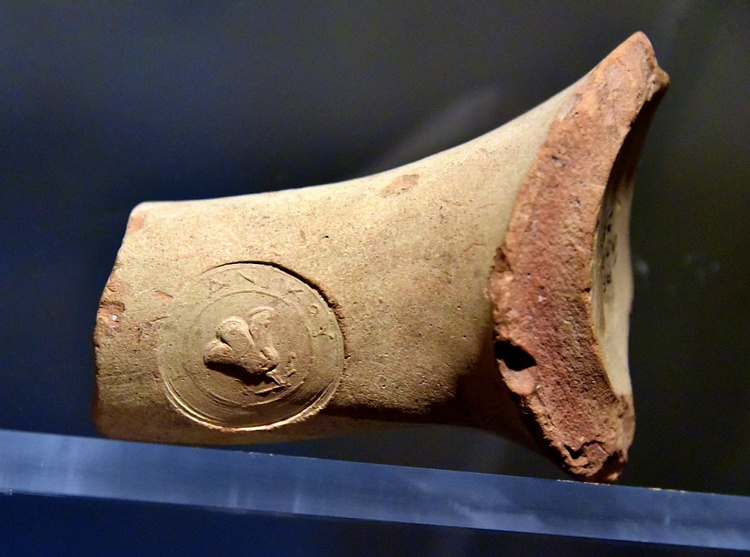 Stamped Rhodesian Amphora Handle from Jordan Osama Shukir Muhammed Amin (Copyright) ](https://www.worldhistory.org/image/10091/stamped-rhodesian-amphora-handle-from-jordan/ "Stamped Rhodesian Amphora Handle from Jordan")All of this information has often been invaluable for archaeologists when attempting to date a site which contains amphorae, especially shipwrecks. Finally, the discovery of amphorae whose origin can be identified and their quantities are helpful in determining the extent of [trade in the ancient world](https://www.worldhistory.org/collection/39/trade-in-the-ancient-world/). The Monte Testaccio in [Rome](https://www.worldhistory.org/Rome/) is an artificial mound of pottery shards coming from some 53 million discarded amphorae; impressive testimony to the fact that the amphora was one of the most common and useful objects in antiquity.
#### Editorial Review
This human-authored definition has been reviewed by our editorial team before publication to ensure accuracy, reliability and adherence to academic standards in accordance with our [editorial policy](https://www.worldhistory.org/static/editorial-policy/).
## Bibliography
- Bagnall, R. et al. *The Encyclopedia of Ancient History.* Wiley-Blackwell, 2012
- [Boardman, J. *Athenian Black Figure Vases.* Thames & Hudson, 2016.](https://www.worldhistory.org/books/B01FGIKIUW/)
- [Clark, A.J. *Understanding Greek Vases.* J. Paul Getty Museum, 2002.](https://www.worldhistory.org/books/0892365994/)
- [Hornblower, S. *The Oxford Classical Dictionary.* Oxford University Press, 2012.](https://www.worldhistory.org/books/0199545561/)
- [Lane, A. *Greek Pottery.* Faber & Faber, 2016.](https://www.worldhistory.org/books/B01K9A5KPA/)
- [Oleson, J.P. *The Oxford Handbook of Engineering and Technology in the Classical World.* Oxford University Press, 2009.](https://www.worldhistory.org/books/0199734852/)
## About the Author
Mark is WHE’s Publishing Director and has an MA in Political Philosophy (University of York). He is a full-time researcher, writer, historian and editor. Special interests include art, architecture and discovering the ideas that all civilizations share.
## Cite This Work
### APA
Cartwright, M. (2016, August 30). Amphora. *World History Encyclopedia*.
### Chicago
Cartwright, Mark. "Amphora." *World History Encyclopedia*, August 30, 2016. .
### MLA
Cartwright, Mark. "Amphora." *World History Encyclopedia*, 30 Aug 2016, .
## License & Copyright
Submitted by [Mark Cartwright](https://www.worldhistory.org/user/markzcartwright/ "User Page: Mark Cartwright"), published on 30 August 2016. The copyright holder has published this content under the following license: [Creative Commons Attribution-NonCommercial-ShareAlike](https://creativecommons.org/licenses/by-nc-sa/4.0/deed.en). This license lets others remix, tweak, and build upon this content non-commercially, as long as they credit the author and license their new creations under the identical terms. When republishing on the web a hyperlink back to the original content source URL must be included. Please note that content linked from this page may have different licensing terms.