---
title: Alaric
author: Donald L. Wasson
source: https://www.worldhistory.org/Alaric/
format: machine-readable-alternate
license: Creative Commons Attribution-NonCommercial-ShareAlike (https://creativecommons.org/licenses/by-nc-sa/4.0/)
updated: 2023-05-26
---
# Alaric
_Authored by [Donald L. Wasson](https://www.worldhistory.org/user/DWasson/)_
Alaric I (r. 394-410 CE) was a Gothic military commander who is famous for sacking [Rome](https://www.worldhistory.org/Rome/) in 410 CE, which was the first time the [city](https://www.worldhistory.org/city/) had been sacked in over 800 years. Although little of his family is known, we do know that he became the chief of the Tervingi and Greuthungi tribes (later known as the [Visigoth](https://www.worldhistory.org/visigoth/) and [Ostrogoth](https://www.worldhistory.org/ostrogoth/), respectively). He led his fellow [Goths](https://www.worldhistory.org/Goths/) on a rampage through the Balkans and into [Italy](https://www.worldhistory.org/italy/), sacking the [Roman](https://www.worldhistory.org/disambiguation/Roman/) capital, and then moving further south and dying soon after in 410 CE. After Alaric's [death](https://www.worldhistory.org/disambiguation/Death/), his brother-in-[law](https://www.worldhistory.org/disambiguation/law/) Athaulf led the Goths into [Gaul](https://www.worldhistory.org/gaul/).
### Alaric Comes to Power
For centuries the people of Rome lived comfortably behind the walls of their city. The [empire](https://www.worldhistory.org/empire/) was continually expanding, and the [Roman army](https://www.worldhistory.org/Roman_Army/), under a long series of capable military commanders, kept the dreaded barbarians safely away from the city's gates. Unfortunately, the supremacy of Rome began to slowly decay when the empire was split into two by [Diocletian](https://www.worldhistory.org/Diocletian/), and the power base gradually moved to [Constantinople](https://www.worldhistory.org/Constantinople/) and to the emperor who resided there. This shift in political and economic power left Rome weak and vulnerable. A young, former Roman commander took advantage of this situation and sacked the once eternal city: his name was Alaric.
Although labeled as a barbarian, Alaric was a Christian who received his military training in the Roman army. He commanded the Gothic allies, fighting alongside the Romans at the [Battle](https://www.worldhistory.org/disambiguation/battle/) of River Frigidus in 394 CE, a battle waged between the eastern emperor Theodosius I and the western usurper emperor Eugenius. Shortly after the battle, in 395 CE, Emperor Theodosius, the last to unite and rule both halves of the empire, died. The [Roman Empire](https://www.worldhistory.org/Roman_Empire/) was again divided. Alaric's nemesis (and later ally) the ambitious Flavius [Stilicho](https://www.worldhistory.org/Stilicho/) (359-408 CE) became regent (or at least claimed to be) for the former emperor's two sons, Arcadius and Honorius (395–423 CE). Arcadius became emperor in the east (dying in 408 CE), while the younger Honorius would eventually assume the throne in the west.
### Alaric & Stilicho
Stilicho, *magister militum* or commander-in-chief (and son of a Roman mother and [Vandal](https://www.worldhistory.org/Vandals/) father), clashed with Alaric. This conflict stemmed from a treaty signed in 382 CE between the Romans and the Goths, after the Gothic [War](https://www.worldhistory.org/disambiguation/War/), which allowed them to settle in the Balkans but only as allies, not citizens. The treaty further required them to serve in the Roman army, something that alarmed many of the Goths. And, as they had feared, their extensive losses at Frigidus validated their concern; they had been placed in the front lines, ahead of the regular Roman legions, as "sacrificial lambs".
Alaric lived under the mistaken delusion that the [Roman government](https://www.worldhistory.org/Roman_Government/) in the west was stable and would last forever, providing security for his people. In an attempt to force a rewrite of the treaty, Alaric and his army took advantage of the growing tension between the east and west and ransacked [cities](https://www.worldhistory.org/city/) throughout the Balkans and into [Greece](https://www.worldhistory.org/greece/), eventually invading Italy in 402 CE. He demanded not only grain for his people but also recognition as citizens of the empire, as well as his appointment as *magister militum*, an equal in the Roman army; Stilicho vehemently refused these demands. Although Alaric was forced to retreat at [Verona](https://www.worldhistory.org/Verona/), in 406 CE an attempt was made for compromise. Through his agent, Jovius, the Roman commander listened to Alaric's demand for legal rights to their land with annual payments of [gold](https://www.worldhistory.org/gold/) and grain. In return, Alaric was to assist Stilicho in his plan to invade the east; with Arcadius in full power in the east, Stilicho had already secured himself in the west (he had married his daughter to Emperor Honorius), and with the help of Alaric, he would attack the east, dethroning Arcadius.
[ 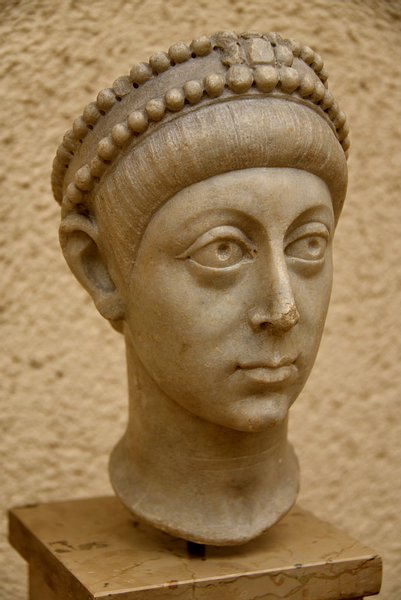 Head of Emperor Arcadius Osama Shukir Muhammed Amin (Copyright) ](https://www.worldhistory.org/image/8799/head-of-emperor-arcadius/ "Head of Emperor Arcadius")The deal would never come to pass. Alaric sat patiently, waiting for Stilicho to join him. Despite his good intentions, Stilicho, however, was delayed due to problems elsewhere in the west: the Gothic king Radagaisus invaded Italy; the [Vandals](https://www.worldhistory.org/Vandals/), Alans, and Suevi invaded Gaul; and the future emperor [Constantine](https://www.worldhistory.org/disambiguation/Constantine/) III (a viable threat to the throne) emerged victorious from [Britain](https://www.worldhistory.org/disambiguation/Britain/). These setbacks made money scarce and negotiations impossible. Alaric's patience wore thin, and his demand for 4,000 pounds of gold (payment for his waiting) went unheard. As a result, he began to slowly move his army closer to Italy. Although Stilicho wanted to pay the demands, the [Roman Senate](https://www.worldhistory.org/Roman_Senate/), under the leadership of a war hawk named Olympius disagreed, and the Senate considered Alaric's actions a declaration of war.
With Olympius' urging, the emperor decided to invade the east. Stilicho warned against the emperor leading the army, choosing to lead an army himself. With Stilicho away, Honorius and Olympius traveled to Ticinum, an Italian city just south of Milan, supposedly to review the troops; however, Olympius, without the permission of the emperor, ordered the killing of thousands of Gothic allies - an action that further angered Alaric. A final fatality of this massacre was Stilicho himself, who was accused of plotting with Alaric. As a result of this treachery, over 10,000 soldiers defected and joined Alaric's army. In 408 CE the Gothic army sacked the cities of Aquilea, Concordia, Altinum, Cremona, Bononia, Ariminum, and Picenum, choosing, however, to avoid Ravenna, the capital of the western empire and home of Emperor Honorius. Instead, Alaric set his sights on Rome, surrounding all 13 gates of the city, blockading the Tiber River and forcing widespread rationing; within weeks decaying corpses littered the city streets.
### Alaric & the Sacking of Rome
As additional forces came to Alaric's side, Emperor Honorius did little to help the city and oppose Alaric. The Goths were still viewed as barbarians and no match for the armies of the empire. Although the treasury was virtually empty, the Senate finally succumbed, and wagons left the city carrying two tons of gold, 13 tons of [silver](https://www.worldhistory.org/Silver/), 4,000 [silk](https://www.worldhistory.org/Silk/) tunics, 3,000 fleeces, and 3,000 pounds of [pepper](https://www.worldhistory.org/Pepper/). Alaric eased the siege, still hoping to negotiate terms, but Honorius remained blind to the seriousness of the situation. While temporarily agreeing to Alaric's demands - something he never intended to honor - 6,000 Roman soldiers were sent to the city but were quickly defeated by Alaric's brother-in-law Athaulf.
[  Sack of Rome by the Visigoths JN Sylvestre (Public Domain) ](https://www.worldhistory.org/image/3002/sack-of-rome-by-the-visigoths/ "Sack of Rome by the Visigoths")Realizing further negotiations were impossible, especially after an ambush from the Roman commander Sarus, Alaric returned to the gates of Rome. He had tried everything, even attempting to name a sympathetic senator named Attalus appointed as a new [Roman emperor](https://www.worldhistory.org/Roman_Emperor/) failed. He took Honorius's sister [Galla Placidia](https://www.worldhistory.org/Galla_Placidia/) hostage but to no avail. An alliance asking for an annual payment of gold and grain, as well as the provinces of Venetia, Noricum, and Dalmatia, was refused. Alaric had few choices left, and on August 24, 410 CE, Alaric prepared to enter the city; Rome had not been sacked since 390 BCE. When the Salarian Gate was opened by an unnamed sympathizer, an army of “barbarians” entered Rome, and a three-day pillage began. While the homes of the wealthy were plundered, buildings burned, and pagan temples destroyed, St. Peter's and St. [Paul](https://www.worldhistory.org/disambiguation/Paul/)'s were left untouched. Oddly, when Honorius heard that Rome was perishing, he feared the worst - not because of his love of the city, but because he believed his beloved fighting cock named Rome had been killed.
Alaric left the city, intending to move into [Sicily](https://www.worldhistory.org/sicily/) and later [Africa](https://www.worldhistory.org/disambiguation/africa/). Unfortunately, he never realized his dream and died soon after in 410 CE. Athaulf assumed control of the army, eventually leading the Goths into Gaul. Alaric had made every attempt to secure a home for his fellow Goths: the sack of Rome was his final hope. The city would never recover. The burning of Rome was, according to pagan interpretation, the result of the city becoming Christian. Others viewed Rome as a symbol of the past; the new center of the empire was Constantinople. In 476 CE, 66 years after Alaric, the city finally fell to [Odoacer](https://www.worldhistory.org/Odoacer/), spelling the end to the Roman Empire in the west.
#### Editorial Review
This human-authored definition has been reviewed by our editorial team before publication to ensure accuracy, reliability and adherence to academic standards in accordance with our [editorial policy](https://www.worldhistory.org/static/editorial-policy/).
## Bibliography
- [Baker, S. *Ancient Rome.* BBC Books, 2007.](https://www.worldhistory.org/books/1846072840/)
- [Boak, A.E.R. *History of Rome to 565 A.D.* Collier Macmillan Ltd, 1965.](https://www.worldhistory.org/books/002311200X/)
- [Clark, G. *Late Antiquity.* Oxford University Press, 2011.](https://www.worldhistory.org/books/0199546207/)
- [Grant, M. *The Roman Emperors.* Charles Scribner's Sons, 1985.](https://www.worldhistory.org/books/0684183889/)
- [Hornblower, S. *The Oxford Classical Dictionary.* Oxford University Press, 2012.](https://www.worldhistory.org/books/0199545561/)
- [James, E. *Europe's Barbarians AD 200-600.* Routledge, 2009.](https://www.worldhistory.org/books/0582772966/)
- [Potter, D. *The Emperors of Rome the Story of Imperial Rome From Julius Caesar to the Last Emperor..* Metro Books, 2014.](https://www.worldhistory.org/books/B0084WNDI2/)
## About the Author
Donald has taught Ancient, Medieval and U.S. History at Lincoln College (Normal, Illinois)and has always been and will always be a student of history, ever since learning about Alexander the Great. He is eager to pass knowledge on to his students.
## Timeline
- **394 CE**: [Battle](https://www.worldhistory.org/disambiguation/battle/) of the Frigidus.
- **394 CE - 410 CE**: Reign of the Gothic King [Alaric](https://www.worldhistory.org/Alaric/) I.
- **395 CE**: [Death](https://www.worldhistory.org/disambiguation/Death/) of [Roman Emperor](https://www.worldhistory.org/Roman_Emperor/) Theodosius I.
- **402 CE**: [Alaric](https://www.worldhistory.org/Alaric/) invades [Italy](https://www.worldhistory.org/italy/).
- **408 CE**: [Death](https://www.worldhistory.org/disambiguation/Death/) of [Roman](https://www.worldhistory.org/disambiguation/Roman/) commander [Stilicho](https://www.worldhistory.org/Stilicho/).
- **410 CE**: [Death](https://www.worldhistory.org/disambiguation/Death/) of [Alaric](https://www.worldhistory.org/Alaric/).
- **24 Aug 410 CE**: [Alaric](https://www.worldhistory.org/Alaric/) sacks [Rome](https://www.worldhistory.org/Rome/).
## Cite This Work
### APA
Wasson, D. L. (2014, September 04). Alaric. *World History Encyclopedia*.
### Chicago
Wasson, Donald L.. "Alaric." *World History Encyclopedia*, September 04, 2014. .
### MLA
Wasson, Donald L.. "Alaric." *World History Encyclopedia*, 04 Sep 2014, .
## License & Copyright
Submitted by [Donald L. Wasson](https://www.worldhistory.org/user/DWasson/ "User Page: Donald L. Wasson"), published on 04 September 2014. The copyright holder has published this content under the following license: [Creative Commons Attribution-NonCommercial-ShareAlike](https://creativecommons.org/licenses/by-nc-sa/4.0/deed.en). This license lets others remix, tweak, and build upon this content non-commercially, as long as they credit the author and license their new creations under the identical terms. When republishing on the web a hyperlink back to the original content source URL must be included. Please note that content linked from this page may have different licensing terms.