---
title: Agni
author: Mark Cartwright
source: https://www.worldhistory.org/Agni/
format: machine-readable-alternate
license: Creative Commons Attribution-NonCommercial-ShareAlike (https://creativecommons.org/licenses/by-nc-sa/4.0/)
updated: 1970-01-01
---
# Agni
_Authored by [Mark Cartwright](https://www.worldhistory.org/user/markzcartwright/)_
Agni is the [Hindu](https://www.worldhistory.org/hinduism/) [god](https://www.worldhistory.org/God/) of fire. He is regarded as the friend and protector of humanity, in particular, he safeguards the home. Various forms of fire are associated with Agni and include the sun, lightning, comets, sacrificial fire, domestic fires, the fire of the funeral pyre, and the digestive fire which is within all humans. Agni was especially important in the Vedic period (1500-500 BCE), and [the Vedas](https://www.worldhistory.org/The_Vedas/) contains more hymns to him than to any other deity. He is still considered today omnipresent though not directly worshipped. Agni knows the thoughts of all people and is a witness to all important actions, hence the use of fire in many important Hindu ceremonies such as marriages. He is also referred to in sacred texts such as the *[Mahabharata](https://www.worldhistory.org/Mahabharata/)* as the 'Oblation-devourer' and the 'Purifier'. With flaming hair and riding a goat, he is easily identified in Hindu art.
Agni's wife is the daughter of King Nila who impressed the fire god by being the only woman in the kingdom who managed to kindle a flame in the royal [palace](https://www.worldhistory.org/disambiguation/palace/). In some myths, Karttikeya (Skanda), the Hindu god of [war](https://www.worldhistory.org/disambiguation/War/), is Agni's son and the result of Agni's [conquest](https://www.worldhistory.org/warfare/) of the Pleiades, the wives of the Seven Sages.
### Agni & Various Fires
Agni is the son of the Celestial Waters, and that element is closely connected with fire which is thought to be carried down to earth within rain. From there fire is drawn up by vegetation and so when two sticks are rubbed together fire appears. Agni is also responsible for lightning which is born from the god's union with the cloud goddess. Another fire Agni is associated with is the funeral pyre; in this role, he leads the dead to their final judgement by [Yama](https://www.worldhistory.org/Yama/), ruler of the Underworld.
Agni is perhaps most closely associated with sacrificial fires where he is thought to carry the offerings of humans to the gods. According to various myths, Agni was at first afraid to take on this duty as his three brothers had been killed already whilst performing the task. Consequently, Agni hid in the subterranean waters but, unfortunately, fish revealed his hiding place to the gods. As a result, Agni cursed them so that fish would become the easy prey of men. In another version it is frogs, then elephants, and then parrots which reveal Agni's attempts at hiding and the god punished them all by distorting their speech ever after. The final hiding place of Agni in this version was inside a *sami* tree and so it is considered the sacred abode of fire in Hindu rituals and its sticks are used to make fires. Reluctantly taking up his duty again Agni did negotiate by way of compensation to always receive a share of the sacrifice he carried to the gods and he was given the boon of ever-lasting life.
Agni appears in all forms of fire and even those things which burn well or have a certain lustre. In the *Brhaddevata* we are told that at one point Agni is dismembered and distributed among earthly things. The god's flesh and fat becomes *guggulu* resin, his bones the pine tree, his semen becomes [gold](https://www.worldhistory.org/gold/) and [silver](https://www.worldhistory.org/Silver/), his blood and bile are transformed into minerals, his nails are tortoises, entrails the *avaka* plant, his bone marrow sand and gravel, his sinews become *tejana* grass, his hair *kusa* grass, and his body hair becomes *kasa* grass which was used in sacrificial rituals.
Over time Agni's importance as a god diminishes, a fact explained in the *Mahabharata* as due to his overindulgence in consuming one too many offerings. In the *Visnu* *Purana* he is described as the eldest son of [Brahma](https://www.worldhistory.org/Brahma/) and Svaha is his wife. Together they had three sons, Pavaka, Pavamana, and Suchi, who in turn had 45 sons, which, including their fathers and grandmother, totals 49, the number of sacred fires in the *Vayu Purana*.
Agni, according to one *Rigveda* hymn attributed to the sage Vasistha, also has a darker side. Similar in nature to the 'flesh-eater' demons, the *raksasa*, he has two wickedly sharp iron tusks and he devours his victims without mercy. However, when called upon by the gods, Agni destroys the *raksasa* with his flaming spears. This episode, when Agni becomes a servant of the gods, is illustrative of his fall from the pinnacle of the [pantheon](https://www.worldhistory.org/Pantheon/).
[ 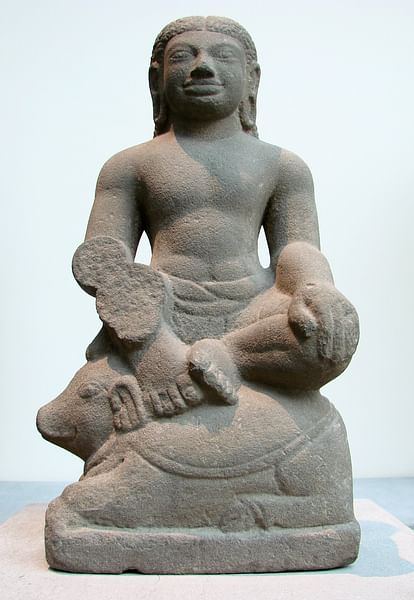 Agni Seated on a Ram Vassil (Public Domain) ](https://www.worldhistory.org/image/3867/agni-seated-on-a-ram/ "Agni Seated on a Ram")### Agni in Hindu Art
In art, Agni is often depicted with black skin, two heads, four arms, and riding either a goat (the most commonly sacrificed animal) or a [chariot](https://www.worldhistory.org/chariot/) drawn by red horses which has seven wheels, representing the seven winds. His two heads, which spout flames, are symbolic of his association with two types of fire: the domestic hearth and the sacrificial fire. He can have seven tongues which are used to lick up the ghee butter given as offerings.
Typically he carries a fan (which he uses to build up fires), a sacrificial ladle, an axe, and a flaming torch or javelin. Agni may also be represented as the [Garuda](https://www.worldhistory.org/Garuda/) bird which carries the seed of life, the fire-bird which carries ambrosia to the gods, and the goat-headed merchant who represents the sacrifice made to the gods. In later Hindu art, Agni is also represented as one of the Dikpalas who were the eight guardians of the directions of space. Agni protects the south-east quarter, Purajyotisa.
#### Editorial Review
This human-authored definition has been reviewed by our editorial team before publication to ensure accuracy, reliability and adherence to academic standards in accordance with our [editorial policy](https://www.worldhistory.org/static/editorial-policy/).
## Bibliography
- [Anon. *Hindu Myths.* Penguin Classics, 2004.](https://www.worldhistory.org/books/0140449906/)
- [Craven, R.C. *Indian Art.* Thames & Hudson, 1997.](https://www.worldhistory.org/books/0500203024/)
- [Das, R. *The Illustrated Encyclopedia of Hinduism.* Lorenz Books, 2012.](https://www.worldhistory.org/books/0754820564/)
- [Dowson, J. *Classical Dictionary of Hindu Mythology and Religion; Geography, History.* DK Print World, 2000.](https://www.worldhistory.org/books/8124601089/)
- [Hackin, J. *Asiatic Mythology 1932.* Kessinger Publishing, LLC, 2005.](https://www.worldhistory.org/books/1417976950/)
## About the Author
Mark is WHE’s Publishing Director and has an MA in Political Philosophy (University of York). He is a full-time researcher, writer, historian and editor. Special interests include art, architecture and discovering the ideas that all civilizations share.
## Timeline
- **c. 1500 BCE - c. 500 BCE**: Indian scholars of the so-called Vedic Period commit [the Vedas](https://www.worldhistory.org/The_Vedas/) to written form; basic tenets of [Hinduism](https://www.worldhistory.org/hinduism/) are established.
## Cite This Work
### APA
Cartwright, M. (2015, May 18). Agni. *World History Encyclopedia*.
### Chicago
Cartwright, Mark. "Agni." *World History Encyclopedia*, May 18, 2015. .
### MLA
Cartwright, Mark. "Agni." *World History Encyclopedia*, 18 May 2015, .
## License & Copyright
Submitted by [Mark Cartwright](https://www.worldhistory.org/user/markzcartwright/ "User Page: Mark Cartwright"), published on 18 May 2015. The copyright holder has published this content under the following license: [Creative Commons Attribution-NonCommercial-ShareAlike](https://creativecommons.org/licenses/by-nc-sa/4.0/deed.en). This license lets others remix, tweak, and build upon this content non-commercially, as long as they credit the author and license their new creations under the identical terms. When republishing on the web a hyperlink back to the original content source URL must be included. Please note that content linked from this page may have different licensing terms.