---
title: Aeneas
author: Liana Miate
source: https://www.worldhistory.org/Aeneas/
format: machine-readable-alternate
license: Creative Commons Attribution-NonCommercial-ShareAlike (https://creativecommons.org/licenses/by-nc-sa/4.0/)
updated: 2025-01-06
---
# Aeneas
_Authored by [Liana Miate](https://www.worldhistory.org/user/lianamiate/)_
In Greco-[Roman mythology](https://www.worldhistory.org/Roman_Mythology/), Aeneas is a Trojan prince and the legendary founder of the Romans. He is the son of Anchises, a member of the Trojan royal family, and the goddess [Aphrodite](https://www.worldhistory.org/Aphrodite/)/[Venus](https://www.worldhistory.org/venus/). Aeneas was one of the few Trojan heroes who escaped the siege of [Troy](https://www.worldhistory.org/troy/). Afterwards, Aeneas embarked on a seven-year journey most famously recounted in the *[Aeneid](https://www.worldhistory.org/The_Aeneid/)* by the [Roman](https://www.worldhistory.org/disambiguation/Roman/) poet [Virgil](https://www.worldhistory.org/virgil/) (70-19 BCE).
### Importance & Parentage
After coming into contact with the ancient Greeks, the Romans were aware that they lacked the legendary epic tradition that the ancient Greeks had. The [Greek literature](https://www.worldhistory.org/Greek_Literature/) featured [Homer](https://www.worldhistory.org/homer/)'s (c. 750 BCE) *[Iliad](https://www.worldhistory.org/iliad/)* and the *[Odyssey](https://www.worldhistory.org/Odyssey/),* and [Greek mythology](https://www.worldhistory.org/Greek_Mythology/) had heroes like [Achilles](https://www.worldhistory.org/achilles/) and [Hercules](https://www.worldhistory.org/hercules/), while the Romans only had [Romulus and Remus](https://www.worldhistory.org/Romulus_and_Remus/), who they knew could not measure up to the fearless [Greek](https://www.worldhistory.org/disambiguation/greek/) heroes.
The Romans created a link between their history and the famous Trojan War by associating a hero from the war with Romulus. They chose a hero whose fate was unknown – Aeneas, a prince of Troy. Around 500 BCE, it became a standard narrative that Aeneas was able to escape burning Troy and made his way to [Italy](https://www.worldhistory.org/italy/), where he established the Roman people.
Aeneas' birth story is told in the *Homeric Hymn to Aphrodite*. The hymn recounts how Aphrodite influenced the love affairs of the gods. Even mighty [Zeus](https://www.worldhistory.org/zeus/) was not immune to Aphrodite's powers, having many love affairs with mortal [women](https://www.worldhistory.org/disambiguation/women/). Zeus decided to give Aphrodite a taste of her own [medicine](https://www.worldhistory.org/disambiguation/medicine/) and made Aphrodite fall in love with a mortal man, making him appear as a [god](https://www.worldhistory.org/God/) to her.
Zeus put a longing in her heart for Anchises, and as soon as she saw him tending to his cattle, passion seized her heart. She travelled to her [temple](https://www.worldhistory.org/temple/) at Paphos in [Cyprus](https://www.worldhistory.org/cyprus/), where she was anointed and prepared. Once she reached Mount Ida, she found Anchises, who was instantly in awe of her. He questioned whether she was a goddess or a [nymph](https://www.worldhistory.org/nymph/). Aphrodite lied, claiming she was a mortal and that [Hermes](https://www.worldhistory.org/Hermes/) had told her that she would be the lawful wife of Anchises.
Anchises and Aphrodite slept together, and in the morning, she revealed her true form to him. Anchises panicked, realising that he had laid with a goddess. However, Aphrodite reassured him and told him there was no need to be afraid.
> You will not suffer harm from me
> nor from the other blessed ones,
> for you are loved by the gods.
> You shall have a dear son
> who will rule among the Trojans
> and children will be born
> to his children forever.
> Aeneas shall be his name. (*The Homeric Hymns: Hymn to Aphrodite*, 194-197)
[ 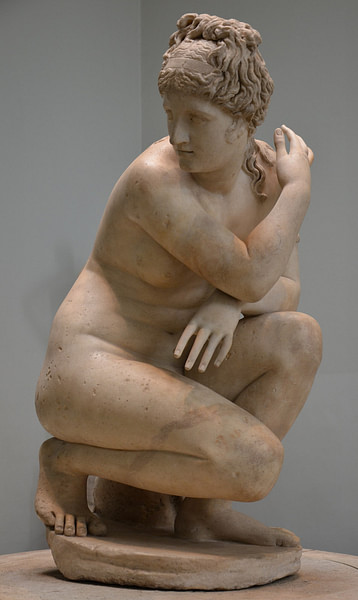 Crouching Venus Carole Raddato (CC BY-SA) ](https://www.worldhistory.org/image/2971/crouching-venus/ "Crouching Venus")Aphrodite told Anchises that mountain nymphs would raise their son, and when he reached a certain age, he would be brought to his father, who was to tell people that the mother of his son was a nymph. She warned him that if he told the truth about their son's parentage, an enraged Zeus would hurl a thunderbolt at him.
Like Aphrodite predicted, once Zeus found out that Anchises was the father of Aeneas, he hurled a thunderbolt at him. Anchises would have died if Aphrodite had not intervened and diverted the thunderbolt to land at his feet. However, the shock of the strike weakened Anchises so much that he could not walk again.
Aeneas' parentage is also mentioned in [Hesiod](https://www.worldhistory.org/hesiod/)'s (c. 700 BCE) *[Theogony](https://www.worldhistory.org/Theogony/)*:
> And fair-crowned Cytherea felt sweet love
> For the hero Anchises, and she lay with him
> And bore Aeneas on the mountaintop,
> In Ida, with its many wooded clefts. (1008-1011)
###
Aeneas in the *Iliad*
Aeneas played a minor role in the *Iliad*, where he was the leader of the Dardanians from Dardania (in modern-day [Anatolia](https://www.worldhistory.org/Asia_Minor/)). He demonstrated great bravery, which is especially evident in Book 5, where he entered the [battle](https://www.worldhistory.org/disambiguation/battle/), oblivious to all the spears surrounding him. He fought alongside Pandarus, a Trojan lord and commander, and shielded his body after he was killed by [Diomedes](https://www.worldhistory.org/Diomedes/), king of [Argos](https://www.worldhistory.org/argos/). Diomedes hit Aeneas in the thigh with a massive boulder, bringing him to his knees. He would have died if his mother, Aphrodite, had not rescued him, shielding him from the onslaught of weapons. Diomedes was able to wound Aphrodite, who retreated. [Apollo](https://www.worldhistory.org/apollo/) swept Aeneas up and took him to the sacred heights of Pergamus, where he was healed. [Ares](https://www.worldhistory.org/Ares/) ordered Aeneas to rescue Hector, so Aeneas returned to the battlefield amongst the cheers of his men.
[  Achilles Tending to Patroclus ArchaiOptix (CC BY-SA) ](https://www.worldhistory.org/image/14193/achilles-tending-to-patroclus/ "Achilles Tending to Patroclus")In Book 20, Apollo urged Aeneas to face Achilles, reminding him of his divinity as the son of Aphrodite. Emboldened by this reminder, Aeneas made his way to Achilles, with the gods gathering to watch. Achilles taunted Aeneas, trying to get him to retreat. Aeneas stood firm, telling Achilles that it would take more than threats to scare him and boasted about his lineage. Aeneas begged Achilles to get on with the battle instead of exchanging insults. They both fought fiercely, but it was evident that Aeneas was no real match for the mighty Achilles. Luckily, the gods decided to save Aeneas. [Poseidon](https://www.worldhistory.org/poseidon/) distracted Achilles by pouring a mist into his eyes and hoisting Aeneas safely away.
### The *Aeneid*
Written c. 30-19 BCE, the *Aeneid* closely parallels the *Odyssey*, and it is clear that Virgil was inspired by Homer's epic poem when [writing](https://www.worldhistory.org/writing/) about his hero. Virgil was unhappy with the *Aeneid* and ordered it to be destroyed once he had died. However, [Roman emperor](https://www.worldhistory.org/Roman_Emperor/) [Augustus](https://www.worldhistory.org/augustus/) (r. 27 BCE to 19 CE) forbade this and asked Virgil's friends Varius Rufus and Plotius Tucca to edit and complete it.
### The Fall of Troy
After ten years of war between the Greeks and the Trojans, Sinon, a Greek soldier, convinced the Trojans to accept a gift from the Greeks – a [giant](https://www.worldhistory.org/Giants/) horse. Laocoön, a priest of [Neptune](https://www.worldhistory.org/Neptune/), warned the Trojans not to trust the Greeks, even when they bore gifts, but the Trojans did not heed his warning.
Hector appeared to Aeneas as he slept and warned him that Troy was doomed and urged him to escape with their gods across the sea. Aeneas ignored his orders and fought in vain to save Troy. Driven to King Priam's [palace](https://www.worldhistory.org/disambiguation/palace/), he joined the surviving Trojans who watched King Priam die. Venus escorted him home, where he begged his father to escape the [city](https://www.worldhistory.org/city/) with him. After initially refusing, Anchises prayed to the gods and was given a sign that he should leave the fallen city.
Carrying his father on his shoulders, Aeneas searched for his wife Creusa, but after she appeared to him in a vision, he realised she was already gone. Gathering the Trojan survivors, including his son Ascanius, Aeneas led the way out of Troy.
### Aeneas' Travels
Aeneas recounted his travels after leaving Troy. After being misguided by prophecies and dreams, they arrived at [Delos](https://www.worldhistory.org/delos/) and were welcomed by King Anius. They then sailed to a deserted [Crete](https://www.worldhistory.org/crete/) but found a hot, barren landscape. After reaching the Strophades, they were driven away by the vicious harpies. Finally arriving at Epirus, they were welcomed by other Trojan refugees, including King Helenus and [Andromache](https://www.worldhistory.org/Andromache/), the former wife of Hector. However, Aeneas knew his destiny was to found a great city and continued on his journey. As they approached [Sicily](https://www.worldhistory.org/sicily/), they heeded the warning of King Helenus and avoided the strait that the monstrous [Scylla and Charybdis](https://www.worldhistory.org/Scylla_and_Charybdis/) guarded. Unfortunately, Anchises died while they were in Sicily.
[  Map of the Voyage of Aeneas and the Mythic Origins of Rome Simeon Netchev (CC BY-NC-ND) ](https://www.worldhistory.org/image/16056/map-of-the-voyage-of-aeneas-and-the-mythic-origins/ "Map of the Voyage of Aeneas and the Mythic Origins of Rome")### Aeneas & [Dido](https://www.worldhistory.org/Dido/)
After six years of sailing around the [Mediterranean](https://www.worldhistory.org/disambiguation/mediterranean/) and being at the mercy of storms and an angry [Juno](https://www.worldhistory.org/Juno/), Aeneas and his men were driven ashore on the Syrtes (the north coast of [Africa](https://www.worldhistory.org/disambiguation/africa/)). Venus (the Roman equivalent of Aphrodite) witnessed her son's struggles and pleaded with her father, [Jupiter](https://www.worldhistory.org/jupiter/), to allow Aeneas to live and fulfil his destiny. Jupiter assured her that he would. Venus disguised herself and guided her son to [Carthage](https://www.worldhistory.org/carthage/) after wrapping him in a mist of invisibility. He reflected on his time in Troy after viewing depictions of the Trojan War at the new Temple of Juno.
Aeneas and his men met Dido, the queen of Carthage, who threw a banquet in their honour. Venus was still uneasy about Juno's intentions towards Aeneas. She decided to make Dido fall in love with her son, sending Cupid in disguise to strike love and passion in her heart. Dido begged Aeneas to tell the tragic story of the Trojan War. Dido and Aeneas fell in love with one another, despite Dido vowing not to fall in love again after the [death](https://www.worldhistory.org/disambiguation/Death/) of her husband. Juno arranged a marriage of sorts between them to keep Aeneas from founding [Rome](https://www.worldhistory.org/Rome/) – which would one day destroy her beloved Carthage. However, Jupiter reminded Aeneas of his destiny and ordered him to leave Dido. A heartbroken Dido built a pyre, cursed Aeneas and swore that Carthage would be in perpetual war with his people before climbing onto the pyre and killing herself.
[ 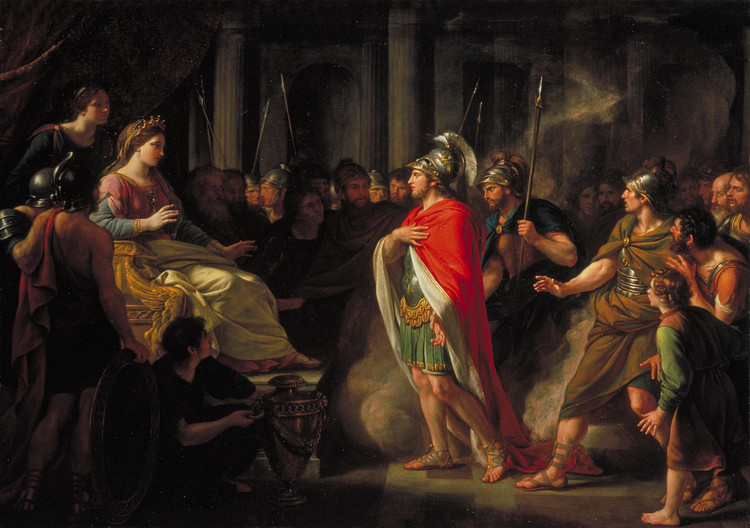 The Meeting of Dido and Aeneas Nathaniel Dance-Holland (Public Domain) ](https://www.worldhistory.org/image/3305/the-meeting-of-dido-and-aeneas/ "The Meeting of Dido and Aeneas")After sailing out of Carthage, Aeneas took one last look at the city and saw fire, not realising that it was Dido burning on the pyre. A storm caused them to sail back to Sicily, where Aeneas held funeral games in his father's honour. Aeneas decided to leave the women and children behind in Sicily in a new city ruled by Acestes, a fellow Trojan.
### Arriving in Italy & War
Aeneas and his men finally arrived in Italy, landing at Cumae, north of the Bay of Naples. He consulted with the Sibyl and begged her to lead him to the underworld so that he could speak to his father, Anchises. She agreed but first asked him to find a golden branch in a tree and bury Misenus, a comrade who had drowned. He completed these tasks and was then led to the underworld. There he met Dido, heroes of Troy and his father in the Field of the Blessed. Anchises explained the creation of the universe and the meaning of life. Finally, they witnessed a parade of great Romans marching towards the light of life.
After returning from the underworld, Aeneas and his men sailed into the River Tiber. Latinus, the king of Latium, welcomed them. He offered his daughter Lavinia in marriage to Aeneas. However, Juno sent down her agent Allecto to start trouble. First, she persuaded Queen Amata to object to the marriage. Next, she caused Turnus, a neighbouring Latin prince, to start a war with the Trojans. Her final move was to start a fight between the people of Latium and a Trojan hunting party.
[ 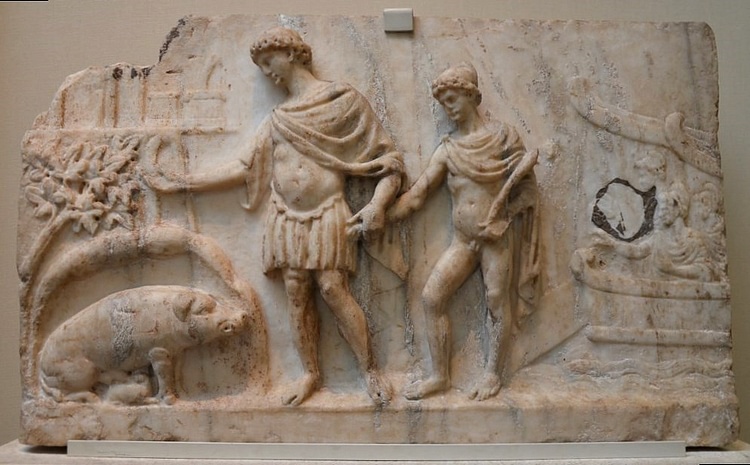 Aeneas' Arrival in Latium Carole Raddato (CC BY-NC-SA) ](https://www.worldhistory.org/image/13528/aeneas-arrival-in-latium/ "Aeneas' Arrival in Latium")Aeneas travelled to the village of Pallenteum (Palatine Hill), where King Evander told him how Hercules had rescued him and informed him about Mezentius, an [Etruscan](https://www.worldhistory.org/Etruscan_Civilization/) who had been dethroned by his subjects and had been given refuge by Turnus. He advised Aeneas that no Etruscan would allow themselves to be ruled by an Italian and told him to go with his son Pallas to claim leadership of the armies fighting against the Latins. Venus persuades [Vulcan](https://www.worldhistory.org/Vulcan/) to make new armour for Aeneas, which portrayed the future wars of Rome.
Aeneas ordered the Trojans to close their gates and decline to fight. They obeyed him even when Turnus and his men attacked their camp. Turnus eventually broke into the Trojan camp. After killing some Trojans, he was forced to withdraw and swim back to his men. Pallas was killed by Turnus, and funeral games were held for him. The Latins pleaded with Aeneas for a truce so that they could collect their dead. He agreed and clarified that the last thing he wanted was war. Aeneas offered to meet Turnus in one-on-one combat, so nobody else would have to die. After much debate, the Latins agreed. However, as Aeneas approached the city, Turnus called his army to battle. Turnus waited in ambush for Aeneas to pass him. Both armies moved towards each other.
Turnus demanded to meet Aeneas in battle, and Aeneas struck a treaty with Latinus, which stated that the one left standing would marry Lavinia. If Aeneas were defeated, the Trojans would peacefully retreat and settle in Pallenteum. Once again, Juno had other plans and caused Aeneas to be wounded by an arrow. After being healed by his mother, he returned to the battle. Jupiter and Juno reconciled, and Juno finally made peace with the destiny of Rome. Turnus was killed by Aeneas, and, once married to Lavinia, Aeneas established the city Lavinium and named his son Ascanius as his successor. Ascanius then founded Alba. Around 400 years later, Romulus founded Rome from Alba Longa.
### Aeneas Becomes a God
Venus begged her father, Jupiter, to make Aeneas a god, claiming that he had already been to the underworld once and survived. Jupiter agreed, and Venus travelled to the River Numicus and asked it to wash away the mortal parts of Aeneas. Venus then anointed his body with divine fragrance and touched his lips with nectar and ambrosia, making him a god. The Romans honoured him with temples and altars.
[  Aeneas Carrying Anchises Carole Raddato (CC BY-NC-SA) ](https://www.worldhistory.org/image/13527/aeneas-carrying-anchises/ "Aeneas Carrying Anchises")### Art & Legacy
One of the most important Trojan relics was the Palladium (an [Athena](https://www.worldhistory.org/athena/) statue), believed to have been of divine origin. There is lots of mystery surrounding the sacred statue. Some sources stated that Diomedes and [Odysseus](https://www.worldhistory.org/odysseus/) stole it because of a prophecy. Other traditions said they merely stole a copy, with Aeneas having the actual statue, which he took with him when he fled Troy. According to Roman tradition, the Palladium ended up in the Temple of [Vesta](https://www.worldhistory.org/Vesta/) in the [Roman Forum](https://www.worldhistory.org/Roman_Forum/), where the [Vestal Virgins](https://www.worldhistory.org/Vestal_Virgin/) tended to it.
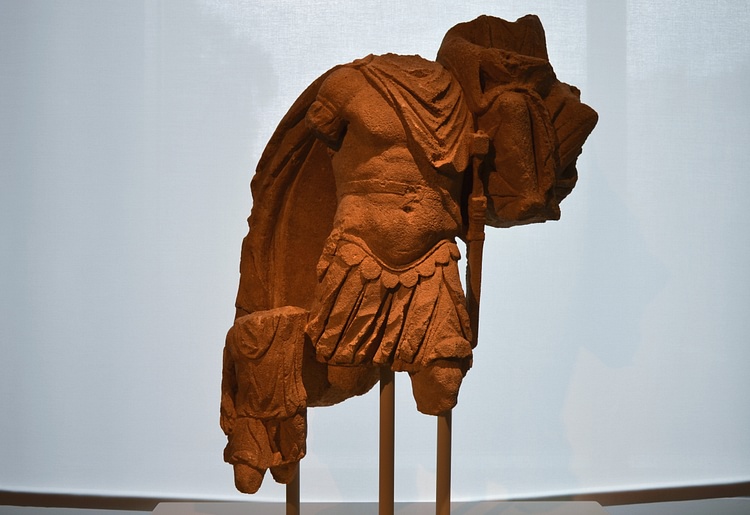
Besides Rome, the Greek city of Aenea in the Chalcidice was also said to be founded by Aeneas. Coins portraying Aeneas carrying his father on his shoulders have been found in the town. Aeneas heroically carrying his father away from Troy was a popular theme in ancient art. In [Veii](https://www.worldhistory.org/Veii/) (an Etruscan city), statues of him dating to c. 500 BCE have been found, as well as ancient vases showing the same scene all over [Etruria](https://www.worldhistory.org/Etruscan_Civilization/).
The story of Aeneas has inspired plays, operas, books, and artwork throughout history. He is a character in the play *Troilus and Cressida* by [William Shakespeare](https://www.worldhistory.org/William_Shakespeare/) (d. 1616 CE). He is also featured in the popular book series *The Heroes of Olympus* by Rick Riordan and is a main character in *Lavinia* by Ursula K. Le Guin (1929-2018 CE), which tells the story of Aeneas from the perspective of his wife, Lavinia. English composer Henry Purcell (1659-1695 CE) wrote his famous opera *Dido and Aeneas* in honour of the great love between Aeneas and Dido and Dido's tragic end.
In Aeneas, the Romans had finally found their hero, who was as illustrious as the great Achilles and Hercules. Here was the son of a goddess who fought bravely in the Trojan War and helped his fellow Trojans escape the fallen city, a man who sailed the seas for seven years and faced many hardships to fulfil his destiny.
#### Editorial Review
This human-authored definition has been reviewed by our editorial team before publication to ensure accuracy, reliability and adherence to academic standards in accordance with our [editorial policy](https://www.worldhistory.org/static/editorial-policy/).
## Bibliography
- [Graves, Robert. *The Greek Myths\[May 15, 2018\] Graves, Robert.* Viking, 2018.](https://www.worldhistory.org/books/0241982359/)
- [Hesiod & Theognis & Wender, Dorothea & Wender, Dorothea. *Hesiod and Theognis .* Penguin Classics, 1976.](https://www.worldhistory.org/books/0140442839/)
- [Homer & Richardson, Nicholas & Cashford, Jules & Richardson, Nicholas. *Homeric Hymns .* Penguin Classics, 2003.](https://www.worldhistory.org/books/0140437827/)
- [Homer & Robert Fagles & Bernard Knox. *The Iliad.* Penguin Classics, 1998.](https://www.worldhistory.org/books/0140275363/)
- [Morford, Mark & Lenardon, Robert J. & Sham, Michael. *Classical Mythology.* Oxford University Press, 2018.](https://www.worldhistory.org/books/0190851643/)
- [Nardo, Don. *Roman Mythology .* Lucent Books, 2012.](https://www.worldhistory.org/books/142050746X/)
- [Ovid & Raeburn, David & Feeney, Denis. *Metamorphoses .* Penguin Classics, 2004.](https://www.worldhistory.org/books/014044789X/)
- [Rutledge, Steven. *Ancient Rome as a Museum& Representation).* Oxford University Press, 2012.](https://www.worldhistory.org/books/0199573239/)
- [Virgil & Fagles, Robert & Knox, Bernard. *The Aeneid .* Penguin Classics, 2008.](https://www.worldhistory.org/books/0143105132/)
- [Woodard, Roger D. *The Cambridge Companion to Greek Mythology .* Cambridge University Press, 2008.](https://www.worldhistory.org/books/0521607264/)
## About the Author
Liana is the Social Media Editor for Ancient History Encyclopedia. She holds a Bachelor of Arts Degree with a major in ancient Greece, Rome & Late Antiquity. She is particularly passionate about Rome and Greece, and anything to do with mythology or wo
- [Linkedin Profile](https://www.linkedin.com/in/lian)
## Timeline
- **c. 30 BCE - c. 19 BCE**: [Roman](https://www.worldhistory.org/disambiguation/Roman/) poet [Virgil](https://www.worldhistory.org/virgil/) writes his [Aeneid](https://www.worldhistory.org/The_Aeneid/).
## Questions & Answers
### What is Aeneas famous for?
Aeneas is famous for his travels, as recounted in the Aeneid by the Roman poet Virgil, and for founding the Roman people.
### Why was Aeneas important to the Romans?
Aeneas was important to the Romans as he founded the Roman people and embodied Roman values (the importance of family and worship of the gods).
### What did Aeneas do after the Trojan War?
Aeneas escaped Troy with his father and son and began a 7-year journey around the Mediterranean. He met many people, most notably Dido, the queen of Carthage, and went on many adventures.
### Was Aeneas the founder of Rome?
Aeneas was said to be the founder of the Roman race. His son Ascanius founded Alba Longa (near Rome), which is where Romulus and Remus were born hundreds of years later.
## Cite This Work
### APA
Miate, L. (2022, December 01). Aeneas. *World History Encyclopedia*.
### Chicago
Miate, Liana. "Aeneas." *World History Encyclopedia*, December 01, 2022. .
### MLA
Miate, Liana. "Aeneas." *World History Encyclopedia*, 01 Dec 2022, .
## License & Copyright
Submitted by [Liana Miate](https://www.worldhistory.org/user/lianamiate/ "User Page: Liana Miate"), published on 01 December 2022. The copyright holder has published this content under the following license: [Creative Commons Attribution-NonCommercial-ShareAlike](https://creativecommons.org/licenses/by-nc-sa/4.0/deed.en). This license lets others remix, tweak, and build upon this content non-commercially, as long as they credit the author and license their new creations under the identical terms. When republishing on the web a hyperlink back to the original content source URL must be included. Please note that content linked from this page may have different licensing terms.